
Last night I walked down our long driveway in the dark to get seeds.
They’d been delivered, left in the container at the end of our driveway the way packages work when you live deep enough in the woods that most drivers won’t make the trip in, and I needed them, so I went in the dark.
In early spring, wearing a winter coat and flip flops because that is the only honest way to describe a Minnesota March, and also because I am exactly the kind of person who will brave coyotes for seeds but will not bother with proper shoes.
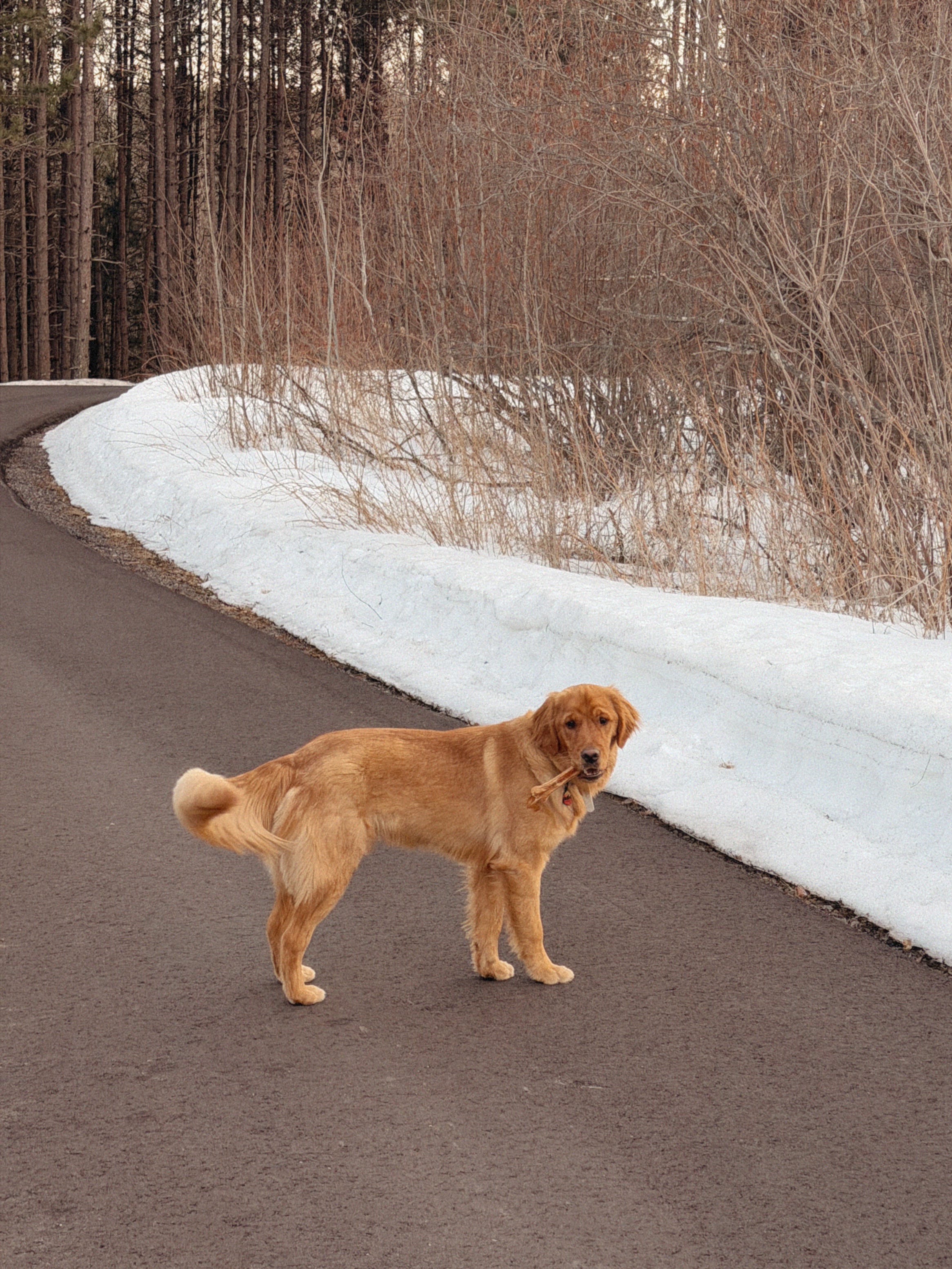
My dogs, whom I was begging out loud to stay close, had other ideas, because somewhere in the tree line coyotes were howling, not far away, and I stood there on the gravel holding a package of seeds thinking: this is my life and I chose it and I would choose it again.
(And if you’re wondering, I made it back.)
I tell you this so you understand who I am right now, and how far that is from who I was even a few years ago, when I killed a succulent and took it as definitive proof that I did not have a green thumb, that I had not been assigned that particular gift.
I’d made a certain kind of peace with not being a plant person. The kind of peace that is really just a closed door you’ve stopped trying to open.
Something pried it back open, and it happened both slowly and fast, the way good things do.
One gardening book, picked up in mild curiosity, put down six hours later by a different person who urgently needed to understand nitrogen. That book became two, became YouTube videos at hours I’m not proud of, became late-night Google searches that ended with me wide-eyed reading about mycorrhizal networks thinking, wait, trees talk to each other? Of course they do.
It became a documentary about soil that Drew and I watched on the couch with ice cream in a mug, which became two documentaries, then another. I cried during the soil ones. I am now an actual person who cries during documentaries about dirt, and I have absolutely no remaining ambivalence about this.
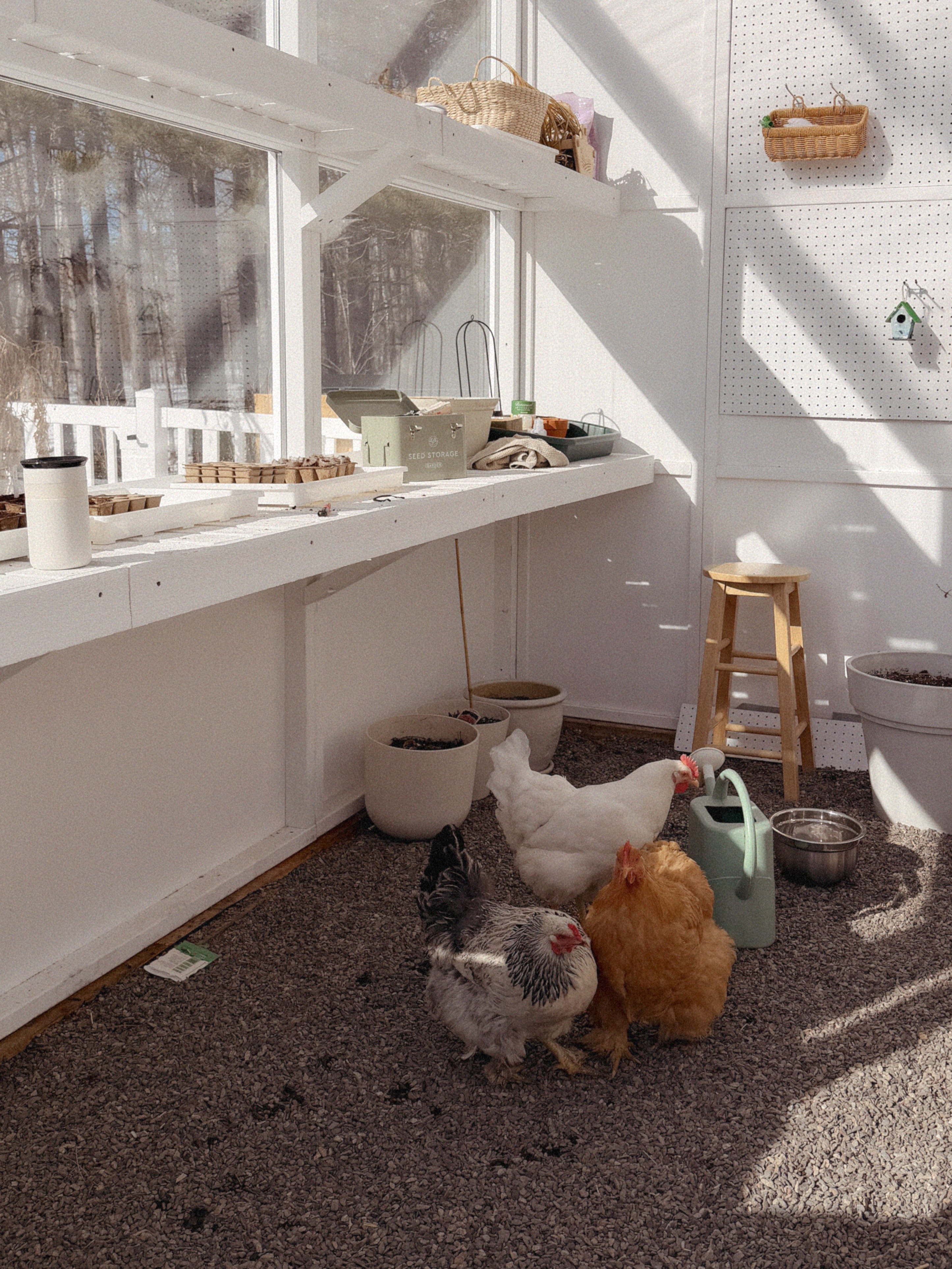
Three years ago, the garden. Two years ago, the bees. A year ago, the chickens. This year, my first season with a greenhouse.
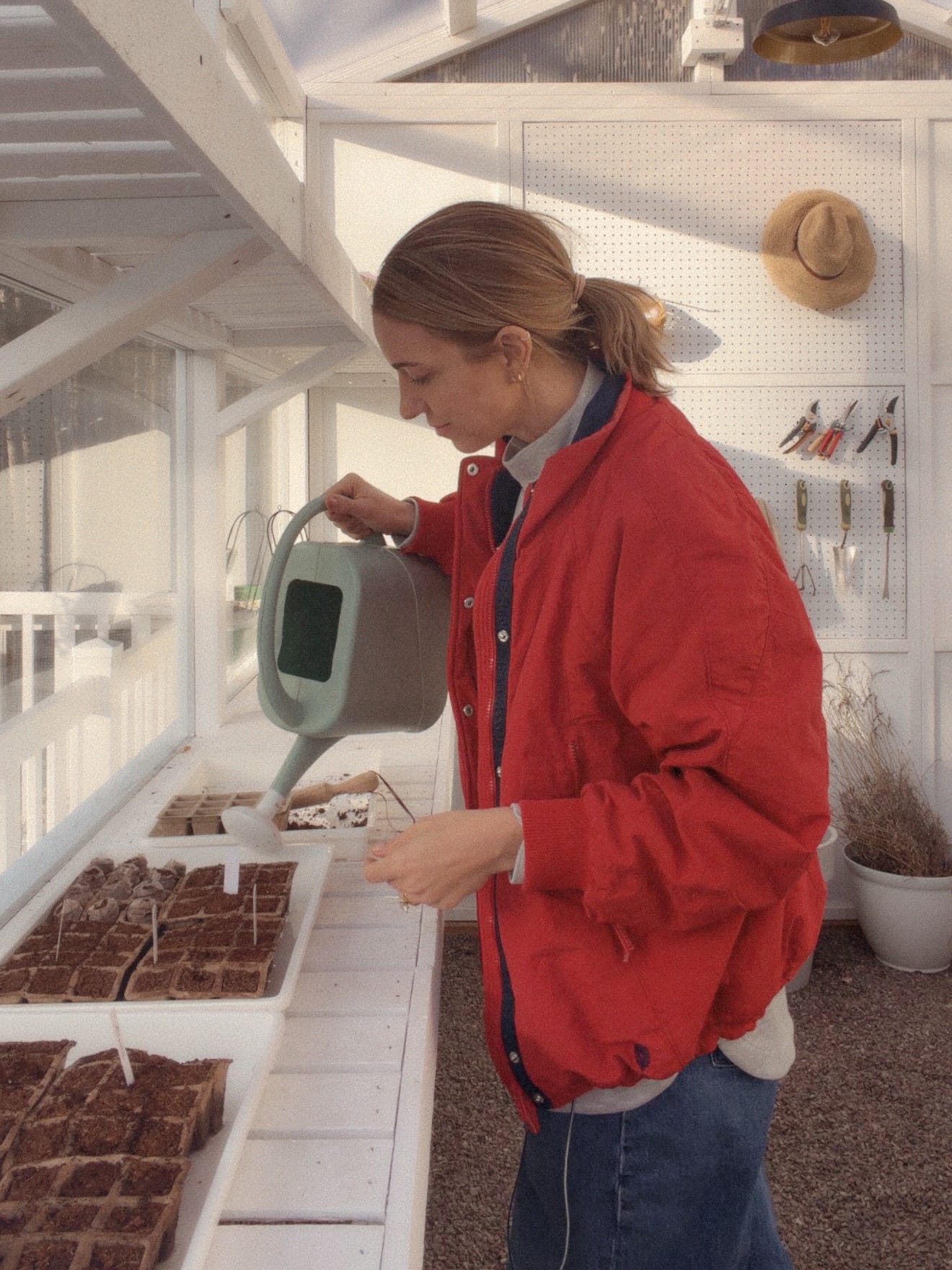
After the girls go to bed I pull on an old sweatshirt and go out into it while the sun sinks behind the treeline, all that pink and gold spending itself on bare branches and half-frozen ground, just me and the seedlings and the quiet of an evening that has finally stopped asking things of me.
I press seeds into soil without always knowing what will come up.
Somewhere in three years of doing this I’ve understood something I somehow didn’t learn in the first thirty-something years of my life: the planting matters more than the certainty of the harvest.
Let me be wildly clear, I am not an expert in any of this. Nothing about this version of my life came from expertise. It came from one book and then another, from making mistakes in the garden and going back the next day anyway, from following curiosity so far down a rabbit hole that you come out the other side a different person standing in rubber boots at dusk looking for places to put things in the ground.
I’m planning an orchard right now, walking the land in my rain boots as the snow melts, trying to see past the white to what the earth looked like last August, where the afternoon light falls, what this piece of ground could become.
Drew, who is a deeply reasonable man, suggests at least once a week that we move somewhere warm, and I understand the impulse completely.
But my body knows these seasons and needs them, the full dramatic unsubtle range of all four, because each one asks something different and gives something different back.
We have maybe ninety days of actual summer up here. Every seed is a decision. Every planting is an act of real belief, the kind where you’re watching the forecast two weeks out because you know how fast the window opens and how little it apologizes when it closes.
An orchard is essentially a decade-long conversation with the future.
I have decided this is exactly the kind of person I want to be: one who does the work she won’t see the return on, because the work itself is the point.
The bees taught me that. This week, they came out.
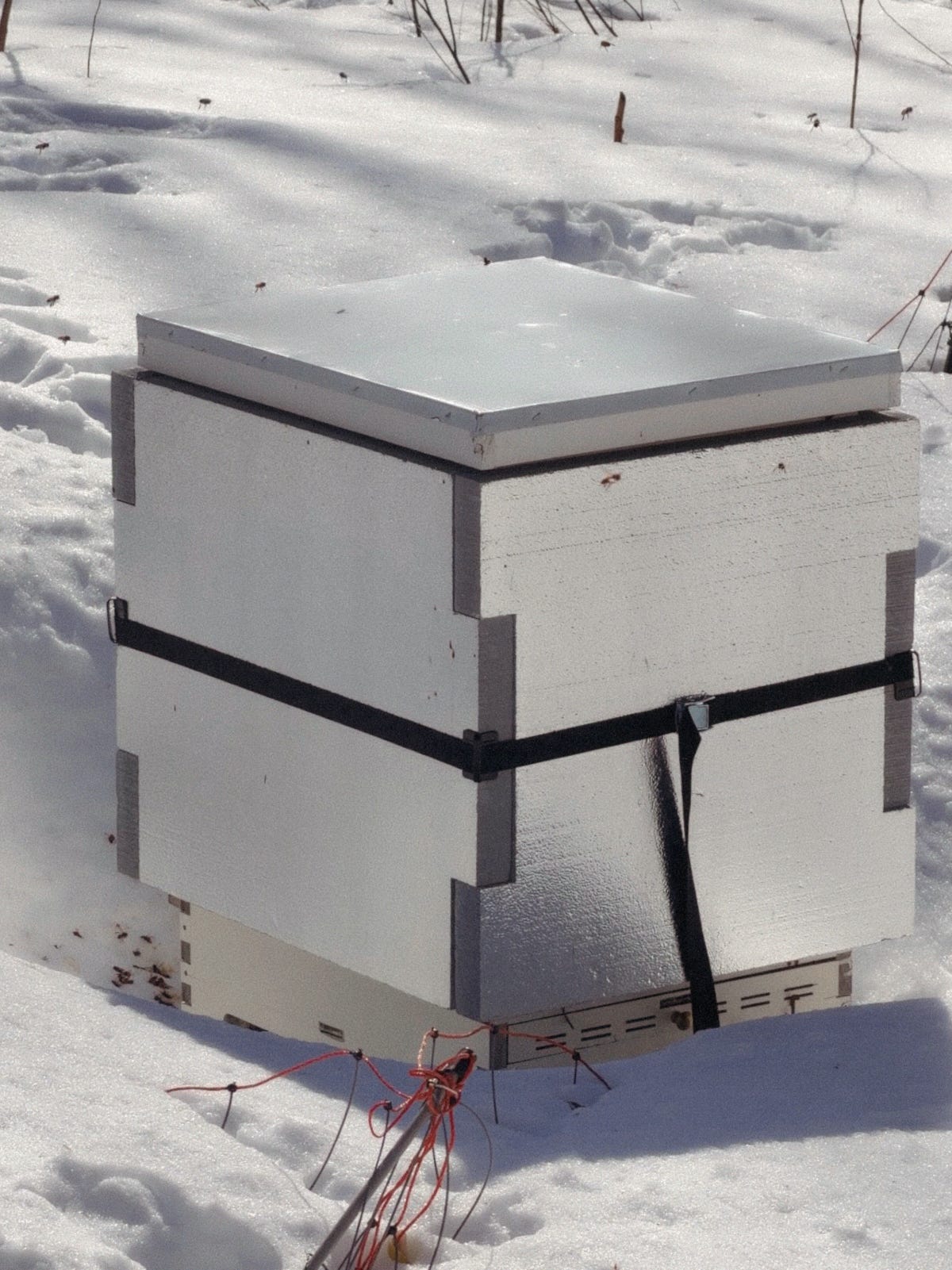
For months we couldn’t even get to the hive, buried so deep in snow it disappeared into the yard completely, just a mound like any other mound, indistinguishable from winter.
We couldn’t press our ears to the wood and listen for the hum the way we did in the fall. We couldn’t check on them. We couldn’t do anything except trust that what we’d done before the cold came was enough.
But I want to back up, because the coming out is only half the story. The part that really changed me happened last fall, when Drew wrapped the hive in something called a hive hugger, an insulating wrap that goes around the outside, and said what I can only describe as a prayer over it, and then watched the snow come and slowly bury it completely.
I would walk past it all winter, this snow-covered mound near the garden, and think: how? Like how does anything survive that? How does something so small and fragile hold on inside all that cold and dark.
And then this week they came out, a few first, testing the air, relearning the coordinates of their own world, then more of them, tumbling over each other in the pale March light, and I stood near the garden and cried the way you cry when something enormous arrives through a small door.
They made it. The bees survived the winter. 😭
Here is what I now know about what happens inside that hive all winter, and I genuinely believe it is some of the most important information I have ever received, which is a thing I am aware sounds unhinged and which I stand behind completely.
Honeybees don’t hibernate. When the cold comes, every bee in the hive presses together into a single living sphere around the queen, a structure called a winter cluster, and then, without a leader, without a thermostat, without anyone telling anyone what to do, they begin to generate heat.
The bees on the inside shiver on purpose, contracting their flight muscles without moving their wings, converting their own bodies into furnaces, heating the cluster’s core to nearly 95 degrees Fahrenheit while the world outside buries them in snow.
The bees on the outer layer pack together so tightly their body hairs interlace, trapping air, building insulation from themselves.
And through the whole long dark of winter, the cluster moves slowly through the hive, eating the honey they spent all summer making, feeding themselves on what they stored when the world was bright and full.
The waggle dance, which is how bees communicate the location of food to each other, a figure-eight movement so precise it encodes direction relative to the sun and distance measured by what scientists call optic flow, won a freaking Nobel Prize. It is the second most information-rich communication system in the animal kingdom. Only human language carries more.
Bees have a sesame seed’s worth of brain. And with it they navigate, dance, make collective decisions without anyone in charge, and maintain a warm living community inside a snow-buried box through the longest winter you can imagine.
There is no dormancy. There is only invisible work, done together, in the dark.
I wish humans were as smart as bees. I really, genuinely do. I wish we understood, the way they seem to without ever being taught, that you survive the cold by generating warmth from the inside, that you make it through the dark by tending the center, that what you store in the abundant seasons is exactly what carries you through the ones that try to take everything.
But we keep doing the opposite, don’t we.
Last week I read The Giving Tree to my daughters and when I got to the end I sat there without words.
I grew up thinking it was a love story, the tree giving and giving and giving right down to her stump, the boy coming back again and again to take, and the book calling it happy.
I accepted that ending for years without questioning it, probably because I grew up in a world that confused depletion with devotion, that taught women selflessness without limit was the highest form of love. But sitting there at 37 I felt for the first time what the story actually is.
Not a love story. A warning. A clear picture of what happens to any living thing that only gives and is never tended, and I sat there trying to find the words for my daughters when I was only just understanding it myself.
The earth has been our Giving Tree. Patient and enormous and running low on stump.
Topsoil that took thousands of years to build can disappear in a generation of careless farming. (I learned this in my soil documentaries!) The bees that pollinate a third of everything we eat are disappearing, and we are genuinely surprised by this, as though the data wasn’t there, as though we didn’t look at the warnings and choose convenience anyway.
Meanwhile the bees, with their sesame seed brains and their Nobel Prize waggle dance, figured out centuries ago that you take care of the whole, you store what you have, you keep the center warm, and you trust that the work you did in the light will carry you through the dark.
They are, with respect, doing better than us. Much, much better.
And listen, I’m not about to hand you a twelve-step plan for saving the earth before your next grocery run.
You don’t have to become a farmer. You don’t have to move to the woods or learn what a nitrogen fixer is or find yourself in a parka and flip flops in the dark with coyotes howling and dogs making their own decisions.
The invitation is simpler and bigger than any of that: notice what you are connected to. Let it matter.
Understand that the same story that stripped the topsoil also told you your worth lived in your output, and that learning to tend one might teach you something real about tending the other.
Now here is the part I’ve been sitting with, and I think it’s finally ready to be said out loud. I have what I need. I have more than I need, actually, and I’ve been sitting with what that asks of me.
The version of this life I get to live, the greenhouse and the chickens and the bees and the orchard I’m planning and the seeds I order with the joy of someone who has found a new religion, is an abundant version that my business has made possible.
It’s not at all lost on me that the time I have to learn and experiment and make beautiful mistakes in a garden is a direct result of years of work that paid off, and I don’t want to stand in a pretty garden in good light and let you think desire alone is the barrier.
Desire is only the beginning. Resources make the rest possible, and not everyone has them equally.
I want the farm life and I want it to look good, and I’ve made my peace with both of those things being true at once.
But abundance that only turns inward isn’t really abundance. It’s just accumulation.
And the longer I spend with my hands in the dirt, the more I believe that what the earth has been trying to teach us, all of us, is that things grown in community feed more than things grown alone.
So here is the next dream (and I can’t believe I’m typing this and sharing it publicly!)
A community garden. The kind where kids come on a Tuesday with no agenda except their hands in the dirt, where you take what you need and leave what you don’t, where the harvest belongs to everyone and what’s left at the end of the season goes to people who need it, because food grown together should feed together.
I have already designed the logo in my head. I know what the sign looks like. I can see the rows and the children playing and the people standing in it at golden hour looking at what they made together. I see it so clearly it almost feels like a memory of something that hasn’t happened yet.
The land isn’t ready. But I am.
And in the meantime I am in my hive, doing the invisible work in the dark, generating heat toward something I can’t fully see yet, trusting what I stored in the bright seasons to carry me through this one.
The bees don’t stop because winter is long. They keep each other warm from the inside and they trust the honey and they wait for the window.
I’m planning an orchard I won’t see bloom for a decade. I’m pressing seeds into soil each night on faith. I’m going to pose with my first tomato harvest with the same fully committed energy as a man on a fishing boat holding a bass like he personally invented the ocean, both hands, full grin, zero irony, and I will mean every bit of it.
And if all I do for the rest of this life is heal soil, plant seeds, learn what each season is asking of me and give it what I have, and raise daughters who know the earth is something you tend and protect and stand inside with muddy boots and a full heart, that is a good life.
That is the life. The one that was always underneath the one I was performing. The one I found by following a single gardening book into the dark.
You are allowed to be in a season that looks like nothing from the outside. The inside work counts. The seed splits open underground before anything green appears, and that splitting is not waiting, it is the work itself, the work that makes everything else possible.
Last night I walked down a dark driveway in a winter coat and flip flops toward coyotes I could hear but not see, for seeds I needed more than I needed warm feet.
The dogs stayed close enough. The seeds are in the greenhouse now.
And something is coming.
No posts
Comments
Nothing yet. Say the first thing.
Sign in to join the conversation.