
I almost didn’t go to yoga on Friday. We were packing the car to head north to the lake house, I had a dahlia bed to amend so I could plant first thing Monday morning, I had already done my workouts for the week, and there is something about Memorial Day weekend in Minnesota where every woman with a greenhouse becomes a slightly unhinged version of herself, walking around her tomato seedlings, whispering encouragement, fully convinced that the entire growing season hinges on whether she gets the bed ready in time for Monday.
Somehow, before I had really decided, I was already on the mat. At the end of the hour I laid down on my back, and savasana landed differently in my body than it has in years. Not because it had been gone, but because it called me back to a remembrance of how tricky stillness used to be for me, how much of my early yoga life I spent on that mat at the end of class secretly singing a song in my head to fast-forward time, or counting backwards from a hundred, or mentally drafting my grocery list, or, on the very worst days, calculating how rude it would be to sit up, roll my mat and leave.
Then, like a time warp, the workout was done and I didn’t even have time to lie on the floor.
On Friday I just laid there. I don’t wear an Apple Watch anymore and haven’t worn a fitness tracker in a year. Nothing Bluetooth-ing through my body trying to tell me what my heart rate is doing, so there was nothing to check, to glance at, to optimize. I didn’t even notice when the women on either side of me rolled up their mats and walked out.
And frankly, I wasn’t worried about how I looked still lying there because somewhere in the middle of it all a small ancient part of me said, oh. There you are.
The wild part is that it was the same teacher. Not the same studio, not the first teacher I ever had, but the same woman I was referencing in a book chapter I wrote six years ago, still saying the same words at the end of practice. This is the peak pose. I had heard that sentence so many times that it had washed right over me every single time, but on Friday she said it again and I actually heard her. Same words, but I was a different woman.
As I turned that sentence around in my sweaty head, I felt like I actually understood what she meant. Nobody takes pictures of a woman lying in a sweaty heap at the end of a yoga class with her hair stuck to her forehead. The handstand is the photograph, the inversion is the achievement, the finishing heap is not.
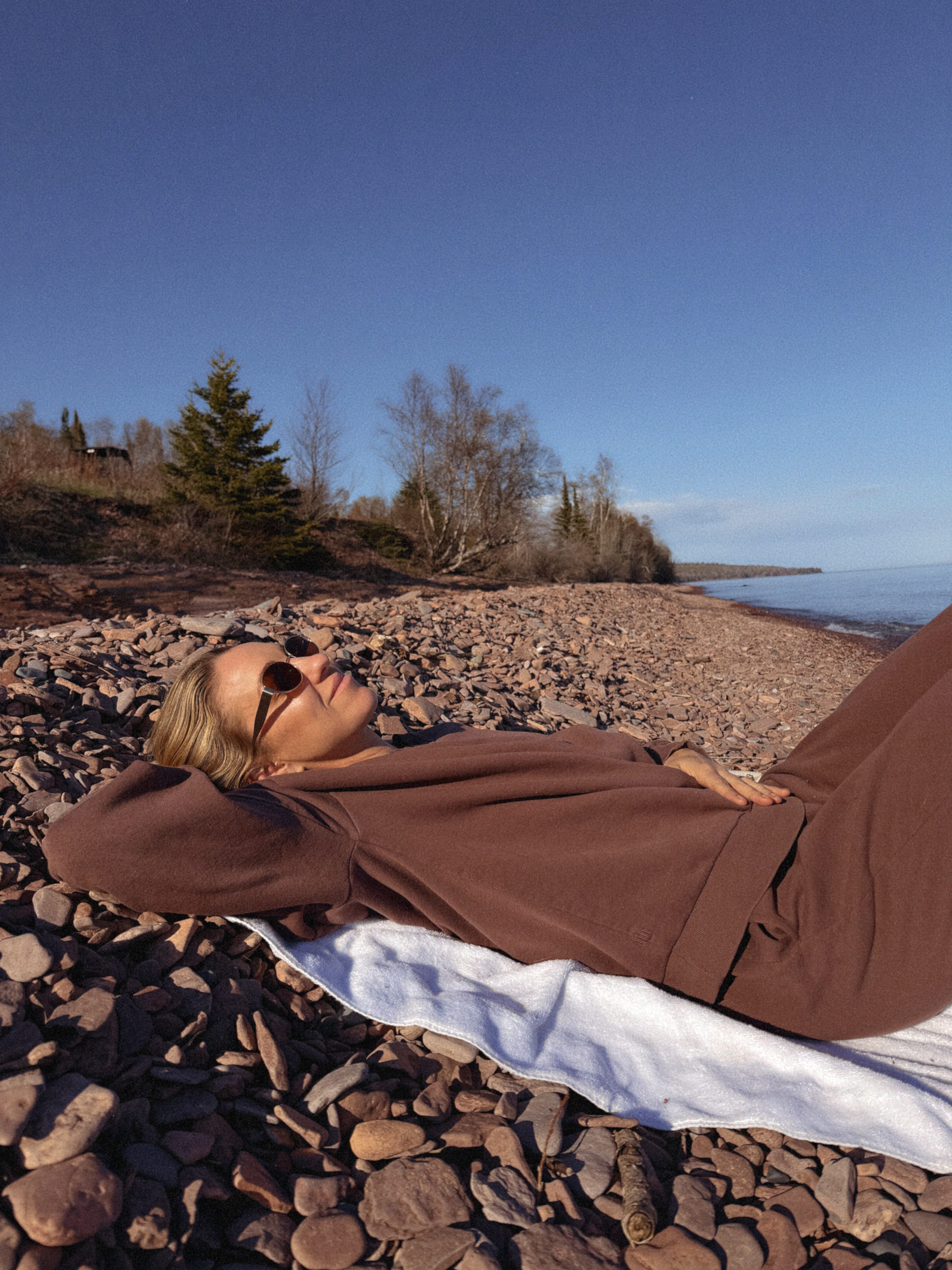
And yet, in the actual practice, the heap is the point. The handstand was the warm-up. The lying down wasn’t earning anything, wasn’t building anything, wasn’t productive in any direction. The lying down was the rest and the rest was allowed to just be rest.
I have spent the better part of fifteen years taking things I have learned and turning them into a podcast episode, a course, a five-step framework. I’m proud of that work, and that work has meant something to a lot of people, but if I’m being honest with myself, I lived for a long time in what I would now call a show and then tell rhythm, where the moment I figured something out, I felt an internal pressure to share it, teach it, package it up nicely while it was still warm.
Part of what I’m doing now, in this slower season, is unwiring that reflex in myself, the instinct to take a wide open spiritual experience and convert it, before it has even fully cooled, into something to be shared in a downloadable PDF. Some things, I am learning, just want to be experiences, not products.
Six years ago I wrote a chapter about rest in my first book, and in it I called rest the “linchpin of my entire life,” and I meant it. I still mean it. But I can see now, with the eyes of a woman who has lived through six more winters since then, who has had a second baby, who has watched her one-year-old turn into a seven-year-old, that I was only standing at the front door of what rest really means. I understood the concept, I just hadn’t yet lived within the depth of it.
Rest so you can come back more focused, rest so you can come back more creative, rest as the strategic pit stop between the laps of the race you were still, in your bones, fully intending to keep running. I had rest in the energy of a reward, not a right.
I had not understood yet that the rest itself was the thing, not the prelude to the thing, not the recovery from the thing, the thing.
That six-years-ago version of me, though, I love her. She was, without knowing it, planting a seed, and that seed has since bloomed in this life into a garden I could not have pictured back then. The chapter was the rough draft, this life I’m living is the published version, and the woman who wrote that chapter is the entire reason the woman writing this one was able to lie down on a Friday afternoon and stay there.
I geniunely can’t wait to see who I will be six years from now.
And I think this is the part of life I’m most surprised by, that the woman I am becoming is the one who is doing less, not more. I always thought future-me would be a more impressive version of present-me, busier, bigger, more booked. It turns out future-me is just quieter. Which makes me want to ask, for all of us, when did we become people who are incapable of rest.
I don’t think any of us woke up one morning and chose this. It was handed to us slowly, not recently, over the course of decades, in a million tiny ways that felt at the time like good news.
Somewhere along the line, work got rebranded as identity, and busy got rebranded as worth, and how are you turned into how busy are you, and that turned into a strange unspoken sport where the winner is the most depleted woman in the room and nobody can quite remember signing up to play.
For a long time, I believed I was incapable of rest. I said it on the podcast more than once. I told myself I was just wired a different way, that I was built for the achievement, that some people need to rest and some people need to run and I was lucky enough to be in the second camp. What I’d actually done was never learn how to rest in the first place, and then mistaken the not-knowing for a personality trait.
And I think the reason that personality trait felt so settled was because the whole world around me was rewarding it. I wasn’t learning how to rest in private, but I was also not being asked to in public. Everything outside of me, the work I was doing, the platforms I was on, the conversations I was having, all of it was telling me my pace was the right pace, that the running was the answer, that the achievement was the thing. I did not invent the way I was living. I had a lot of help.
The internet, for what it is worth, helped us so much. It helped us learn things our mothers would have had to drive to a library to find out. It helped us connect with women we never would have met. It helped me build a life I would not trade for anything. But the internet also became, over time, a place that rewards the never-resting. It keeps you consuming. It keeps you scrolling. It keeps you measuring your own life against the highlight reel of everyone else’s, on a loop, all day long.
We’re on track to be the first generation that consumes more of other people’s lives than we enjoy our own. That fact alone scares me to death, and the only thing that scares me more is the thought of not interrupting it.
We are constantly looking for the fresh start, the new journal, the clean Monday, the first day of the month, the September of it all. We tell ourselves that when life finally slows down, we will become these dramatically different women, the women who garden in the morning and read poetry in the afternoon and call their mothers more often, and we have been telling ourselves that lie for years.
Life isn’t going to slow down unless we slow it down.
Nothing out there is coming to rescue us from the pace we have set for ourselves. The world does not want us to slow down. The algorithms don’t want us to slow down. The economy genuinely does not benefit from us slowing down. If it is going to happen, it is going to be us.
We are the creators of our own chaos. Which is the most hopeful sentence I know how to write. Because if we are the ones building it, we are the ones who can build something else. The same hands that fill the calendar can clear it. The same nervous system that learned to run can learn to rest. We are not stuck inside the lives we have made, we are inside lives we are still making, and the making is happening whether we are paying attention to it or not.
There’s a part of us, and I’m literally the worst offender, that secretly craves the chaos, that feels safer inside the urgency than outside of it, that mistakes adrenaline for aliveness, that will, the moment a week opens up, fill it, and the moment something finishes, manufacture a new urgent thing inside of forty-eight hours, sometimes inside of forty-eight minutes, sometimes before we have even fully sat down on the couch we had been so looking forward to sitting on.
We say we want rest, and then when rest shows up at the door, we treat it like an unexpected houseguest and immediately start cleaning around it. We say we want peace, and then the second peace arrives, we start a small fire in the kitchen just to have something to put out.
I’m pointing very specifically at the version of myself who still, on her loudest days, reaches for the match.
And I’m noticing, lately, that I’m not the only one. The more honest I am about my own match-reaching, the more I hear the same admission coming back to me from the women and men I love most, the ones who have built lives that look, from the outside, like they would not need to be carrying any matches at all. We are all walking around with our hands full of them, and most of us only notice the match when someone we trust holds up a mirror.
Someone I deeply respect, someone who feels like a brother to me, sent me a message this week I have not been able to stop carrying around. He told me his heart has been whispering a single word to him for years and he has been afraid to say it out loud, so he has been calling it everything else, all the soft acceptable euphemisms a person reaches for when they are afraid the real word will make them look weak.
When I said the word back to him plainly, when I said the word is slow, and please don’t let anyone make you embarrassed about it, something in him let go that had been clenched for years. Here’s a man who has accomplished, by every legible measure, the things the world says are worth accomplishing, and what his soul wants is to lie in a field with his kids. What his soul wants is the same thing your soul wants and my soul wants and every soul I have ever known underneath the performance wants, which is to be allowed to simply be here.
He and I were able to have that conversation from inside lives that have given us the choice to even consider slowing down, and I know that is not the shape of most lives.
The longing for rest isn’t the same as the access to it. There is a woman reading this whose phone is the only place she has been alone in days, and a Substack essay is not going to hand her the conditions she actually needs. What she has the right to want is what we all have the right to want, which is permission to stop asking if she’s earned it.
Our nervous systems can’t handle stillness straight, not at first. I came down by degrees, by phases, never in one clean sabbath. The body panics. It writes phantom to-do lists in the air because something happening is the only frequency it has ever been tuned to.
The good news, the part that lets me sleep at night, is that if we are the ones building the urgency, we are also the ones who get to set it down.
Not in a guru way, not in a five-step way, not in a here is the perfect morning routine way, just in the small, ordinary, unsexy, repeated way that we sit down at the edge of our own lives and stop performing the next emergency.
The permission isn’t coming from anywhere outside of us. It’s not coming from the people who love us, or from the economy that depends on us, and the algorithm is going to keep doing what it has always done. The permission is something we hand to ourselves, and then we keep handing it to ourselves, every single time the old reflex kicks in and tries to talk us into doing one more thing.
I used to feel like there was a match in my hand most days, and the smallest spark of unstructured time would light it, and I would go looking for something to set on fire just so I had a reason to be busy putting it out.
Lately I notice the match less. Some days it is not in my hand at all. I’m letting the houseguest stay. I’m letting the quiet stretch out longer than is comfortable. On Sundays, more often than not, I’m just on the porch.
The peak pose was never the handstand. It was the heap. And once we stop waiting for the applause, the freedom finds us.
That seed I planted six years ago is still seeding, on a yoga mat, in a garden, on a porch. The next six years are already underway. So are yours, whether you mean them to be or not. The question is what we are planting.
No posts
Comments
Nothing yet. Say the first thing.
Sign in to join the conversation.