
Friends, I have a special announcement below about my 2027 calendar - scroll down for more info.
Although it never left me, I’m rediscovering a love of Celtic theology. Specifically that of the “heretic” Pelagius. What proceeds is the Jen version of history (abbreviated and slightly biased).
For those of you unfamiliar with Pelagius, he often is mentioned as believing God is all creation (i.e., pantheism), and has the bad rap of being excommunicated from the Catholic Church. His was a name that didn’t come up at all in my conservative seminary. Except that I began to research Celtic theology. I remember reading that he was misunderstood, but didn’t dig into the story beyond that.
A few years ago I was preparing to guide a group on pilgrimage on St. Cuthbert’s Way to Lindisfarne/Holy Island - a place at the heart of Celtic spirituality, alongside the Iona community. And it was then that I was really introduced to Pelagius.
A contemporary (and let’s be honest, an enemy) of Augustine, he stood in contrast to the religious leaders of the time who had lots of power and influence. Pelagius believed in the goodness of God’s creation and saw it as a way of pointing to the Creator.
“How many of us were taught actually to look for God within creation and to recognize the world as the place of revelation and the whole of life as sacramental?”
-Phillip Newell, “Listening for the Heartbeat of God
These beliefs were subverted to claims of pantheism, which ultimately led to his being kicked out of the Church.
What doesn’t often get mentioned is how the Celtic monks cut their hair differently than Roman monks (how scandalous), that they celebrated Easter on a different date (how rude), and that Pelagius valued educating women in the Scriptures (how preposterous). He also lived in more rural spaces and resisted the temptation to power, money, and influence that had snared many a pastoral voice in that time (not that this sounds familiar at all…). These are the unspoken reasons why he was kicked out, but are worth holding as we consider Pelagius.
When you read what he actually wrote, it’s hard to find the issue. Yes, it could be construed in a particular way, but when you read in context, his theology aligns well with the concept of humanity as bearing the imago dei (image of God). I am reminded that who gets to tell the story is often wrapped up with who has the power.
Last week when reading about Pelagius and other Celtic voices, I remembered once more the resonance I first felt all those years back in grad school. Lately, I have been caught by the writings of Hildegard of Bingen (not news to many of you who have been reading this Substack for the past year). I’m discovering the organic ways in which Hildegard and the Celtic voices are in harmony together. Both are deeply formed by nature and creation, as a mirror and sign to post to God, the Creator. There is a respect and sense of care for creation, in light of these beliefs, and a desire to work with rather than against nature. It struck me, while out on a walk, how wondrous that this interest many years ago (of Celtic Spirituality) is present once more and resonating with this new draw to Hildegard. They are being woven together right before my eyes.
There are moments in my life - the briefest of moments - when I pause and catch a glimpse of the larger story of my life, and the ways that all of the seemingly random, stand alone threads, are actually being incorporated and woven into my life. Almost always, this weaving has not been of my doing, I am too close to it all to be able to distinguish and discern what is needed from my life in a particular moment. And it’s rare that I actually can see this work in progress, but when I do, all I can do is pause, notice, and once more allow the awe of this glimpse to wash over me.
Reflection
Consider your own life as woven material.
-Begin by looking at the “threads” of your life - your loves, your hates, your pains, your moments, etc. Notice how you respond to these pieces that make up your life.
-Focus your attention on one “thread”, following it from the beginning to this moment right now. In what ways is this “thread” on its own? In what way is this “thread” woven into the other threads of your life.
-Pause in silence, listening, noticing, opening up to how God may be inviting you deeper into love via this glimpse of your life.
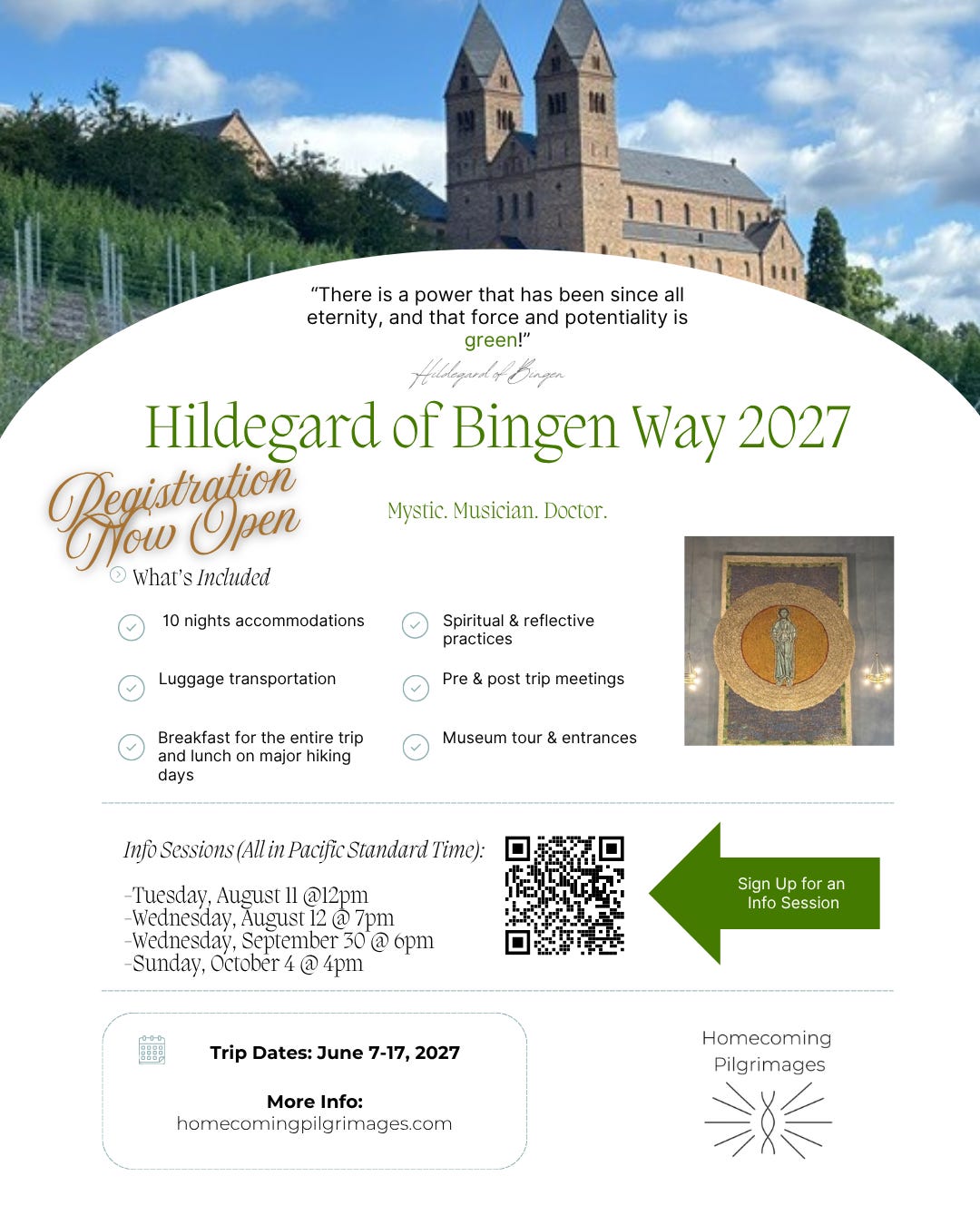
Discover the life and prolific ministry of St. Hildegard of Bingen on pilgrimage June 7-17 2026. This 70 mile route will be broken up into six days of walking, through places of significance in the life of Hildegard. Only 6 spots are available for this unique experience.
Is is said that we don’t choose to go on the Camino, but rather that it calls us. Respond to the call to pilgrimage and experience the unique gift of walking during a Holy Year of the Camino (2027). Join me for a guided experience on the Camino Inglés, May 14-24, 2027. This 68~ mile route will be broken up into 8 days of walking, within an intimate group setting.
Registration opens soon.
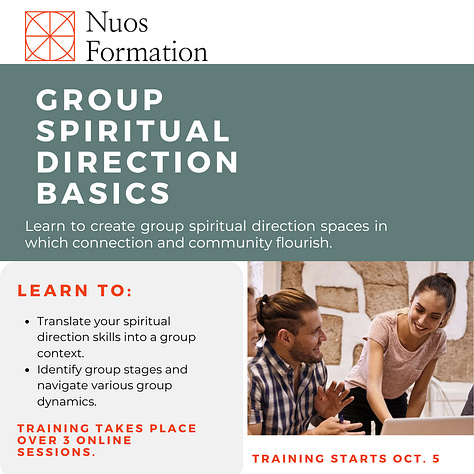
Just as spiritual direction is an art form, the practice of group spiritual direction is its own craft to be learned and developed. Discover how to create safe and welcoming spaces where community, connection, and discernment flourish. This 3-part training begins October 6, 2026.
Perhaps you are preparing to walk your own pilgrimage. Let me support you as you prepare for your solo or group experience. I provide practical guidance, while also helping you clarify your desires for pilgrimage, through one-on-one sessions, exercises, spiritual practices, and training plans. Or, if you’re needing support as you return from your pilgrimage, I am available for post-pilgrimage debriefing and integration.
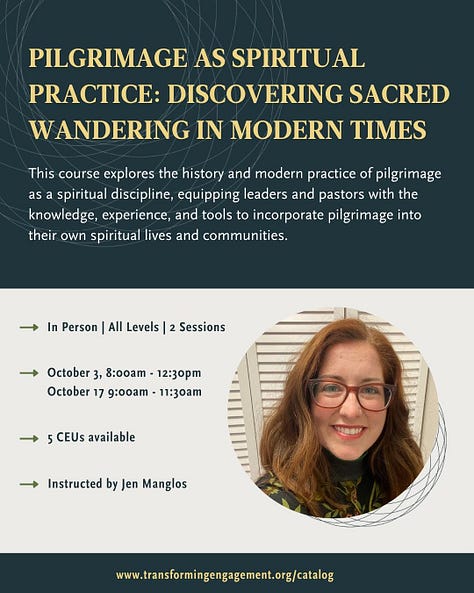
The act of pilgrimage has a storied history, with countless tales of folks embarking on sacred wanderings to places of spiritual significance. But how do we engage in pilgrimage as a spiritual practice in light of the lives we actually have?
Join me this October for a course with The Center for Transforming Engagement, an organization dedicated to supporting pastors, ministry leaders, community builders, and lifelong learners through trainings, courses, etc. This course will offer a guided pilgrimage experience along with simple ways to incorporate a spiritual practice of pilgrimage into daily life.
No posts
Comments
Nothing yet. Say the first thing.
Sign in to join the conversation.