
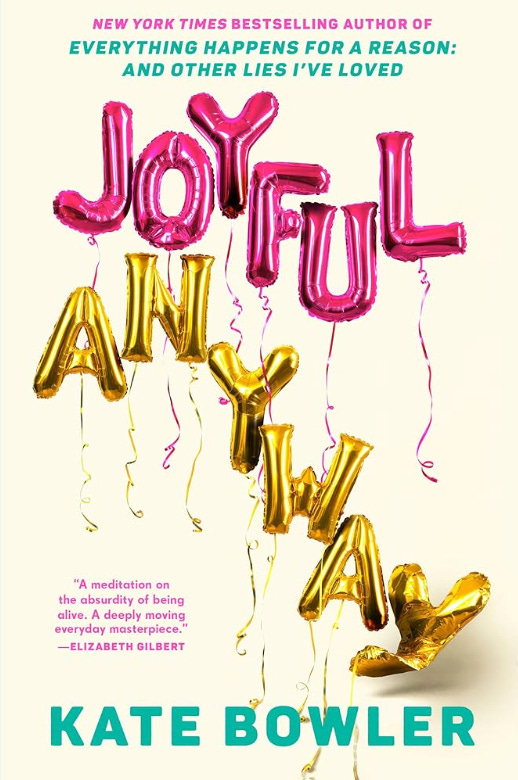
The July book pick is Kate Bowler’s Joyful, Anyway. I read this book back in April and it’s stuck with me. Give how much I’ve been reading these days, that feels important and so I read it again.
I’m not a naturally gleeful person. I come from a long line of sun-starved Scandinavians who were sometimes Swedish and sometimes Finnish depending on who’d won what battle that month, a ladies’ maid whose out-of-wedlock son was allegedly sired by a British Royal, and from Canadians who go back to the beginning of recorded history. (I’’d like to think that the union between my 7th-great-grandfather, a Hudson’s Bay Company Governor, and 7th-great-grandmother, noted only as “Cree Woman,” was entirely blissful, but it seems unlikely.) If you put stock in the science around epigenetics, the odds of being lighthearted are against me. When I interviewed Dr. Sonja Lyubomirsky in 2009 for an article I was writing and she told me that baseline happiness is 50% genetic, I felt a little doomed.
As a result, I’ve studied happiness like a job (and incorporate it into my work at U of T.) There are all sorts of scientifically-backed ways to make yourself happier and more successful. You can work on your health and relationships since both drive happiness. You can find work and hobbies that get you into a flow state. You can master skills, find your purpose, and increase autonomy in your life. Money can also buy happiness since it increases access to pleasure and ease and can decrease worry and pain. Studies show that when life is at a steady state, money and happiness have a pretty linear relationship - mo money, mo happiness - which is why everyone is out there is hustling.
Happiness is fabulous but it’s conditional. It’s a fair-weather friend and when certain levers beyond our control are pulled - sickness, grief, stress, insolvency - it disappears pretty quickly. Happiness also plateaus. Hedonic adaptation means that what once spiked dopamine, oxytocin and serotonin suddenly seems routine, which is why billionaires have to buy bigger and bigger yachts. No matter what the TikTok life coaches tell you, chasing only happiness is building your life on sand.
Joy, on the other hand, has more permanence. It’s something we can tap into at the worst of times. Joy is active and is something we can craft. It’s about finding moments of beauty or humour or lightness in the midst of ordinariness or pain.
Kate Bowler, a history professor at Duke’s Divinity School, started to study the concept of joy after being diagnosed with Stage 4 cancer when she was 35 and a new mom. In her book, Joyful, Anyway, Bowler unpacks how to tap into joy when happiness in not available. This is in no way toxic positivity. Bowler has studied prosperity gospel preachers in depth and generally views those who “guarantee your complete emotional, mental, physical, and spiritual health” by following their advice as predators who are “one viral social media post away from their own brand of supplements.” Life is beautiful but life is also hard.
In Joyful, Anyway, Bowler addresses the idea that sometimes we simply have unlucky seasons even when we do everything right. Bowler’s unlucky season stretched over a decade, with chronic pain, multiple misdiagnoses, near financial ruin from medical bills, and a brutal cancer treatment protocol she was told she might not survive. In the middle of this, she was bitten by a poisonous snake. It’s hard to be happy with a season like that but there is still room for joy. As she writes,
“You will never be cured of this grief, it’s true. But you will be joyful anyways, I swear.”
Joy is not about ease and feel-good chemicals the way happiness is. It’s about finding our unshakeable aliveness. During her medical treatments, Bowler could derive a weird sense of joy from the arrogance of doctors telling her how she should feel, the absurdity of the insurance and healthcare systems, and also from the kindness of those around her. Joy is not simply gallows humour (although that can be part of it), but is an acknowledgement that the human experience is kind of weird. It’s Jim in The Office making eye contact with Pam or the camera guy as if to signal, “Are you seeing this too?”
I felt joy at my mother’s funeral service when a funeral home employee marched in at the end holding a large QR code like a round card at a boxing match. He announced to the mostly octogenarian crowd that they could scan the code for a discount if they booked their pre-paid funeral that day. It was a moment of absurd joy: was he really doing this very inappropriate thing that was also just bad marketing? It served as a much needed release. Bowler urges us to seek out these moments and to hold them tight. They are what can help you through the struggle.
Joy is unique and personal. Bowler recruits strangers to see “the world’s biggest” monuments with her when she travels to conferences. There is no guide-to-life algorithm that tells one to visit the world’s largest Coke can, and yet it works for her. Her father suffered from debilitating depression yet found joy in becoming the world’s leading academic expert on Santa Claus. How wonderfully weird! Joy is rooted in our humanity: ChatGPT could never come up with these wild pivots and plot twists.
Years ago, I went through the hardest times in my life. It was harder that this past season and harder than my divorce and financial loss when my kids were small. There will never been a silver lining to this experience and Bowler’s words sum up that time perfectly:
“The most unforgivable things will happen to you. What happens, happens. And there will be no apology.”
In the midst of it all, I became the second owner of a prize winning French Bulldog and was plunged into community of elite French Bulldog fanciers. Frenchies were just starting to explode in popularity, there was a lot of money on the line for breeders, and these seemed like naturally dramatic people (plastic surgeons, luxury retailers, a once-imprisoned heiress.) It was a live version of Best in Show. While I was trying to sew the wreck of my life back together, the bulldog fanciers were up in arms over the correct length of a dog’s snout. There were lawsuits. Someone was allegedly hospitalized due to the stress. And it was all over the length of a dog’s nose. How can you not find some sort of weird joy in that? It did not take away from my troubles, but it provided a wonderful distraction that helped get me to the other side.
As Bowler writes,
“Joy can come in when you least expect it. But it is more than just a feeling, it is an argument for life itself. Joy is the idea that, yes, it’s good to exist - even now. Even in the midst of horrible suffering. It is the ultimate yes.”
I seek out joy daily. For me, it’s often involving dogs. I was walking around the neighbourhood this week and saw the cutest Miniature Dachshund who was light tan with absurdly large dark brown fluffy ears. I stopped to tell his person how cute he was. “Don’t trust him,” she said. “People say he’s so cute but they don’t see the bloody marks where he’s scratched me.” This tiny adorable dog is a secret sociopath. How amazing! It didn’t solve any of my problems, but it sure was fun to observe.
I’ll be focusing on Joy for July and coming back to this book each Tuesday. I’d encourage you to read it (she’s has a Christian world-view and teaches at a Divinity School but the book is written for a secular audience and has made all the best-seller lists.) I’d also encourage you to think about what brings you joy in the midst of this crazy time we live in. I’d love you to share in the comments.
See you next Tuesday. (Even writing that innocent sign-off, which has been completely coopted and turned NSFW, brings me a weird sense of joy!)
Xx Jen
Comments
Nothing yet. Say the first thing.
Sign in to join the conversation.