
Hey there,
So I had a great Substack Live conversation with David Deutsch. But it wasn’t without its tech mishaps.
David was ready. People were waiting for us to start talking…
And I was sitting there scowling at my laptop because I couldn’t get the camera and mic to turn on. 🫣
(The irony of this is not lost on me.) So finally I had to join on my phone, which meant the camera wobbled a bit during our conversation.
🤷 Sorry about that.
But it’s worth it.
We talked about copy, persuasion, AI, and what makes people respond to your writing.
David started his career at Ogilvy & Mather on Madison Avenue. He’s spent decades understanding what makes people stop, read, and respond.
We also pulled up a current nonfiction book sales page and went through it together. David critiqued it live.
This is the kind of feedback most authors never get access to. A master of direct response copy telling you exactly what's working and what isn't.
His Substack is called Speaking of Writing. And he is very good company.
So let’s get to it…

If you’re a skimmer, here are your takeaways:
📌 A live critique of the sales page for the book, Wired for Money, by Michele Masters, and what every author needs to know about what works and what doesn’t.
📌 Memorable writing rises above the AI noise. Not because it’s clever, but because it’s thoughtful and has your unique voice and style.
📌 The most interesting writing doesn’t affirm what people already believe. It flips it.
📌 Good writing is good thinking. Discernment is a skill we can’t take for granted.
📌 Don’t ask AI to rewrite your work. Ask it to tell you how to rewrite it.
📌 Your Substack is a world. Build one worth coming back to.
I’ve added timestamps to each section so you can skip to the parts that interest you most.

David opened by talking about the connection he makes between writing and music.
David: I’m fascinated by the overlap between writing and other disciplines like mathematics and music. There’s a certain mathematicalness to writing if you analyze it.
Music has its rhythm, its harmony, dissonance, and consonance. Each of those things lets you see writing differently and gives you more control over yours.
Jen: I’ve always seen it in a musical way too. The cadence and rhythm is what draws people in on an unconscious level. They may not be studying it, but that’s what keeps them reading down the page.
David: Same with music. You don’t really think about why you’re listening to a song or why you like it. You just do.
💡 Which brought us, naturally, to the infamous “ad man” David Ogilvy.
David Deutsch started his career at Ogilvy & Mather as a temp. He won a t-shirt design contest for Rums of Puerto Rico (”Let’s make it” on the front, “with rums of Puerto Rico” on the back.)
Then he showed some speculative work to a creative director which landed him a job as a copywriter.
He started his Mad Men career in a department that did everything from Bermuda guidebooks to trade advertising.
One of the many things he absorbed there was a mindset.
David: At Ogilvy, one of the biggest things I learned is that advertising is for selling, and it can be done in a classy way. We don’t have to shout at people. Because David Ogilvy was a very classy guy.
He was British, eccentric, and very deliberate about being memorable. He’d call restaurants ahead to have his usual dish ready. He showed up to parties in a kilt.
He talked in soundbites, and not by accident, but by design. So people would remember what he said.
He respected the intelligence of the reader. He wasn’t afraid to use big words or throw in a little Latin.
You can be sophisticated and still make it understandable. It’s about giving the reader context and explaining things in a non-condescending way.
Right now, there’s so much AI slop coming out that when something is human and different, it just rises above the rest.

David and I talked about using AI as a devil’s advocate. Not to write for you, but to work through your ideas. Consider asking AI to outline suggestions to make a piece stronger, then make the changes yourself.
David: There’s a danger in being facile with writing. You wind up being a little bit superficial, and you don’t go deeper. Sometimes I have to force myself to go a little deeper.
A lot of times, we look at something as an isolated thing. And we miss the whole system around it.
A great way to capture people’s interest is to show them a world they haven’t seen. Take a big system and show them a small part of it.
Give them a glimpse into what’s really going on behind the scenes, whether it’s behind the scenes of politics or your own brain or how people act.
Jen: That’s what I love about Katherine May on Substack. She writes mostly memoir and uses the metaphors of the seasons of life.
Reading her books feels like a friend giving you the pulled-back picture of what a difficult season looks like.
You can see yourself in it. You’re thinking about something in a way you haven’t thought about it. Even if you went through something that felt very similar.
David: That’s the experience we all crave. Like going through Hogwarts with Harry Potter. That’s why people love Game of Thrones, it takes you into another world. But we can take people into worlds that are real too.
Jen: I think that’s one of the opportunities with Substack right now. You can create your own little world, whether it’s a newsletter world, a media company, or a podcast world. Every time someone gets your email or joins a Live, you can bring them into a different place.
✍️ David mentioned Robots Ate My Homework, by Mia Kiraki 🎭. It’s a Substack about AI with steampunk clockwork illustrations that create an entirely distinctive, humanized world around a topic that usually feels cold. A perfect example of what’s possible.

David read a 1971 academic essay called “That’s Interesting! Towards a Phenomenology of Sociology and a Sociology of Phenomenology” by Murray Davis.
Davis was a professor of sociology at Northern Illinois University. Its central argument is both simple and a little provocative: a theorist is considered great not because their theories are true, but because they are interesting.
David brought it up in our conversation because the same logic applies to writing.
David: What people find interesting is when you tell them something they thought was true, but isn’t.
For example, you think junk food is bad for you? Let me tell you about some junk foods that are actually good for you.
You lose money when a stock goes down? Let me tell you how you can make money when a stock goes down. Now that’s interesting.
He broke it into four types of “flips”: appearance, reach and scope, function and value, and relationship.
And he gave us a caveat that matters most for writers.
David: You can’t do it with something people don’t care about. And you can’t do it with something someone feels strongly about.
Like saying a political party is the good guys or the bad guys. That’s not going to make someone go, oh, that’s interesting.
It’s going to make them go, “screw you.”
The sweet spot?
Something they care about, but where their identity isn’t wrapped up in being right about it. Where they’re open to thinking, “Oh, maybe I am mistaken about the best way to make money online, or how to load the dishwasher.”
That’s where the real writing lives.
Not confirming what people already believe, and not in the stuff that makes them defensive. In the middle, where they can be genuinely curious and open.

This came up naturally, and David’s take makes sense from a guy who’s been writing copy for decades.
David: We’ve got to be really clear about where we add value now. We can’t say we add value and just do mediocre writing because now AI can generate mediocre writing.
Can we go back and forth with AI to refine ideas?
Do we have the discernment to take the best of those ideas and develop and implement them in the right way?
We have to be able to take AI’s feedback and transform it into something interesting that has our unique voice and point of view. And be able to give it our thoughts, our ideas, our imagination, and let it help us develop those into better writing.
But you have to be really careful. Because AI will take over. And before you know it, it’s not X, it’s Y. And it’s soulless.
You do that by how you prompt it. By being really strict with it.
You can’t just give AI something and say make this better and then cut and paste what it rewrote.
You have to say, tell me how to make it better. Suggest edits that I will then make. Don’t just give me an improved version. Spell out exactly what you think I should do.
Then you make those edits. Not AI.
The moment you let it rewrite, it’s not your voice anymore.
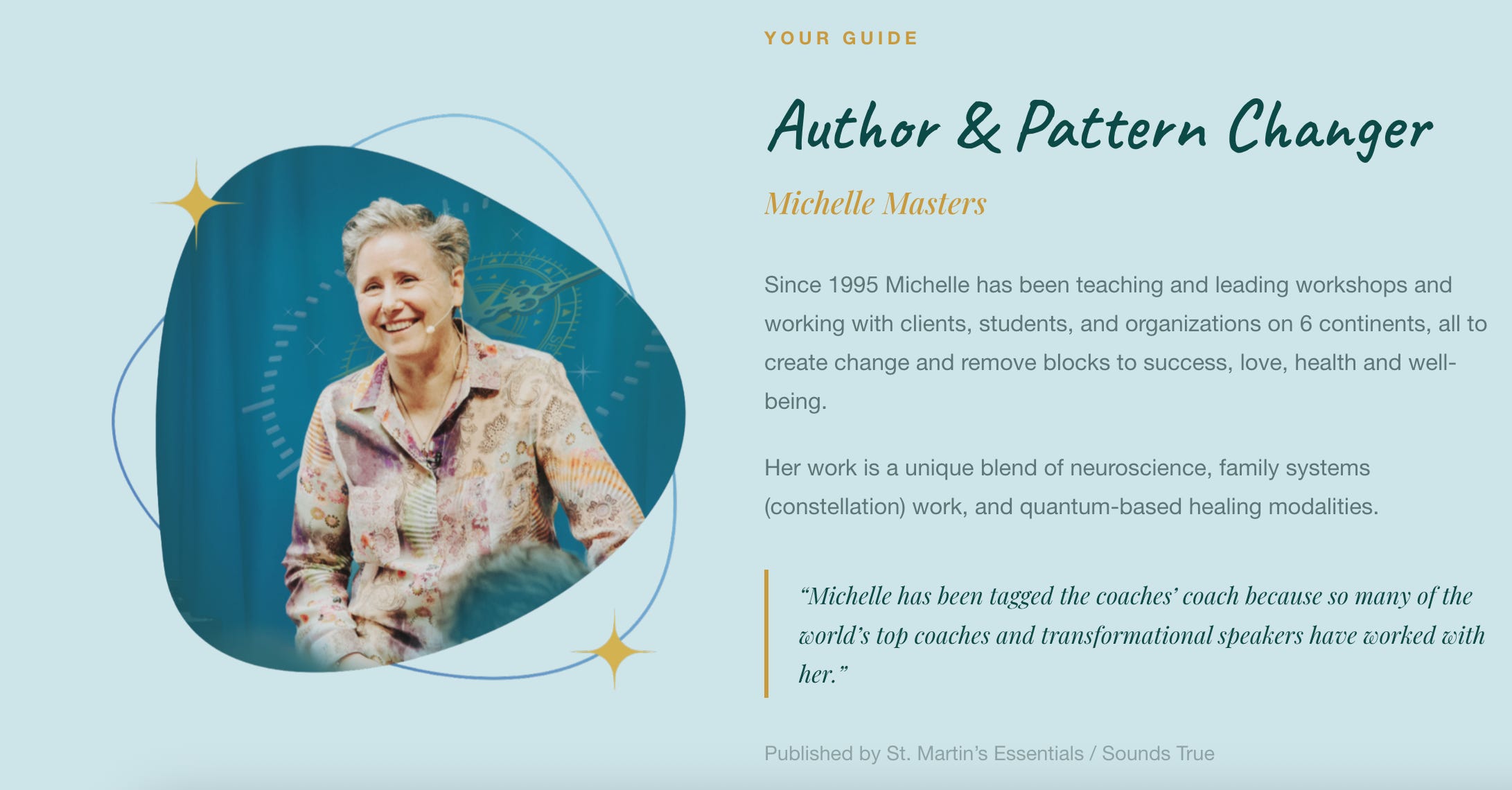
Then we pulled up the sales page for the current book launch for Wired for Money by Michelle Masters. And we went through it together.
David took the lead, and I got out of the way.
This section is worth watching if you’re interested in what makes a strong sales page for your book.
Here are the highlights from his critique:
🔍 The subtitle was already losing him. Change the Patterns That Block You From Thriving stacks vague words on top of each other. “Change,” “patterns,” “thriving” — none of them paint a picture. David’s rule: get as close to “magicalness” as possible. Small, concrete, specific beats abstract every time.
🔍 Too many prepositional phrases. The copy kept tacking on phrases and parentheticals until the rhythm became monotonous. His fix: write it the way you’d say it to someone in person. Not “a neuroscience-based guide to rewiring unconscious patterns running your relationships with money, success, and worth.” Just — here’s what this book does for you, in plain language. Convey the excitement.
🔍 Your copy has to close the gap between what you’re excited about and what the reader actually wants to hear. You wouldn’t describe your book to a friend using the subtitle. So don’t use it on the page either.
🔍 Mine your Amazon reviews. The book already had hundreds of reviews from readers describing their experience in their own words. Those phrases should be on the sales page. That’s your copy, written by the people you’re trying to reach.
🔍 Ask this about every element of your launch: is this pulling its weight? The bonuses section got a raised eyebrow. Early access chapters, private podcast, book club — none of them were compelling enough to tip someone over the fence. The best bonuses make you want to order because of the bonus. If you have to assign a dollar value to “a community of like-minded changemakers,” it’s not a bonus. It’s filler.
Just access that thing inside you. Ask yourself: is this something I would say? Does it feel natural? Is it from my heart?
David: All I’m doing in copywriting training is teaching people how to access their own inner persuader.
The one who’s perfectly able to convince their spouse which restaurant to go to and get friends to play mini-golf instead of bowling. Bring that same style to persuade someone on the page.
Don’t go for the formulaic things rolling around in your head that make it sound like everything else. Or let AI do that for you. AI is very good at making it sound like everything else.
Just access that thing inside you. Ask yourself: is this something I would say? Does it feel natural? Is it from my heart?
The best writing is something you get off your chest.
Something from the heart.
Thanks so much to Susan Schroeder, Jenn Woltjen, Paul k, Nicole Piper and the many others who joined us!
David’s Substack is Speaking of Writing. Go find him!
Keep writing,

P.S. I'm raffling off paid subscriptions and Amazon gift cards to readers who weigh in on what they actually want from The Skillful Scribbler. Three minutes of your time will help me decide whether to keep doing Lives like this one.
🔗 Click here to answer a few questions. 🙏🏼


Available for iOS and Android
Comments
Nothing yet. Say the first thing.
Sign in to join the conversation.