
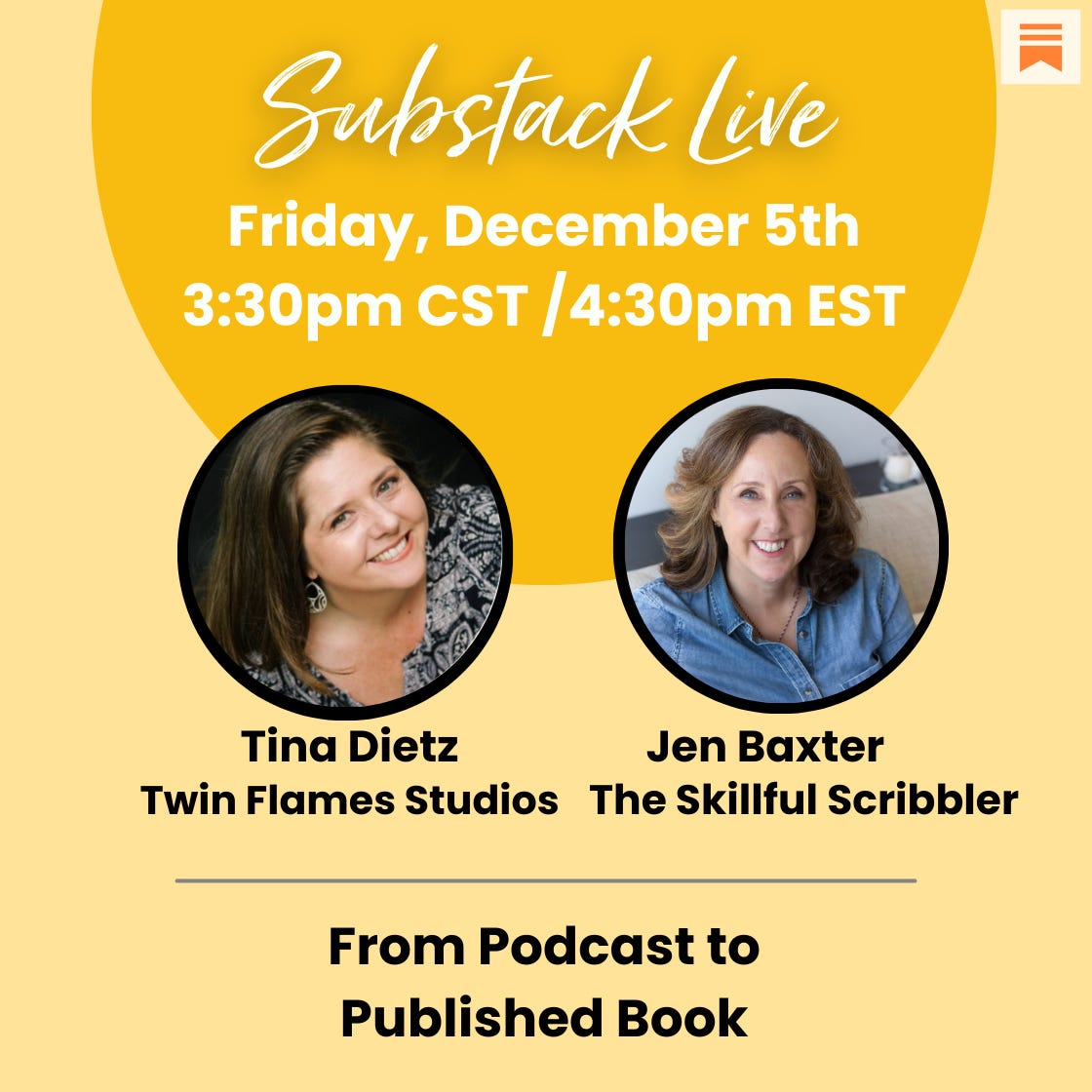
I got together with Tina Dietz from Twin Flames Studios to talk about something I’d never considered: your podcast is already a book.
Tina’s team has produced over 500 audiobooks with bestselling authors. She’s been a guest on 60-70 podcasts over the years, hosts her own shows, and runs The Publishing Tea—a community of 180+ publishing professionals. Twin Flames Studios was the first audio company to develop fully remote but fully supported audiobook production.
In other words, she knows publishing. And she’s seen what works and what doesn’t.
What caught my attention was something called the PodCraft™ Method, a way to transform existing podcast episodes into a professionally published book. Not a transcript dump. An actual, strategic book that preserves your voice and serves your audience.
If you’ve ever wondered whether your podcast could become a book, or whether starting a podcast could help you write one, this conversation is for you.

If You Only Remember 6 Things:
🎙️ Your podcast is already a body of work — From 100 episodes, you could probably write 3-4 different books. The question is which one serves your goals.
💰 Traditional book publishing costs more than you think — Most authors building a platform spend $30,000-$70,000 on their book before marketing. The PodCraft™ Method starts with content you’ve already created.
🎯 Strategy comes first — Same content, completely different books. One podcaster created a category-defining mental health book. Another used it for thought leadership. Another launched a career as first-time authors.
✨ Your voice gets preserved — Specialized software captures your voice characteristics and speaking patterns. You don’t want “absolutely” repeated 150 times in your book, but your warmth and storytelling style stays intact.
📚 You already have an audience — When you launch a book from podcast content, you’re not starting from zero. You have guests who’ll promote it, listeners who trust you, and a community ready to support it.
🎧 Human narration still wins — Despite the AI hype, appetite for AI audio is going down. 70-75% of Twin Flames’ audiobooks are narrated by the author, with full remote support.
Now let’s get into it…
I’ve been thinking about audio a lot lately. On Substack, you can add audio to every post, integrate podcasts into your platform, and use voice notes for challenges or programs.
And what is the relationship between podcasting and writing? Are they competing for attention, or is there something more interesting happening?
Then I talked to Tina, and she flipped the whole thing on its head.
Jen: So let’s start with your background. How did you get into this work?
Tina: About six years ago, I got frustrated with what I kept seeing authors go through with either some kind of ghostwriting process or a developmental editing process that took forever and cost a fortune.
I realized we’re in a place now where technology (used ethically and correctly) can work with a large body of knowledge, like podcast episodes, and use it as source material to develop book content.
👉 Here’s why this matters:
This isn’t about cleaning up transcripts or slapping your podcast into a PDF. We’re talking about wrapping your hands around the body of knowledge you’ve already developed as a podcaster. It’s material you probably don’t even realize you could draw on to write your authority-building book.

Jen: So tell us what you see when authors come to you. What’s the typical path they’ve taken before they find you?
Tina: After producing hundreds and hundreds of audiobooks, we’ve seen our authors go through all of the ups and downs of publishing. All of the expectations, all of the time, and money spent.
And a lot of folks won’t tell you how much time or how much money (or the combination of both) it took to make their book successful. People don’t want to talk about that.
But I would say on average, somebody who is really building a platform in the nonfiction space, by the time they get to creating an audiobook with us, they’ve spent anywhere from $30,000 to $70,000 on developing their book.
Jen: Wow. And that’s before marketing?
Tina: That’s before marketing. That’s before distribution. That’s before any of the “getting your book into readers’ hands” work.
📌 Let that sink in for a minute:
$30,000 to $70,000 just to get to a finished manuscript and audiobook.
The only time we don’t see that is when somebody is a really good natural writer on their own, has a tremendous amount of time on their hands, and they’ve done it that way. Every other situation typically results in a book that an author is not happy with in terms of quality, anytime somebody tries to shortcut the process.
Tina: The strategy is crucial with any book. It has to be something that’s going to meet your goals and serve your audience.
Jen: So, how do you help someone figure that out? Because I imagine from 100 episodes of a podcast, you could pull multiple book ideas.
Tina: Absolutely. We could probably write three or four different types of books from 100 episodes. So the type of book is really important. And who you’re writing it for matters just as much as why you’re writing it.
Let me give you some examples of folks we worked with this last year. All of them had very, very different content and very different goals.
💡 This is important:
Responder Resilience — A show with three co-hosts that has talked with folks in the first responder industry for years. Their goal was impact. We wrote a book that created a category in mental health. It’s called Helping the Helpers, and it is the first book of its kind in the world, specifically designed to help leaders in the first responder world and mental health practitioners help first responders deal with their mental wellness.
It’s a very deep topic for something that’s created from podcast content. But that book, from first-time authors, putting no money into marketing, ended up eight weeks in the top five on three different categories on Amazon.
Jen: That’s incredible.
Tina: And they’re already writing grants based on the book content to create courses and scholarships for mental health practitioners to get continuing education credits and become certified to help this population.
That’s a lot of impact. And that was their goal from the beginning.
We’re also working with Jennifer Brown, who has been a significant presence in the DEI space as a thought leader for 20+ years, on her fourth book, called The Shape of Change, which is coming out in early 2026. It’s based on her popular podcast, The Will To Change.
We had already worked with Jennifer on 3 of her audiobooks, so getting to work together on her 4th book from scratch was a wonderful opportunity to deepen our relationship.
Another project we’re proud of is The Loud Quiet, a relatively new podcast run by a couple about what happens when you become empty nesters. This is their first real entree into this world. They’re looking to make a name for themselves. Different audience, different goal, different book.
Jen: Same process, totally different books.
Tina: Exactly. That’s why we start with strategy. Because you could write the wrong book from your podcast content if you’re not clear on what you’re trying to accomplish and who you’re trying to reach.
This is the part that fascinated me. Because when I think about podcast episodes, I think about: guests, tangents, sponsors, inside jokes, technical difficulties, and the occasional rambling answer.
Jen: So, how do you turn that into a coherent book that still sounds like the host?
Tina: We have software that brings in every bit of information from an RSS feed. We’re able to create what’s called a corpus, which means we’re able to pull out the themes. We’re able to pull out the voice print of the host and the characteristics of their voice. And separate out the voices of other guests.
So if we want to bring in quotes or information from other guests, we know those are going to be accurate and associated correctly with the right pieces of information.
Jen: So you’re not just transcribing and editing. Are you actually training something to understand the host’s voice?
Tina: Right. And here’s what matters: we’re not just running your content through AI and calling it done.
The content development is pulled from the podcast content, but there’s a lot of human editorial work. For example, I know I say the word “absolutely” like 150 times a day, but you don’t want that in a book.
So we have to change vocal patterns that don’t work. We look at the style of speaking, are they authoritative? Are they warm? Are they a great storyteller? What are those things? All of it has to be preserved inside this content.
The books we’re creating lean into the strengths of podcasts, conversational, relationship-oriented, trusting the audience, and being a thought partner for the author and the reader.
And that creates a very deep relationship, particularly since the voice of the host is so well preserved through these books.
Jen: One thing I hadn’t thought about when you write a book from podcast content, you’re not starting from zero with your launch, are you?
Tina: No. You already have an audience. You already have guests who might promote the book. You already have a community of listeners who trust you and want to support your work.
When you go to launch it, typically, if you have an interview show or you know other podcasters, those are resources you then have to get the book out into the world in a bigger way.
Jen: That’s what happened with Responder Resilience, right?
Tina: Exactly. They had all of these guests, and they already had a following on their podcast. So when they said, “Hey guys, we’re launching this book,” their audience and guests were all saying, “Of course, we’re going to support this book.”
That is another real big advantage of creating a book from podcast material. There’s already an audience there.
Compare that to the traditional author experience: write for months or years in isolation, then try to build an audience from scratch just before the book launches.
The podcast-to-book path flips that entirely.
Since Tina’s company specializes in audiobook production, I had to ask…
Jen: Do you suggest that authors read their own book, or do you have a professional narrator do it?
Tina: It really depends on the book and the author. About 70 to 75% of the audiobooks we produce are narrated by the author.
We were the first audio company to develop fully remote but fully supported audiobooks. So you don’t have to go into a studio, but you do have a director, not just an audio engineer. Those are two different things.
Somebody who operates as an audio engineer and a director is in your ear with you the entire time. We handle the tech, the recording, the direction, the editing, all the things to make sure that you are good and you sound good. So you’re giving the best performance possible.
Jen: And what about AI narration? I feel like there’s a lot of hype around that.
Tina: We get a lot of questions about AI. And I actually have an article about it that I updated for 2025. The appetite for AI audio has actually gone down. It hasn’t gone up.
If you look around, you would think it has gone up because so many companies have jumped into the space. But the stats don’t bear it out because it’s still not good enough.
AI audiobooks sell really badly across the board. The only place we see them doing well is when they’re produced like an audio drama on YouTube, where people can listen for free, and the creator gets paid by YouTube. That’s a whole different business model.
But for audiobooks people are paying for? Human narration still wins.
Before we wrapped up, I wanted Tina to talk about The Publishing Tea, because that’s how we met, and it’s one of the coolest places I’ve encountered online in a while.
Jen: Let’s talk about The Publishing Tea because this is one of the best experiences and coolest places that I have encountered online in a while. I love it.
So tell us a little bit about when you started it and how that idea came to be and what it’s turned into. Because the panels also look fantastic.
Tina: I started it about four and a half years ago. I’m a business coach and therapist by training, so I like facilitating groups. And I wanted a way to nurture my referral partners, because in producing audiobooks, we’re at the end of the process. I can’t refer clients back to editors and publishers.
So I created this kind of mastermind environment for free for publishing professionals. It’s grown to about 180 publishing professionals now. Anywhere from 25 to 40 of us get together every month to talk about different topics and meet each other.
What came out of that for authors and the public are monthly expert panels. Every month, we have a different topic related to the publishing world, writing, marketing, or some facet of it. I generally bring together three experts on that topic for a one-hour discussion.
Those are all on-demand on our website. And we have a directory of vetted professionals in the publishing world, all of whom have agreed to a code of ethics and have a minimum of five years full-time experience.
Jen: That’s huge. Especially for authors who don’t know where to start or who to trust.
Tina: Exactly. We want to make it easy for authors to find the resources they need. There’s a lot to think about when you’re writing any kind of content, let alone writing a book. The faster and easier we can make it for folks to connect with quality professionals, that’s what we want to do.

If you’re a podcaster, you’re not just creating content that disappears into the interwebs. You’re building a body of work that could become multiple books. Ones that already have an audience waiting for them.
And if you’re an author thinking about starting a podcast, you’re not just adding another content channel to your already-full plate. You’re creating source material for future books while building the audience that will support them.
The relationship between podcasting and publishing isn’t competitive.
It’s symbiotic.

Want to explore the PodCraft™ Method?
Twin Flames Studios
Looking for publishing resources?
The Publishing Tea Community (free monthly panels + vetted professional directory)
A few great articles:
👉 The State of AI Audiobooks in 2025
👉 7 Smart Ways to Sell More Books During the Holidays
👉 Why Great Writers Struggle with Publishing
💭 Question for you: Do you have a podcast that could become a book? Or have you thought about starting a podcast specifically to create content for a future book? Hit reply and let me know. I’d love to hear what you’re working on.
Keep writing,

P.S. This Thursday 12/11 at 11am CST I’m doing another Live with Claire Venus of Sparkle on Substack and Creatively Conscious. We’re talking about closing your Substack year with ease. It’s gonna be a fun one! Here’s the link:
Substack Live Link with Claire
Thanks Jennifer Ann Blair, GRETCHEN & NICOLE, Eleanor Shannon, and many others for tuning into my live video with Tina Dietz! You can join the next Live in the app.

Available for iOS and Android
Comments
Nothing yet. Say the first thing.
Sign in to join the conversation.