
This episode, we’re getting ‘agents-y’, and asking who should be in the driver’s seat.
🤖 A guide to set up your own AI agents (an agency?) in Claude Cowork
🧪 What happened when I attempted to completely automate JEN_AI’s “idea → AI experiment” workflow
⚡ Why Silicon Valley’s latest buzzphrase for ‘people who do things’ (”high agency individuals”) is 🙄 [eyeroll], but also maybe how to beat both burnout and the AI-job-pocalypse
🤸♀️ JEN_AI in real life: the highs & lows of getting back into aerial circus (sure, why not?)
🎧 The bots chose a theme song
JEN_AI Challenge #19: Set up an AI Agent Agency to Build My Dream Life
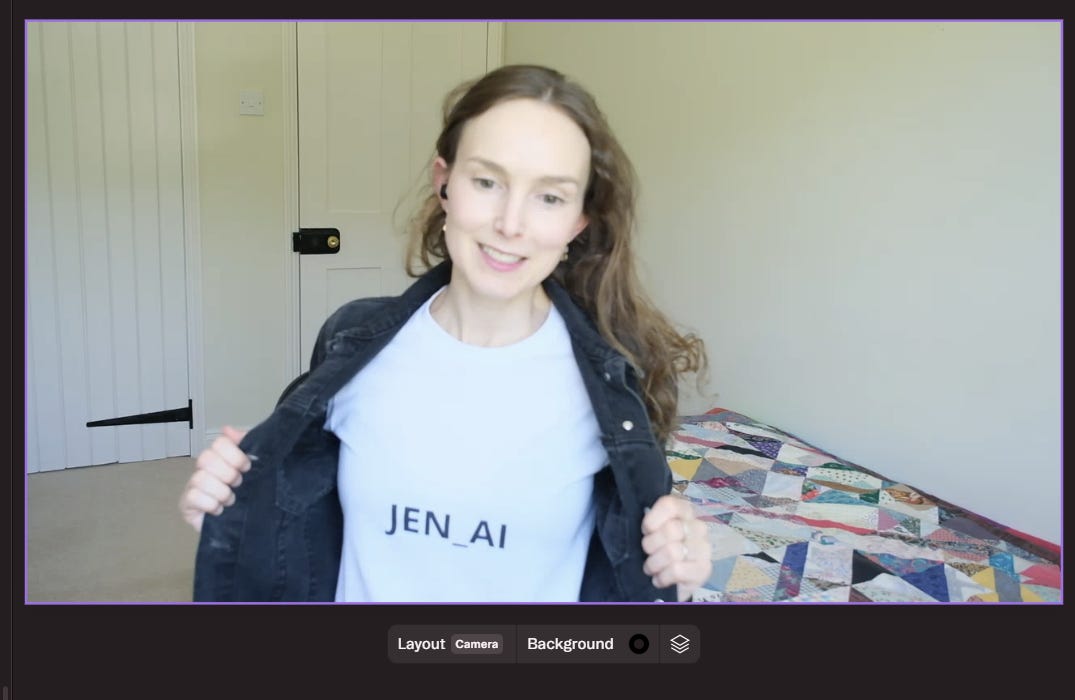
We’ve all had an idea for a ‘killer app’, business or creative project that died in our heads before we could make it real.
I’m Jenni Munroe, an ex Google / DeepMind Generative AI (’GenAI’) Experimentalist & Founder at JEN_AI, my human + AI creative lab. I’m challenging myself (and you too, if you feel like it) to make ideas & dreams real, mashing-up new and retro tech, culture and media, as we work out what it means to be human in the age of the machines.
This week: I built myself some robot coworkers. (Don’t come for me.)
There’s an experiment, a how-to guide and a thought piece. Skip ahead and choose your own adventure. You’ve got agency, after all.
An agent earns the name when it takes several steps toward a goal, uses real tools to actually do things, makes its own small judgement calls, reviews its work & keeps going without you prompting every click. The aim is not engineering “prompts” but “loops”. We’re not just talking about chatbots here.
Anthropic’s ‘Claude’ suite has arguably been considered ‘the best’ of the 3 top AI ecosystems in most of 2026 (next to OpenAI’s ChatGPT & Codex and Google’s Gemini & Antigravity, and all the rest). ‘Claude’ itself is the chatbot, ‘Claude Code’ is targeted at software developers and ‘Claude Cowork’ is aimed at non-technical knowledge workers. Claude Code & Cowork can be used more agentically, but they work best when you set up your “context” first. Which is what I’m going to guide you through.
Shocking confession: I hadn’t set this up properly for myself in the Claude ecosystem until this week. (If you haven’t either - solidarity, & also, it took me a couple hours to do it.)
Why it’s worth the faff: once an AI actually knows you - your goals, your style, your references & preferences - it stops being generic & starts being more useful. Especially once you have connected it to the tools you regularly use (Slack, Gmail, Excel, whatever). In my case “useful” means: I spit a half-baked idea into my setup (”Make It Real Lab”), & it helps me turn the crazy brain-vomit and reference docs / images etc. into something real.
This is a tight setup guide for Claude Cowork: a no-code way to put an AI to work inside your own computer. I distilled these essentials from guidance by both Ruben Hassid, ranked #1 in Education on Substack (it’s impressive, ok), and “#1 Voice in AI for Business” Allie K. Miller, so you don’t have to.
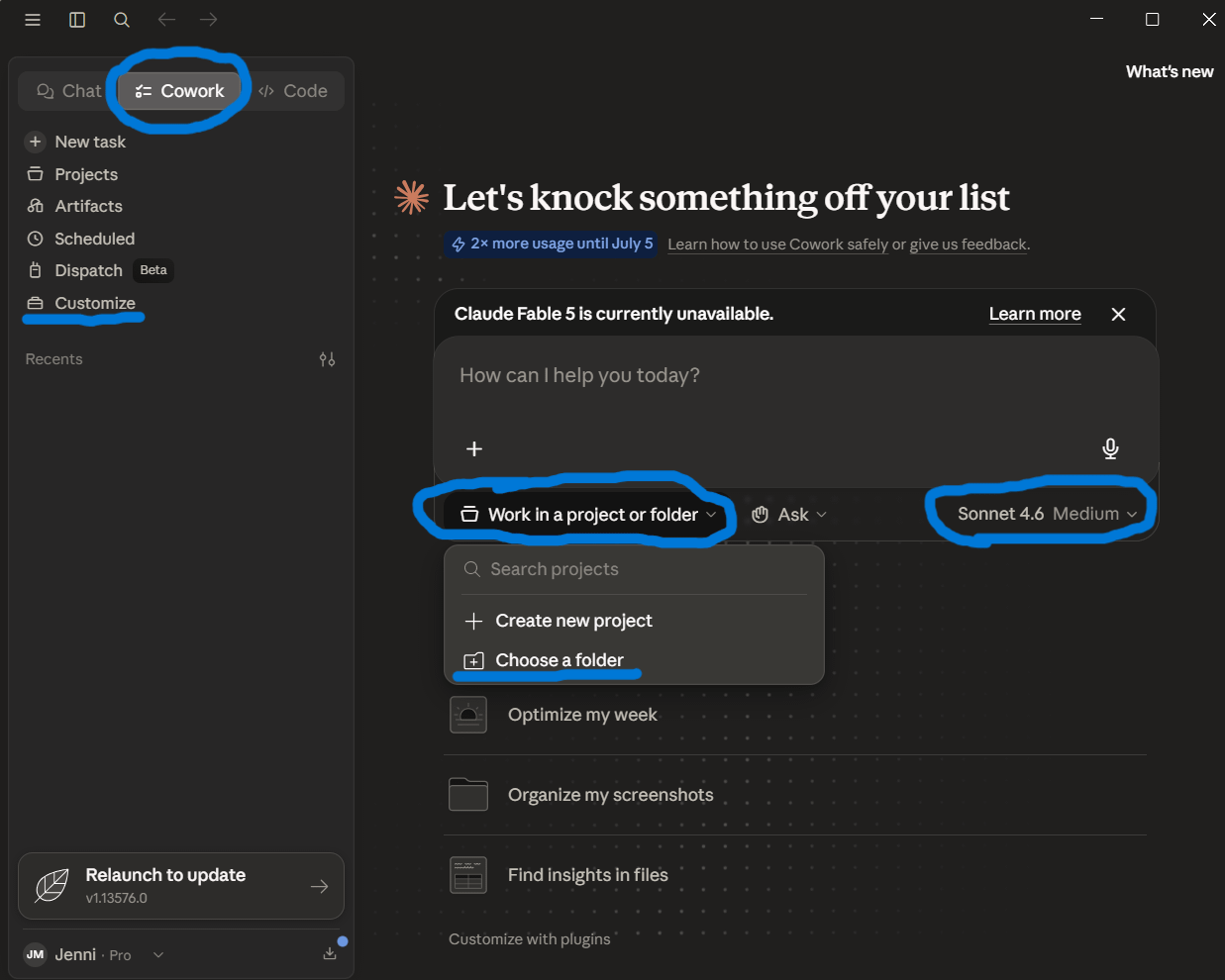
1. Download Claude. Get Claude for Desktop, get the paid $20 plan (3 passes for a free week here!), open the Cowork tab. Optional but good: pick the Opus model & switch thinking on.
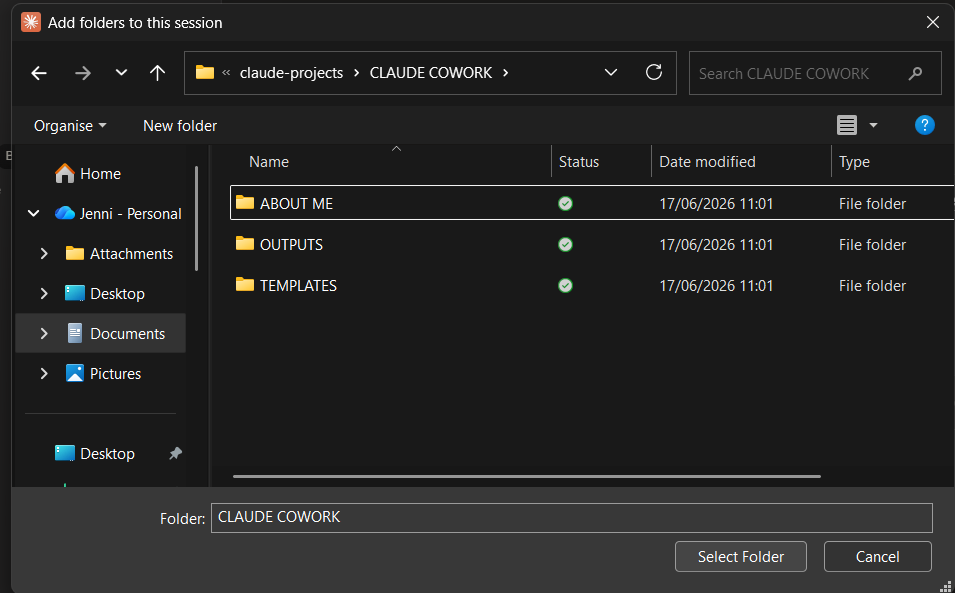
2. Create empty folders. Make one folder on your computer somewhere (’Documents’ is fine), call it CLAUDE COWORK, with three folders inside: ABOUT ME, OUTPUTS, TEMPLATES. When you start typing in Cowork → ‘Work in a project or folder’ → ‘Choose Folder’ and choose that CLAUDE COWORK folder you made. Now it reads & writes here, & nowhere it shouldn’t. (It baffles me that Claude doesn’t do this for you.)
3. Download yourself. Ask Cowork to interview you & write your context into ABOUT ME: an about-me file (who you are, how you work, what you can’t stand), a my-company (or job) file (goals etc.), & an optional brand file. Paste into the CLAUDE COWORK folder an anti-ai-writing-style doc (the AI words & patterns you ban). These are all saved as ‘markdown’ files (.md), which is just a text file with funny formatting.
Bonus: if you dictate your answers instead of typing, it’s faster, actually sounds like you, and you tend to give more context. (Wispr Flow - wisprflow.ai (free month here!)- has one hell of a marketing team and is good, but you can also just click the mic button.)
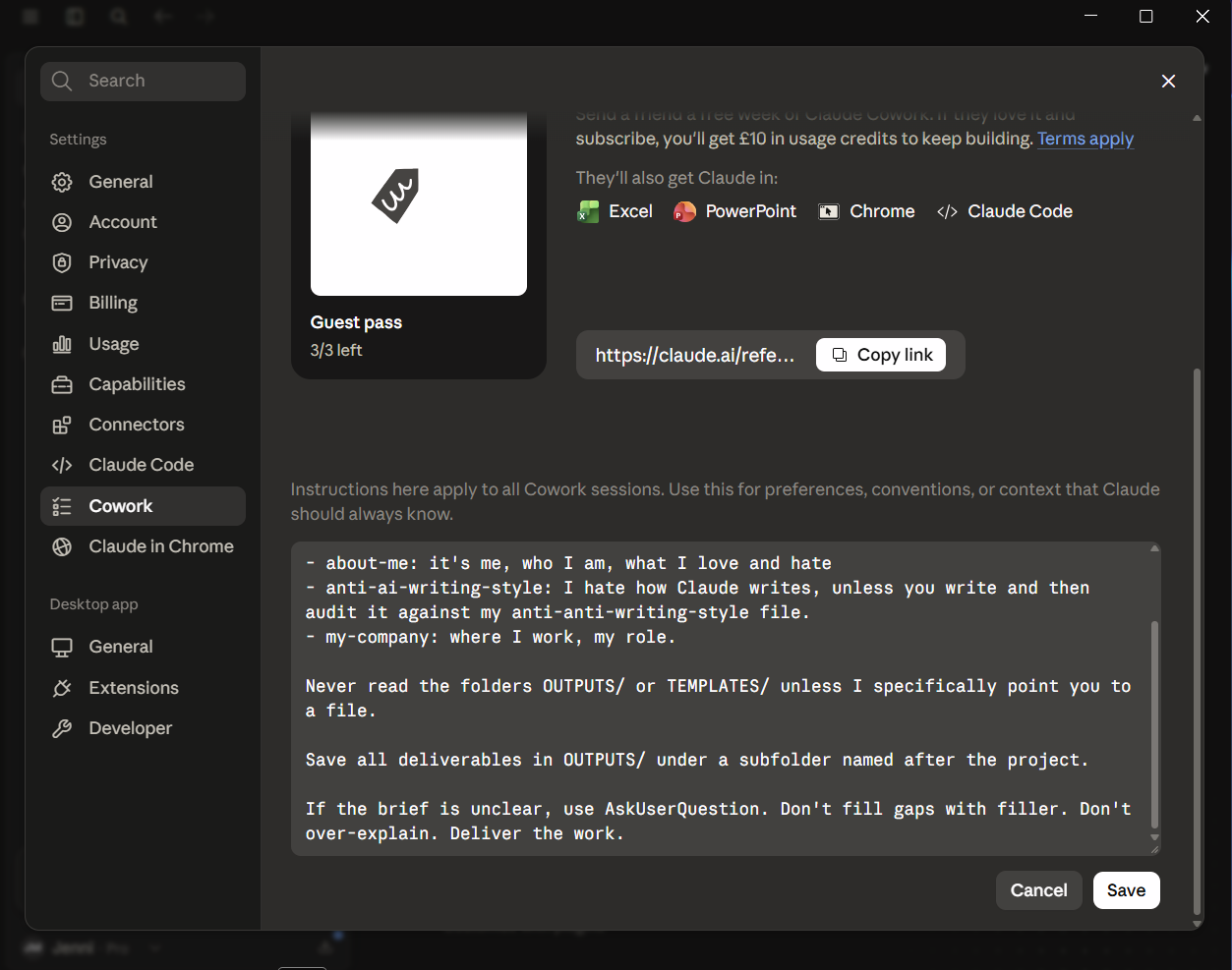
4. Set this one instruction. In Settings → Cowork → Instructions section, tell it to read every file in ABOUT ME before every single task. (Again: why does Claude not do something like this for you?)
5. Connect your tools. Click Customize → Connect your apps → choose the tools you live in: Gmail, Calendar, Drive, Slack, Canva, whatever. The moment it can take actions in the tools you use, with your real data, you’ve crossed from chatbot to agent.
Optional 6. Teach it a repeatable ‘skill’. When you catch yourself explaining the same job twice, ask Claude to save it as a Skill. A Skill is a small reusable task - a text file with a name, a job, & a short description of when to use it - that Claude loads on demand, so you shouldn’t have to re-explain. You build it once & it runs when Claude thinks its relevant to what you’ve asked to do, or you can schedule it to run on a timer (a daily news brief at 7am, say).
As Ruben Hassid puts it, “you’re basically a text file now”. (or, not)
(with thanks to Allie K. Miller, who demos these properly)
Now try asking Claude Cowork to do whatever work you’d normally do. Research a topic & turn it into a report or a deck. Or, if you’re me, give it a daft idea & ask it to build it. When something works well, ask Claude to update your ABOUT ME files or save it as a Skill. A couple to start with:
Auto-draft your boring emails. Connect Gmail. Tell it: read my “non-urgent” folder, draft replies in my voice, strip the AI-sounding phrases, save as drafts. (You review, tweak, then send. Don’t try attempt it to send them for you.)
Schedule a daily briefing. Ask it to pull your day’s calendar, inbox priorities & relevant news each morning. Set once, fires itself daily.
Allie Miller runs 34 named agents - a chief of staff called Simon, directors named after the Friends cast, & a note-taker called Toby whose only job is helping the system remember itself (again: for the love of god, Anthropic, build this in). Every one of them is just a markdown text file like this containing repeatable jobs grouped into role functions (marketing, education etc.). The advice is ‘stop writing prompts & start writing job descriptions’, & ‘promote yourself from worker to CEO of a system’. Then maybe try Claude Code.
It went. Wow. I set up the above, fed in a ton of JEN_AI examples of my writing & branding, then showed Claude Cowork how I turn a brain-dump into an AI experiment. Then I tested it on some of my many ADHD-adjacent crazy ideas. Such as:
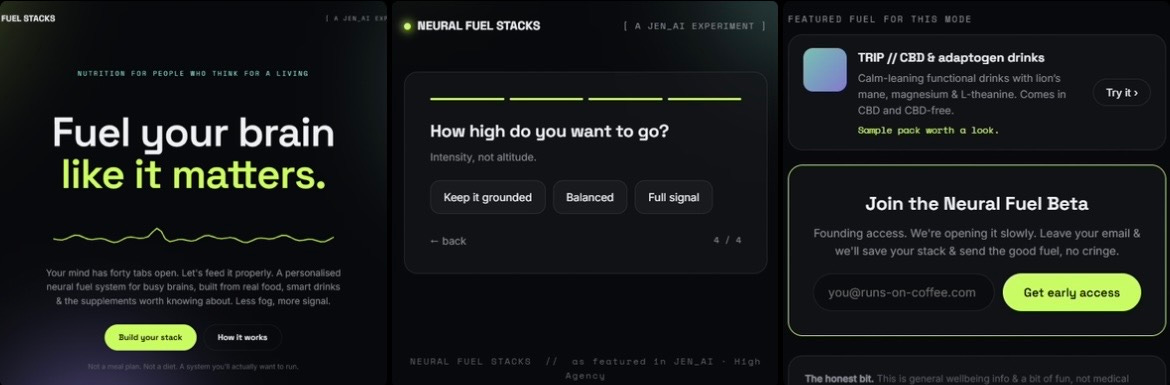
Neural Fuel Stacks. I had a vague idea for a web app that jumps on a questionable trend by giving you a stack of personalised nutrition & supplement recommendations depending on what mode you’re in (Creative Sprint, Burnout Recovery, Parent Survival etc.). So I fed it in. Out came a pitch, a rough plan, a demo website mockup, messages to send people for feedback, a drafted Substack newsletter about the experiment, and 4 platform-tailored social posts. My god, I’ve created a monster.
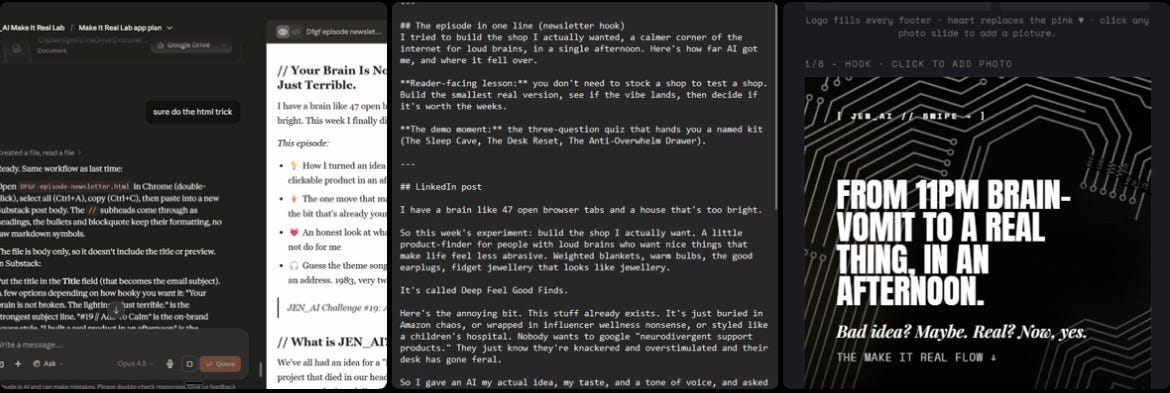
Make It Real Bot. Here on JEN_AI we like to get meta, so of course I also fed in my idea for a web app that makes other people’s ideas real (something I’m building in my AI Accelerator program too, more on that next week). It was fascinating. A rough skeleton held together with bad code & far worse draft LinkedIn posts, but still: it’s not nothing. It even used Netlify to deploy it as a real website for me (this site is a demo tho). Good for prototyping, bad for humanity?
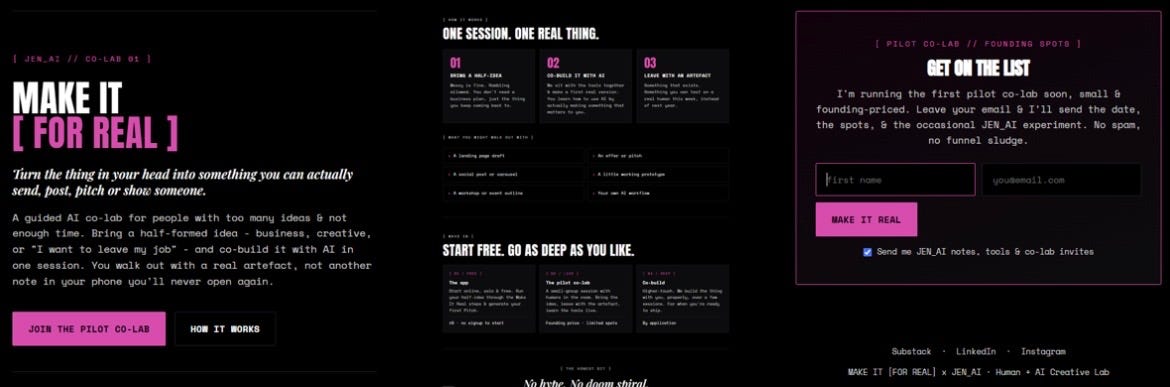
For sure, my fake JEN_AI startup hasn’t earned me a single $, it needs work, and even then it will be far be perfect. And I’m not sure it’s a good idea to fully automate personal social media content. (Or is it? You tell me, Substack.)
Full disclosure: the first draft of this newsletter was written by my AI agentcy, from a dictated rant, my notes, & all the context I set up above. It was... a start. But not good enough. I overwrote it into something better.
The robot gives leverage, speed, analysis, and a cohesive draft of your 2am mind-mess. It cannot (or rather, should not) invent your stories or your lived experience, & the jury’s still out on how well it helps you write & share them. People who use Claude can spot what it wrote. Mine only started sounding remotely like me once I’d fed it a pile of my own writing & sat down & actually told it what I was trying to say.
It’s a bit alarming to hand so much of yourself to an AI company, for sure. Only share what you’re comfortable with, & toggle off ‘train models with my data’ in Settings.
The safest way to run agents: don’t let one send, publish, post or pay on your behalf. Give it the least access it needs. Read before you ship.
What makes agents terrifying is also what makes them powerful. ‘OpenClaw’ caused a stir earlier this year: a freely available, homemade, superpowered agentic security timebomb. You could box it into a constrained space & restrict its tools, but then it couldn’t do the really useful stuff. (Claude’s slightly safer take is ‘Dispatch’. I tried it by asking it, from my phone while I was out of the house, to build me an online survey by controlling the mouse cursor on my open laptop. Terrifying. Also: a terrible example!.)
Here’s a bot-summary tl;dr of my rant below: “High agency” is a cringe phrase hiding an important concept & a real human need that nearly cost me my health. AI is breaking a system that was already part-broken, & the future of work should work for us.
Why am I even talking about this phrase? Because AI thought-leaders keep saying it on social media. (See also: “taste”. My god.) The gist: in the age of AI, you want to hire people who actually get things done, using a range of both human & AI skills, without waiting for permission. Revolutionary. (The same trend has given us CEOs & elite tech-bro bosses solemnly retitling themselves “Member of Technical Staff”.)
Any idea that boils down to “the only thing in your way is you” is mildly triggering for those of us who’ve been there, done that, got the burnout t-shirt. The system is broken, babes, & I’m done contorting myself & my family around it.
Hustle culture celebrates grinding yourself down: work 100 hours, then work more; ‘failure’ just means you didn’t work hard enough (and by the way, you should have failed faster). Being a girlboss was about juggling & leaning in so hard that - yeah, guess what? - we fell over 💀
High agency, done right, should - I think - be more about working smart to live a life worth living. (Yes, including automating the repetitive stuff.)
The most high-agency step I’ve ever taken obviously wasn’t setting up an automated daily briefing. It was leaving a very well-paid job at Google in March this year to take control of my health & my life.
From the outside I looked successful. Inside, I’d been drowning for a long time. Three kids (one with additional support needs), years of barely sleeping, doing the 24/7 parent shift on top of household management on top of the actual job, plus work calls scheduled at kidtime, aka California o’clock. I’ll spare you the full saga, but how does anyone do this? It just doesn’t work. A lot of my friends are somewhere on the same map: parental burnout, work burnout, the time they don’t have disappearing into mind-numbing social media, grinding a slightly soul-destroying job for the money & feeling too guilty to complain because they’re ‘lucky’ to have one.
I’d progressively moved to easier roles at Google to hang on in there, & felt like a glorified babysitter with a great salary. How could I complain? I was privileged, compensated, accommodated (after a fight). And going slowly out of my mind, with no corner of my life that was actually mine.
I couldn’t stop being a parent, & I didn’t want to. But something had to give. So when Google offered everyone in the UK voluntary redundancy, I left.
This is a privileged option I only had through luck, & because I spent years doing what millennials were “supposed to” first - a route that isn’t as open to as many young people now. ‘Herding cats’ at Google after the Accenture corporate-ladder grind, saying no to the fun AI-creativity PhD (& even the Art A-level) & getting a Sensible Job.
A lot of my friends are staring down their finances (& their list of health symptoms) trying to work out whether to leap. I’ve been biting my tongue, knowing how much financial security matters, while wanting to scream “this is killing you, get out, you’ll work it out!”
And you ask, “what if I fall?” Oh but my darling. What if you fly?
Agency over your actual life. That’s what I’m fighting for here.
That’s what JEN_AI was for me: first, a tiny space of my own; then, slowly, building a life & a dream that’s actually mine, & using this ridiculous tech as a creative medium, a new way to make a living, & a way to claw back the hours to go & live. And I’m trying to make it something that helps other people too. Even if that’s just to smile while laughing at me.
I’m not going to pretend AI is innocent & lovely. It isn’t. I know everyone’s sick of it. Sick of the pace, the hype, unsure about jobs & privacy & deepfakes & the climate bill for all this compute & copyright & the handful of giant companies hoovering up the power.
But. The tools do, however, exist now for a non-coding human to take the thing in their head & make something real with it. Maybe even a new kind of living. That’s what I’m experimenting for.
Yes, we’re all exhausted. (Don’t talk to me about sleep until my kids learn how to do it.) But we can meet the future like it’s happening to us, or we can meet it with agency. We can learn enough about AI to know what’s dangerous, what to push back on, what to regulate, & take the upsides while we’re at it.
It might be messy, but we can choose who, or what, drives us. Sometimes letting go is how you take the wheel.
(Here I’m just talking about stuff I did in the physical world. Yes, this is also a very lame nerd-joke about the classic AI problem of ‘embodiment’, i.e. getting ‘AI in robots’ to actually work.)
Don’t panic, I’m joking, this isn’t a 2018 LinkedIn post. Just some quick highs & lows while enjoying the freedom of getting slowly back into aerial circus gymnastics after 6 years & 3 kids:
The high & lows: (yes, its just another lame joke)

The agents chose: “Harder, Better, Faster, Stronger” - Daft Punk.
Not bad for a bot. It’s literally a song about machines doing the work, sung by two men pretending to be hyper-productive robots, built almost entirely from a chopped-up sample of someone else’s record. On the nose? Yeah. Fab. (Don’t get me started on the Kanye version. Hint: the meaning of ‘Harder, Better, Faster, Stronger’ shifts the second you add ‘baby you make me’ to the front.)
🎧 Playlist: The JEN_AI Mixtape
Shoutout also to Taylor Swift doing the new Toy Story 5 track & confusing the internet.
Consider this your reminder that sometimes “flying is just falling with style”.
If you liked this or it got you experimenting, do the high-agency thing & share it with someone else who might benefit.
The one ask: subscribe (free!) so the next experiment lands in your inbox
And if you feel like it, tell me: what’s the idea you wish you could make real?
(P.s. - I’m building towards live workshops to help you make your own idea real, plus a little tool, Make It Real Bot, to do the first steps yourself. Both still cooking. Reply if you’re curious.)
Find Jenni Munroe on LinkedIn, Instagram or Substack.
Thanks, as always, for being part of the experiment.
Jenni x
Comments
Nothing yet. Say the first thing.
Sign in to join the conversation.