
This publication runs on paid subscriptions. No ads, no institution behind it, no one telling me what history is safe to write about. If Footnotes has given you something worth having, become a paid subscriber.
In November 1867, Black men in South Carolina voted for the first time. They chose 124 delegates to write a new state constitution. Seventy-six of those delegates were Black. Forty-eight were white.
Black people made up a majority of the body tasked with drafting the state constitution. It never happened again.
The 1868 gathering in Charleston is the only constitutional convention in American history in which Black delegates held a majority.
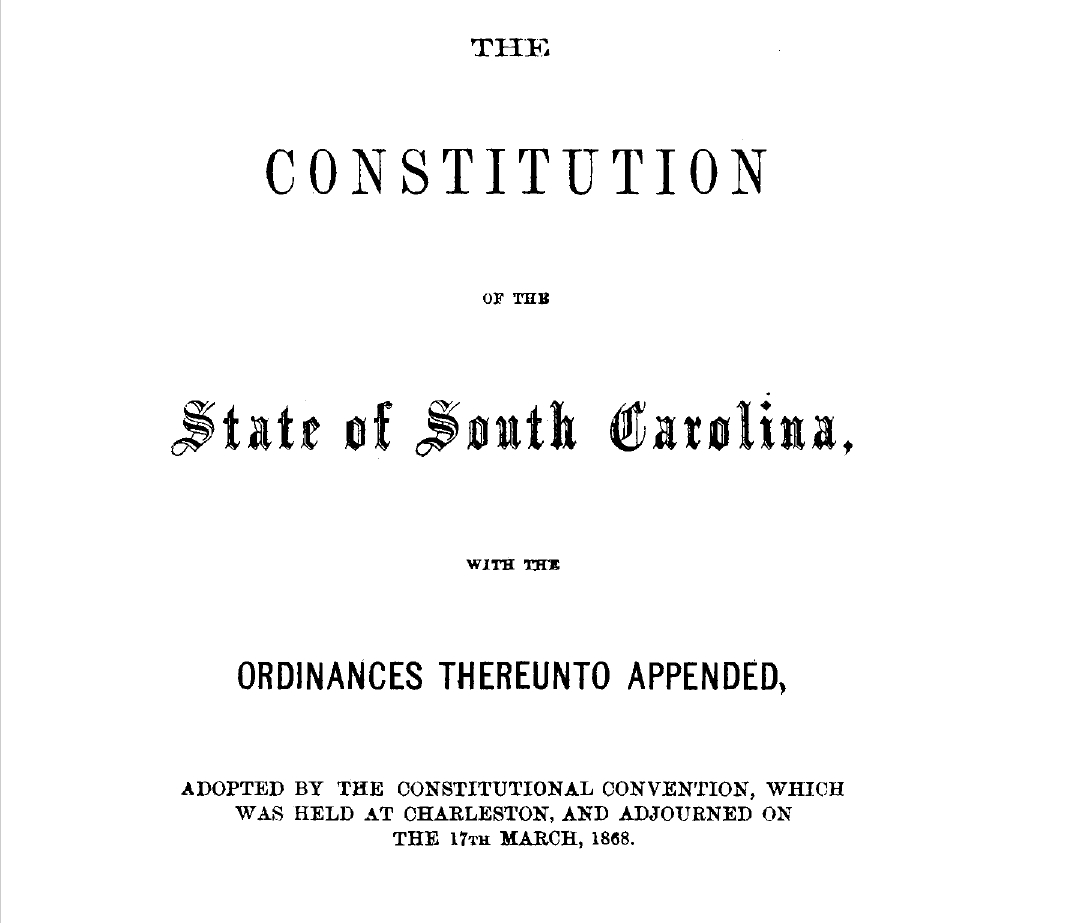
What they wrote was the most democratic constitution the state had ever seen.
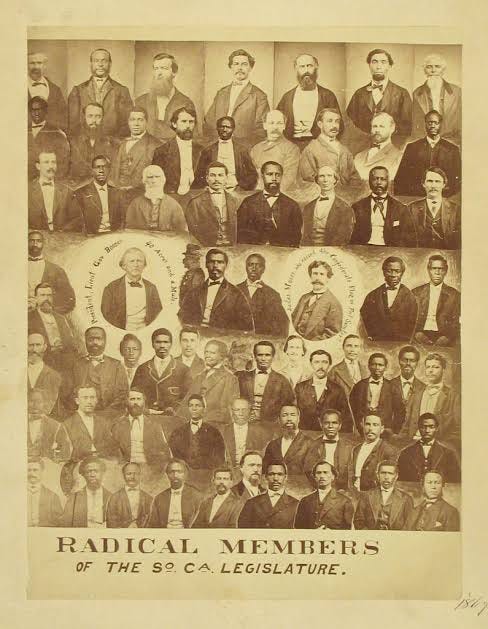
Later that same year, voters elected 88 Black lawmakers to the first legislature under the new constitution.
It was the only state legislature in American history with a Black majority.
South Carolina was the first state to secede from the Union, and it fired the first shots of the Civil War.
The Confederates lost the military conflict and, in a grand irony of history, in 1868, recently emancipated Black men became the authors of a new founding political document with an expansive vision for how the state could help its most vulnerable residents.
On March 2, 1867, Congress passed the First Reconstruction Act over President Andrew Johnson’s veto.
The law placed the South under military supervision and set the terms for its return to the Union.
Each state had to write a new constitution.
The U.S. Congress threw out the state’s 1865 constitution, a document that barred Black men from voting and left room for the Black Codes.
So the state had to write a new constitution, and that required a constitutional convention and the election of delegates.
Federal troops registered voters across South Carolina through the summer of 1867—the first time Black men in the state could register at all.
White Democrats saw what was coming and tried to stop it with a technicality.
This article is part of a series called “History Rhymes: Democracy and Voting Edition.” It traces the fight over the ballot from Reconstruction and Redemption through the Jim Crow and Civil Rights era.
Every attack on democracy we face today has a precedent, and every precedent has a record of people inspired by the spirit of justice who met it.
Each week from now through the midterms, you’ll receive a new installment that traces the history of the franchise, how it was challenged, and how people fought to keep and extend it. Subscribe so you never miss an article.
A convention needed yes votes from a majority of all registered voters, not a majority of those who showed up. A man who registered and stayed home was counted as a no.
White politicians saw the opening. They told white men to sign up and then sit it out. Every name added to the rolls raised the number of yes votes required to win. Then those same men withheld their yes votes by staying home.
The plan was to pad the rolls, then refuse to vote, and let the math do the rest.
It failed.
Black voters turned out on November 19 and 20, 1867, and carried the convention anyway.
Then came the next irony of history. The boycott had an unintended effect that ran counter to its white architects’ intentions.
Voters who skipped the election also skipped the chance to choose delegates.
White South Carolinians locked themselves out of selecting the people who would write their new constitution.
Black South Carolinians were already a majority of the state’s population, and the misstep of white legislators made Black people, for the first time, a majority of its voters.
When the delegates gathered in Charleston on January 14, 1868, seventy-six of the one hundred twenty-four were Black.
The constitutional convention met at the Charleston Club House, a building that before the war had been reserved for the city’s planter elite.
What happens when people who have been on the receiving end of unjust laws get to write new ones?
History demonstrates that oppressed people generally do not seek revenge on those who wronged them; they seek the rights that should have always belonged to them.
Here is what Black delegates wrote into the state constitution when they had a majority:
They wrote equality into the constitution.
“All men are born free and equal, endowed by their Creator with certain inalienable rights, among which are the right of enjoying and defending their lives and liberties, of acquiring, possessing and protecting property, and of seeking and obtaining their safety and happiness.” Article I, Section 1, South Carolina State Constitution, 1868
Familiar words, but this time written by Black men who included the people the Declaration of Independence had left out.
Voided every contract for the purchase of a human being
“All contracts, whether under seal or not, the consideration of which were for the purchase of slaves, are hereby declared null and void and of no effect.” Article IV, Section 34, South Carolina State Constitution, 1868
No one could go back and claim “ownership” of another human being.
Protected the right to vote
“The General Assembly shall never pass any law that will deprive any of the citizens of this State of the right of suffrage except for treason, murder, robbery, or dueling, whereof the persons shall have been duly tried and convicted.” Article VIII, Section 8, South Carolina State Constitution, 1868
No tricks, games, or deviousness. Every eligible voter has the right to vote. Period.
Ensured free public schools for every child, Black and white.
“The General Assembly shall…provide for a liberal and uniform system of free public schools throughout the State…without regard to race or color.” Article X, South Carolina State Constitution, 1868
It was the first time in South Carolina's two-hundred-year history that the state was obligated to provide schooling.
South Carolina and Louisiana were the only two states in the South whose Reconstruction constitutions explicitly banned racial segregation in schools.
Guaranteed universal male suffrage.
“Every male citizen of the United States, of the age of twenty-one years and upwards…without distinction of race, color, or former condition…shall be entitled to vote.” Article VIII, Section 2, South Carolina State Constitution, 1868
The right to vote would not be determined by property or a literacy test. And this provision was written into the state constitution two years before the Fifteenth Amendment.
Declared the state could never secede again
“This state shall ever remain a member of the American Union, and all attempts, from whatever source, or upon whatever pretext, to dissolve the said Union, shall be resisted with the whole power of the state.” Article I, Section 5, South Carolina State Constitution, 1868
This provision prevented proslavery politicians from ever breaking away from the Union again.
Property ownership abolished as a qualification for holding office
“No property qualification shall be necessary for an election to or the holding of any office, and no office shall be created, the appointment to which shall be for a longer time than good behavior.” Article I, Section 32, South Carolina State Constitution, 1868
The constitution ensured that ownership did not determine votership.
Divorce legalized and women’s property rights established
“Divorces from the bonds of matrimony shall not be allowed but by the judgment of a Court, as shall be prescribed by law.” Article XIV, Section 5
“The real and personal property of a woman…shall not be subject to levy and sale for her husband's debts; but shall be held as her separate property and may be bequeathed, devised, or alienated by her the same as if she were unmarried.” Article XIV, Section 8, South Carolina State Constitution, 1868
The language sounds restrictive except when you realize that South Carolina did not allow divorce at all prior to this constitution. And now a woman could keep her property.
Made provisions for institutions for people who are deaf or hard of hearing and blind
“Educational institutions for the benefit of all the blind, deaf and dumb, and such other benevolent institutions as the public good may require, shall be established and supported by the State, subject to such regulations as may be prescribed by law.” Article X, Section 7, South Carolina State Constitution, 1868
Even people with disabilities gained constitutional protections under the rewritten document.
The Black delegates who composed the South Carolina state constitution had every reason to write a document for themselves alone.
Instead, they wrote one for the whole state, including the people who had owned them.
It’s strange.
For centuries, white people have assumed that the alternative to white domination of Black people was Black domination of white people.
In fact, history shows us the opposite.
When Black people gained political power, they did not pursue dominance; they pursued democracy.
Right now, the regime in power is claiming that expanding access to the vote is a threat to the nation.
They do not want immigrants, Black people, or others who may threaten their power to head to the polls.
But the 1868 South Carolina constitutional convention shows what is possible when the right people write the laws.
With less than 100 days until the 2026 midterms, voters at the state level must stop thinking of themselves as people begging legislators to pass policies that will uplift all.
Lawmakers represent us. So should constitutions at the state and federal level.
It’s time to demand the lawmakers work for the people, not their own interests.
Comments
Nothing yet. Say the first thing.
Sign in to join the conversation.