
History Rhymes: Democracy and Voting Edition traces the fight over the ballot from Reconstruction and Redemption through the Jim Crow and Civil Rights era. Every attack on democracy we face today has a precedent, and every precedent has a record of people inspired by the spirit of justice who met it.
Each week from now through the midterms, you’ll receive a new installment that traces the history of the franchise, how it was challenged, and how people fought to keep and extend it. Subscribe so you never miss an article.
By now, even the keenest observers have lost track of the many ways the current president has disqualified himself.
The damage extends far beyond one individual. The politicians and administrators who carry out his anti-democratic ends are also culpable.
With each passing day, it becomes more incomprehensible how this man still holds office, how his unqualified and unethical nominations for positions keep getting approved, how the bills that do the most harm to the most vulnerable people keep getting passed into law.
Is Congress powerless? Are there not just a handful of politicians willing to honor their commitment to the people of the United States and the Constitution above party or this president?
History has the receipts.
There was a time when Congress had the will and the votes to make sweeping changes to the law and the Constitution to benefit all people—especially the millions of recently emancipated people.
In the aftermath of the Civil War, members of Congress passed the Reconstruction Amendments, often in opposition to the president of the time, and their votes changed the nation’s legal and political landscape.
The 13th, 14th, and 15th Amendments are collectively known as the Reconstruction Amendments.
Congress ratified each between 1865 and 1870.
These Constitutional amendments reshaped the contours of U.S. legal and political life so profoundly that they are the foundation of what historian Eric Foner has called the “Second Founding.”
In brief, here’s what each did:
13th Amendment - Legally abolished slavery (not the Emancipation Proclamation), included an “exception” clause that said people convicted of a crime could be forced to labor
14th Amendment - Made everyone born in the U.S. a citizen (overturning Dred Scott, which said Black people could never be citizens), guaranteed due process and equal protection under the law, and gave Congress the power to enforce it
15th Amendment - Barred denying the vote based on race (not on literacy, property, or sex, gaps the South used for the next century), and it applied only to men
The Reconstruction Amendments did not descend from the sky.
A faction of legislators wrote them, then spent years using every lever of congressional power to force them into law over the resistance of a sitting president, a hostile Supreme Court, and half the country.
They were called “Radical” as an insult, but they proudly wore the label.1
These members of Congress included Thaddeus Stevens, Charles Sumner, John Bingham, James Ashley, Lyman Trumbull, Benjamin Wade, George Boutwell, and William Stewart.
These men had their flaws. The aim is not to find politicians who are unassailable in their integrity or their views.
The point is to show how they used the levers of power to push through legislation that benefited all people and moved the nation toward a “more perfect union.”
They had a vision of multiracial democracy, and they were not embarrassed to use power to get it. That distinguishes them from many legislators today who may not even have the vision and certainly hesitate to use the legislative levers at their fingertips.
Here’s what Congress did when members had a spine.
The 39th Congress convened on December 4, 1865, just months after the conclusion of the Civil War.
More than sixty former Confederates won seats. The same people who had seceded in defense of slavery and protest of the Union were now trying to govern within it.
Just a few months later, the Georgia legislature would even attempt to send the former vice president of the Confederacy, Alexander Stephens—the same one who gave the infamous “Cornerstone” speech—to the Senate.
But these rebels could not just walk into Congress and be seated with the other members as if the Civil War hadn’t just happened.2
The members of Congress who had remained loyal to the Union refused to seat officials from the rebellious states.
The Clerk of the House left their names off the roll call. None were sworn in.
That same day, Thaddeus Stevens moved to create a Joint Committee on Reconstruction, and Congress gave that committee the power to investigate and report on whether those states were entitled to representation.
The committee concluded that, “It must not be forgotten that the people of these [Confederate] States, without justification or excuse, rose in insurrection against the United States.”
They ended up drafting the 14th Amendment and the Reconstruction Act of 1867.
Former Confederates were held accountable for their anti-democratic actions and could not immediately take office as a result.
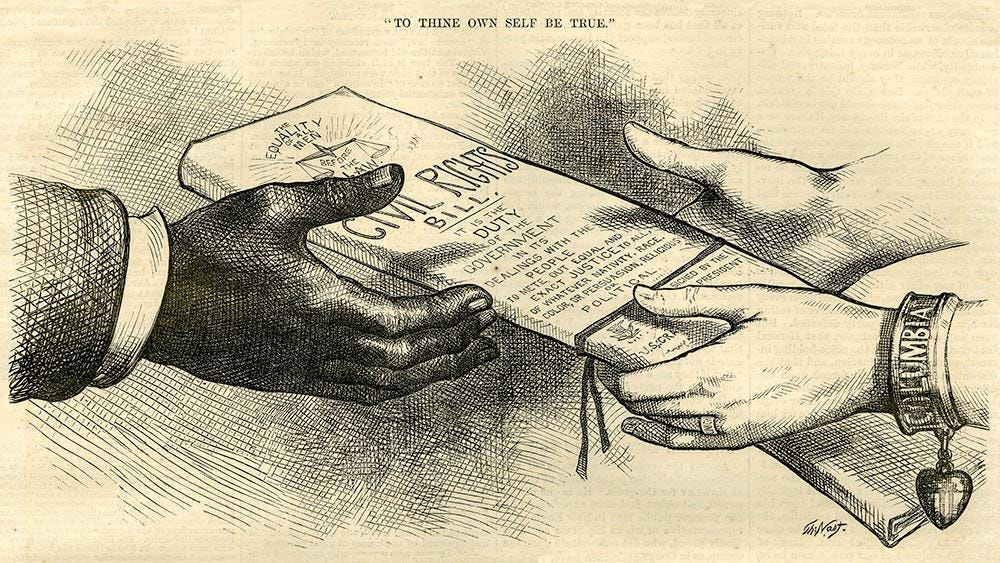
On March 27, 1866, President Andrew Johnson—who took office after Lincoln’s assassination—vetoed the Civil Rights Act, the first federal law to define American citizenship.
He called it a stride toward centralization.
But in a remarkable move, the Senate overrode him on April 6. The House followed on April 9, 122 to 41.
It became the first major law in U.S. history enacted over a presidential veto. Congress then repeated the practice of overriding the president’s veto for the rest of his term.
Johnson vetoed nearly thirty bills. Congress overrode more than half of them, which was three times the number of overrides in all prior federal history combined.
This proved that an anti-democratic president does not have the last word in what becomes law—a two-thirds majority does.
On March 2, 1867, every Southern state except Tennessee had rejected the Fourteenth Amendment.
Other members of Congress didn’t give up or roll over. Instead, they passed—again over the president’s veto—the Reconstruction Act of 1867.
This act set the conditions for readmission of members of the former Confederacy to Congress.
The conditions included:
Write a new democratic state constitution.
Let Black men vote on the proposed constitution.
Ratify the Fourteenth Amendment
If they met the requirements, then a state could have its senators and representatives seated.
The “radical” members of Congress made seats in the legislative body conditional on support of democracy.3
In July of 1866, Congress passed a law that reduced the number of seats on the Supreme Court from 10 down to seven. As seats came open, they did not fill them.4
As a result, President Johnson never appointed a single justice.
Then in March 1868, with a case pending that could have gutted military Reconstruction, Congress repealed the Court’s authority to hear it—again, over Johnson’s veto.
Finally, in 1869, under Grant, Congress set the number of Supreme Court justices at nine. It’s been there ever since.
Today, there is an increasing demand to expand the Supreme Court.
After the Civil War, members of Congress changed the size of the court to support democracy.
They showed that the number of justices is a statute, and Congress writes the statutes.
In 1868, the House impeached Johnson, 126 to 47, for obstructing Reconstruction.
The Senate trial ran two months. On May 16 and again on May 26, the vote was 35 for convicting Johnson to 19 against.
Seven Republicans broke ranks with the rest of their party.
Ultimately, the impeachment trial fell just one vote short of the two-thirds needed to remove Johnson from office.
Johnson served out his term, but he was severely hampered throughout his presidency. He kept vetoing bills, and Congress kept overriding him.
The post-Civil War Congress demonstrated a willingness to take the most drastic legislative action at their disposal—impeaching a president—to ensure democracy.
Today, talk of impeachment is almost nonexistent. Not because the power isn’t there, but because the will to use it isn’t.
Congress is not weak. It has been unwilling.
The Radical members of Congress in the 1860s proved what a legislative majority can do when it has a clear vision of democracy and no embarrassment about using power to secure it.
These tools are largely still available today. And they are neutral. They can be used to promote democracy or destroy it.
But where there are the means and opportunity to use policy measures to ensure democracy and voting rights, officials should use them.
As individual citizens, we cannot take these actions in Congress, but we elect the people who can.
Before the midterms, ask whether the people seeking your vote believe Congress has this kind of power and if they are willing to use it to protect the right to vote when they get elected.
No one gets your vote who is not willing to use the power of their elected office to defend and extend democracy.
Does Congress lack the will to use these levers of power? Do you see any members standing on the tradition of these “radicals”?
They were the “Radical Republicans” to be specific. But this is before the party realignment of the 20th century. Today’s Republicans hold exactly the opposite platform of the post-Civil War party.
Andrew Johnson had already set relatively lenient conditions for the former states of the Confederacy to re-enter the Union. The actions above are specifically about seating members of Congress.
Radical Congress members also passed the Freedmen’s Bureau in 1866—a standing federal office that served as an affirmative method to ensure Black civil and political rights.
Congress set the Court’s authorized size at seven, but the number of sitting justices only fell to eight before Grant took office.
Comments
Nothing yet. Say the first thing.
Sign in to join the conversation.