
In this penultimate reading from Joseph Conrad, Heart of Darkness, the narrator, Marlow confronts and establishes an intimate connection with Kurtz, despite his troubled state of mind.
“Believe me or not, his intelligence was perfectly clear - concentrated, it is true upon himself with horrible intensity, yet clear . . . But his soul was mad.”
Conrad, Heart of Darkness, p. 95
Marlow is not one of the admirers of Kurtz, unlike the Africans who protest his departure, or the Russian harlequin in patchwork clothes who protects his reputation. Despite his doubts, Marlow carries the ailing Kurtz to the steamboat, and despite the protests of the African tribe who Kurtz appeared to have a charismatic hold over, takes the mad soul away from the heart of darkness.
As with previous weeks, I am reading Heart of Darkness slowly in conversation with Maya Jasanoff, The Dawn Watch: Joseph Conrad in a Global World. It provides a unique historical reflection on this classic novel of colonialism and the darkness at the heart of modernity. This week I read pages 86 to 97.
If you have missed the earlier episodes of the Slow Read you can catch up here
Invitation to read Heart of Darkness with global history (Slow Read intro)
Heart of Darkness #1: This also has been one of the dark places of the earth (pp. 1-14)
Conrad, Heart of Darkness #2: “the merry dance of death and trade” (pp. 14-23)
Conrad, Heart of Darkness #3 the banality of civilisation and the humanity of savagery (pp. 23-35)
Conrad, Heart of Darkness #4: Sordid buccaneers tear treasure out of the bowels of the land (pp. 35-44, end of Part I)
Conrad, Heart of Darkness #5: the essentials of this affair lay beyond my power of meddling (pp. 44-55, start of Part II)
Conrad, Heart of Darkness #6: “The man presented himself as a voice.” (pp. 55-73)
Conrad, Heart of Darkness #7: ““an animated image of death carved out of old ivory.” (pp. 73-86)
Each episode contains a segment of my spoken narration or audiobook of Heart of Darkness, commentary on the story and text, historical footnotes informed my Jasanoff, The Dawn Watch, and reflections on the historical themes I discuss on the Burning Archive.
Paid subscribers have access to my narration of pages 86 to 97, continuing Part III of Heart of Darkness.
Join the Burning Archive as a paid subscriber for the whole journey of this Slow Read.
My curated Slow Reads bring history and literature back together. Join as a paid subscriber to enjoy it all.
This section of the novel narrates Marlow meeting Kurtz, and extracting him from his African village to the steam boat. Kurtz has speaking parts in this section of the narrative, but his character is refracted and seen obliquely through recollections and the eyes of his patched-up admirer, the Russian.
The narrative moves from the death of Conrad’s helmsman to the threatening images of the Africans who are loyal to Kurtz but angry at the other Europeans. The most striking of the Africans is a woman, mourning and protesting Kurtz’s departure. “She was savage and superb, wild-eyed and magnificent,” and she becomes a mirror to peer into the abyss of the dark African land itself, “as though it had been looking at the image of its own tenebrous and passionate soul.” (p. 87)
We suspect this woman is Kurtz’s consort, and her power presides over the village as much as his, if practised through sorcery. She exercises strange power over Kurtz, and the man of patches, the Russian, fears her. He says if she had boarded the steamer, rather than cursed the boat, he would have “tried to shoot her.” At this point, Marlow overhears an argument between Kurtz and the manager. Kurtz is frustrated that the venal manager claims to save him when, in fact, his concern is the ivory. Kurtz protests at the company’s interference and how it prevents him carrying out his ideas. “I will return,” he says, as the manager walks out of his quarrel to complain to Marlow about Kurtz’s “unsound methods” that had placed the company in a precarious position.
Despite the complaints of the office manager, the Russian “man of patches” is determined to protect Mr Kurtz’s reputation. The Russian reveals to Marlow that,
“it was Kurtz who had ordered the attack to be made on the steamer. ‘He hated sometimes the idea of being taken away - and then again . . . But I don’t understand these matters. I am a simple man. He thought it would scare you away - that you would give it up, thinking him dead.”
Conrad, Heart of Darkness, p. 90
Marlow and the Russian part, with the man of patches effusing to the end about how Kurtz recited poetry - “Poetry!” - and again, “Oh, he enlarged my mind!” But Marlow wonders of this Russian “whether I had ever really seen him - whether it was possible to meet such a phenomenon! . . .” (p. 91)
Marlow and the Europeans watch the “uneasy vigil” of the Africans, drumming, chanting, wailing and burning fires. They guard against the theft of the ivory. But the physical threat does not explain how Marlow became “completely unnerved by a sheer blank fright, pure abstract terror.” That was caused by a “moral shock” which Marlow experienced “as if something altogether monstrous, intolerable to thought and odious to the soul, had been thrust upon me unexpectedly.” It only lasted a minute before a more commonplace fear of physical danger - “the possibility of a sudden onslaught and massacre” - calmed his nerves.
Kurtz returned to shore amidst the wailing, and Marlow returned to gather him, without betraying him to the others - “loyal to the nightmare of my choice.” He finds Kurtz “irretrievably lost” beside a ceremony conducted by a sorcerer with antelope horns on his head. Marlow speaks to Kurtz to draw him back to the steamer. Kurtz speaks his regret:
““I had immense plans,” he muttered irresolutely. . . “I was on the threshold of great things,” he pleaded, in a voice of longing, with a wistfulness that made my blood run cold. “And now for this stupid scoundrel - “ “Your success in Europe is assured in any case,” I affirmed steadily.”
Conrad, Heart of Darkness, p. 94
Marlow tries to “break the spell - the heavy, mute spell of the wilderness - that seemed to draw him to its pitiless breast by awakening of forgotten and brutal instincts, by the memory of gratified and monstrous passions.” This spell of the wilderness “beguiled his unlawful soul beyond the bounds of permitted aspirations” and caused his “exalted and incredible degradation” (p. 95). Marlow recalled the words but confessed to his fellow sailors that he could not recreate the mad spirits that animated those words. They were “phrases spoken in nightmares.” This was the dark soul he wrestled with, but he was not a madman.
“Believe me or not, his intelligence was perfectly clear - concentrated, it is true upon himself with horrible intensity, yet clear . . . But his soul was mad. Being alone in the wilderness, it had looked within itself, and, by heavens! I tell you, it had gone mad.”
Conrad, Heart of Darkness, p. 95
This was the moral shock that stripped Marlow of his belief in mankind. “I saw the inconceivable mystery of a soul,” he recalled, “that knew no restraint, no faith, and no fear, yet struggling blindly with itself.” Kurtz had succumbed to nihilism.
Marlow carries Kurtz from the village to the steamer and leaves by boat at noon. The fleeing boat is presented, through the Africans’ eyes as a threshing river demon. Their reaction is recorded but not understood by Marlow or the other Europeans because it is chanted in words “that resembled no human language.” But rather a “satanic litany.”
Marlow finds the threats, sorcery or emotions of grief and anger incomprehensible. He asks Kurtz, “Do you understand this?” But Kurtz’s response is more disturbing than the African displays.
He kept on looking out past me with fiery, longing eyes, with a mingled expression of wistfulness and hate. He made no answer, but I saw a smile, a smile of indefinable meaning, appear on his colourless lips that a moment after twitched convulsively. “Do I not?” he said slowly, gasping, as if the words had been torn out of him by a supernatural power.
Conrad, Heart of Darkness, p. 97
This moment establishes an intimate connection between Marlow and Kurtz until and beyond death. But the moment is quickly spoiled by the banality of imperial violence. The fleeing steam boat blows its whistle. The “barbarous and superb” African woman, who we assume was Kurtz’s consort, stands, bravely as the Europeans start to shoot.
And then that imbecile crowd down on the deck started their little fun, and I could see nothing more for smoke.”
Conrad, Heart of Darkness, p. 97
Why does Conrad cast Kurtz’s credulous admirer as a Russian? Not say, a Britisher?
Conrad carried the resentment of frustrated Polish nationalism towards the Russian Empire, and transferred his loyalties to his adopted empire of Britain, which he associated with values of honour, craft and integrity, like Towson’s book of sailing craft that the Russian thrusts into his pocket on departure.
Conrad’s antipathy to Russia and ambiguity to his homeland of Poland would strengthen in the years after Heart of Darkness with the onset of World War One, and the threat of Bolshevism. By his old age, Conrad had become a dyed-in-the-wool Russophobe.
Jasanoff recalls how Conrad’s conservatism, or perhaps more precisely retreat to a moral world in fear of a globalising world, grew. She contrasts this early traverser of the globalised world with others who dreamt of revolution and social reform: Ho Chi Minh, Mohandas Gandhi, Sun Yat-Sen, and Roger Casement. Casement was the most interesting because he had been to the Belgian Congo too, seen the heart of darkness, and asked Conrad to make a stand. Conrad chose to hide, reflecting a world-weariness that came with the comforts of empire.
“Conrad’s experience of the world had made him skeptical that you could change systems, or redirect fate. He kept his focus on the individuals bound up in the systems and pegged his hopes for good outcomes on a sense of human solidarity that encouraged individuals to be just and true. He traipsed into the 1910s with the weariness of late middle age.
Jasanoff, The Dawn Watch, p. 286
The book he wrote to express that weariness was Under Western Eyes, which portrays both Tsarist autocracy and Russian revolutionaries as oppressive machineries of fear and delusion. The dogmatic extremism of the Russian characters is contrasted to the liberal common sense of British liberal empire. The Russian man of patches in the Congo was a foretaste of this propaganda meme.
Under Western Eyes was written in the wake of the 1905 Russian Revolution and published in 1910. A few years later Conrad’s antipathy to Russia and middle-age weariness would deepen in response to World War One.
During the week I published a video on lessons of World War One, and commented how social historians are revising an old view that there was universal war fever in Europe at the outbreak of World War One. Conrad exemplifies this more nuanced sentiment. He shrugged his shoulders at the assassination at Sarajevo as no different to all the other assassinations, including Sergei Witte, over the years. He carried on his summer holiday travels while the July Crisis unfolded, ultimately being trapped in Poland at a summer resort together with “refugees of various nationalities.”
However, Conrad felt Poland was trapped between “Germany’s superficial, grinding civilization.” and “Russian barbarism.” There is the antipathy again. By 1917, the Russian Revolution had scared Conrad with its Bolshevism, and by the peace talks of 1918 and 1919, Conrad was trapped as a European between an ascendant USA and a Bolshevik Russia. He feared that these rising powers meant Europe would take a back seat. He wrote to the novelist Hugh Walpole,
The great sacrifice is consummated, and what will come of it to the nations of the earth the future will show. I can not confess to an easy mind. Great and very blind forces are set free catastrophically all over the world.”
Conrad, Correspondence, 1918, quoted Jasanoff, The Dawn Watch, p. 300
Despite his antipathy to Russia, Conrad welcomed neither the USA nor the Versailles Treaty’s establishment of an independent Poland. “American influence in European affairs cannot possibly be good on account of those people’s crudeness and ignorance backed by great material strength and an awakened sense of their power.”
Conrad was sentimentally loyal to the British empire, almost as a prototypical case of today’s transnational émigré elites, who serve whichever empire faction is winning. He looked down on US American materialism but loathed Russian Bolshevism and class politics in the West more intensely.
Class for me is by definition a hateful thing. The only class really worth consideration is the class of honest and able men to whatever sphere of human activity they may belong.
Conrad, Correspondence 1922, quoted Jasanoff, The Dawn Watch, p. 302
Conrad retreated into the hard shell of his fatality, with an obsessive liberty from system or belief that Jasanoff anchors in the ethics of the szlachta, the Polish nobility from which he descended. That ethics destroyed Poland at least once, in the Partition, as discussed in my Slow Read of The Books of Jacob, and they now turned Conrad’s darkening heart against the man who had seen as deeply into the heart of darkness in the Belgian Congo: Roger Casement.
Casement supported the Irish republican revolt against the British Empire, including seeking arms from Germany in preparation for the Easter Rising of 1916. The British Empire sentenced Casement to death and executed him. Friends pleaded with Conrad to sign a petition for clemency. But Conrad believed that Irish republicanism was a “stab in the back” of the British Empire. He believed that Britain was the good empire that could do no wrong. He looked back on his time in the Belgian Congo, forgetting his earlier refusal to put his name to Casement’s petition against those abuses, and his neglect of Casement’s exposés of abuses in Latin America.
“Already in Africa I judged that he was a man, properly speaking, of no mind at all. . . . I don’t mean stupid. I mean that he was all emotion. By emotional force (Congo report Putumayo—etc) he made his way, and sheer emotionalism has undone him.”
Conrad, Correspondence, 1916, quoted Jasanoff, The Dawn Watch, p. 302
Jasanoff is too kind to Conrad and the British in the case of Roger Casement. Readers may wish instead to consult chapter five of another masterpiece, W. G. Sebald, The Rings of Saturn which tells the story in mesmerising prose of Conrad and Casement’s twinned fate. He was not only executed. He was convicted of high treason and his memory extirpated.
“Not until 1965 did the British government permit the exhumation of the remains of Roger Casement, presumably scarcely identifiable any more, from the lime pit in the courtyard of Pentonville prison into which his body had been thrown.”
Sebald, The Rings of Saturn, p. 134
Conrad did not lift a finger to help him. He just bad mouthed him in letters.
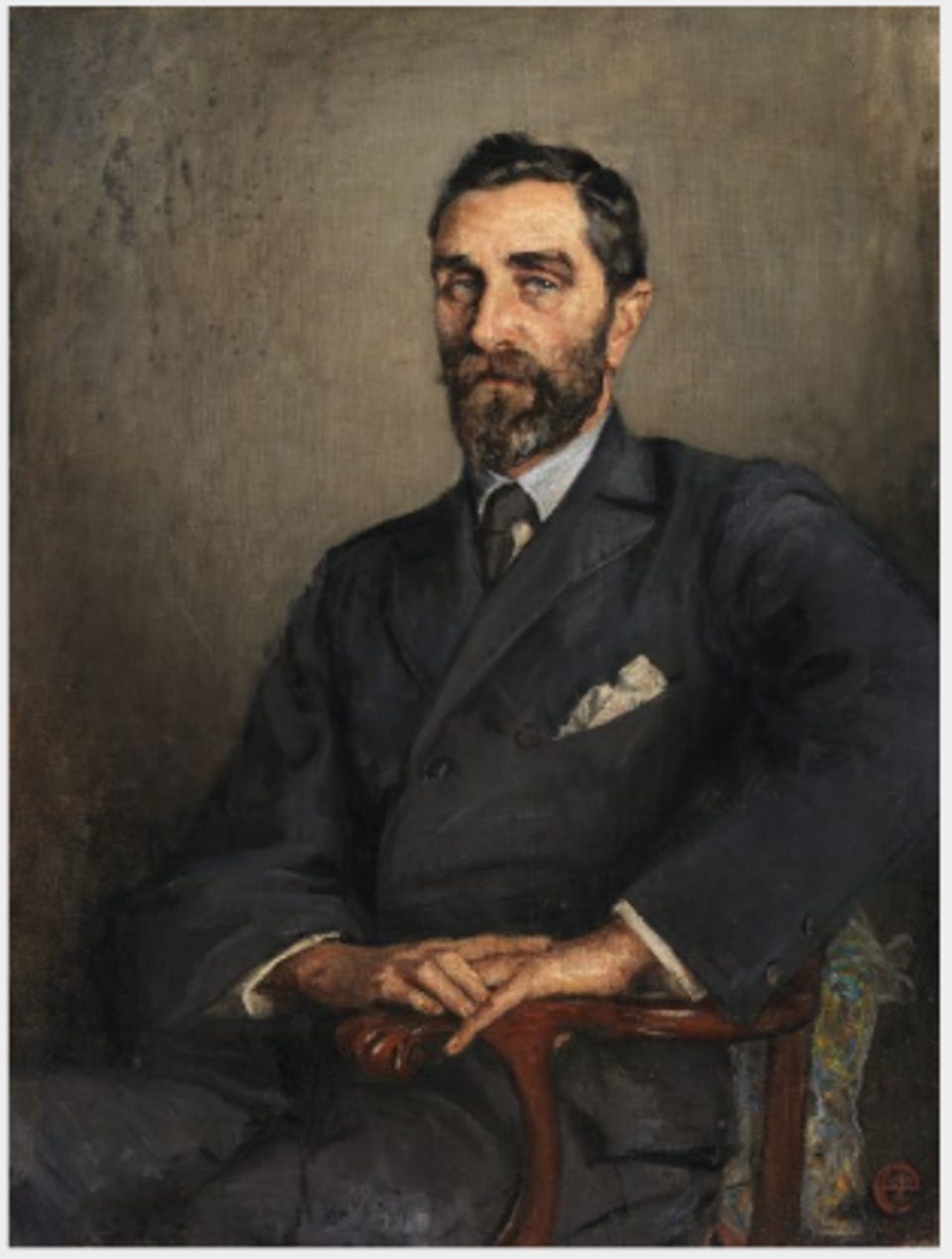
There was a heart of darkness in Conrad and the British Empire too. Even if Conrad obscured his vision of that heart with his sentimental attachment to Russia’s enemy and the British navy.
Conrad was an empire loyalist and a critic of empire. Perhaps that is why minor nationalities and the Russians are rolled out to depict the worst of empire in Heart of Darkness.
In this respect, Conrad resembles today’s liberal, progressive advocates of the One West’s (in Pascal Lottaz’s term) or the USA’s good empire of values. That is, the empire that Jasanoff evoked when she described Conrad as “one of us.” “Like me,” Jasanoff wrote, “he was privileged to belong to the middle class of the leading world power of the age.”
But do you share that privilege with Jasanoff and Conrad? Which “one of us” was Conrad really? Those are the questions to which I will return next week in my final reflection on Heart of Darkness and the history of the globalising world.
Thanks for reading, and listening
Jeff
Comments
Nothing yet. Say the first thing.
Sign in to join the conversation.