
Finally, on page 85 of 111, this week we finally stand face to face with Kurtz.
“It was as though an animated image of death carved out of old ivory had been shaking its hand with menace at a motionless crowd of men made of dark and glittering bronze. ”
Conrad, Heart of Darkness, p. 85
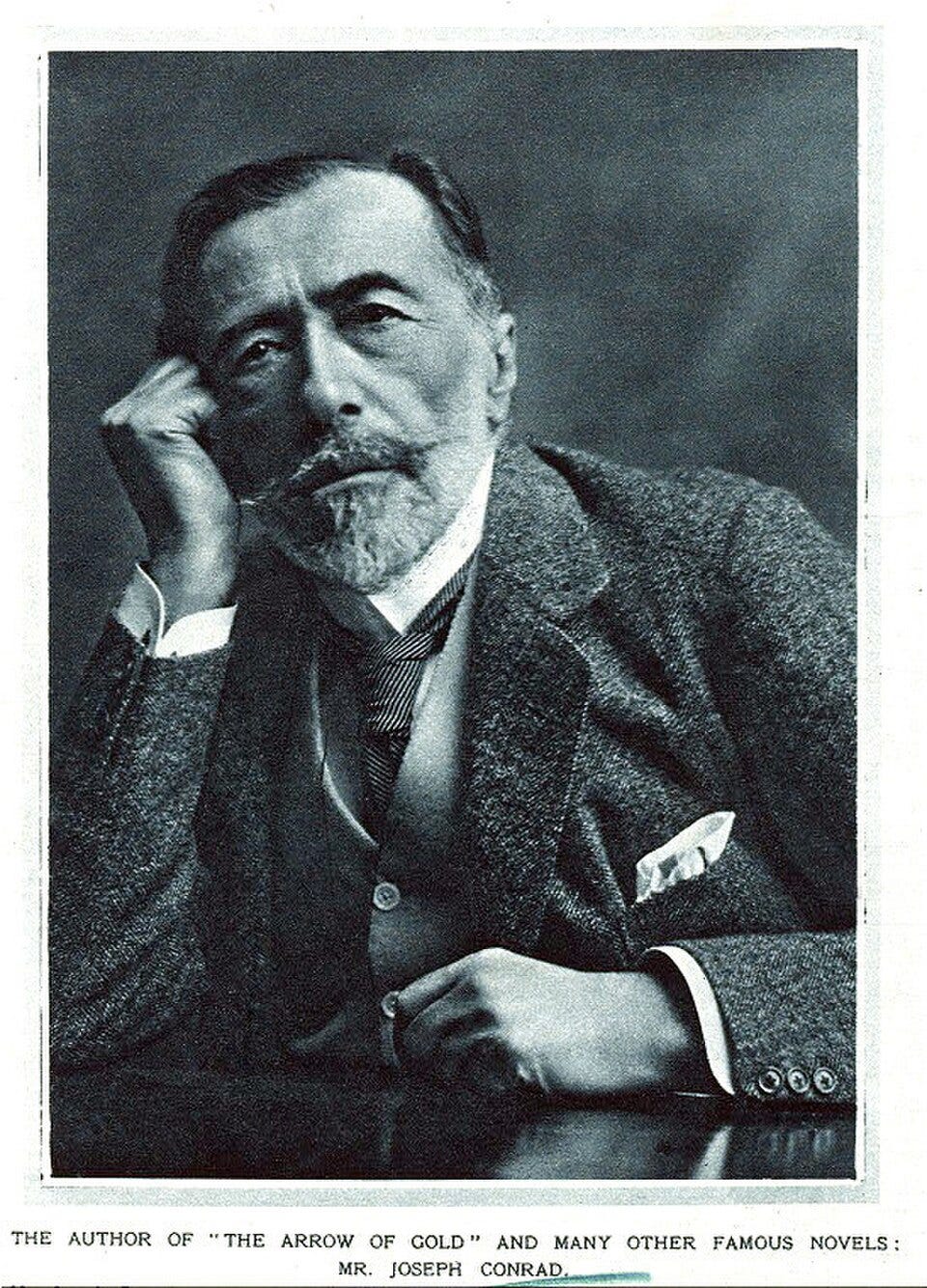
As with previous weeks, I am reading Heart of Darkness slowly in conversation with Maya Jasanoff, The Dawn Watch: Joseph Conrad in a Global World. It provides a unique historical reflection on this classic novel of colonialism, empire and the darkness at the heart of modernity. This week I read pages 73 to 86.
If you have missed the earlier episodes of the Slow Read you can catch up here
Invitation to read Heart of Darkness with global history (Slow Read intro)
Heart of Darkness #1: This also has been one of the dark places of the earth (pp. 1-14)
Conrad, Heart of Darkness #2: “the merry dance of death and trade” (pp. 14-23)
Conrad, Heart of Darkness #3 the banality of civilisation and the humanity of savagery (pp. 23-35)
Conrad, Heart of Darkness #4: Sordid buccaneers tear treasure out of the bowels of the land (pp. 35-44, end of Part I)
Conrad, Heart of Darkness #5: the essentials of this affair lay beyond my power of meddling (pp. 44-55, start of Part II)
Conrad, Heart of Darkness #6: “The man presented himself as a voice.” [Insert Link] (pp. 55-73)
Each episode contains a segment of my spoken narration or audiobook of Heart of Darkness, commentary on the story and text, historical footnotes informed my Jasanoff, The Dawn Watch, and reflections on the historical themes I discuss on the Burning Archive.
Join the Burning Archive as a paid subscriber for the whole journey of this Slow Read.
In previous weeks I have paywalled content below this line. This week, using new features available through Substack, I am making accessible to all readers the full post, except the audiobook narration of Heart of Darkness that is visible to paid subscribers.
This section of the novel narrates the culmination of Marlow’s slow approach to Kurtz, and the heart of darkness. First, Marlow heartlessly disposes of the corpse of his African helmsman, speared in the attack on the steamboat. Then, near Kurtz’s outpost, Marlow meets a Russian, who worked on English ships, in patched clothes, dressed like a harlequin, who is a passionate admirer of Kurtz. Then finally, on page 85 of the 111 page novella, Marlow meets Kurtz himself carried like a ghastly apparition on a stretcher by his African admirers, or subjects.
At the end of last week’s passage, Marlow expressed his “distant kinship” for his African helmsman. But the exigencies of colonial small wars left Marlow little time for mercy or ceremonial burial. “He had been a very second-rate helmsman while alive,” Marlow recalled, “but now he was dead he might have become a first-class temptation, and possibly cause some startling trouble.” (p. 74) He throws the corpse into the river, and moves on to find Kurtz.
After passing through the trouble, he meets an admirer of Kurtz who “had gone to sea in a Russian ship; ran away again; served some time in English ships.” The Russian sounds like an alter ego of Konrad Korzeniowski himself. He is dressed like a harlequin in coloured patched clothing, but is curious about Marlow’s English service and obsessed with Kurtz. The Russian, who is never named, explains that Kurtz does not dominate his African tribesmen without consent because they want him to stay because of his charisma and eloquence.
“I tell you,” he cried, “this man has enlarged my mind.”
Conrad, Heart of Darkness, p. 78
The Russian harlequin’s admiration of Kurtz, indeed the “eager fatalism” of his devotion to Kurtz, gives us an insight to the mysterious figure’s charismatic power. He recalls how he stayed up all night listening to Kurtz’s words on “Everything! Everything! . . . Of love, too.” “It isn’t what you think,” he cried, almost passionately. “It was in general. He made me see things.”
At this point of the narrative, despite the Russian’s rapturous praise, Marlow falls to the lowest point of the heart of darkness.
“I looked around, and I don’t know why, but I assure you that never, never before, did this land, this river, this jungle, the very arch of this blazing sky, appear to me so hopeless and so dark, so impenetrable to human thought, so pitiless to human weakness.”
Conrad, Heart of Darkness, pp. 79-80
Marlow contrasts the idealisation of Kurtz by the Russian to the plain facts of his violence and domination. ‘“To speak plainly, he raided the country,” I said.’ (p. 80) Then Marlow looks through his telescope at the hut from which Kurtz ruled his ivory-raiding domain. Through the scope, he slowly comes to realise the ornamentation atop poles surrounding the hut are shrunken human heads. More disturbing still, the faces of these heads do not point outward from the hut, as a warning to outsiders. All but one of the heads are pointed towards the hut, as if forced in death to submit obediently to Kurtz.
His expression of sovereignty by placing the shrunken heads around his colonial demesne was not driven by material objectives. Kurtz’s methods “had ruined the district,” and “there was nothing exactly profitable in these heads being there.” It came from a strange deficiency.
“But the wilderness had found him out early, and had taken on him a terrible vengeance for the fantastic invasion. I think it had whispered to him things about himself which he did not know, things of which he had no conception till he took counsel with this great solitude - and the whisper had proved irresistibly fascinating. It echoed loudly within him because he was hollow at the core.”
Conrad, Heart of Darkness, p. 83
But it turns out the deficiency may have been more a drive for domination. The heads were those of rebels. What drove Kurtz is unclear. Ideals? A deficiency within? Or the colonial structures of domination and power?
Finally, Kurtz appears before Marlow. The passage I read this week closes with Kurtz—whose name we are told means ‘short’ in German—rising like an ominous apparition from the stretcher. He appears near death and as a harbinger of death itself.
“I could see the cage of his ribs all astir, the bones of his arms waving. It was as though an animated image of death carved out of old ivory had been shaking its hand with menaces at a motionless crowd of men made of dark and glittering bronze. I saw him open his mouth wide - it gave him a weirdly voracious aspect, as though he had wanted to swallow all the air, all the earth, all the men before him.
Conrad, Heart of Darkness, pp. 85-86
Meeting Kurtz for the first time is an extraordinary moment in this narrative. He is, on one side, voice, wraith, and inspirer of cult-like admiration by both Africans and Europeans. Yet, on the other hand, he is also greedy, ruthless, and deranged in his exercise of power, violence and raiding. My footnotes will not seek to rival the intensity of this passage, but share some passages from Maya Jasanoff on migration and informal empire.
The late nineteenth century was a period of exceptionally high migration around the world. Unlike today, amidst concerns about Moroccans swimming to Spain that have excited the worst instincts of so many Euro-American nationalists, many of those migrants were Europeans going to other parts of the world, such as Australia, the Americas, Siberia, the treaty ports of China, or Africa. Many also were the indentured ‘coolie’ workers of South Asia or the Pacific who replaced the labour supply of the Transatlantic Slave Trade, banned by the freedom-loving British Empire.
As we saw in the Belgian Congo, slavery is not the only form of coerced labour. Not all of that migration was settlement, and it often came with violent displacement of others. But, in other cases, it led people to imagine new social arrangements for how people from different nations, races or civilizations could live amongst each other.
Migration and intermingling inspired W. E. Du Bois to hope in 1910 that “all mankind is becoming one people.” With tolerance and reason, bigotry and prejudice could be replaced by human brotherhood, and avoid the errors of “the awful history of the contact of nations and groups in the past.” It inspired many darker visions, including the fears of an Australian intellectual, Charles Pearson that the ‘coloured peoples’ of what we would call the Global South would one day call time on the white man’s domination, as I described in this video.
This was a facet of the globalised and colonised world that Conrad experienced. Migration or people on the move will also be the theme of my Long Read this month in the Decolonisation series. As Jasanoff wrote:
“More than thirty years since Joseph Conrad walked out of Liverpool Street Station, the paths he’d traced in the late nineteenth century as an immigrant and sailor had broadened into avenues. Tens of millions of migrants boarded cheap steamers and trains to richer possibilities in North and South America, north and Southeast Asia.”
Jasanoff, The Dawn Watch, p. 284
It was a world that mixed migrants from many nations and empires. They did not live their lives within the borders of neatly coloured maps of imperial territories. They were caught up in the vast tangled web of material interests and dark imperial visions, spun out by capital markets, industrial methods, empires and their small wars. It was that web of material interests that saw, in this week’s passage a Russian who had worked on British ships employed by a Dutch company in the Belgian Congo.
That web of material interests also created a new form of empire distinct from loyalties to blood, soil and dynasty. That form of “informal empire” was dominated by the new commercial networks controlled by Britain and the USA, but spanning beyond their imperial territories to nominally independent states, especially the many republics of Latin America.
Conrad was uncomfortable with this kind of change in the world. He saw this kind of empire of ‘material interests’ as “a magnificent and unconscious wild beast.” Jasanoff writes that his greatest novel coming to terms with that form of empire was not Heart of Darkness, but the novel Nostromo, which is set in an invented Central or South American republic of Costaguana.
“The secret to Nostromo’s extraordinary prescience was that Conrad folded between its covers his own “theory of the worlds’ future.” In the world to come, the better values that Conrad associated with British power would become as obsolete as the romantic dreams of Garibaldi. Instead he anticipated the ascent of an American-led consortium of “material interests.” “Material interests” would dictate the fortunes of new nations. They would make imperialism continue to thrive whether or not it has the word “empire” attached to it.”
Jasanoff, The Dawn Watch, p. 285
As yet I have not fully read Nostromo, but this novel about the new British and American empires that dared not say their names, was published in 1904. In April 1904, Halford Mackinder published The Geographical Pivot of History (you can listen to my audio reading of the full text of this over-venerated manifesto here). Mackinder’s claim to know the fundamental laws of geography and history gave birth to the pseudoscience of geopolitics. His Heartland theory of world domination has ruled the intellectual horizon of Anglo-American or Western elites ever since.
Mackinder’s vision was one of many contending imperial stories at the turn of the century about a shrinking world. He was concerned that the “European phase of history is passing away . . . and a new balance of power is being evolved.” The mood of the time was dominated by fears of doom and decline of European empires.
Mackinder’s vision already appeared to be coming true. Concerned about fending off rising Germany, Britain scaled back its commitments in the Western Hemisphere in favour of American interests. In the Far East, Japan trounced Russia in a war in the Pacific, and the tsar had to cede power to a newly formed parliament. (Conrad crowed over the corpse of his childhood bogeyman, “part ghoul, part Djinn, part Old Man of the Sea, with beak and claws and a double head.”
Jasanoff, The Dawn Watch, p 283
There are many authors who may be placed on the Index of Russophobic Books, and Conrad was certainly one of them! But more to the point Jasanoff also refers to the general mood of the time that Old Europe was being overwhelmed by the new commercial empires of Britain and the USA. Conrad himself believed, without Mackinder’s liberal technocratic fantasies, that the end of Europe was near.
To casual readers Nostromo offered another illustration of the changing balance of power. But Conrad pulled back the curtain of geopolitics to reveal a deeper logic at work. “Il n’y a plus d’Europe,” he growled—something he’d already muttered when Casement told him about the Congo abuses. There’s no more Europe. “There is only an armed and trading continent, the home of slowly maturing economical contests for life and death, and of loudly proclaimed world-wide ambitions.” More fool all those free traders who hoped that people who did business together would live together in peace. “Industrialism and commercialism . . . stand ready almost eager, to appeal to the sword.” Henceforth, he predicted, “no war will be waged for an idea.” Money will be everything.
Jasanoff, The Dawn Watch, p. 283
Nostromo was a condemnation of the new web of empire in service of “material interests” being constructed by US American and British agents. It was a prescient observation of the shapeshifting of empires, which never maintain the fixed form of imperialism.
Remarkably, within a few years of the turn of the century, a set of texts were published that still define the Western political imaginary of imperialism: Conrad, Heart of Darkness and Nostromo, Mackinder, The Geographical Pivot of History, and John A. Hobson, Imperialism: A Study (1902).
Hobson’s study argued that imperialism arose from capitalist oligarchy and the search for greater profits outside national markets in foreign countries. Fourteen years after this profoundly influential work was published, an exiled Russian revolutionary published the pamphlet on imperialism that I feel still lies like a dead weight on our historical imagination of empire.
Here too there is a surprising link with Conrad.
Conrad was far from alone in his critique of “material interests.” Nostromo sat squarely alongside the idea of imperialism launched by Hobson. In fact, though Conrad would have shivered at the comparison, it illustrated imperialism as defined by Hobson’s follower V. I. Lenin in his pamphlet Imperialism: The Highest Stage of Capitalism, namely “the exploitation of an increasing number of small or weak nations by a handful of the richest of most powerful nations.”
Jasanoff, The Dawn Watch, p. 282
My final reflection for this week is that 120 years after the publication of those defining texts of imperialism, is it not time for us to look elsewhere for our political imagination of empire? Has not the shapeshifting beast of empire changed form many times since the days of Conrad, Hobson, Mackinder and Lenin? If we are still hunting for the spirit of imperialism, as seen in 1902 or 1916 or even 1991, we will fail to grasp the horrors of the remade empires of today.
Thanks for reading, and listening
Jeff
Comments
Nothing yet. Say the first thing.
Sign in to join the conversation.