
Okay, it’s time to talk about John Cage.
I have a satsang - a circle of teachers, a cohort of wise beings I’ve encountered in my life, which I draw inspiration from. Cage is most certainly among them, and might be the oldest of all.
He was probably my first real “Hero.” I never met him, but I have engaged – listened, studied, contemplated. It was his work that, working on a teenage mind, started to plant seeds — devastating questions like “what is music?” “Who is the composer?” That of course led straight into the house of Zen.
Cage’s devotion to removing the composer from the composition struck me deeply, and much of my current work bears his influence. For me, he unshackled the soul of music from the mechanics of music, and gave me a taste of what it could really be.
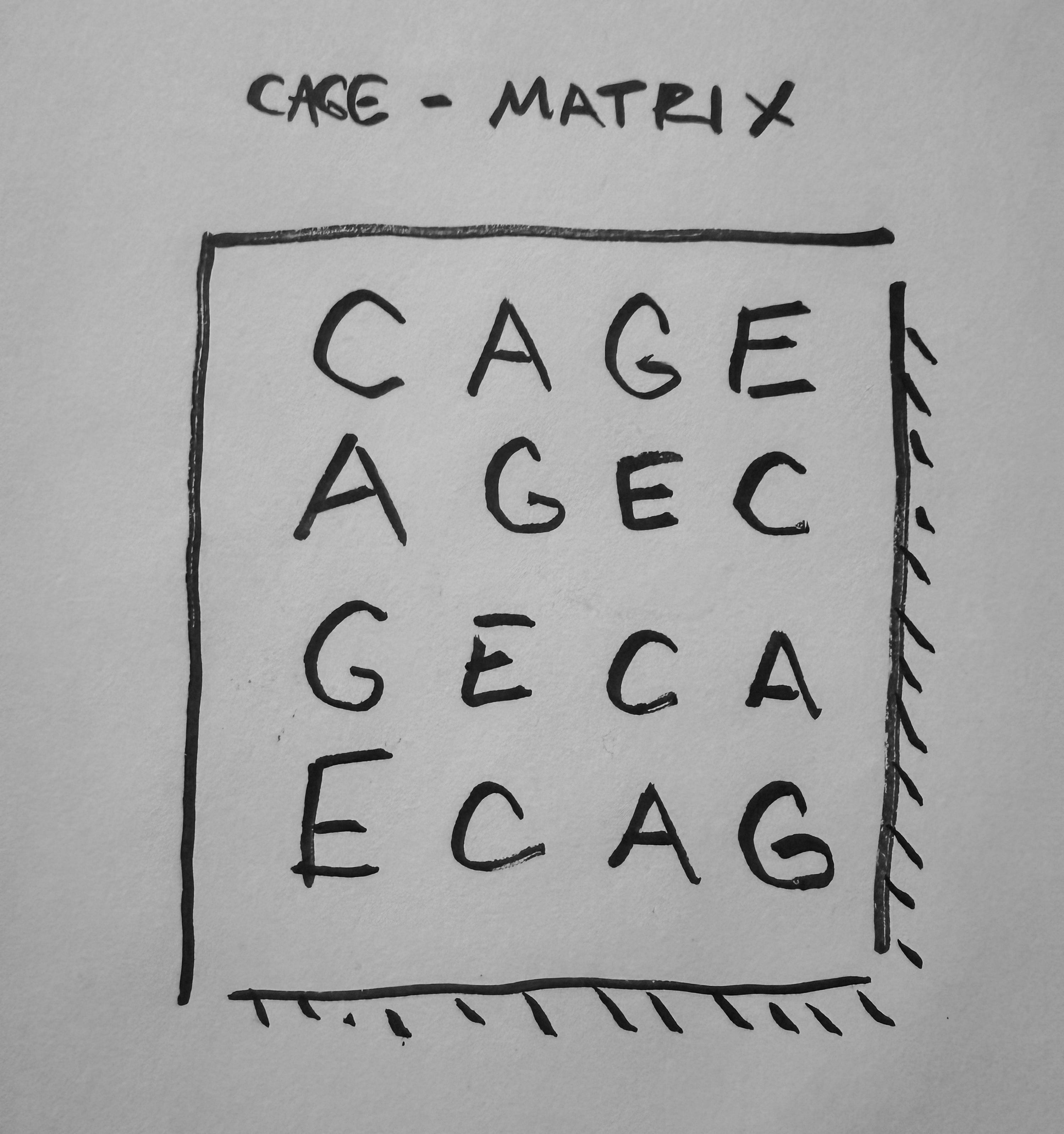
One of Cage’s quotes, though, struck me hard:
Text within this block will maintain its original spacing when published
I have nothing to say, I am saying it, and that is poetry.
– John Cage
It struck me as a rare false note from the Maestro. Looking at it again, written so bare, it still makes my brow crinkle like it did the first time I heard it as a teenager. “If you don’t have anything to say, just don’t say anything, and enjoy the silence! That’s better poetry!” Teenage me galumphs.
This saying never let me go – I seem to accumulate koans. Why did it buzz in me? Even as I struggled with it, I made it the byline of my early 2000s blog. And as I aged, I continued to sit with this question, which had become “how do you really know when you have something worth saying?” Cage’s answer dissatisfied me, but what was my authentic answer to that question?
Like all koans, there’s the answer your lips say and the answer your life gives. While I cogitated endlessly, the answer my life gave was unequivocally “it’s never the right time to say anything.” So I kept quiet, and, well, this led to complications.
This is the part of the koan where the disciple struggles and fails comically. Let’s say, that after much engagement, my view on Cage’s statement has ripened.
I’d say it differently, perhaps, but the truth is that we have to say something, because we’re always speaking. And to be able to speak when you’ve really got nothing to say, is indeed poetry.
There is another answer to this koan – what, for us, is worth speaking of arises from our perspective. By our actions we give life to our positionality. We have something to say – we are saying it! And that is poetry.
I imagine a landscape, and a point of view being a particular location on that landscape. Up a mountain, in a bog, at this desk, writing this article on a rainy morning. Anyone who makes the trek out to the mountain can see the view – this isn’t about ego, it’s topology. Anyone who climbs the peak can see. Anyone with eyes to see can see.
Cognitive positionality is trickier though – I can come to where you are, but not to how you are. The journey is the way we’ve lived our lives, the choices we’ve made, the experiences we’ve had, shape us differently. Each seed unfolds into a perfect yet unique version of a tree. So unlike the natural world, where you can scale the summit and replicate another’s view, you have to grow into it instead.
I recall, at an arts retreat at Zen Mountain Monastery, someone asked Daido Roshi, “How do you take pictures like a Zen Master?” His reply – “Become a Zen Master, then take pictures.”
How does one grow oneself into a new view, to get people to see what they currently can’t see? That’s the heart of Education. The Latin captures this lovely – it’s a “leading out.” So you get led out, and that changes your perspective, and you can see something you could not before. The journey is the growth.
What you do, and the way you do it, changes who you are, changes your position, and your view.
I have grown myself into a place to appreciate Cage’s koan. From here, well, things look a lot different than I expected. It’s beautiful, and it invites me to add my music to the mix. Less focused on the artifact of poetry than the act of poetry, the “poesis.” Verbs before nouns.
I’ve done some weird and wonderful growing of my own, and it’s brought me some wonderful insights. I’ve studied broadly and deeply and intently, and gone very deep into some very complex and magic things. I am a complete naif in other things, a walking fool. A divine hot mess of a human being. And so are we all, in our way. We all have our unique views.
I’ve made a game of changing up positionalities – taking different viewpoints, moving from first, to second, to finally an n-th person perspective. A composer imagines and assumes the position of every member of the orchestra, hearing the whole through each part. Any system can be approached this way. Every view offers something new – composed together, more possibilities still. Every position offers a different truth.
And what is that truth, invariant under transformation, that all positions share? Another koan.
This place that Cage led me to, a positionality that subverts positionality, is a neat place, and my desire is to talk, less about this place which is not particularly interesting, but from this place.
This is a lesson John Cage taught me. There’s always music. Do we have the ears to hear, and the heart to sing along?
No posts
Comments
Nothing yet. Say the first thing.
Sign in to join the conversation.