
“Inactivity, sloth, laziness, negligence, are vices which shun labor, since labor, though useful, is itself a punishment” ~ Augustine, The City of God
“…what distinguishes the worst architect from the best of bees is this, that the architect raises his structure in imagination before he erects it in reality” ~ Karl Marx, Capital, Volume I
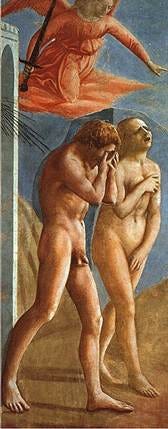
The taken-for-granted understanding of Adam and Eve’s fall in the Garden of Eden, as understood by Christians, today, was once hotly disputed. In Adam, Eve, and the Serpent (1988), the religious historian, Elaine Pagels explains what most Jewish and Christian thinkers before Augustine of Hippo understood the Book of Genesis’ Adam and Eve story “as a story of human freedom.” In Augustine’s hands, it became “a story of human bondage.” Pagels writes,
“Most Jews and Christians had agreed that God gave humankind in creation the gift of moral freedom, and that Adam’s misuse of it brought death upon his progeny. But Augustine went further: Adam’s sin not only caused our mortality but cost us our moral freedom, irreversibly corrupted our experience of sexuality (which Augustine tended to identify with original sin), and made us incapable of genuine political freedom.”1
As Bishop of Hippo, in Northern Africa, Augustine argued that human beings not only inherited death from their forebears’ sin but also an inescapable compulsion to sin. Against the insistence of Julian, Bishop of Eclanum in Southern Italy and a leader of the Pelagians, that procreation was part of God’s inherently good design,2 Augustine insisted sexuality itself as well as mortality was the result of Adam and Eve’s fall. On this view, all forms of sexual desire are unnatural consequences of sin. The very origin of human life—from the sexual act to the mother’s womb—ensures that sin is genetic to all humanity.3 Thus even infants are carriers of sin.
The only way to be saved from this sinful trajectory, Augustine believed, was to recognize the insufficiency of individual self-determination and to submit to Christianity and the Catholic Church.4 This vision of humanity contradicted his earlier work, On Free Will (395 CE), which argued in favor of human freedom.5 Protestant thinkers including John Calvin would later turn to Augustine to argue that human beings were predestined for damnation or salvation and that only God was truly free to act in the world.
Augustine’s theory of Original Sin had profound implications for society. According to Pagels, Augustine convinced many of his contemporaries to adopt a pessimistic vision of an inherently sinful humanity requiring “external government—which meant, in their case, both a Christian state and an imperially supported church.” Augustine’s lasting influence is clear from the fact that most Christians, today, “regard the story of Adam and Eve as virtually synonymous with original sin” and are unaware of the bitter theological battle required for the Original Sin theory to prevail.6
The following excerpts by Augustine demonstrate his vision of an inescapably fallen human condition. They also give us important insight into the way in which human labor—work—has been culturally characterized for more than a thousand years within Western society. According to Augustine, work is not supposed to be pleasing; it is punishment.
More than 1,400 years later, Karl Marx challenged the Augustinian conceptions of life and labor affirming the good and joyful potential of human existence. While Augustine saw labor as punishment for sin, Marx argued that work, when liberated from oppressive social strictures, was a fundamental feature of our humanity—the capacity to imaginatively plan then will ourselves to make our plans real.7 According to Marx, misery and disempowerment are not intrinsic to work but are the result of the systems of production and ownership enacted by power.8
Following selections of Augustine’s texts, the reader will find excerpts of Marx’s work in which he criticizes capitalism’s emphasis on purchasing and possessing things rather than experiencing life and realizing our potential for creative becoming. Though Marx disagrees with Augustine on the pathological nature of work, he joins him in declaring accumulation for its own sake absurd.
— Jeffrey Nall, Ph.D.
If you believe the humanities should challenge how we understand work, freedom, and human nature consider subscribing (free or sustaining) to support the work.
What is the source of all that is bad in human life?
What would happen if human beings were left to do as they please, without the guidance of religious authorities?
What, according to Augustine, is the ultimate purpose of the various punishments we experience in life?
What does Augustine have to say about the human experience of sorrow in this life? Is it avoidable?
What pursuit, according to Augustine, causes us to experience a “fever of anxiety”?
That the whole human race has been condemned in its first origin, this life itself, if life it is to be called, bears witness by the host of cruel ills with which it is filled. Is not this proved by the profound and dreadful ignorance which produces all the errors that enfold the children of Adam, and from which no man can be delivered without toil, pain, and fear? Is it not proved by his love of so many vain and hurtful things, which produces gnawing cares, disquiet, griefs, fears, wild joys, quarrels, lawsuits, wars, treasons, angers, hatreds, deceit, flattery, fraud, theft, robbery, perfidy, pride, ambition, envy, murders, parricides, cruelty, ferocity, wickedness, luxury, insolence, impudence, shamelessness, fornications, adulteries, incests, and the numberless uncleannesses and unnatural acts of both sexes, which it is shameful so much as to mention; sacrileges, heresies, blasphemies, perjuries, oppression of the innocent, calumnies, plots, falsehoods, false witnessings, unrighteous judgments, violent deeds, plunderings, and whatever similar wickedness has found its way into the lives of men, though it cannot find its way into the conception of pure minds? These are indeed the crimes of wicked men, yet they spring from that root of error and misplaced love which is born with every son of Adam. For who is there that has not observed with what profound ignorance, manifesting itself even in infancy, and with what superfluity of foolish desires, beginning to appear in boyhood, man comes into this life, so that, were he left to live as he pleased, and to do whatever he pleased, he would plunge into all, or certainly into many of those crimes and iniquities which I mentioned, and could not mention?
But because God does not wholly desert those whom He condemns, nor shuts up in His anger His tender mercies, the human race is restrained by law and instruction, which keep guard against the ignorance that besets us, and oppose the assaults of vice, but are themselves full of labor and sorrow. For what mean those multifarious threats which are used to restrain the folly of children? What mean pedagogues, masters, the birch, the strap, the cane, the schooling which Scripture says must be given a child, “beating him on the sides lest he wax stubborn,” and it be hardly possible or not possible at all to subdue him? Why all these punishments, save to overcome ignorance and bridle evil desires—these evils with which we come into the world? For why is it that we remember with difficulty, and without difficulty forget? learn with difficulty, and without difficulty remain ignorant? are diligent with difficulty, and without difficulty are indolent? Does not this show what vitiated nature inclines and tends to by its own weight, and what succor it needs if it is to be delivered? Inactivity, sloth, laziness, negligence, are vices which shun labor, since labor, though useful, is itself a punishment.9
Excerpt from Section Two: “On the words of the Gospel, Matthew 6:19, ‘Lay not up for yourselves treasures upon earth’”.10
A hard condition is the life of man. What else is it to be born, but to enter on a life of toil? Of our toil that is to be, the infant’s very cry is witness. From this cup of sorrow no one may be excused. The cup that Adam has pledged, must be drunk. We were made, it is true, by the hands of Truth, but because of sin we were cast forth upon days of vanity. “We were made after the image of God,” but we disfigured it by sinful transgression. Therefore does the Psalm remind us how we were made, and to what a state we have come. For it says, Though a man walk in the image of God. See, what he was made. Whither has he come? Hearken to what follows, “Yet will he be disquieted in vain.” He walks in the image of truth, and will be disquieted in the counsel of vanity. Finally, see his disquiet, see it, and as it were in a glass, be displeased with yourself. “Though,” he says, “man walk in the image of God,” and therefore be something great, “yet will he be disquieted in vain;” and as though we might ask, How I pray you, how is man disquieted in vain? “He heaps up treasure,” says he, “and knows not for whom he does gather it.” See then, this man, that is the whole human race represented as one man, who is without resource in his own case, and has lost counsel and wandered out of the way of a sound mind; “Heaps up treasure, and knows not for whom he does gather it.” What is more mad, what more unhappy? But surely he is doing it for himself? Not so. Why not for himself? Because he must die, because the life of man is short, because the treasure lasts, but he who gathers it, quickly passes away. As pitying therefore the man who walks in the image of God, who confesses things that are true, yet follows after vain things, he says, “He will be disquieted in vain.” I grieve for him; “he heaps up treasure, and knows not for whom he does gather it.” Does he gather it for himself? No. Because the man dies while the treasure endures. For whom then? If you have any good counsel, give it to me. But counsel have you none to give me, and so you have none for yourself. Wherefore if we are both without it, let us both seek it, let us both receive it, and both consider the matter together. He is disquieted, he heaps up treasure, he thinks, and toils, and is kept awake by anxiety. All day long are you harassed by labor, all night agitated by fear. That your coffer may be filled with money, your soul is in a fever of anxiety.
What does Marx’s analysis of labor contribute to the philosophy of work?
In what ways does Marx’s work challenge Augustine’s view of human nature and work?
Does Marx’s analysis of labor and consumption complement Augustine’s in any way? How so?
What makes human labor distinct from that of the rest of the animal kingdom, according to Marx? Is this an accurate distinction given what we know of animals, today?
Labor is, in the first place, a process in which both man and nature participate, and in which man of his own accord starts, regulates, and controls the material reactions between himself and nature. He opposes himself to nature as one of her own forces, setting in motion arms and legs, head and hands, the natural forces of his body, in order to appropriate nature’s productions in a form adapted to his own wants. By thus acting on the external world and changing it, he at the same time changes his own nature. He develops his slumbering powers and compels them to act in obedience to his sway… A spider conducts operations that resemble those of a weaver, and a bee puts to shame many an architect in the construction of her cells. But what distinguishes the worst architect from the best of bees is this, that the architect raises his structure in imagination before he erects it in reality. At the end of every labor process, we get a result that already existed in the imagination of the laborer at its commencement. He not only effects a change of form in the material on which he works, but he also realizes a purpose of his own that gives the law to his modus operandi, and to which he must subordinate his will. And this subordination is no mere momentary act. Besides the exertion of the bodily organs, the process demands that, during the whole operation, the workman’s will be steadily in consonance with his purpose. This means close attention. The less he is attracted by the nature of the work, and the mode in which it is carried on, and the less, therefore, he enjoys it as something which gives play to his bodily and mental powers, the more close his attention is forced to be.
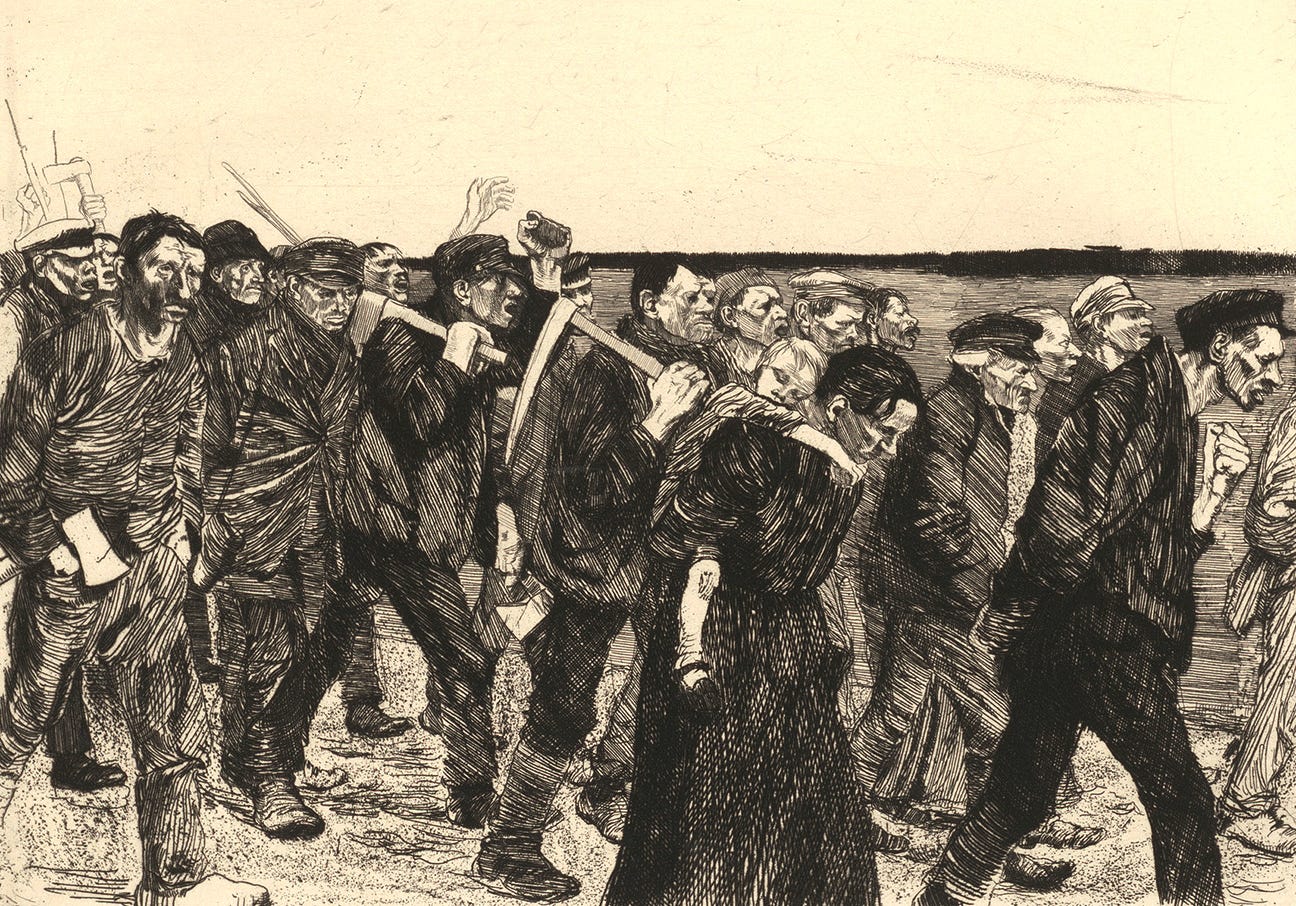
In “The Great Class War,” singer-songwriter, Jesse Welles’ sings, “there’s good people in a warehouse breaking their backs/ shuffling junks around, putting shit in stacks/ Dreaming someday of a brand new start / the demise of mankind’s in a shopping cart.”
Welles’ dissatisfaction with the disempowerment of workers and characterization of the situation as a “class war” is not unique to Karl Marx. Both Mark Twain and the Knights of Labor, forerunners of the U.S. labor movement, criticized oligarchy and the control of workers by owners. To learn more about the U.S. labor right’s movement, read our prior work…
In the wage system labor appears not as an end in itself but as the servant of wages…. An enforced increase in wages… would be nothing more than a better remuneration of slaves, and would not restore, either to the worker or to the work, their human significance and worth.
Even the equality of incomes which Proudhon demands would only change the relation of the present day worker to his work into a relation of all men to work. Society would then be conceived as an abstract capitalist.
A being does not regard himself as independent unless he is his own master, and he is only his own master when he owes his existence to himself. A man who lives by the favor of another considers himself a dependent being. But I live completely by another person’s favor when I owe to him not only the continuance of my life but also its creation; when he is its source….
[Capitalistic economics’] principal thesis is the renunciation of life and of human needs. The less you eat, drink, buy books, go to the theatre or to balls, or to the public house, and the less you think, love, theorize, sing, paint, fence, etc. the more you will be able to save and the greater will become your treasure which neither moth nor rust will corrupt—your capital. The less you are, the less you express your life, the more you have, the greater is your alienated life and the greater is the saving of your alienated being. Everything which the economist takes from you in the way of life and humanity, he restores to you in the form of money and wealth. And everything which you are unable to do, your money can do for you; it can eat, drink, go to the ball and to the theatre. It can acquire art, learning, historical treasures, political power; and it can travel. It can appropriate all these things for you, can purchase everything; it is the true opulence. But although it can do all this, it only desires to create itself, and to buy itself, for everything else is subservient to it. When one owns the master, one also owns the servant, and one has no need of the master’s servant. Thus all passions and activities must be submerged in avarice. The worker must have just what is necessary for him to want to live, and he must want to live only in order to have this.
How would adopting Augustine’s view of labor and punishment impact attitudes toward social reform efforts including making work more fulfilling and enjoyable or exchanging punishment for positive behavioral reinforcement?
In “Sermon 10,” Augustine contends that we are not driven to store up treasure for ourselves since “he who gathers it” is quick to pass away while “the treasure lasts.” How might such a thought help us critically examine our relationship to work and consumption?
Augustine criticizes working for what he contends is the spiritually absurd end of amassing wealth. What might an alternative vision to work as mere means to economic gain look like? What does life-sustaining yet joyful work look like or is such a contradiction in terms?
Is Augustine’s insistence that the only solution to the intrinsic depravity of human nature, after the fall, is to submit to Christianity and the Church compatible with religious freedom and self-governance? Why or why not?
In what respect does Augustine’s theory of human nature, including the meaning of and function of labor and punishment, continue to influence contemporary society?
What insight, if any, does Karl Marx’s analysis of labor provide those living in the 21st century?
In what sense does Marx reclaim the dignity of human labor?
Marx’s criticizes the capitalist economic system’s emphasis on possession over becoming and direct experience. How might this criticism be applied to growing reliance on emerging technologies such as artificial intelligence? Could it be said that some are attempting to enhance their technological possessions in place of and at the expense of their own personal growth and development?
Become a Sustaining Subscriber
If this work matters to you, please❤️ like,🔄 share, 🗨️ comment, and consider supporting Humanities in Revolt as a sustaining✊ subscriber or with a one-time contribution
Elaine Pagels, Adam, Eve, and the Serpent (New York: Vintage Books, 1988), xxv.
As Erich Fromm explained, “Labor is the self-expression of man, an expression of his individual physical and mental powers. In this process of genuine activity man develops himself, becomes himself; work is not only a means to an end—the product—but an end in itself, the meaningful expression of human energy; hence work is enjoyable.” Erich Fromm, “The Nature of Man,” in Marx’s Concept of Man (New York: Martino Publishing, 1961), 41-42.
“Marx’s central criticism of capitalism is not the injustice in the distribution of wealth,” wrote Fromm; “it is the perversion of labor into forced, alienated, meaningless labor, hence the transformation of man into a ‘crippled monstrosity’” (42).
Excerpt source: Augustine, Saint. The City of God. Translated by Marcus Dods, Modern Library, 1950.
Excerpt source: Augustine, Saint. Sermon 10: On the New Testament. Translated by R.G. MacMullen. From Nicene and Post-Nicene Fathers, First Series, Vol. 6. Edited by Philip Schaff. (Buffalo, NY: Christian Literature Publishing Co., 1888.) Revised and edited for New Advent by Kevin Knight.
No posts
Comments
Nothing yet. Say the first thing.
Sign in to join the conversation.