
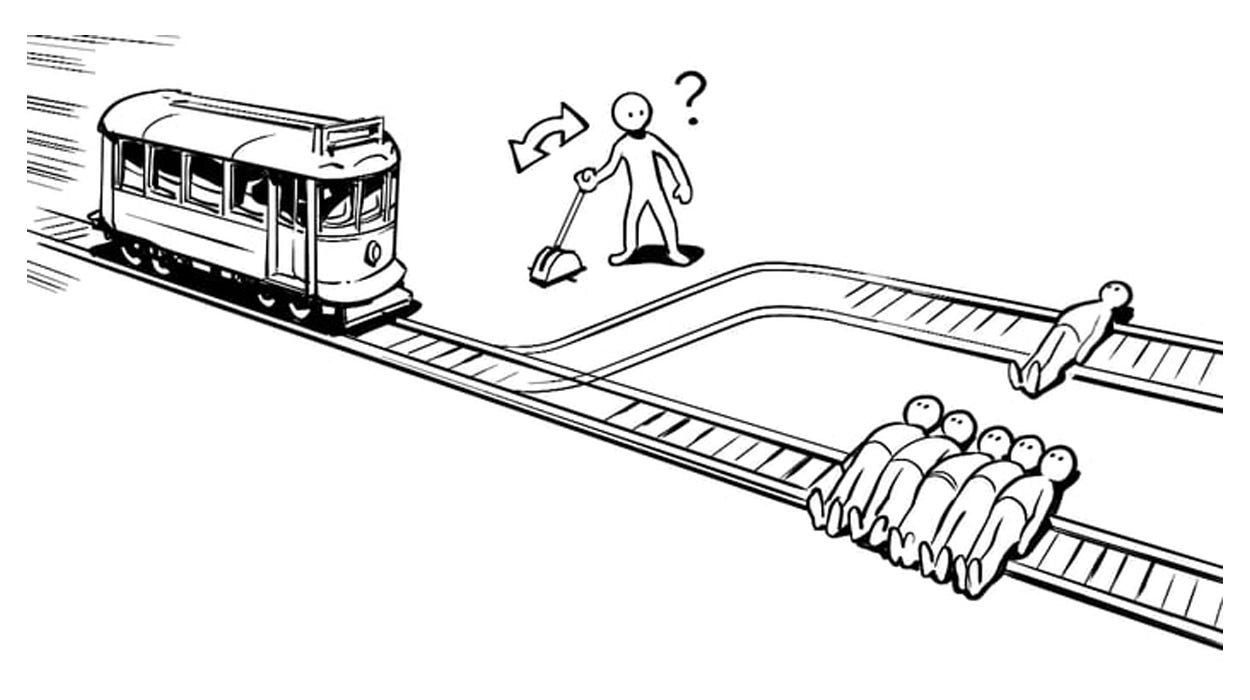
Walking into Philosophy 101 freshman year of college chances are you will be immediately presented with the Trolley Problem.
Should we intentionally harm the one to save the many? This is the question that undergirds utilitarianism, "the doctrine that actions are right if they are useful or for the benefit of a majority."
Rene Girard, former Stanford professor and philosopher, also has much to say about the majority. Versus the "might makes right" of utilitarianism, Girard saw a deeper social reality of mimesis and sacrificial scapegoating - the tendency of the war of all-against-all to turn into the war of all-against-one.
So let's analyze the Trolley problem through a Girardian frame. (*note, I have never seen anyone talk about this which is very surprising.)
Observations
The group on the track are truly bound, in that they do not know how to escape their mimetic trap, and they may have also self-bound themselves in an attempt to de-risk further violence.
The individual on the track is the innocent scapegoat. Occasionally variants of the Trolley Problem make this even more explicit by suggesting the singular person is a baby or child.
The narrator, the one who pulls the lever, does not exist. He is a convenient omniscient narrator, a way for the group to "wash their hands" of the crime they are about to commit. But make no mistake, the group pulls the lever, and the man does not exist.
You can divert the trolley once, but the trolley will keep coming again and again - and presumably the group can and will continue to make the same decision - to sacrifice the one to return (temporarily) the sanity of the many. The mimetic sacrificial cycle will continue ad-infinitum.
The trolley problem is a modern invention - one that emphasizes the rational and logical decision of the individual (the lever-puller) over the violent mimetic social dynamics of the group. This "covering", whether intentional or unintentional is telling. We do not want to see what we do not want to see. Psychosocially - we must bury this reality - because by burying it we give it the power we need it to have.
What is the solution to the trolley problem? It is to derail the train. It is to realize that your restraints are self-imposed, and to get off the tracks. Girard would say that this is what Christ's crucifixion enabled - it revealed the scapegoating mechanism and provided a way out.
The problem with utilitarianism
The problem with utilitarianism then is that it hides the deeper reality of mimetic social contagion and power - and adopts the modern myth of a rational individual sitting down at the table to dispense resources and adjudicate crimes.
Utilitarianism as of late has become even more global, under the guise of being "effective" (see effective altruists). The globalizing frame is especially dangerous. Through globalizing utilitarianism - it creates a global mimetic contagion and competition. It becomes totalitarian - demanding you become subservient to its panopticon of reason. "Who can be the most effective" on a global scale becomes a pathologically and manically pursued status-game - often to bitter bitter end (see FTX). Rivalry leads to insanity. By subscribing to the “effective”ness of the “superintelligent” crowd - one is actually adopting the madness of the mob.
Altruism - the care for others -- and accelerationism - the view that only in the future can we find the salve for our past and can we break from it -- I am quite sympathetic to.
Perhaps we need altruistic accelerationism. Humble, earnest, and active.
"For the Lord does not see as man sees; for man looks at the outward appearance, but the Lord looks at the heart.” - 1 Samuel 16:7
"And though I bestow all my goods to feed the poor, and though I give my body to be burned, but have not love, it profits me nothing." - 1 Corinthians 13: 3
No posts
Comments
Nothing yet. Say the first thing.
Sign in to join the conversation.