
Friday, April 17
Grand Rapids, Mich.
In 324 CE, Byzantium was renamed Constantinople, to honor the emperor Constantine. A few years later, work began on a new church outside the city walls. It was named for the Holy Savior of the Countryside (in Greek, Ἁγίου Σωτῆρος ἐν τῇ Χώρᾳ—Hagiou Soteros en tei Chora).
The church was the centerpiece of a monastic complex and a sign of the Roman Empire’s Christianization under Constantine. Earthquakes hit. The empire expanded and contracted, and the church was built and rebuilt. About a thousand years later, Theodore Metochites came along. A preacher’s kid, he grew up to become a scholar and ascended the ladder of imperial service. Under Emperor Andronicus II, Theodore oversaw imperial estates that bred warhorses. He then became treasury chief and eventually was appointed foreign minister.
All the while, he grew fabulously wealthy. With some of that money and in his free time, he orchestrated a radical redecoration of the Chora Church, commissioning the creation of dazzling frescos and mosaics.
After the Ottomans conquered Constantinople in 1453, the Chora Church became the Kariye Mosque. A minaret replaced the belfry. Some faces on the frescos and mosaics were erased to align with Islamic teaching about imagery, and eventually, nearly all the artwork was covered by plaster. Following the secular Turkish republic’s establishment in 1923, the Kariye Mosque was desacralized and made into a museum. In 1948, art historians and archaeologists began stripping away the plaster, revealing all that had been hidden for centuries.
A few days ago, while in Byzantium, my friend Laura and I visited the Chora Church. (Yes, I know it’s called Istanbul now, but it makes me feel like a time traveler to call it Byzantium.) The images from Christ’s life, the portraits of apostles and saints, the Gospel stories—what remains of these ancient paintings and mosaics is stunning.
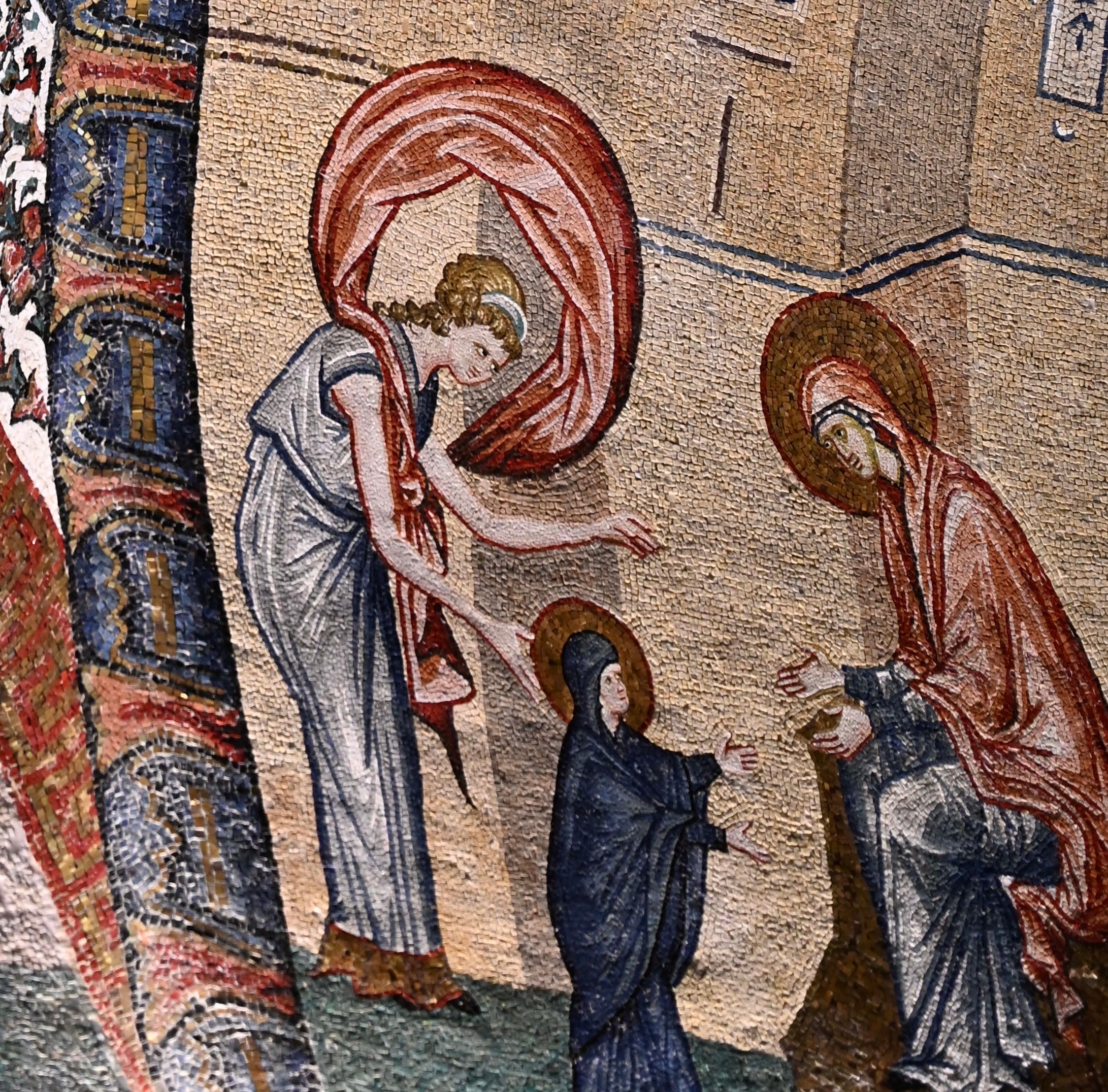
A series of depictions of Mary’s life has a sweet scene of her taking her first steps.
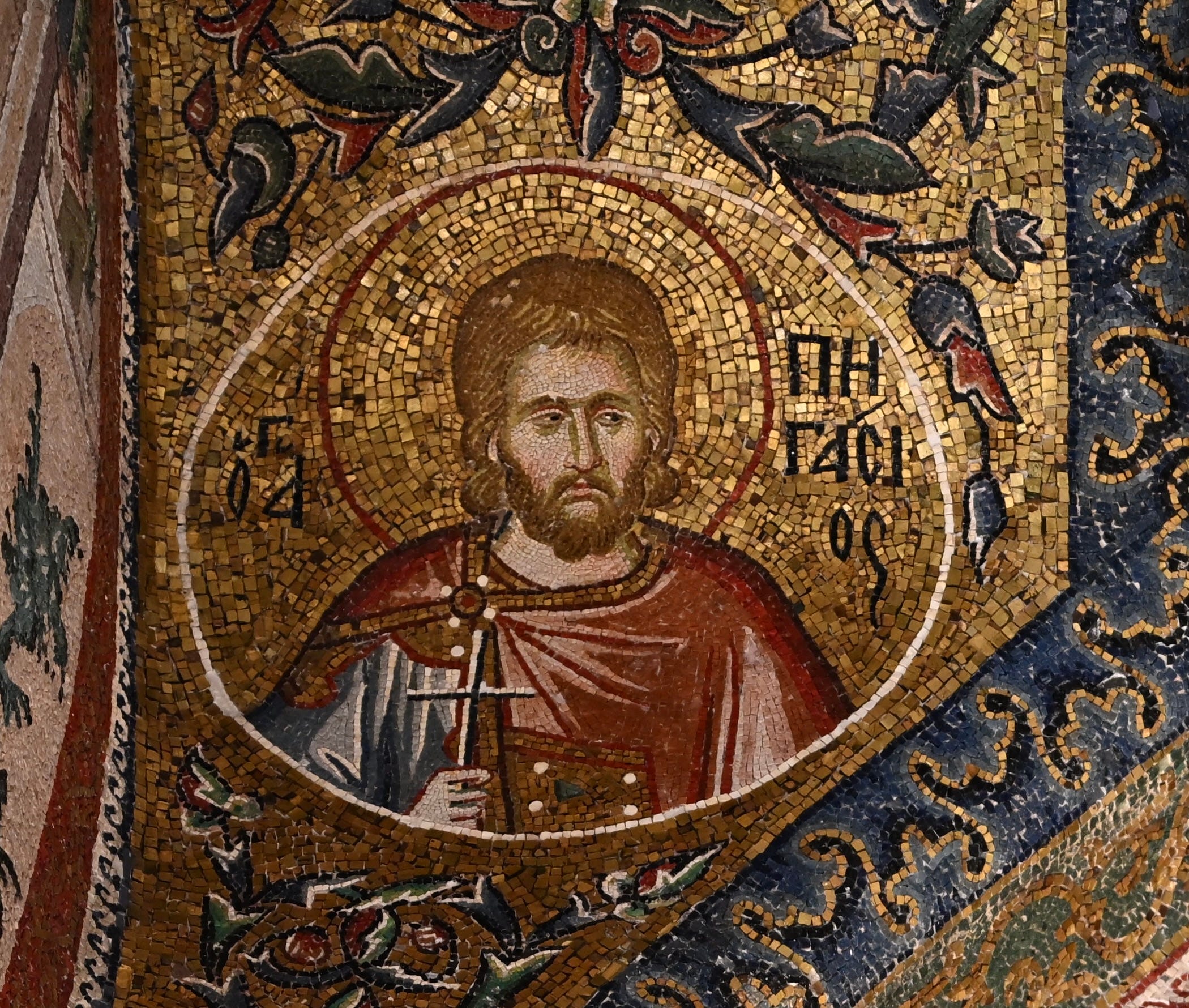
So many of the saints are giving tremendous side-eye, in particular St. Pegasius, a Persian martyr.
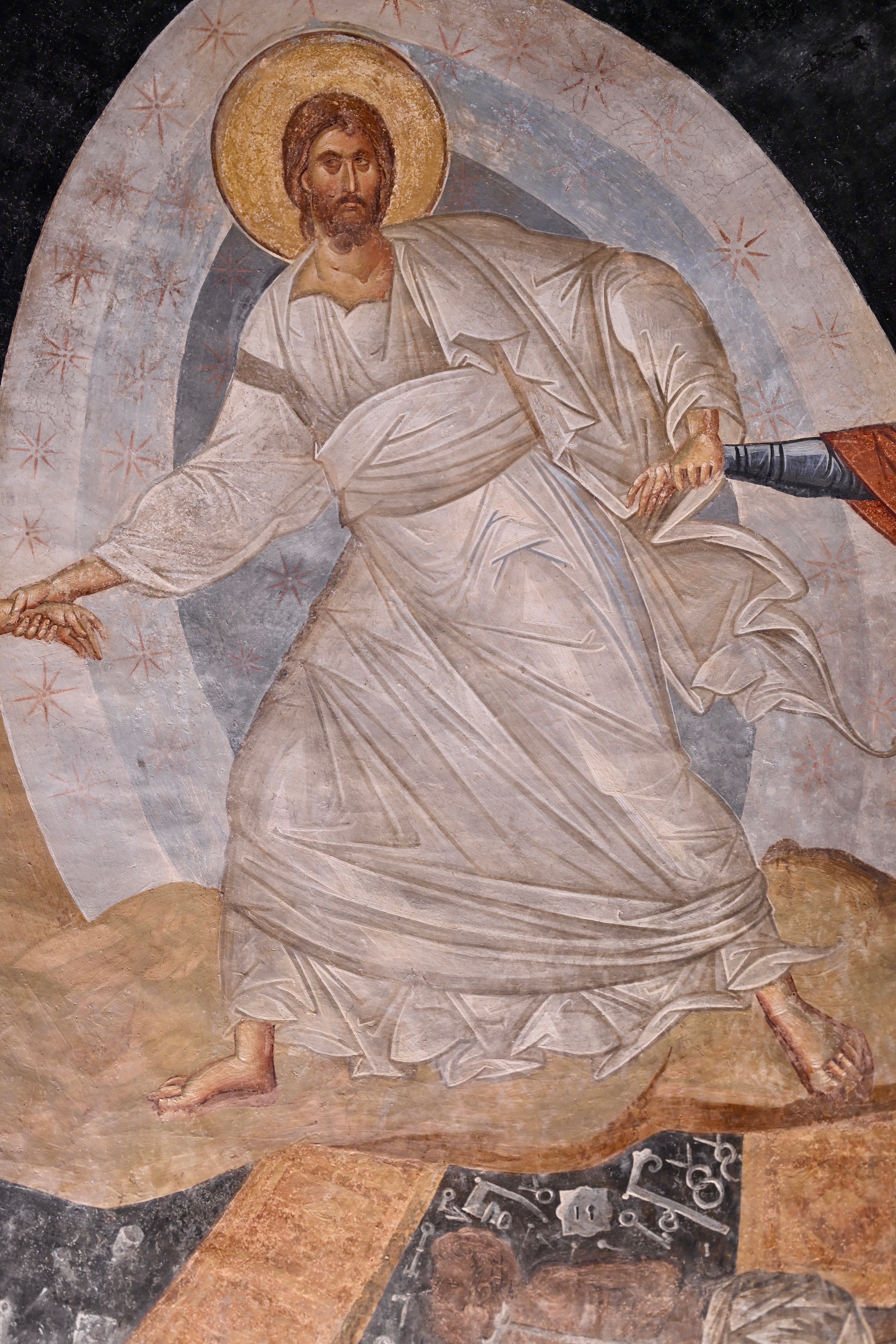
One favorite among the many Jesuses, in a side chapel, is a depiction of a resplendent Christ with his arms and legs out wide, as if dancing.
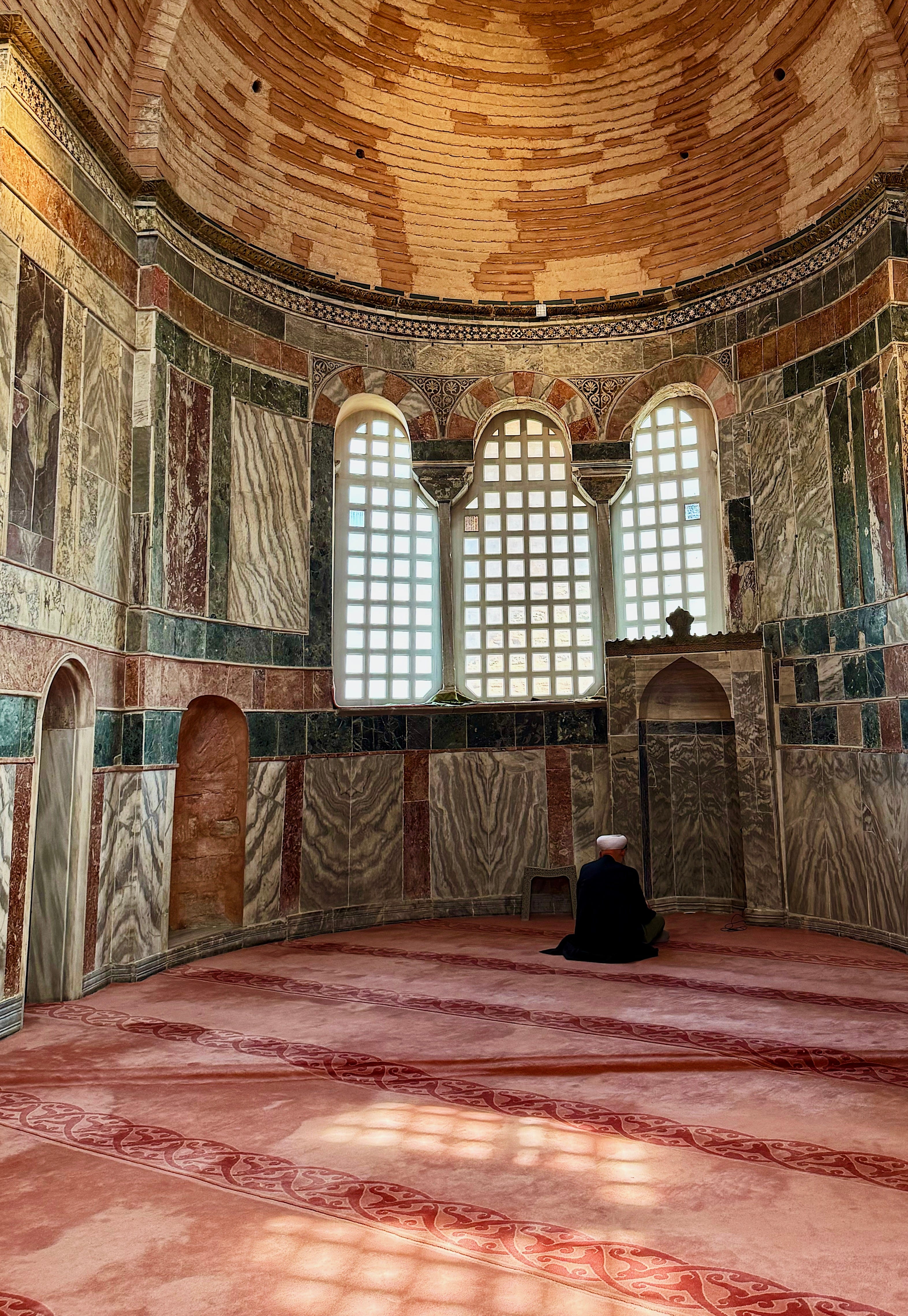
In the main prayer hall, I watched an imam sit in silent prayer, facing Mecca. Only later did I learn that the clergyman’s presence signaled another change: In 2024, the Turkish government reopened the Chora Church as a mosque.
--
The day before our visit to the Chora Church, Laura and I had visited the present-day countryside—the Gallipoli Peninsula, a finger of land poking southwestward from European Türkiye.
Our first stop was an empty beach on the Aegean Sea called Arı Burnu. Along the road, a line of Judas trees bloomed, branches thick with pink flowers. On a small rise, spring wildflowers blossomed—the Mediterranean catchfly in shades of purple, the hartwort in white, and one lone red poppy.
Across the water, we could see the cloud-veiled island of Samothrace. In ancient times, people made long journeys to worship at Samothrace’s holy sanctuary. These pilgrims sought initiation into Samothrace’s mysterious cult, which was believed to offer divine protection and spiritual succor. “The fame has travelled wide of how these gods appear to mankind and bring unexpected aid to those initiates of theirs who call upon them in the midst of perils,” the Greek historian Diodorus Siculus wrote. The pilgrims “become both more pious and more just and better in every respect than they were before.”
In April 1915, thousands of troops who had made even longer journeys landed at Arı Burnu. Allied forces were attempting an amphibious invasion of Gallipoli, part of an effort to seize the Dardanelles straits, on the other side of this peninsula. This beach was the designated landing spot for the Australian and New Zealand Army Corps—the ANZACs. But the Allies seriously underestimated Ottoman strength. Within a day, hundreds of ANZAC troops had died. By the end of the disastrous Gallipoli campaign, more than 10,000 were dead.
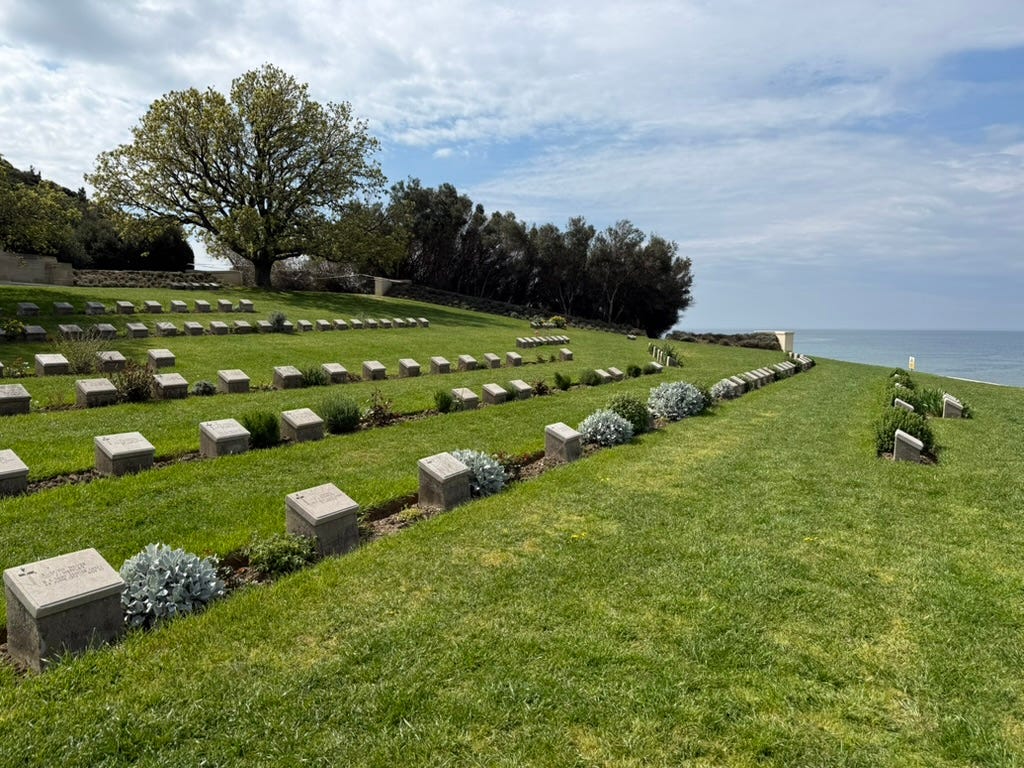
Some 250 Commonwealth soldiers and sailors are buried in the Arı Burnu cemetery. The gravestone of Queenslander Henry Kimber, who was 19, says, “Thy will be done.” George Seager, whose grandfather had been part of the Charge of the Light Brigade during the Crimean War, lied about his age to enlist; he was 17. Henry Burton was 18; for his grave, his parents chose an inscription that reads, in part, “Only a boy.”
--
From Arı Burnu, we drove about thirty minutes southwest to Cape Helles, at the tip of the Gallipoli Peninsula. We looked out to the churning seas where the Dardanelles’ waters greet those of the Aegean. In 1924, a 30-meter-tall obelisk was erected at Cape Helles to honor the 21,000 fallen Commonwealth soldiers and sailors—mostly British but also Indian, Australian, and New Zealander—buried in unmarked graves.
As I walked the tidy rows of the small cemetery between the memorial and the sea, I noticed the words “believed to be buried in this cemetery” on most of the gravestones. At the bottom, many of the markers said, “Their glory shall not be blotted out.” What impossible hope! But also, what glory?
My eye landed on a snail that had sheltered inside the cross on a gravestone honoring Private William Murphy. An Irishman who fought for the Royal Munster Fusiliers, he died on the Gallipoli campaign’s first day. He was 25.
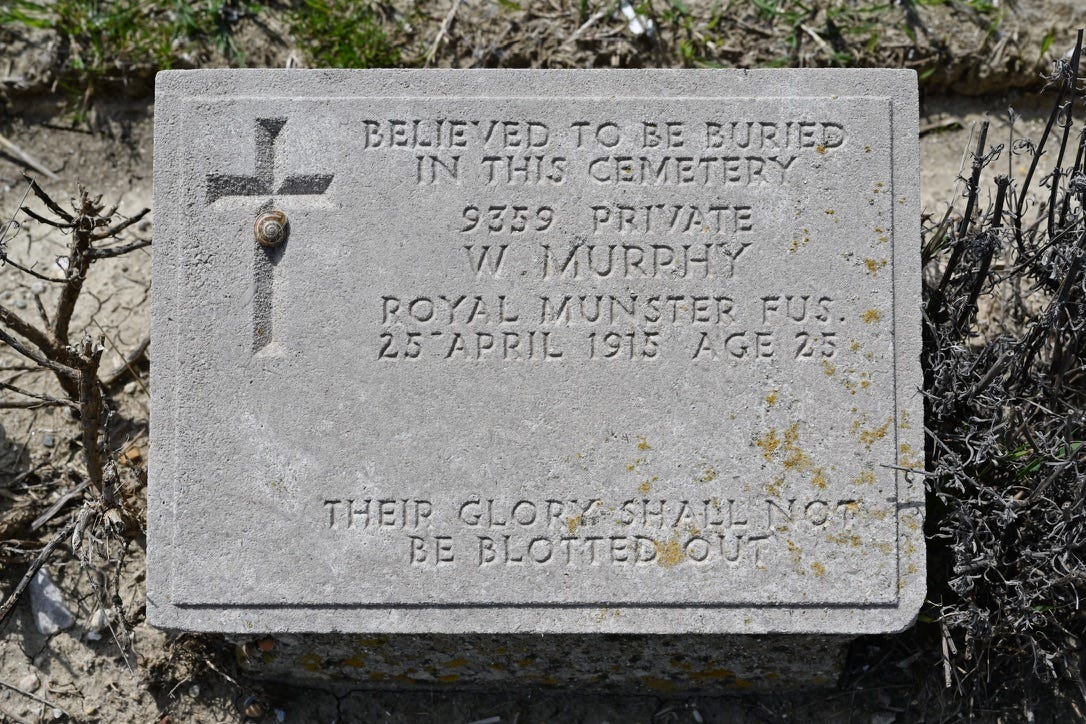
When I got home, I pored over British military records online to learn more about Murphy and his regiment. A Cork native, he was the son of John and Elizabeth Burton, who lived in Brandon, a town on the Assiniboine River in Manitoba that sprang up as a junction on Canada’s transcontinental railway. I wondered how long it took for news of Murphy’s death to reach his parents, thousands of miles away. When had they last seen him or heard from him?
Murphy’s unit was descended from the Bengal European Regiment. Formed in 1652, this group of mercenaries worked to protect and expand the domain of the British East India Company on the Indian subcontinent. In other words, it was a commercial paramilitary. Two centuries later, the Bengal European Regiment was folded into the British Army, and in a military reorganization in the 1880s, the regiment became based in Tralee, in Ireland’s southwest, drawing its recruits from the counties of Munster. Its soldiers fought, and died, in the Second Boer War and then in the First World War. It’s an age-old story, this intermingling of corporate lust and military might, imperial expansion and epic fury.
After Ireland achieved independence from Britain in 1922, the Royal Munster Fusiliers were disbanded. The regimental motto was Spectamur agendo—“let us be judged by our acts.”
--
What are we fighting for?
It’s both wrong and right to say “we.” I want nothing to do with the war the current administration has ignited, and polls consistently show that a majority of Americans don’t back it. Yet as much as it grieves me to acknowledge it, the conflict with Iran has been instigated by our elected government, orchestrated with our tax dollars, and executed with our warplanes, our weaponry, our soldiers and sailors.
We still fight in the same old ways, with the same stale motives, but new, ever more devastating technology. The young still die; 120 schoolchildren in an errant U.S. airstrike in southern Iran on February 28, then Sgt. Declan Coady, 20, of West Des Moines, Ia., killed by an Iranian drone in Kuwait the next day. We find ourselves in similar straits, if different locations—then the Dardanelles, now Hormuz.
Where has all the fighting gotten us?
Late in his political career, Theodore Metochites wrote a wide-ranging series of philosophical essays reflecting on life together, which I found unexpectedly relevant even now. In one essay, he writes, for instance, about a prototypical leader who “takes aim and shoots at others from a distance and surreptitiously does evil... while feigning sincere benevolence and an interest in the public weal”; he insisted that “Fate most conspicuously will make him reap the benefit of his wickedness and artfulness and evil mind.” In another, he notes that the world will always be plagued by those “who entertain a disastrous love for low and useless things, and who either speak contemptuously or disregard what is judicious and the love of what is good.”
Of all his counsel, this moved me most: “It is absolutely necessary to keep to the rules of the good.” He believed such faithfulness was embodied through “true reverence and belief in Christ.” “You must believe that the good life lies in this and that you should not live in any other way,” he wrote. “Even though it is difficult to do good, one should never try to avoid this, nor despair in the view of all the toil which the good involves and which is inevitable in order to acquire it.”
The depiction in the Chora Church of Dancing Jesus is called the Anastasis, meaning resurrection. Beneath his feet are two broken pieces of wood, representing the gates of hell. On either side of him are sarcophagi, from which two people emerge—Adam on Jesus’s right, Eve on his left. They represent all of humankind. He’s grasping their hands and pulling them out of death.
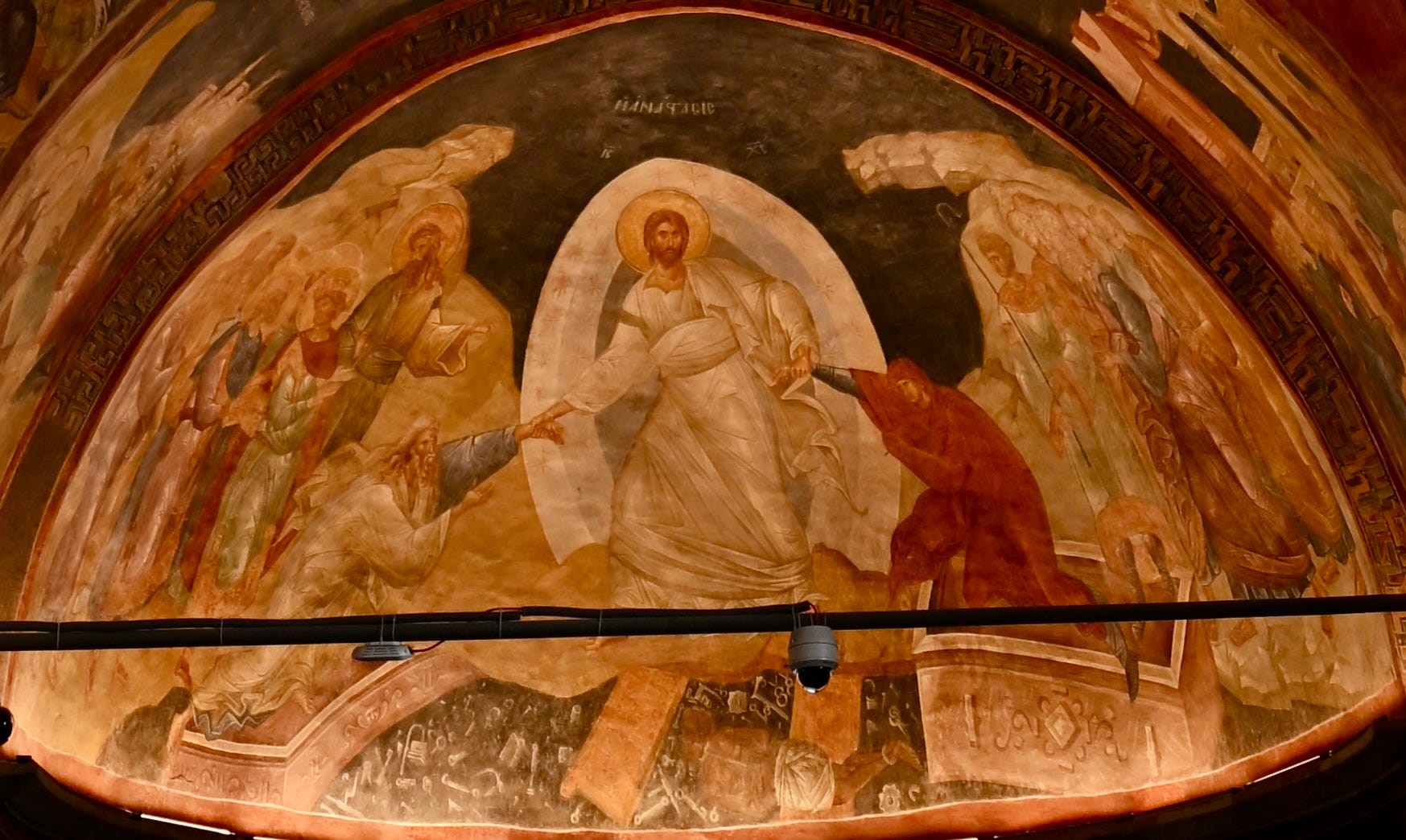
I love the fresco because it reminds me of how we, too, are held as beloveds, and compelled toward good, and lifted into life. Oh, how I want this story to be true! And I suppose I believe that if there is to be renewal, we cannot and will not fight our way to life, at least not in the old ways. We will have to be lifted by love—and perhaps we might dance, but only because Jesus did so first, and then held us by hand and called us to join him.
A postscript on Theodore Metochites: After his patron-emperor was deposed by his own grandson, Theodore was stripped of his power and wealth. He became a monk at Chora. As his new name, he chose Theoleptos, which means “apprehended by God.”
Quick programming note: If you are in or near Grand Rapids, tonight, Friday, April 17th, I’ll be in conversation with the philosopher and all-around-great human James K.A. Smith. We’ll be discussing his new book Make Your Home in This Luminous Dark, which I commend to you. Those of you who are familiar with Jamie’s work will know that I tell no lies when I say that he’s learned and incredibly thoughtful. The trait that most marks this book—and what sets it apart from so much philosophical writing these days—is that it radiates love. The event is at 7 p.m. at Sherman Street Church. Please come! It’s free. More information can be found here.
With gratitude and in hope,
Jeff
No posts
Comments
Nothing yet. Say the first thing.
Sign in to join the conversation.