
The first warning sign came last fall, when my child and I toured a college with an excellent reputation, particularly in business.
We sat in a lecture hall outfitted with sleek blonde wooden rows of seats, tastefully upholstered, no plastic or synthetic for our rumps. After the welcome slide, the presentation got to business.
Growing up, I had pored over the Barron’s Profile of American Colleges, that telephone book-sized encyclopedia, mostly for fun. But I knew almost nothing about the school we were visiting, and was eager to find out what it had to offer.
The next slide was jarring.
Graduates have an undergraduate starting salary of $77,642 a year (exceeding the national business major average by 13%). Ninety-five percent have a job, are in grad school, or are otherwise employed within six months of graduation.
Early Career Median: Ranges between $71,400 and $90,600 depending on the reporting benchmark.
I blinked, stunned that we had already fast-forwarded to post-college. This felt less like a welcome and get-to-know-you message and more like a sell.
Was I missing something? I blew the dust off my own memories of the college search, more than thirty years ago, and I could not recall a single school telling us what its graduates would earn.
The world was different then. We were riding high on the belief that anything was possible, that we could reach for the moon, and if we fell short, we’d land on a star.
Now, with inflation at 4.2%, energy prices up over 23%, and all of us holding portable fear devices reminding us in reels, snaps, and posts that the future was grim, I understand why colleges feel the need to prove, in dollars, that the investment of higher education will pay off.
College is no longer the stepping stone to guaranteed prosperity. It’s selling a dream that does not exist anymore.
College is no longer the stepping stone to guaranteed prosperity. It's selling a dream that does not exist anymore.
My first real notice that college had changed came earlier than that tour with my child. When I was living in Boston in the early 2000s, a new dorm was going up on the Boston University campus; a tower that looked less like student housing and more like a sleek hotel for young professionals living large. I had heard about the fancy chefs and the fitness centers that put health and wellness establishments like Equinox to shame, but seeing it in person, the picture windows framing the Charles River, the Citgo sign glowing from just the right angle, made me feel almost sorry for the kids living there.
Where were the cinderblock walls? The food you complained about but ate anyway? The industrial-grade carpet? College was supposed to feel a little bit like camping. You rough it for a while, find the humor in a different kind of living, and come home appreciating what you have.
College was supposed to feel a little bit like camping. You rough it for a while, find the humor in a different kind of living, and come home appreciating what you have.
Now the glossy mailers arrive for my son almost weekly, advertising what looks, to me, like a four-year all-inclusive resort vacation.
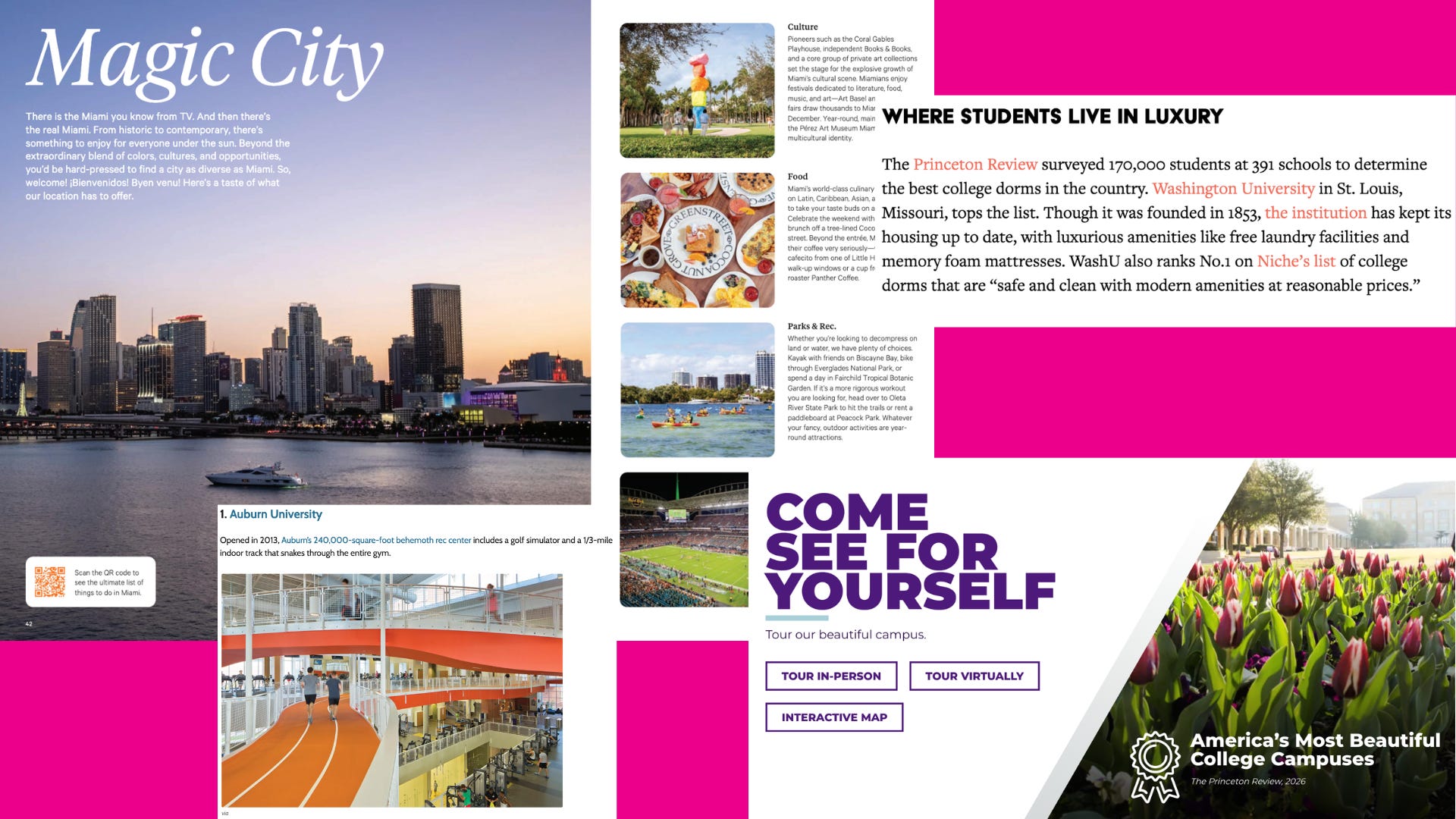
Photo credits: University of Miami, Auburn University, Princeton Review, Texas Christian University
Like any consumer weighing a major purchase, parents (really our children) need to know what we are buying and what we can expect to get back. A four-year private college averages at $400,000. That price tag will only go up.
Four hundred thousand dollars buys a lot of things. Invested elsewhere, in the stock market, in real estate, it might buy quite a lot more.
I still believe in college. I believe in the space it gives a young adult to explore, to follow a stray curiosity, to make a few bad decisions with the training wheels still on. But what college has become, at least the version being marketed to my teenager, feels less like an education and more like a transaction dressed up as a dream.
I can only imagine the nightmare greeting graduates when the vacation comes to an end, and the future looks so grim you want to pull down your sleep mask and avoid reality.
I grew up believing college was the key to success. And with every hyper-marketed mailing material greeting me at my front door, I don’t believe anymore.
I feel no pull for my child to attend a name-brand school. I feel no tightening in my chest imagining what I will say to other parents at graduation when they ask where he is headed. I want him to make smart choices, work hard, have some fun, and come out the other side as financially free as possible.
I grew up believing college was the key to success. And with every hyper-marketed mailing material greeting me at my front door, I don't believe anymore.
After all, he’s going to have quite the electric bill to pay.
Writing prompts:
What would financial freedom actually look like in your adult child's daily life? Describe it not as a number, but rather how they would feel getting up on a Monday morning, ready to begin their day.
Write about the dorm room, the apartment, or the living situation that shaped you more than any class did when you were in your late teens or early twenties.
Book pairings:
The Adjunct, Maria Adelman. I plowed through this campus novel that follows a woman on the edge gigging her way through academia’s poor job market. It rips the veil off the industry of higher education in a fierce and oddly entertaining way. A great reminder that the likelihood of traditional success still rests on the laurels of privilege, not diplomas.

My Last Innocent Year, Daisy Florin. This was the book I wish had been published when I was a college student in the late ‘90s. It’s a coming-of-age story about a nonconsensual sexual encounter that propels one woman’s final semester at an elite New England college into controversy and chaos. Set against the backdrop of the Clinton/Lewinsky scandal, it taught me how much I didn’t understand my agency as I was on the brink of adulthood.



Citation
“Undergraduate Career Outcomes & Employment Stats.” Babson College, 2026, https://www.babson.edu/undergraduate/outcomes/. Accessed 19 June 2026.
No posts
Comments
Nothing yet. Say the first thing.
Sign in to join the conversation.