
One of my most magical memories of summer as a child doesn’t involve a hot day at the beach, savoring the sweet frozen delight of a soft serve cone, or reading the long afternoons away.
It was dusk, and we were at my Grandma Stehle’s house in suburban Waldwick, New Jersey. The schoolhouse-red asbestos siding held the warmth of family gatherings throughout all four seasons.
My older cousin Shannon and I were always in quiet competition to control the younger brood of cousins and siblings. She spotted the lightning bugs first — the faint orbs glowing across the lawn just beyond our grandma’s bay window.
The leaf piles we treat as an eyesore are what keep the magic of summer alive.
It was hard, not knowing what I was looking at outside, nor what to expect, when my cousin grabbed mason jars from a kitchen she felt so at home in and handed them out like tools.
Shannon demonstrated how to hover the open mouth of the jar near the firefly with one hand and clap it shut into the jar with the other.
Always the little mother since my parents’ divorce, I worried the bugs would suffocate in the jars and die.
It was Shannon’s confidence that reassured me: we wouldn’t keep the lightning bugs for long. We’d enjoy them for a bit, then set them free.
As dusk inched towards darkness, silhouettes of my cousins and sisters darted around my grandmother’s front lawn, exclaiming “Got one!” as their jars transformed into living lanterns.
My grandmother’s house was on a corner lot, and though she lived in a quiet neighborhood, cars passed by regularly. What an enchanting sight for passerbys to smile at: a cluster of children capturing fireflies on their grandmother’s front lawn.
Or perhaps we weren’t even noticed, since this childhood magic was commonplace back then.
We want nature neat, controlled. But that neatness erases the very life we claim to cherish.
More than 40 years later, I recalled to my children with glee the joy of catching these magical little creatures and the awe of observing their little rumps bulge an electric green. Just as joyful was the feeling of releasing them back into the freedom of the night sky.
But my children couldn’t relate to my memory. I felt like I was spinning a fairytale from a childhood that hadn’t existed. I didn’t stop to ponder why my children hadn’t seen fireflies in our verdant Boston suburb. I figured the bugs didn’t populate north of New Jersey.
I didn’t think about that childhood memory until last fall, when my neighbor — an avid gardener — was collecting leaves to mulch his garden beds.
My neighbor asked, “Do you remember lightning bugs?” The answer landed in my heart before I nodded.
He explained that our obsession with tidy lawns is destroying the habitat fireflies need for their larval stage. The leaf piles we treat as an eyesore are what keep the magic of summer alive.
We want nature neat, controlled. But that neatness erases the very life we claim to cherish.
If we manicure our lawns enough, maybe we can manicure the chaos of our lives, too.
I’ve bought into it too. I’ve lost hours — probably months… okay, half a year — trying to force my lawn to mirror the immaculate ones around me. Competing in a contest no one admits exists. And for what? To look like I have everything under control?
Scrolling through images of perfect homes and gardens only sharpens the lie: that perfection is possible—and expected. If we manicure our lawns enough, maybe we can manicure the chaos of our lives, too.
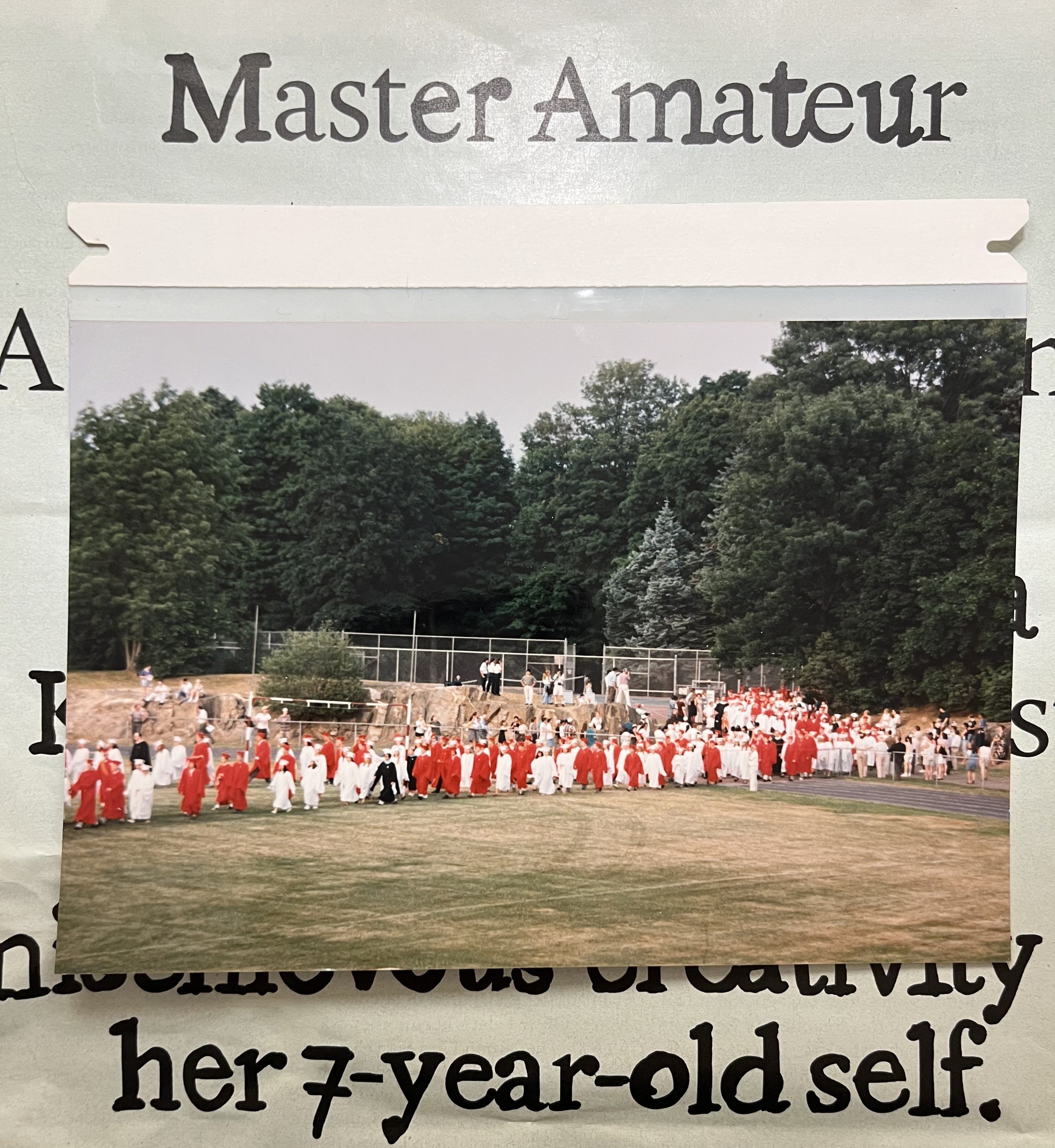
Recently, while preparing for my mother’s 80th birthday, I found photos from my high school graduation in 1995. My future felt sharp that day, even though all I could make out in the pictures were blurry faces, the boys in red gowns, the girls in white.
But what showed up most clearly was the field: patches of sun-scorched grass, near the podium.
Nobody cared then. That’s just what grass did. And my father’s embarrassing fervor to inform practically everyone he came in contact with about global warming was only met with eye rolls.
Eventually, my high school’s football field, like so many, was demolished for artificial turf — perfectly green, scattered with tiny synthetic pellets, like the stowaways that arrive in my daughter’s cleats and reappear in the most unexpected places: tucked behind a toilet, nestled in a couch cushion.
Like the lightning bugs from my childhood.
I see now we once had something perfect — not in appearance, but in existence. And in striving for a prettier version, we dimmed the parts that glowed on their own.
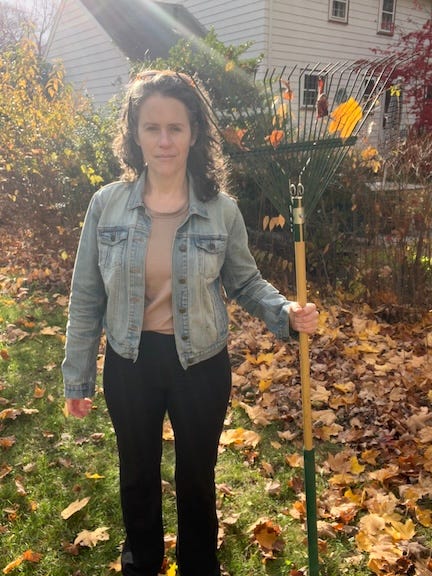
Recently, I stood in my backyard, basking in the cool autumn air. The warm sunlight ignited the oranges, yellows, and reds around me. It was a quintessential fall afternoon in New England.
As I raked the lawn, I noticed the matted piles of leaves I’d intentionally left last year after learning about the disappearance of lightning bugs. I chided myself for not cleaning the beds in the spring.
This was my small act of defiance against perfectionism and its quiet destruction, yet there I was, criticizing myself for not clearing the beds this spring.
In striving for a prettier version, we dimmed the parts that glowed on their own.
Oh, Jean.
Does it matter? Were the days you spent outside this year any less enjoyable because of those decaying leaves in your flower beds?
If anything, those imperfect parts of your yard will hold more hope and joy than the manicured ones — hope that in a world that so often feels out of control, your grandchildren might someday catch a small glow in their hands and feel the joy of setting it free.
Writing prompts
1. On Childhood Magic vs. Adult Perfection
What is something that felt magical in your childhood—the more ordinary or common, the better! What has changed more: the world, or the way you’ve been taught to see and manage it?
2. On Neatness, Control, and What Gets Lost
Think of a place in your life where you’re trying to maintain “neatness”—your home, your schedule, your emotions, your appearance, your parenting. Perhaps you’re like me, and it’s all of the above? What would happen if you left something “undone”?
3. On Letting Things Live
Recall a moment when you stopped trying to perfect something and instead allowed it to exist as it was—messy, natural, or unfinished. Was this difficult? What possibility or beauty emerged once you loosened your grip?
Book pairings
The Very Lonely Firefly, Eric Carle (ages 0-3)
One Jar of Magic, Corey Ann Haydu (ages 8-12)
Ultimate Bugopedia, The Most Complete Bug Reference Ever, Darlyne Murawski, Nancy Honovich (ages 8-12)
An Immense World: How Animal Senses Reveal the Hidden Realms Around Us, Ed Young
Firefly Lane, Kristin Hannah
The Perfectionist’s Guide to Losing Control, Katherine Morgan Schafler
No posts
Comments
Nothing yet. Say the first thing.
Sign in to join the conversation.