
Dear Substack friends,
Most of you know I’ve been a mom to a daughter with complex care needs (Sarah) for thirteen years. She was my introduction into the world of disability, I am sometimes ashamed to say. What I mean is that I grew up in an able-bodied community without consideration as to how disabled people might be perceived or have to work harder to live in this world. I had little exposure to people with disabilities.
This week’s guest essay is written by David B. Younger, a Substack author I became acquainted with by his thought-provoking comments on an essay written by Sam DeCosmo on my Ghost Mother publication. Then, I saw David write eloquently and honestly about living with muscular dystrophy, and I invited him to write a guest post here.
What strengthens my faith in humanity is witnessing people own their stories and give voice to them, like David did here. He writes about how he doesn’t fit the conventional definition of a father, but he’s proud of the man, husband, and father he is. What I take away from his story is that none of us have to be who others say we are; we get to honor our True Self and celebrate who we truly are.
Enjoy this piece, and please be generous in the comments, as you always are!
Thanks for being here.
With love,
Jeannie
Host of I Grow Strong Again and Ghost Mother
When my son was eleven, I showed up to his soccer game in a wheelchair for the first time. We had recently moved from New York City to Austin, and I started using my first-ever wheelchair that I bought at a trade show prior to moving. It’s WHILL brand, so it’s easily the coolest looking Professor X chair on the market, but it was the first time anyone he knew had seen me in a wheelchair.
My son couldn’t look at me the whole game. Afterward, he told me how hard and distracting it was. I stayed calm and told him I understood, because I did, and remembered my own self-consciousness and shame with my mom. We had a stair lift in our house for her, and when friends asked me why it was there, I told them it was to transport boxes of books up and down the stairs because my parents were rare book dealers.
Later that day, I drove to Radio Coffee and sat alone, feeling so many different things. I felt empowered that I showed up in my chair and proud of myself for not reacting defensively when he shared how he felt. I felt some of my own shame—and some of his—as well as grief, helplessness, and anger. It felt like the chair had eclipsed everything about me in my son’s eyes, even though rationally I knew that wasn’t the case.
I have muscular dystrophy. My mother had the same kind. I watched her body deteriorate over time, and my kids have been watching mine do the same. My kids are nine years apart. My son is 21, and my daughter is 12. I had a completely different body when he was 12 than I do now that my daughter is 12. I need help cooking, showering, getting my shoes on, and getting in and out of a car. I can still stand and use a rollator (a wheeled walker with handlebars, brakes, and a seat) at home, but my strength is dissipating.
I have a pretty good idea where this road is headed, barring a treatment or a cure, which medical professionals are working on.
But I haven’t been able to do a lot of the things that are traditionally associated with a father being a father. So, I have to figure out what remains when all of that is stripped away. It turns out a lot is left. It just doesn’t look like what our culture told me fatherhood is supposed to look like.
I show up to events even when I’m exhausted, but more than that is how present I am with them. I listen to my kids, talk with them, connect with them, respect them, and absolutely treasure being a dad. It’s one of the few things in the world that I cannot deconstruct into something whose meaning is fleeting. I absolutely know that when my time comes to leave this earth that if I feel good about how I parented my kids and how I showed up as a husband, son, and friend, that’s all that will matter. That’s the part I’m proud of—and I don’t say that to be inspirational, because there’s nothing inspirational about it. It’s just the choice I make repeatedly, that my kids will not grow up with a father who checked out because his body gave him a permanent excuse to.
My daughter is neurodivergent, and I am one of her lifelines. She has her own invisible disability, so we understand each other in a way that has nothing to do with my legs. I don’t know if it’s my kids’ very different personalities, or the fact that my relationship to my disability has evolved, or that I’ve been using a wheelchair pretty much my daughter’s whole life, but she doesn’t feel the shame and self-consciousness that my son did. She calls my wheelchair her chariot, because she likes to sit on my lap and have me drive her around. She says she wants me to “chariot her down the aisle” when she gets married.
With my son, I know that some of his shame was mine, passed down without my consent, the same way I absorbed it watching my own mother. We’ve talked about it since, more than once, which is more than my mother and I ever managed. The shame doesn’t disappear, but it stops being a secret.
A shame I can say out loud to my own child is a different animal than one that just sits between us, unspoken, for thirty years.
That, I’ve come to realize, is one of the most important aspects of parenting with a disability. It’s certainly not about hiding my body. Nor is it about pretending it isn’t hard or always putting on a brave face, so my kids feel okay. The work is staying in the room, letting them see the wheelchair and the braces and the pain and the fatigue, and staying anyway, present and steady, so they learn that my body can fail me and I can still show up for the people I love, that dependence isn’t the opposite of strength; rather, it requires more strength, and I can grieve what I lost and still be entirely here and grateful for it.
My kids will not remember a father who carried them on his shoulders. I’ve made my peace with the fact that I can’t give them that. What they will remember is that I was there at the game and the graduation I had to fight to be included in, present in the hard conversations I didn’t avoid, and every day in between. When my body took so much and kept taking and taking, the one thing it couldn’t take was my decision to keep showing up and loving them with every cell of my body.
A father is not a set of working legs. I know that now, in a way I could never have known if my body had stayed whole. It’s a hard way to learn it, but I’d rather know it than not, and I’d rather my kids learn it from me than from anyone else.
I’ll leave you with a short poem that I wrote for my daughter when she was born. I read it to her every year on her birthday.
My Heart Has Arms
My heart has arms.
So even though I won’t be able to throw you in the air and catch you,
I will hold you there.
My heart has legs.
So even though I won’t be able to put you on a bike and ride with you,
we will travel there.
You see,
My heart beats for you.
My lungs breathe for you.
And you will always know what strength is when I look at you,
because you have my heart
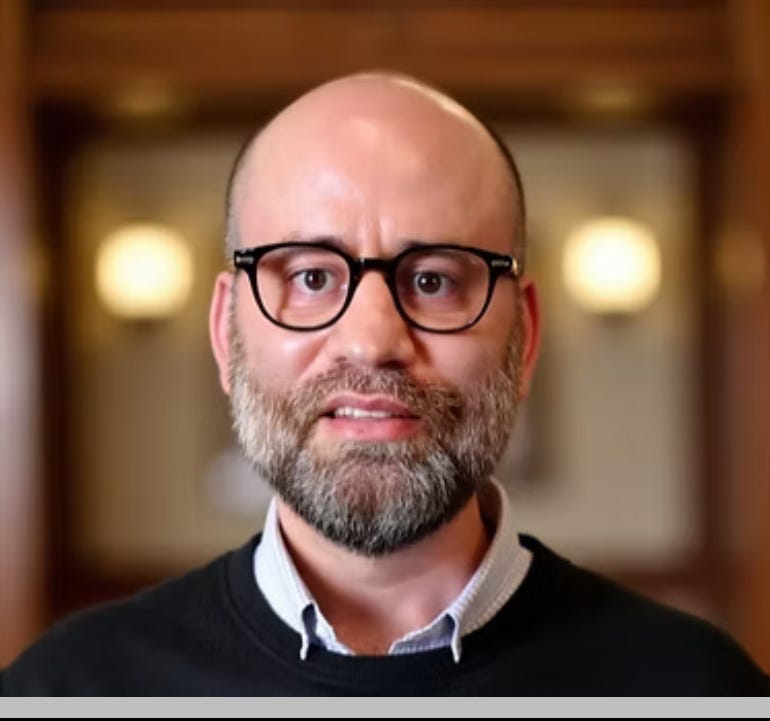
David B. Younger, PhD: I’ve been living with muscular dystrophy my entire life, married for 23 years, a father to two kids, and a therapist for 25 years. I write because I need to make sense of what it means to soften to ongoing loss without pretending I’m okay with it.
Follow/subscribe on Substack:
https://substack.com/@davidbyounger
Comments
Nothing yet. Say the first thing.
Sign in to join the conversation.