
Continued from last week…
Anyone who has stood next to a cremello, a champagne, pearl or sometimes a silver dapple or chestnut in good light, has probably noticed it: a shifting, almost metallic sheen that seems to change colour depending on the angle you’re looking from.
Photos rarely capture it properly. It isn’t quite the same as a “shiny” coat, even though the two get talked about as if they’re the same thing. Here we look at what iridescence actually is, why it shows up so often in dilute horses, and why it seems to owe far more to genetics than to what’s in the feed bin.
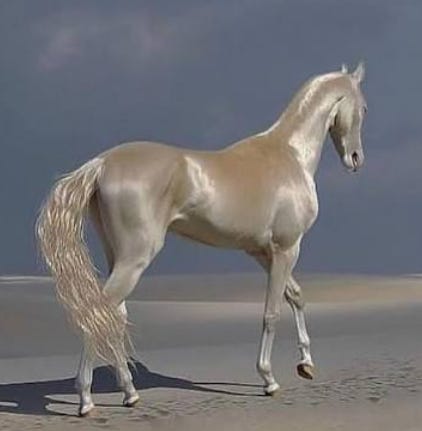
Ordinary coat colour comes from pigment: eumelanin and phaeomelanin granules packed inside the hair shaft, absorbing and reflecting light in fairly straightforward ways. Iridescence works differently. It’s what’s known as structural colour: light bending, scattering and interfering as it passes through and reflects off the physical structure of the hair, rather than colour created by pigment alone.
In dilute horses, the genes responsible (cream, champagne, silver, pearl, and others) don’t just lighten pigment; they change how that pigment is packed and distributed inside the hair shaft. Diluted hair tends to have less densely packed, more unevenly distributed pigment granules, and often a thinner or more translucent cortex. That altered internal structure lets light penetrate further into the hair, bounce around, and exit at different angles, producing the shifting, rainbow-like sheen we call iridescence.
This is really a side effect of the dilution itself. A fully pigmented, non-dilute hair shaft is comparatively dense and opaque; light mostly bounces off the surface, which is what gives a healthy dark coat its glossy but fairly uniform shine. A diluted hair shaft, with less pigment and a more open internal structure, behaves more like a translucent fibre: light gets in, refracts, and interacts with what pigment is there before coming back out.

Comments
Nothing yet. Say the first thing.
Sign in to join the conversation.