
In my last article I gave current literary phenom Yesteryear (by Claro Claire Burke) a serious drubbing, and a lot of my criticisms centered upon the “believablilty” of the book. This prompted the natural and (to my mind) completely fair push-back:
“Why does any of this nit-picky shit matter? Surely the only thing that matters is if a book is connecting with the audience’s emotional needs.”
In other words, if people are buying, reading, and enjoying the book (for whatever reason), why shouldn’t that be all that matters?
So I thought it would be fun to look at what it means to write “good” and “believable” fiction, and why any of us should care about it.
There are a few different ways that a piece of fiction can be “good.”
It can create an enjoyable experience
When someone says “this is a good book/movie” and their friend says “oh, I hated that one!”, their disagreement is over whether it was an enjoyable experience for them. This is the “subjective” portion of art and entertainment.
It can be crafted with excellence
When you understand how art works—both the universal principles and how they are applied within a specific discipline—you can recognize whether a work (no matter how enjoyable) is executed well. This is “good” in an objective sense. It is possible for work to be objectively excellent while it is subjectively awful. Wes Anderson and Stephen King are both good artists who produce objectively excellent work that I personally cannot stand. It’s also possible for work to be objectively horrible while being subjectively fantastic. Most True Crime television falls under this category for me, and weaning myself off of it is one of the reasons I got rid of my TV’s cable subscription far earlier than the other members of my generation.
It can advance an admirable moral vision
Of course, one man’s “admirable moral vision” is another man’s “horrific indoctrinating propaganda”—and no, there is no way to adjudicate such a dispute “objectively,” because entirely positive human moral values can come into conflict with one another (and often do). The entire metagenre of “tragedy” is concerned entirely with what happens when one moral good comes into conflict with another moral good in such a fashion that one moral good must lose. Thus, this category of “good” is one of those where subjective and objective qualities are a bit of a mishmash.
It can exhibit integrity
The work, taken as a whole, needs nothing from the outside and works internally like a finely-tuned instrument. In a sense, this is a sort of excellence of craft, but I break it out separately here because if a work can exhibit integrity without having other aspects of excellence-of-craft, and vice versa. Artistic integrity is a result of a unifying creative vision and a willingness (on the part of the artist) to treat the finished product as an artifact rather than as merely a conduit for transferring ideas from the artist’s mind to the audience’s.
For example, Tolkien developed all the languages for his universe and used them to shape the thought-patterns of his characters (a basic aspect of linguistics), and also the cultural traditions of his races. This level of depth gives startling integrity to his works.
For the purposes of this article, I’m not worried about the “moral vision” angle of good, and I’m going to assert-without-bothering-to-prove that anything that is subjectively enjoyable has some element of objective goodness going on even if the overall work is objectively bad.1

So what is fiction?
In the crassest possible language, fiction is a lie that tells the truth. Nothing you read in a novel (even a very grounded and well-researched historical novel) is meant to be factual in any meaningful sense. Just like any other huckster, a novelist will use facts—the more facts the better—to spin their web of illusion, but the facts are always selectively used for the purpose of serving the deception. The novelist—just like the filmmaker or the surrealist painter—is constructing a dream that feels true, at least for the amount of time it takes to move from “once upon a time” to “the end.”
Fiction is like a film set, or like Disneyland: the illusion has limits. There are always borders where, if a reader were to push hard enough, the illusion would break down. The novelists’s primary job, therefore, is making sure that the reader never gets close enough to one of those borders where they start to question the dream.
In the biz, we call this process “verisimiltude,” which is derived from Latin2 and means “the illusion of truth.”
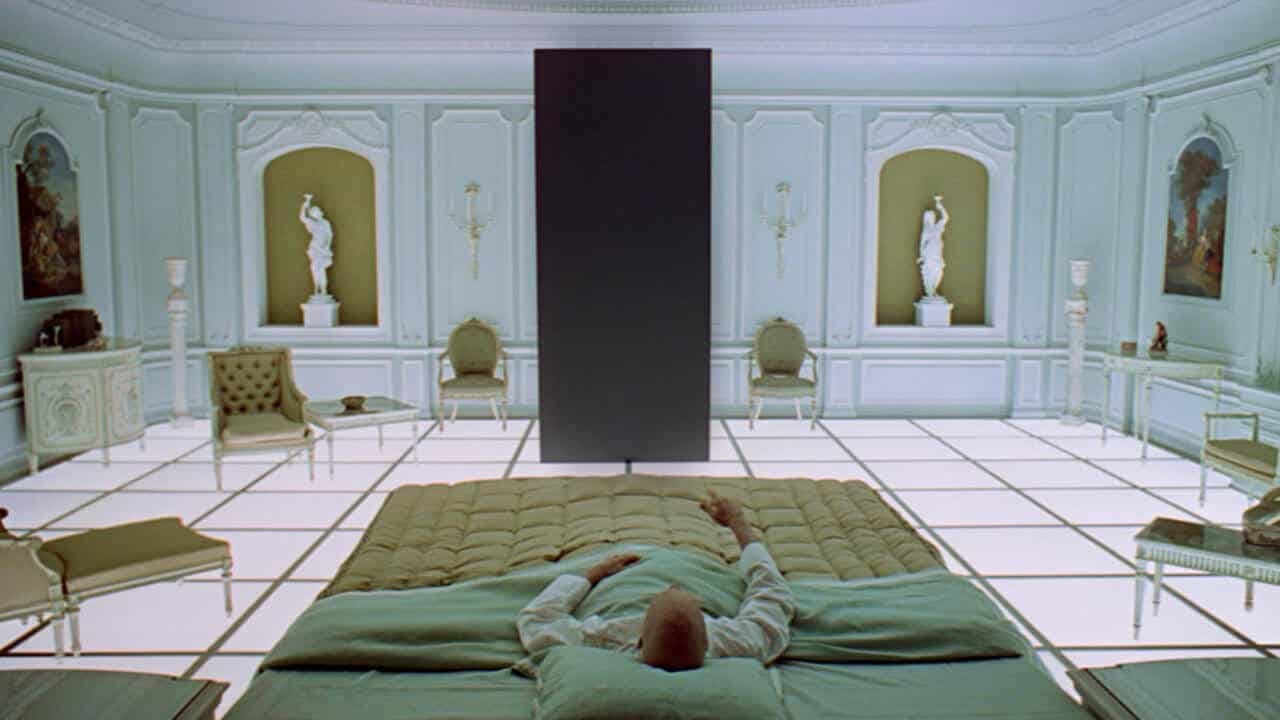
An entire layer of the film of 2001: A Space Odyssey is a meditation on the ability of illusions with verisimilitude (as delivered through cinema) to deliver consciousness-changing experience.3
So how do you pull off this verisimilitude thing?
It’s as difficult to do as it is easy to describe:
You play fair with your novel’s baseline conceits.
Baseline conceits?
Most stories depend on several, but let’s start with one. Consider the baseline conceit of Robert E. Howard’s Conan universe:
The stories take place in the “Hyborean Age,” a time between the destruction of Atlantis and the beginning of recorded history.
Howard takes this seriously and asks himself the question “What might this interstitial age after an ancient advanced civilization look like?” And he settles on “a strange world of minglings.” Mysticism and technology mingle together in the way you might expect in a post-advanced-civilizational dark age. Metallurgy is similarly confused, with bronze age technology existing alongside older iron age technology that is treated as almost magical. Religions are also all mixed up—Celtic gods alongside Norse gods alongside Egyptian gods with even the occasional Lovecraftian gods and so many others—as if all these gods were descended from the original Atlantean gods and the world was still in the process of the diaspora that would eventually creates Earth’s great civilizational groups.
By playing fair with this conceit (and Howard was supremely good at playing fair with his conceits), a writer (or other narrative artist) builds a sense of completeness into their illusion.
The great science fiction and fantasy writers are uncommonly good at this (it’s what makes them great). They have perfected the discipline of asking the question “If this premise is true, then what else must also be true?” As a result, they settle on elements such as “wood is an amazing luxury material in off-world economies”4 that they pepper throughout their descriptions and turn into major plot points.
There are two basic approaches to verisimilitude through this method. Let’s call them the “dazzle method” and the “deep stack” method.
Harry Potter is an excellent example of the “dazzle” method. Rowling’s world is filled with wonders and whimsy—magic is easy and cheap for the wizarding world, so it does for them all the little jobs that us muggles would use technology for. But as the books progress, the story get more political, which brings the reader quite close to the walls of the illusion. Once the reader thinks to ask “How does political power in the wizarding world interface with the muggle world, exactly?” or “Why are no wizards going into industry and harnessing magic to lower production costs for muggle goods in a way that builds a fortune and undercuts the market?” the game is over—the world of Harry Potter does not stand up to this kind of scrutiny.
Magic is, after all, a form of energy. Energy that can be summoned at will is an industrial force. To borrow Devon Eriksen’s corollary to Clarke’s Third Law: Any sufficiently cheap form of magic is indistinguishable from technology. This is why canny fantasy authors—from JRR Tolkien to Jim Butcher—take great care to place limits and costs on the magic in their worlds.
“Deep stack” verisimilitude takes the opposite approach. It seeks to create a set of interlocking premises that work together in a way that make the walls of the illusion impossible to approach. If you have human slavery on Venus, it’s because slave ownership is an aristocratic signalling mechanism rather than a labor force (as seen in my novel Suave Rob’s Amazing Ass-Saving Association), or it’s because the harsh environment of Venus makes mechanized labor (including intelligent robots) too expensive to maintain and/or because the industrial supply chain on Venus hasn’t yet been developed enough for such machines to be built locally, and shipping in space is expensive (as in Logic of Empire by Robert A. Heinlein).
Perhaps the best example of this that’s readily accessible is the Dune universe, where “thinking machines” (i.e. all computers and AI) are banned and space travel only exists because the Spice allows human mutants to manipulate space-time with their minds. This means that the ecology which produces the Spice will be the most tightly controlled and protected terrain in the universe, and also that “he who controls the Spice controls the universe.” This, in turn, implies that political power structures will look like the royal dynasties in the Persian Gulf states. It means that humans have to do all the jobs that a tech-centric society would trust to computers and AI, which means that anyone who wants power or prestige will be incentivized to employ selective breeding to optimize their clan’s ability to do strategy, higher mathematics, philosophy, or to use any of the brute-force tools of politics and religion (such as intelligence, self-discipline, appropriate temperment, Spice-psychic abilities, etc.). It follows from this that eugenics will be de rigueur among all powerful factions in the political system. The fact that the Spice allows for spacetime manipulation means that, from the perspective of the uneducated masses, the universe is ruled by demi-gods with magical powers. This, in turn, implies that the ruling classes will be spectacularly corrupt and have characters and vices similar to the gods of ancient mythology. This, in turn, implies that any revolution or coup will take the form of a religious cult centered around one of these demi-gods.
All of those are necessary effects of the two foundational premises (“the Spice” and “no thinking machines”). The reader, no matter how critical or incredulous he’s determined to be, cannot escape the trap that the illusion has swallowed him in. He may only leave it by closing the covers of the book.
Thanks for reading Unfolding the World! This post is public so feel free to share it.
It doesn’t matter if your movie or novel is science fiction, fantasy, mystery, thriller, techno-thriller, or romance—all stories must weave this illusion, and the better the story is (in an objective sense), the more completely this illusion is weaved from within the story itself.
A mystery such as Hammet’s The Maltese Falcon may be set in 1930s San Francisco and take the real world in that setting as read, but it still must build the world of incentives and limitations that the hero and villains are operating under (the flows of money and sexual passion, the stakes each player is in the game for, the rules governing murder and police corruption, the laws that are being broken and the danger that the criminality presents, the economics of the international market in antiquities, etc.).
A romance in which a woman is trying to marry into a wealthy family must establish the social rules, the taboos, the sorts of paranoia, and the monetary realities and pressures that the wealthy family operates under—and, to be successful (in an objective sense), those rules must be honored in the story by the characters who are creating the drama.
Bad writing reveals itself not on a sentence-by-sentence level (though writing can be bad on a sentence-by-sentence level), but by the rug-pulls it engages in. A bad writer changes the operating premises of his or her story, on the fly, to suit the needs of the moment. A bad writer may set up a spectacularly intelligent character who is unable to puzzle out the most elementary problems (I’m looking at you Yesteryear).
A good writer, on the other hand, will honor all of the rules of their world, even in the breach—meaning that any time the rules of the world are broken, the way that they are broken simply reveals a deeper set of rules that were operating all along. An excellent of example of this may be found in the film The Usual Suspects (spoilers ahead!). This film is, at heart, a verbal chess game being played between a cop and a low-rent criminal. The criminal is being pressed for details of a crime spree that ended in a massacre. Throughout the film we watch the history of the crime spree play out, step-by-step, and the tale is so compelling and convincing that we become lost in its intrigue. A mystery develops, and is eventually solved, and the experience is fully satisfying based on everything we’ve seen. But in the last moments of the film, one of the great narrative twists of all time happens as the solution to the mystery turns out to have been a lie—in fact, everything we have just seen was a lie…except for the bare fact that we started out with: the entire story is a chess match between a criminal and a cop. The cop is trying to get at the truth, and the criminal is trying to deceive the cop and win his release. The fundamental rules of the game are reinforced by the rug pull.
Fiction is a magic trick. The illusion must be complete enough that the audience doesn’t question it.
A good writer will keep you from questioning the integrity of the illusion until the story is done.
A great writer will keep you from questioning the integrity of the illusion, ever.
A bad writer will trust in the fact that you are too stupid to realize that you’re watching an illusion.
Fiction is not alone in having such inherent rules and constraints. Every other art form has its own analogous rules, which emerge from the nature of the form, that govern questions of quality.
Good art is not subjective. It is as solid and objective as a marble statue. Whether you like a particular artwork or not is a wholly separate question from its quality.
And this is a beautiful thing, for if you learn to recognize quality on its own merits, you will inevitably find your tastes maturing and broadening—and, when your friends ask about the movie/book/album you’ve just experienced, you’ll be able to provide a substantive answer to that all-important question:
“Is it any good?”
I work hard to bring high-quality craft, thought, and imagination to my own works, so if you’re looking for fresh stories, you can find my novels, short stories, visions, and dreams (along with some how-to books and literary studies) by clicking here.
If you’re feeling adventurous click here to find a ridiculous number of fiction and nonfiction podcasts for which I will eventually have to accept responsibility.
This column is a big part of how I make my living—bigger now due to recent exciting events which you can read about here. If you want to support this article in particular and tell me to write more like it, drop a couple bucks in the tip jar.
If you want to join for the long haul and get access to pre-publication serials and other goodies, subscribe and support now and get 20% off the annual rate!
I’m doing this for the sake of brevity, but in case you want a quick example…
50 Shades of Grey is, by almost all measures, a bad novel, but it is popular because it does one thing objectively well: it delivers solidly on its promise of eroticized melodrama. For other examples and discussions, I invite you to sift through the archives of my podcast The Every Day Novelist.
From veritas (truth) and similis (resembling—this is also the root word from which we get “simulation”).
How do we know this, given that the director (Stanley Kubrick) was notoriously reticent about the meaning of his films? See Rob Ager’s video essay breaking down how the monolith which spurs human evolution from ape through god-like Star Child is the same aspect ratio as 2001 is filmed in—it’s a movie about how a movie screen takes humans to other worlds.
No posts
Comments
Nothing yet. Say the first thing.
Sign in to join the conversation.