

June 13, 2026 ~ Vol. 57
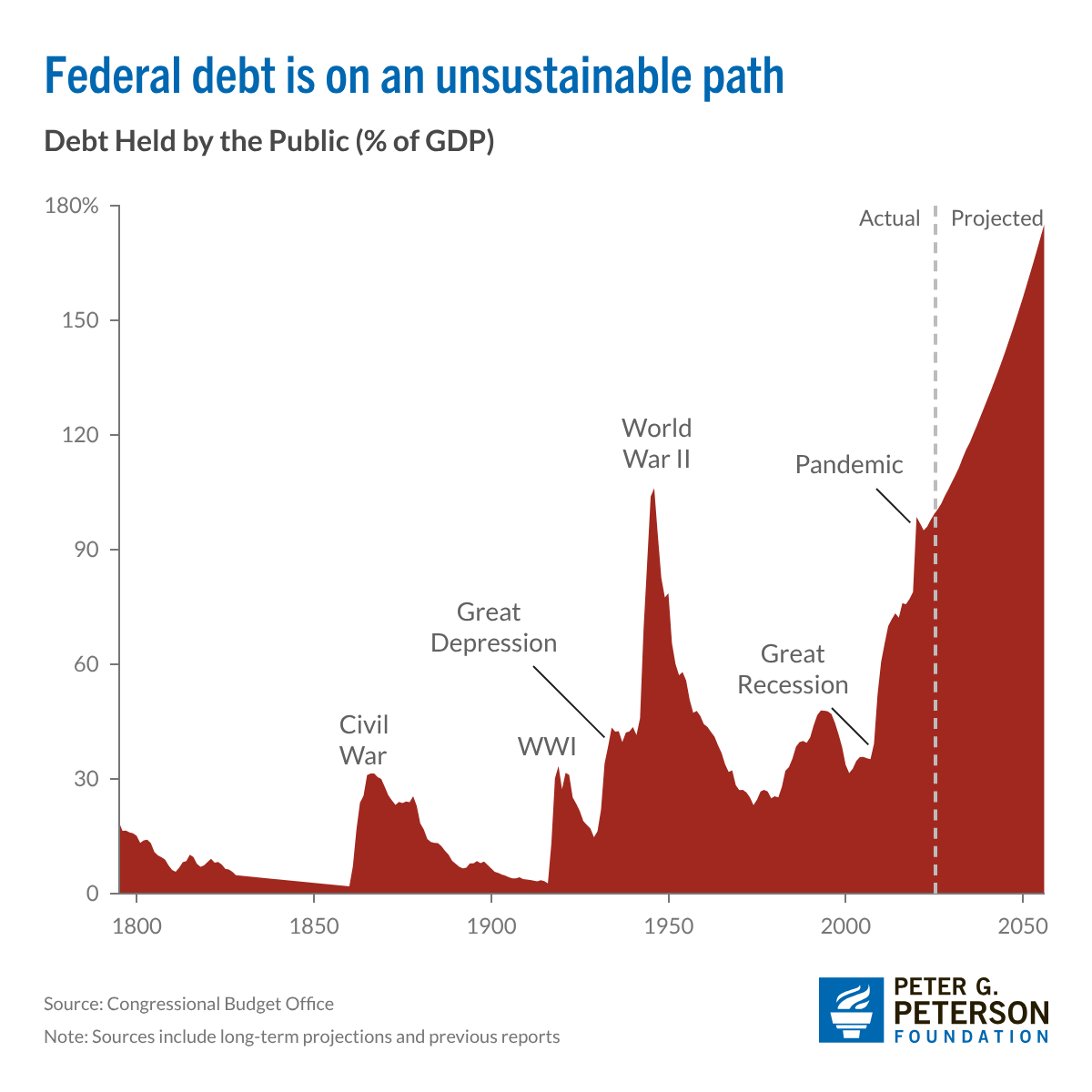
I have been hearing warnings about our mounting US federal debt crisis for as long as I can remember. Curiously, I have not heard a peep about the looming insolvency of the Social Security Trust Fund from any of my Congressional representatives in years. Former House Speaker Paul Ryan spent most of his twenty years in Congress warning that government spending was about to upend the country’s finances, and drag our economy into a fiscal death spiral. Thanks in part to the recently passed Big Beautiful Bill, our debt service today is double what it was just four years ago. According to the Congressional Budget Office debt-service costs attributable to the bill would total $551 billion over the 2025–2034 period. This is on top of a primary deficit increase of $2.4 trillion (from $3.7 trillion in revenue reductions offset by $1.3 trillion in spending cuts), bringing the total cumulative deficit impact to $3.0 trillion. But this bubble has yet to burst.
The US dollar is still the world’s “reserve currency”, even though there are a dozen countries whose credit rating is now higher than ours. I suspect that many people do not remember that the credit rating on US debt was first lowered by S&P fifteen years ago, in 2011. At the time, the reason given by Standard and Poor’s for lowering their credit assessment was the irresponsibility of the US Congress which was refusing to raise the debt ceiling to fund the budget because it had a deficit. Oh, for the good old days of the Tea Party Republicans who threatened to shut down the government and default on our sovereign debt, rather than increase the federal deficit. How times have changed! Moody’s and Fitch Rating Services have both since lowered their own US credit assessment, Fitch in 2023, and Moody’s last year. Currently, there are eleven remaining AAA countries with credit ratings higher than ours, including Australia, Canada, and Switzerland. The only reason that US dollar remains the preferred currency for international trading is simply that there is enough of it to go around and people still believe that we will honor our debts. Importantly, there are not enough Australian or Canadian dollars or Swiss francs to provide the liquidity necessary to accommodate the world’s financial transactions. This all works until it doesn’t, and it will not work when people start to wonder if we have the capacity to continue to finance our debts. Part of the problem is simply that no one really knows how much is too much. It will be when investors hesitate to buy US Treasuries because the perceived risk of a timely repayment is too great—and when that happens it’s too late to fix the problem.
I can’t help noticing that quite a few fiscal wizards, people that I pay attention to like Bridgewater Associates’ founder, Ray Dalio, have now joined the chorus warning that the end is nigh. Dalio is warning that America is heading toward a “debt death spiral” — a phase of the debt cycle where the government must borrow money simply to pay its existing debt service, which accelerates the problem. Speaking at the Forbes “Disruptors Summit” earlier this month, he indicated that the U.S. has crossed a critical debt threshold that may compel the Federal Reserve to implement policies similar to those of the 1930s to maintain artificially low interest rates, pointing to federal expenditures of $7 trillion against revenues of only $5 trillion. Dalio believes the crisis won’t necessarily manifest itself as an outright default, but rather through public spending being squeezed out as ever-growing interest payments crowd out other programs.
A companion crisis is also looming in the bond markets, fueled by accelerating inflation exacerbated by recent tariff policy and by the war in Iran. Historically, the prescription for rising inflation is for the Federal Reserve to raise interest rates. Raising rates, which is the “cost of money”, will slow spending, which should decelerate demand—and temper inflationary price increases. The flip side of that, unfortunately, is raising rates will also hamper economic growth which can manifest itself in a recession. If the Fed is forced to choose between containing inflation or fostering economic growth, containing inflation will win out—it always does— and the Fed will be forced to raise rates. That eventuality has been talked about a lot lately by another fiscal wizard whom I pay attention to—JP Morgan Chase CEO, Jamie Dimon—who warns of an impending bond crisis. In his mind the question is not “if”, but only “when”.
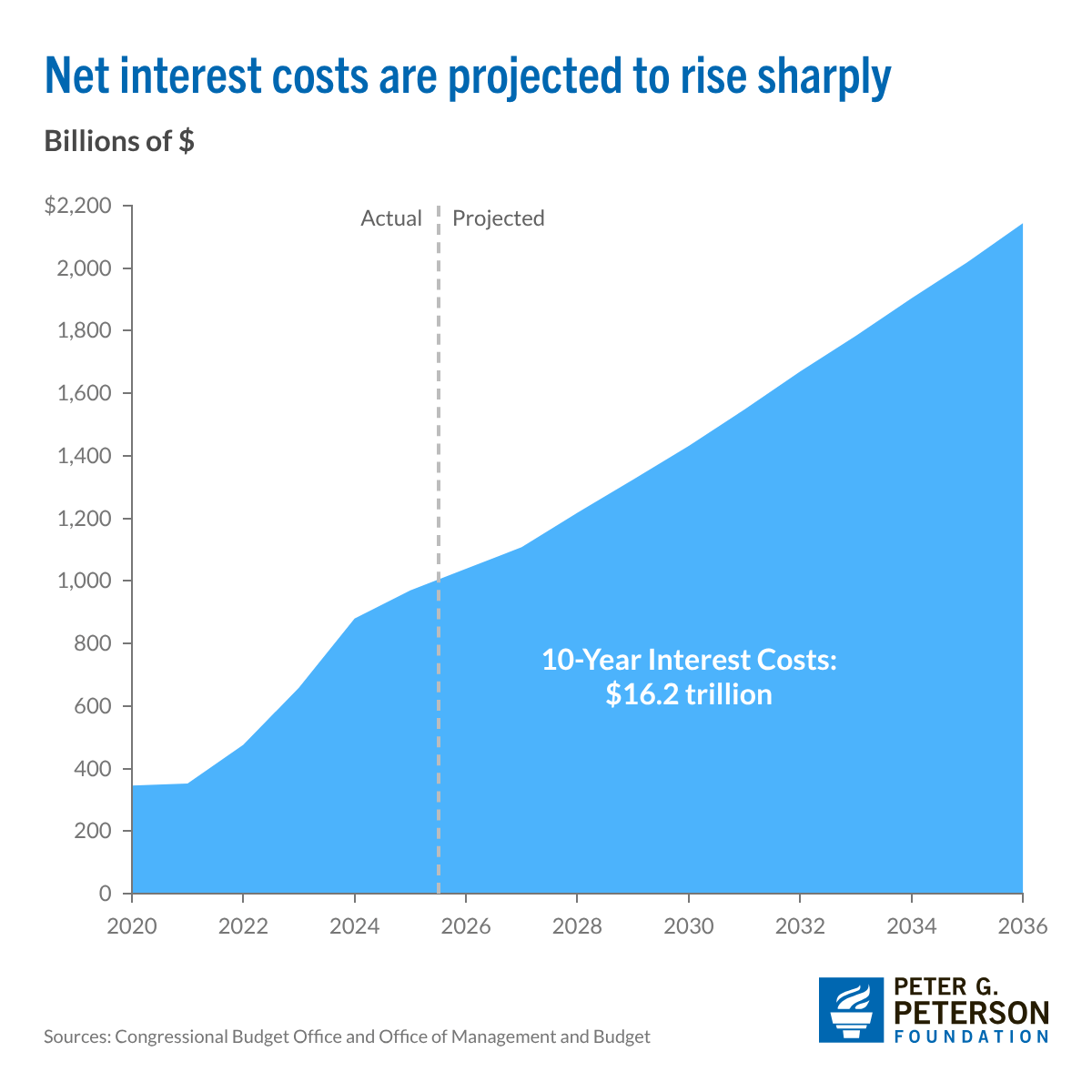
Dimon has been candid in predicting that “there will be a bond crisis, and then we’ll have to deal with it,” arguing the debt problem needs to be resolved and that unresolved tectonic pressures could cause real problems down the road. His primary concern is a market reckoning: as the debt pile grows, bond investors will begin to view the U.S. Treasury as a riskier borrower and raise their rates accordingly. Interest payments on the national debt already hit $970 billion in 2025 — roughly double what was paid in 2022 — and are now the second-largest line item in the entire federal budget, just behind Social Security. (More on this in a moment.) The CBO projects those annual interest payments will reach $2.1 trillion by 2036.
Dimon is certainly not alone in thinking that push is about to come to shove. Citadel Capital’s Ken Griffin (the guy who owns the penthouse that NYC Mayor Momdani really wants to levy his proposed pied-à-terre tax on). Griffin has said that America was sent an “explicit warning” from the bond market, and that it’s time to get the national debt in order. His concern centers on the bond market’s role as an early signal system — when bond investors lose confidence in the government’s fiscal path, they demand higher yields, which raises borrowing costs for the entire economy. The interest rate on US treasuries is used to price all other debt. If the Treasury pays 5% to borrow money, then commercial and retail borrowers pay 6%, or 7% or 10% depending on their credit rating. The ten year treasury rate is used by banks to calculate mortgage rates. The impact of rising rates on treasuries spreads far beyond the treasury market, which is why the White House is always laser focused on rates, for better or worse.
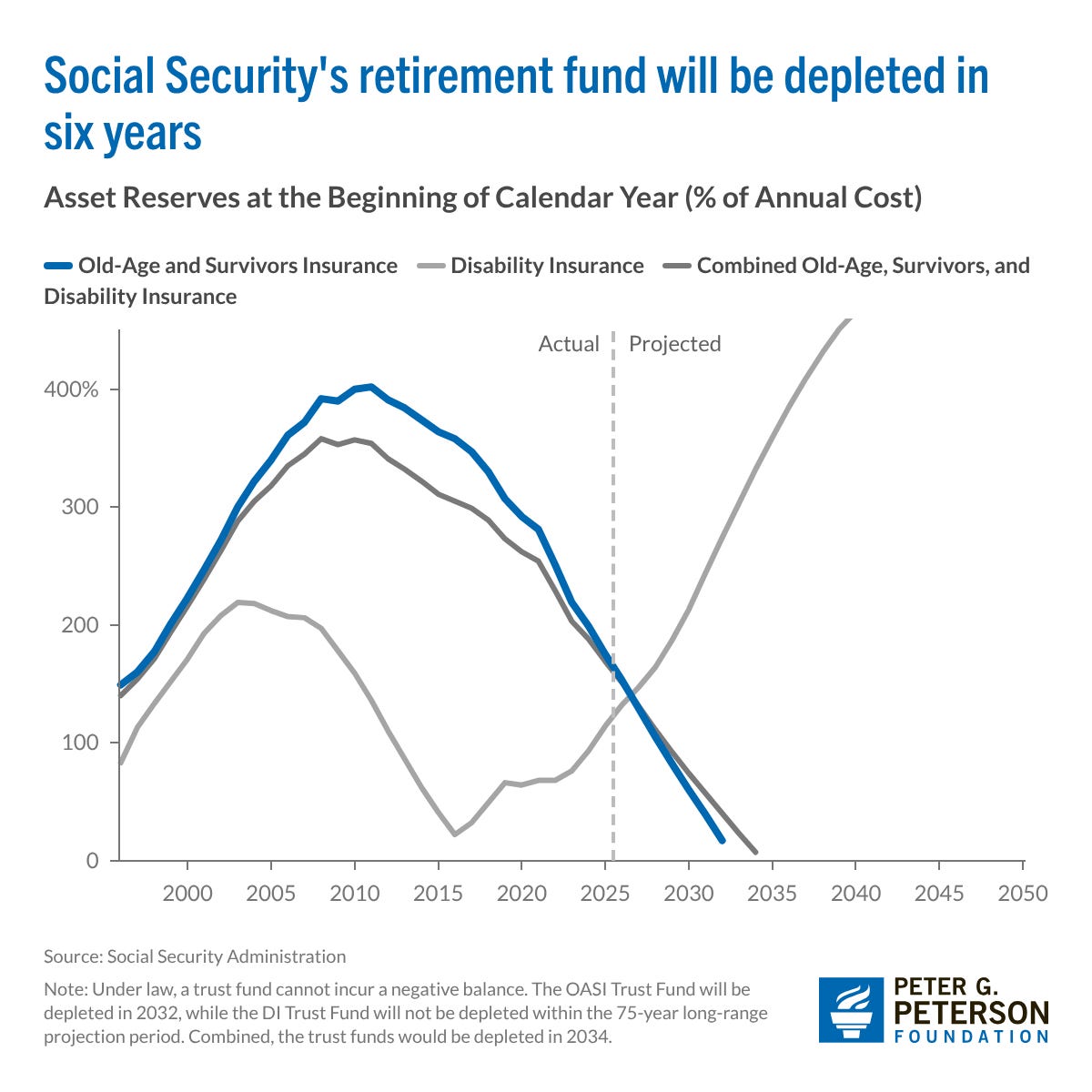
At the same time that the soaring federal deficit is threatening to upend treasury borrowing and the US economy, the Social Security Trust Fund is also racing towards insolvency. Earlier this week, the trustees of the Social Security Trust Fund moved up their projected date for the fund’s insolvency to 2032, just six years from now.
__________________________________
I first wrote about this impending crisis last year: Social Security is on the Brink
____________________________________
Currently, the Social Security Trust Fund provides 22% of the payments that Social Security recipients receive each month. 78% of each payment is funded by the SSI taxes that are collected from workers who are currently employed, and their employers. When the trust fund is depleted, the only source of revenue will be funds provided from current workers and employers, so SSI recipients would see their benefits drop immediately by 22%. I believe that the probability of that happening is zero. Something must be done to close the gap, and something will be done to close the gap, but the choices are getting more expensive each passing day, and our elected representatives - both Republican and Democrats - are doing absolutely nothing to resolve the issue.
There are a number of ways to resolve the shortfall, but each of them will cost something. Doing nothing is not an option. “Keep your hands off my SSI” is not a strategy. Doing nothing will result in a 22% reduction in everyone’s benefit, starting in six years. One option would be to simply raise the amount of money that is collected from current workers. There are two different ways to make that happen. One is to raise the current rate of tax from 6.2% to a higher rate. Currently employees and their employers each pay 6.2% of current earnings 12.4% in total, on earnings up to $184,500. There is no tax on earnings above that number, and that is part of possible fix #2: taxing earnings above $184,500. People who earn up to $184,500 pay 6.2% in tax, a maximum of $11,439, but people who earn $1 million dollars pay the same $11,439, which is only 1.14% of their income. Most folks who do not earn $1 million annually feel that those folks should pay more. I agree. The last potential fix would simply be to push back the age when people can elect to start taking their benefits. Pushing back the full benefit age from 66/67 to 70 would bring the benefit more in line with current retirement plans for most workers. There is no reason or necessity to alter any current benefits for current recipients. I know that the AARP feels the same way and they probably have more sway with Congress than I do.
If any of these solutions had been implemented thirty years ago, the cost of fixing the problem would have been far less than what it will cost now, but Congress did not have the courage to act. As we approach ground zero on this matter, Congress will finally decide who will share the pain, and how, and likely each of these three fixes will be a part of the ultimate solution. I am absolutely certain that a solution will be worked out and passed - just in time. In the meantime - and this is the most tragic part of this story - people are being scared into making really bad, and very costly decisions about the timing of their personal SSI payments. For many if not most people, the best time to start collecting your social security benefit is at age 70. Yes, there are situations when this is not true and an earlier date will be appropriate, but in most situations—for recipients who live to their life expectancy and have a cash flow that does not require immediate SSI payments to make the math work in retirement— delaying benefits until age 70 is usually recommended. For most recipients, payments started at age 70 are 32% higher than payments started at 66. In our current situation, many people, afraid that their benefits “will not be there” are electing to take an earlier—and lower— payment immediately, which is then locked in for the rest of their life. Many retirees are afraid that their social security benefit will not be there when they are seventy, and that to me is a criminal offense on the part of Congress. Their constituents are being frightened into making terrible decisions that could cost them thousands of dollars annually in retirement income, and all because our Congressional representatives are afraid to make the hard but necessary decisions to fix the problem now.
There are many positions that I want to hear about from our congressional candidates in the upcoming elections, but among the most important are the candidates’ recommendations for addressing the SSI shortfall and curtailing our unsustainable federal debt. In an ideal world, this should not be a partisan discussion, but the reality is that a resolution is grounded in deciding who will bear the brunt of funding the shortfall—businesses or their employees, or wealthy taxpayers who have had most of their income go untaxed—or SSI recipients will receive less than promised. Congress has to find the courage to call for the tab and let everyone know how the bill is going to be paid. Each constituency has its own partisan agenda, and each has a political party that best represents those interests. Who do we want to have in office to best represent our own interests? The next Congress will (hopefully) be tasked with finding the solution. The thirty three senators elected in this cycle will most certainly have to vote on a solution in the next six years. The window of opportunity to solve these problems is closing fast. If Congressional candidates do not have policy positions with recommendations and solutions and the courage to stand by them, they have no business running for Congress.
~~~~~~~~~~~~~~~~~~~~~~~~
The Peter G Peterson Foundation issued a white paper on Wednesday with their takeaways from the Social Security Trust Fund Trustees report issued this week.
You can read their comments here.
~~~~~~~~~~~~~~~~~~~~~~~~~~
Comments and suggestions are always welcome, as are Shares. If you like what you have read and you would like to receive a Saturday morning email with the current week’s Adirondack Diary update, please consider subscribing. All posts are public and available for free.
~~~~~~~~~~~~~~~~~~~~~~~~~~~~~
Join the conversation on Facebook @ My Adirondack Diary
Join me on BlueSky@ northcountryjoe.bsky.
Comments
Nothing yet. Say the first thing.
Sign in to join the conversation.