
In the summer of 2008, when the economy was beginning to wobble and the news seemed to get worse by the day, I found myself unexpectedly cut loose from the consulting firm where I’d been working. Unsure of what came next, I retreated to my parents’ house while they were away on vacation, using the quiet weeks to research schools for retraining and halfheartedly hunt for a new job. My father and I had, years earlier, stumbled into the world of military surplus firearms, back when Russian and Yugoslavian stock was flooding the market and Mosin–Nagant rifles could be had for less than fifty dollars—a different era entirely.
Those weeks, in that familiar rural place of rolling hills and deep green woods, I decided to take an old friend out to the backyard range. It was the sort of place where you could shoot just about anything, so long as you weren’t reckless. As kids, we’d swung swords and makeshift spears, traded pellet guns and .22’s, and daydreamed about medieval battlefields—but this time, it was different. The weapon on the table was an AK-47. My friend, a blacksmith and occasional martial artist, was no stranger to strength or impact, yet the sudden, physical authority of a 7.62mm round caught him off guard. He admitted there was something about it—something raw and a little frightening—that no hammer blow could match.
Among shooting enthusiasts, rifles and pistols are common ground: AR-15s, old bolt-action warhorses, even the occasional submachine gun or light machine gun aren’t all that rare in the right circles. But there exists another category of weaponry, a threshold between small arms and true artillery—machines that speak with a voice heavier and deeper than any rifle can match. Almost entirely absent outside of military hands (though a few lucky collectors hold transferable Oerlikons), these are the realm of the autocannon.
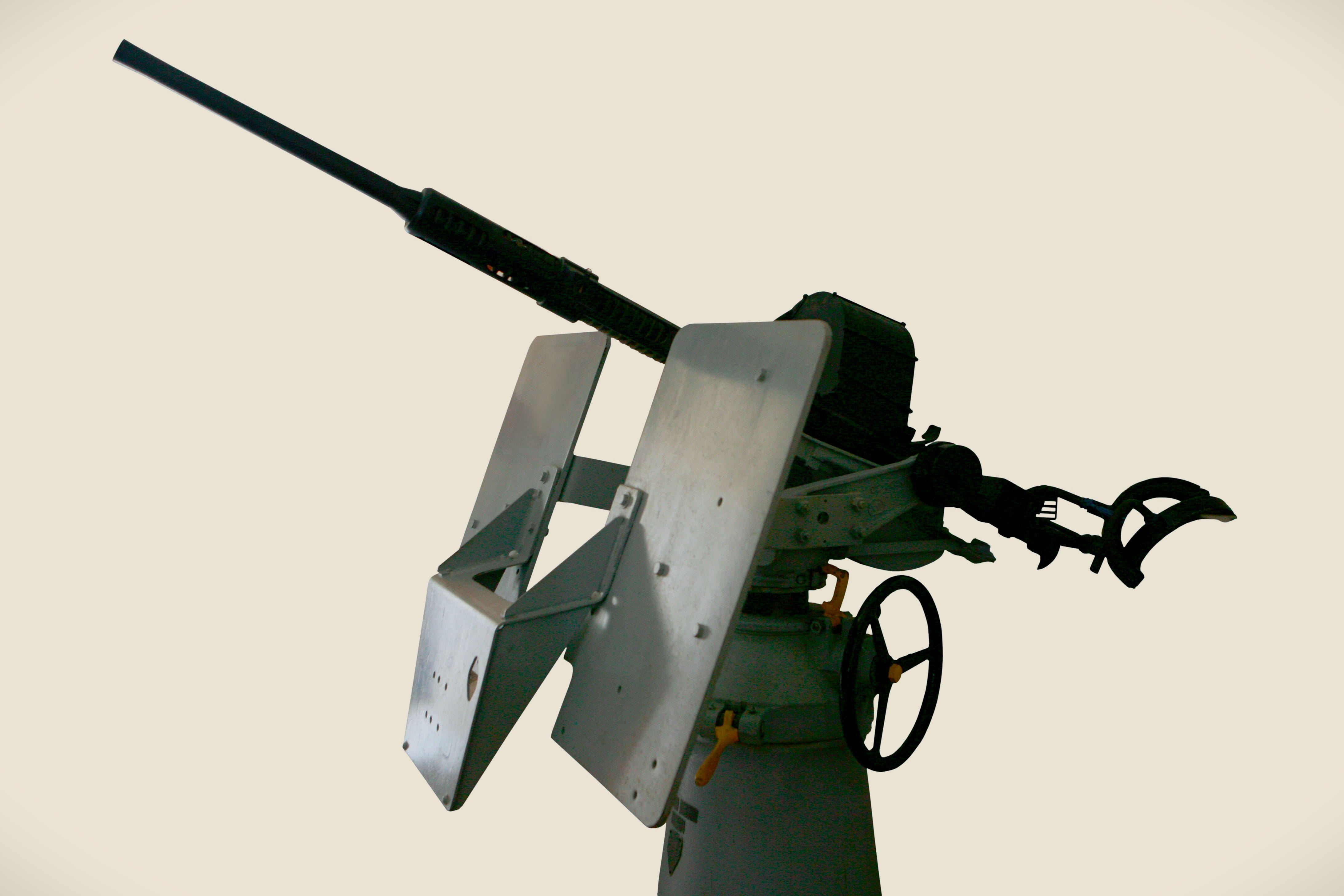
Autocannons are fully automatic weapons chambered for cartridges larger than .50 caliber (12.7 mm), bridging the gap between heavy machine guns and artillery. Unlike small arms, they can fire a variety of specialized ammunition types, including armor-piercing (AP) rounds for defeating armored targets and high-explosive (HE) shells for damaging aircraft or soft targets. This versatility makes them suitable for a wide array of combat roles.
The primary roles of autocannons include heavy fire support where machine guns lack penetration, use in aircraft and vehicle armaments, and as versatile anti-air and anti-vehicle weapons. Compared to artillery, they have a much higher rate of fire, shorter range, and are often mounted on mobile platforms.
Their roots, or at least the ideas behind them, trace back to early breech-loaded swivel guns of the 17th and 18th centuries, which allowed for mobile, comparatively fast firing, firepower in the age of muskets and piracy. Breech-loading swivel guns could be deployed by two men, and reloaded with powder and shot using removable canisters. Later designs like the Hotchkiss revolving cannon of the late 19th century, which offered rapid, sustained fire at a time when most artillery was still slow and cumbersome, modernized the concept by applying the Gatling gun model to naval deck guns.
Development: 19th Century and World War I
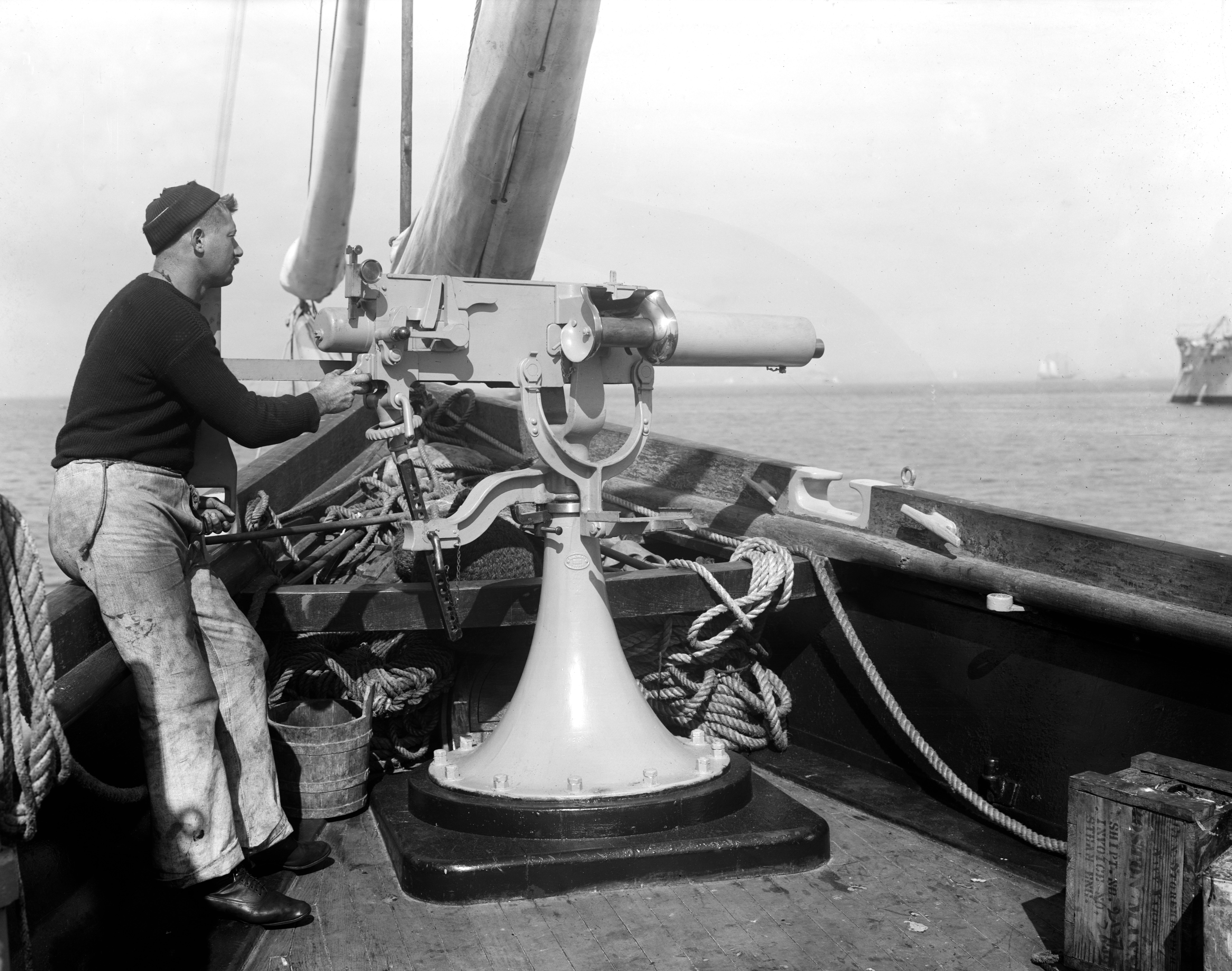
The late 1800s saw key breakthroughs in automatic large-caliber weapons, most notably the Maxim "Pom-Pom" gun, designed by Hiram Maxim in the 1890s. Essentially a scaled-up Maxim machine gun chambered in calibers up to 37 mm, it was one of the first successful autocannons. Adopted by several nations — including Britain during the Second Boer War (1899–1902) — it proved effective in both anti-air and ground roles during its service, including World War I. Germany followed with the Tank und Flieger (TuF) gun in 1918, a 13.2 mm heavy Maxim variant intended to counter early tanks and low-flying aircraft. While never quite reaching the size or firepower of a true autocannon, it reflected early attempts to bridge machine guns and cannon technology.
Germany also pioneered one of the first practical aircraft and anti-air autocannons with the Becker 20 mm cannon, designed by Reinhold Becker in 1916. Simple, blowback-operated, and lightweight, it was used late in WWI on seaplanes and ground mounts. Britain experimented with larger-caliber aircraft guns such as the COW (Coventry Ordnance Works) 37 mm gun, designed around 1918 for use against airships and bombers. However, the heavy, slow-firing design was not yet suited to widespread operational use, and such concepts would have to wait for improvements in metallurgy, ammunition, and recoil systems before becoming practical.
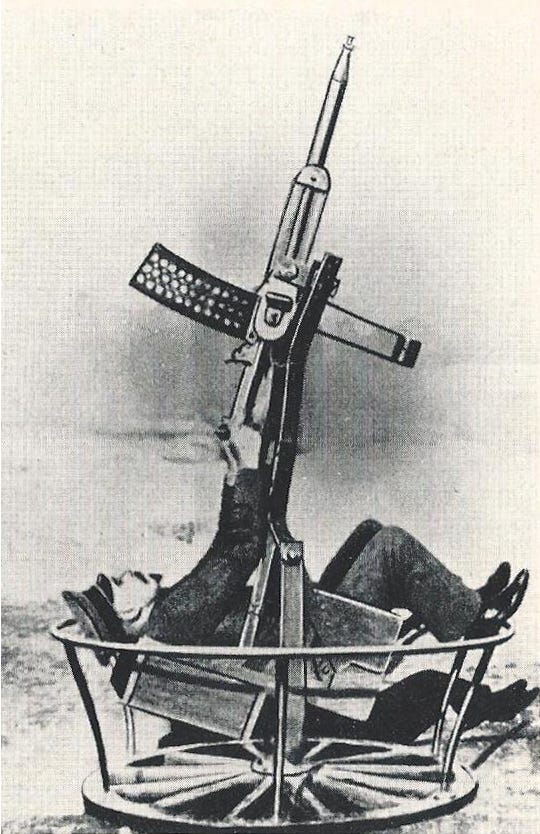
During the interwar years and World War II, autocannon technology matured rapidly. Germany’s MG FF and later MG 151 (20 mm and 15 mm) provided high rates of fire for fighters like the Bf 109, while the MK 108 30 mm cannon, designed by Rheinmetall-Borsig and adopted in 1943, offered devastating short-range firepower against Allied bombers. The British developed the Hispano-Suiza HS.404 under license, first adopted in 1938, which became the RAF’s standard fighter armament and was used by the U.S. as the M2 20 mm. Japan fielded the Type 99 20 mm series, and the Soviet Union deployed weapons such as the ShVAK and VYa-23 for both aircraft and ground roles. By the war’s end, the autocannon had cemented itself as the dominant aircraft armament, replacing heavy machine guns in most front-line service.
World War II
By WWII, aircraft were faster, tougher, and often armored, making rifle-caliber machine guns largely ineffective. Even the .50 BMG, while effective, had limits in range and penetration against heavy bombers and armored fighters. Autocannons like the German MG 151/20 and MK 108, Soviet ShVAK, and British Hispano-Suiza became standard.
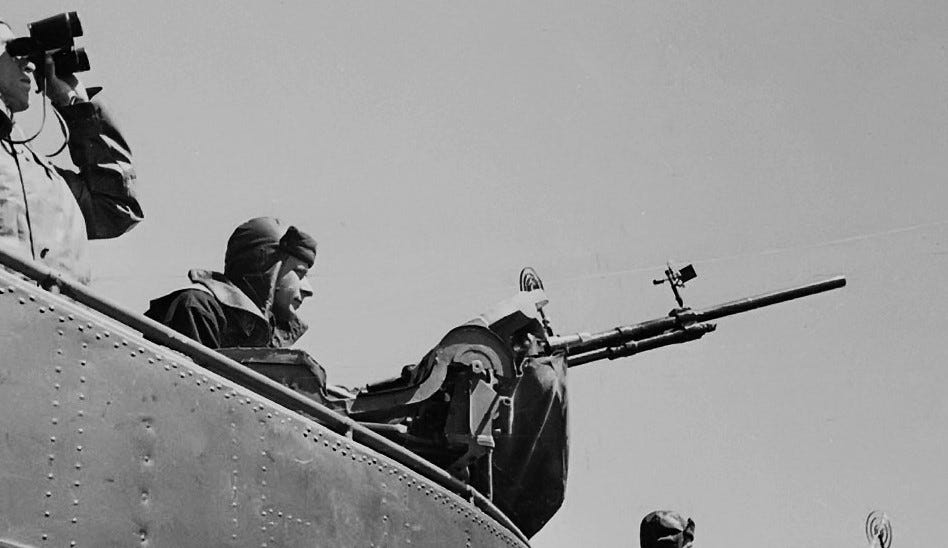
On the ground, anti-aircraft autocannons such as the German FlaK 38 and Soviet 37 mm guns were often turned on enemy infantry, vehicles, and fortifications. However, large-caliber weapons brought challenges: heavy recoil made them hard to fit on lighter aircraft, and ammunition capacity was often severely limited, as seen in the Stuka G’s BK 37 cannon pods.
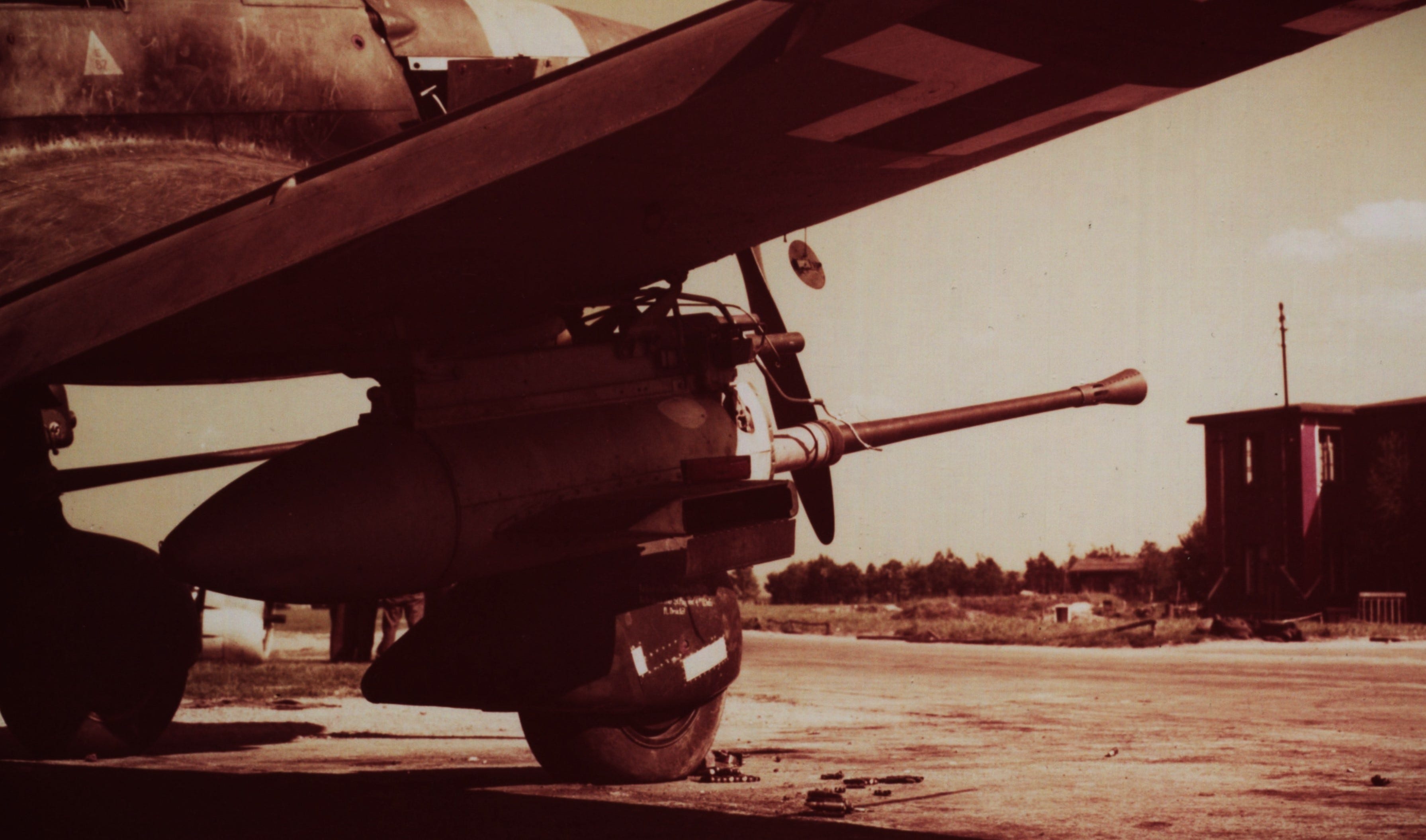
The proliferation of autocannons over .50 caliber was most visible in German and Soviet forces. The US, while prolific in aircraft and naval autocannons, relied heavily on the Browning M2 for ground use, partly because its logistical ubiquity outweighed the advantages of deploying more specialized autocannons.
In the Soviet Union, the ShVAK 20 mm autocannon, designed by Boris Shpitalny and Semyon Vladimirov and adopted in 1936, provided a lightweight yet powerful aircraft weapon that could be mounted in wings, turrets, or synchronized through a propeller. Using a gas-operated mechanism and drum or belt feed, it armed fighters, bombers, and ground vehicles. While its smaller projectile was less destructive than some Western counterparts, its high rate of fire made it an effective air combat weapon, and it was produced in massive numbers — over 100,000 units — making it one of the most successful autocannons of the war.
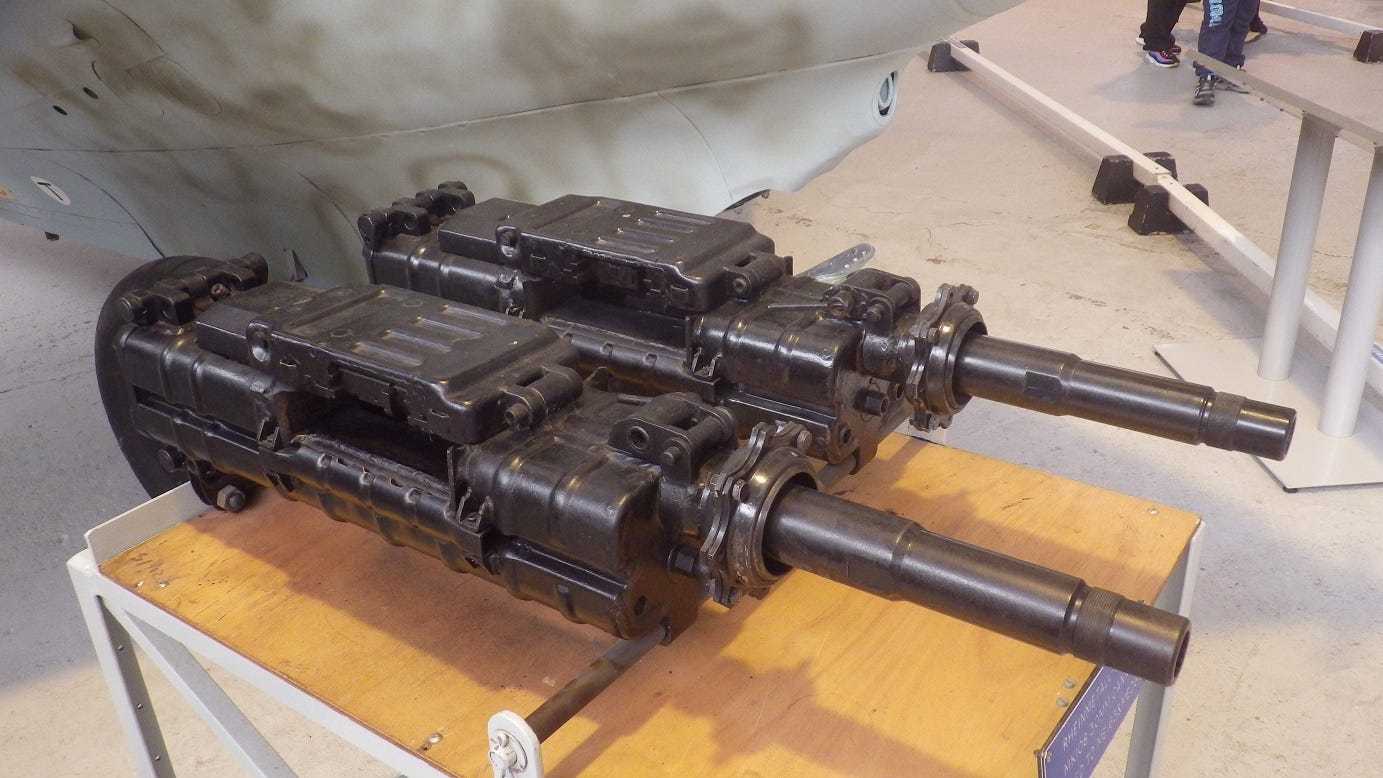
Germany, meanwhile, became synonymous with advanced aircraft cannon development during WWII, most notably with the MG FF, MG 151, and MK 108 series. The MG FF, an Oerlikon derivative adopted in 1936, gave way to the MG 151/20 in 1941, designed by Mauser and praised for its balance of firepower and reliability. The MK 108, adopted in 1942, used a low-velocity but heavy 30 mm round to devastating effect against Allied bombers. While each had strengths and weaknesses, collectively they defined Luftwaffe firepower and influenced postwar cannon development across NATO and Warsaw Pact nations.
Cold War to the Present
Following World War II, rapid advances in jet aircraft and armored warfare drove a new generation of autocannon development. In Britain, the ADEN 30 mm revolver cannon, designed in the late 1940s by the Armament Development Establishment (drawing on captured Mauser MK 213C research), was officially adopted in 1954. Using a gas-operated revolver mechanism, it offered a high rate of fire in a compact package suited to jet fighters and served on aircraft like the Hawker Hunter, Harrier, and SEPECAT Jaguar. The French DEFA 550 series, adopted the same year, followed a similar pattern and armed a wide range of Mirage fighters and export aircraft.
In the United States, the M39 20 mm revolver cannon, adopted in 1952 and developed by Springfield Armory, provided a balance of velocity and rate of fire for fighters such as the F-86, F-100, and F-5. However, as air combat speeds increased, the U.S. adopted the M61 Vulcan in 1959, a six-barreled electrically driven Gatling cannon designed by General Electric. With a firing rate exceeding 6,000 rounds per minute, the Vulcan became the standard gun for U.S. fighters and inspired derivatives like the Phalanx CIWS for naval defense
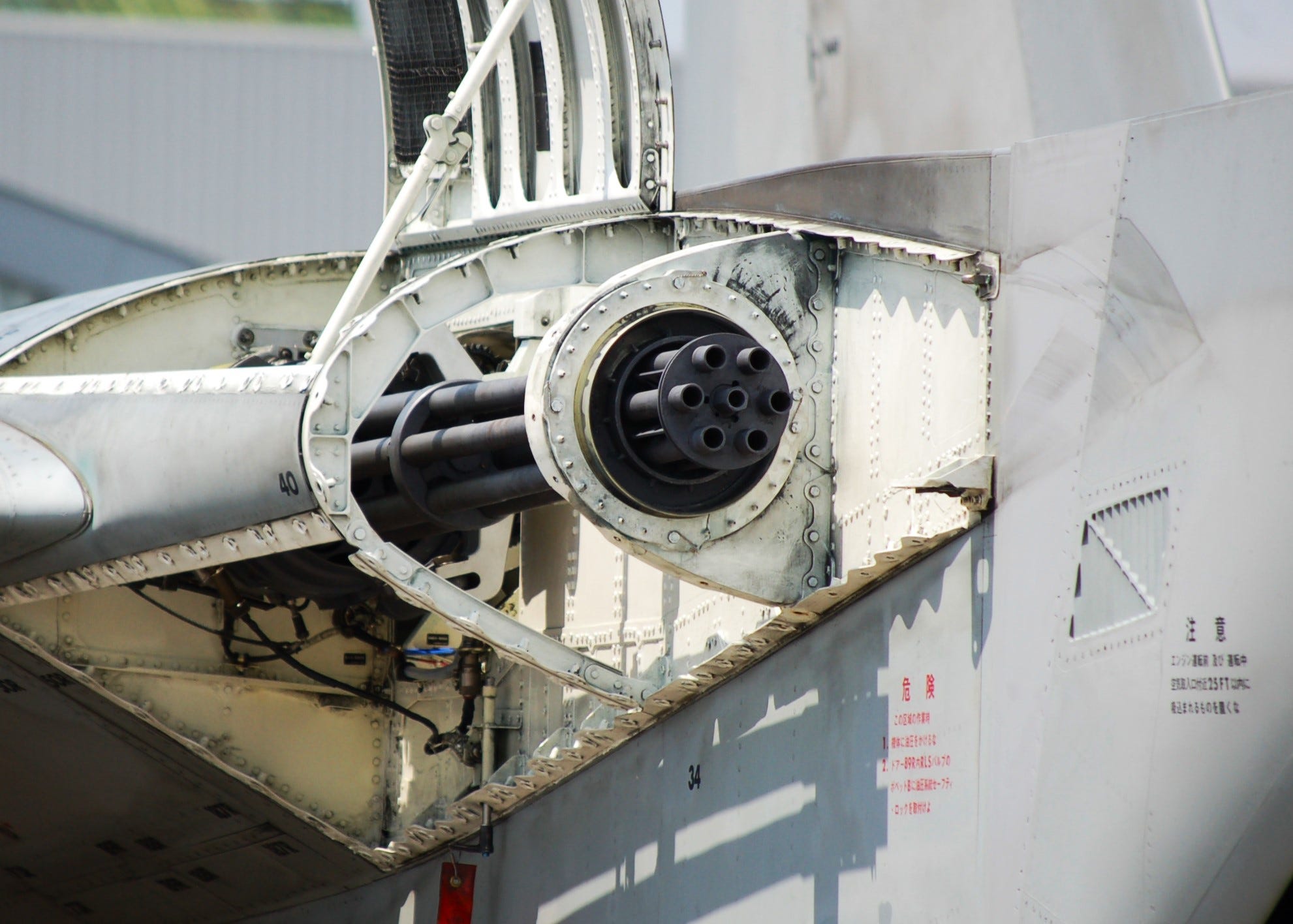
.The Soviet Union countered with designs by Vassily Gryazev and Arkady Shipunov, including the GSh-23 twin-barrel cannon (adopted 1965) and the GSh-30 series (from 1974), prized for their high rates of fire and light weight. Into the 21st century, autocannons remain integral to both air and naval warfare — from the Eurofighter Typhoon’s Mauser BK-27 to the A-10 Thunderbolt II’s GAU-8/A Avenger — continuing a technological lineage that began with the earliest belt-fed guns of the 1890s and evolved into precision, high-speed weapons for modern battlefields.
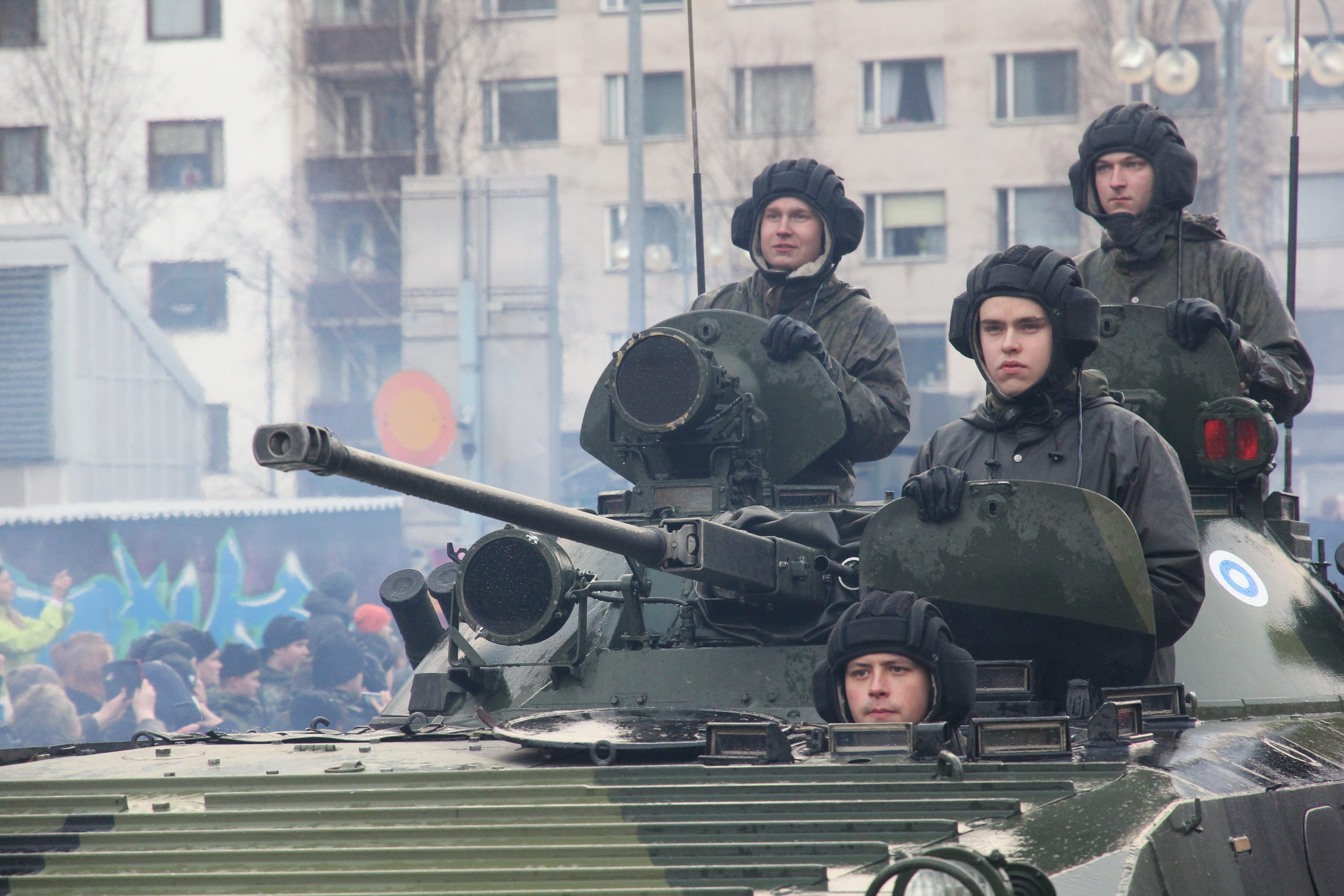
The Cold War cemented the autocannon’s place in modern warfare. Infantry fighting vehicles like the US M2 Bradley and Soviet BMP series mounted 20–40 mm cannons, providing mobile, rapid-firing firepower. The Soviets continued to field a wide range of autocannons for aircraft, vehicles, and infantry, while the US retained the M2 for many roles but developed heavier weapons for specialized platforms.
Helicopter gunships emerged as new autocannon platforms: the Soviet Mi-24 Hind used fixed and flexible cannons, while the US employed the M197 and multi-barrel rotary cannons on AH-1 Cobras and AH-64 Apaches. Air superiority and ground attack aircraft brought the autocannon to new extremes, from the US GAU-8 Avenger on the A-10 to the German BK-27 on Tornados.
In the 21st century, new designs are coming on line to update the autocannon. One notable example is the 40CT (40 mm Cased Telescoped) cannon, jointly developed by CTA International — a joint venture between BAE Systems (UK) and Nexter Systems (France). Unlike traditional autocannon designs, the 40CT uses cased telescoped ammunition, where the projectile is fully enclosed within the propellant case. This arrangement shortens the overall cartridge length, allowing for a more compact weapon system without sacrificing ballistic performance. The 40CT can fire a variety of advanced ammunition types, including armor-piercing fin-stabilized discarding sabot (APFSDS-T) rounds capable of defeating modern IFV armor, programmable high-explosive general-purpose rounds (GPR-PD-T), and airburst munitions for engaging infantry in cover or drones.
The weapon has been adopted for next-generation infantry fighting vehicles and reconnaissance platforms in both France and the UK. In the British Army, the 40CT equips the AJAX family of armored reconnaissance vehicles, specifically the Ajax reconnaissance variant and the Ares support vehicle. The 40CT is also mounted on the Warrior Capability Sustainment Programme (WCSP) prototypes, intended to upgrade the Warrior IFV fleet (although that program has faced cancellation and delays). In the French Army, the cannon is integrated into the Jaguar EBRC (Engin Blindé de Reconnaissance et de Combat), a wheeled 6×6 armored reconnaissance and combat vehicle designed to replace the AMX-10RC and ERC-90 Sagaie.
By employing the same 40CT armament across multiple platforms, both nations aim to streamline logistics, training, and ammunition supply, while ensuring their forces have a future-proof weapon able to defeat emerging armored threats well into the mid-21st century. The system’s combination of compact design, high muzzle energy, and advanced programmable ammunition represents a significant step forward in autocannon technology, offering lethality levels traditionally associated with larger 50–60 mm guns but within a smaller turret footprint.
Conclusions
From the slow-firing swivel guns of the 19th century to today’s high-tech, radar-guided CIWS, the autocannon has proven to be one of the most adaptable and enduring weapon systems in military history. Its ability to deliver sustained, high-caliber fire makes it invaluable against a wide range of targets, and while missiles have taken over many roles, the autocannon remains indispensable wherever rapid, versatile, and high-volume fire is needed.
Autocannons take the power of conventional firearms and turn it up to 11, still understandable to the average shooter but not quite rising to the level of the truly big guns. 20mm autocannons are just barely not out of reach of civilian collectors, particularly if we include semi-auto anti-tank rivals of World War II vintage in the definition. Laahti 20mm rifles and Swiss Solothurn guns are sold amongst collectors, registered under the NFA as destructive devices. Destructive devices are tightly regulated, but without the registry closure of the Hughes Amendment which drove machine gun prices into the stratosphere. So long as fired with custom made solid shells (surplus explosive shells are of course a no-no), such weapons are legal to own if the proper process has been followed
.
No posts
Comments
Nothing yet. Say the first thing.
Sign in to join the conversation.