
Recently, I was speaking with a dear friend who’s spine is slowly fusing, leaving him with pain and limited mobility. He expressed a desire to learn Taiji from me, but admitted that driving to me would put him in too much pain. I thought about ways I could help him. Could we do a zoom meeting, where I trained him remotely? It would take away some of the hands-on training, but it could work. However, I knew I would need to work on how I train the form. I would need the time to break it down into even smaller components to benefit him. And what about his neck mobility? He has very little mobility, only able to turn his head very slightly without agony. It was time for some shosin.
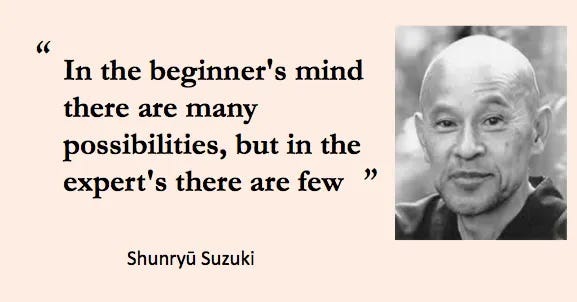
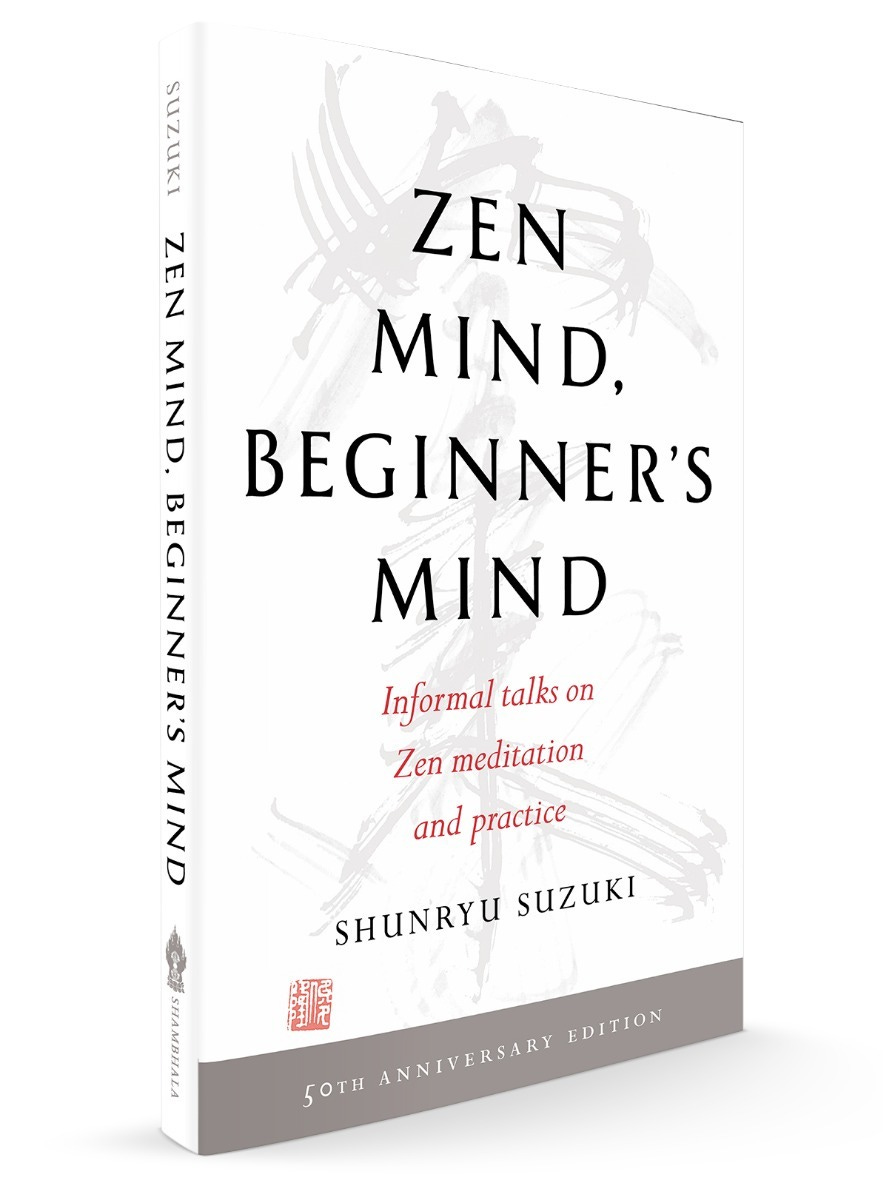
The first formal book I read on Zen Buddhism was “Zen Mind, Beginner’s Mind” by Shunryu Suzuki. In this book he speaks about cultivating shosin, or the “beginner’s mind” as a full time practice. As this was my first study of Zen, when I read it I was already a beginner and 18 years old, so I’m afraid that concept was a little lost on me. I mean, sure, I could relate to it by thinking about learning how to drive, something I do that’s now almost automatic. But when you cultivate beginner’s mind as a regular practice, all the things you do by rote get that focus you only had when you were first learning them. Only now, you (hopefully) have some additional wisdom to back it up. You discover old habits and new methodologies and you access your inner teacher —the most important teacher in your life. You also get a reward, but you’ll have to read to the end to find out what that reward is.
I’ll admit that my practice of the form has fallen away dramatically over the last year. It unfortunately came down to a lack of space in my house. I mean, technically I can do my Taiji form in a 1 x 1 meter space, but I lose some of quality in the movements when I’m that restricted. Usually, we use the 1 meter constriction to help pull in students who put too much flourish on their hand movements or who step wider than shoulder width, throwing off their balance. Ideally, I need a 7 x 4 meter space to get all of the steps in. That’s a lot of room, and I lack a studio area that size. But, as fortune would have it, my wife rearranged our living room and I wound up with an area of around 6 x 3 meters, so I started practice again. It’s since gotten unseasonably warm this past week, letting me return to my back yard.
My first day of practice I had to actually consult my list of movements. I was too much in my head and kept forgetting the sequence. I had to tell myself to calm down, enter a Zen state, and relax. The next day, I got through the form without having to consult my notes. The next few days after that I focused on doing each movement correctly as I had learned them as a thinner, spryer 23 year-old. Focus on the feet, focus on the hands, focus on the hips, and focus on the breath. One discipline each day. This wasn’t shosin, yet. I would compare it more to driving a standard transmission after years of driving an automatic. I learned how to drive “stick” when I was 16 and have driven a stick shift off and on for a few years at a time, but the majority of the time I’ve owned automatic cars. So when I get back into a standard car, I have to focus for a bit on clutch-shift-throttle until it comes back to me and is automatic once again.
Shosin is more than that. It’s not just refreshing your abilities, it’s re-learning them as if for the first time and discovering something new.
“Practice doesn’t make perfect, practice makes permanent. Only perfect practice makes perfect permanent.” - Sifu Bill Parkinson (my teacher)
Let’s look at the stick shift analogy (and apologies for the younger readers who never learned to drive stick) from a beginner’s mind. It’s time to change the gear. You put your hand onto the shifter, push in the clutch with your left foot, and lift your right foot off the throttle. You then engage your arm to move the shifter to the next gear. From first to second gear and from third to fourth gear it’s a simple movement of moving from an upward position down to the gear. But from second gear to third gear, it’s a tricky run from the lower second position, through the middle Neutral, horizontal line, up to third gear. You have to engage your shoulder to move your arm outward. Once in gear, you have to ease your left foot off the clutch while performing the opposite task as you apply your right foot back to the starter.
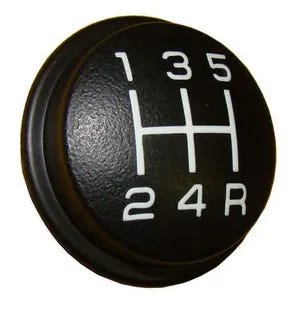
Now, experience those movements one shift at a time. What muscles are you engaging? What are you feeling for?
Now imagine if you had an injury that makes one of those actions difficult? What could you change to make the movement even easier?
What if you have a tight shifter that requires you to muscle through shifting, or an “easy” shifter after having driven a tight shifter for a while?—I literally broke a shifter off once.
Approaching the activity with a beginner’s mind can help you make corrections in your old habits and teach yourself new ones that make the task easier for your new situation. Once you have it down, you can return to “doing it all by rote for efficiency,” or you can remain in beginners mind and see what else you can learn.
If you didn’t, that’s okay.
The idea is to apply beginner’s mind to whatever task you run on automatic from time-to-time and see if you can pick up anything new. This is particularly valuable when your situation has changed, but can have equal value at any time. Maybe you’ll discover you weren’t doing a particular element of a task correctly. Maybe you’ll have insight into something that broadens the element and applies it to more than just the task at hand.
Time is, as Einstein stated, relevant to the observer. Once you have entered beginner’s mind your time will seem to slow down as you dispassionately observe the moment, but that doesn’t mean your action necessarily needs to slow down. I mean it will while you are learning to enter Shosin, but once you’re able to enter it at will, you can move at a normal rate while your mind can simultaneously observe, analyze, and appreciate the moment. Ask yourself this:
What is my mind doing in that moment when I’m doing a task by rote?
Odds are you’re thinking of another thing entirely during the action. In other words, you’re distracted. In the time it takes for you to shift from first to second gear, you might be thinking about a song you’re listening to, the errand you’re running, or maybe something that somebody said earlier (or ages ago). Your mind is on the future or the past. It knows you’ve “got this.” You’ve done it hundreds of times, right? It’s automatic. It doesn’t require it’s attention because that would be boring to only think about what’s happening right now. The past or the future are much more interesting, right?
Whenever I would catch a student in their head, I would ask them: “where are you?” The first time I ask that, they would say something like: “umm…the practice space?”
“More specific,” I’ll say.
“[name of the town]?” they’ll ask.
“More specific”
“[name of the state]?”
“More specific.”
“Earth? The Milky Way Galaxy?”
“Where are you physically right now?”
“Well, I’m here, and…”
“That’s right. You are physically here. Where do you need to be mentally?
“Here,” they would say sheepishly.
“Good. Now, what time is it?”
“Um…” they would look at the clock, “[time estimate]? Oh wait! It’s NOW.”
“Very good. You need to be both physically and mentally in the here and now. Whatever is going on there and then, doesn’t need your focus.”
If you drive, you probably drive a lot. So much so, that thinking about “there and then” won’t seem that invasive. But it’s a distraction, and I’m sure we’ve all had those moments of momentary distraction as we hurl our 80 MPH missiles down the road and nearly get into an accident because of it. Maintaining beginner’s mind keeps our awareness on the here and now, so we can avoid those near accidents. After all, every other driver is likely living in their own there and then moment and likely have even worse distractions in their vehicles, so keeping your mind on the moment can save you having to call your insurance companies, or worse. But let’s not turn this into a PSA about distracted driving.
After I got my Taiji “sea legs” back I focused on the movements of the form, applying beginner’s mind to each movement in relation to two things. First, the limited movement of my friend and second, the changed movement I now had in my 50s.
As I explored this, I discovered that my own practice had introduced torsion when there didn’t need to be any. For example, when performing Lu 捋 or “Roll Back,” you shift your weight to your back foot, lifting the forward foot, move your left arm in a low arc across your body from a front-facing position to a back-facing position, while your right hand moves to protect your throat.
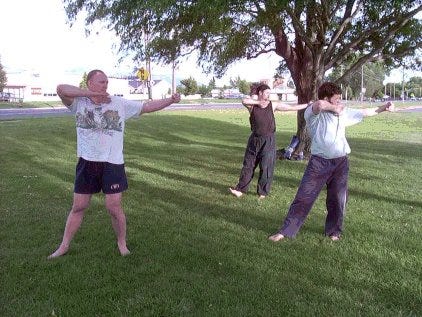
In this very old photo, I’m in the back. Student 1 hasn’t completed his weight shift, but has completed his arm movement. Student 2 has really turned his head and his his right hand too high. But looking at my posture, I can see that my head is turned more than necessary. That was a bad habit that I had already developed.
Shosin taught me that I had slipped into even more bad habits while performing the movement. I wasn’t following my hand back, which meant I was putting too much torsion into my rotator cuff as well as my upper spine. I wasn’t moving my hip like I was supposed to anymore, and I was treating the movement as almost unimportant.
Under Shosin, as I moved into the posture I followed my weight shift and my hip position, and watched my arm going back —as I had been taught 30+ years ago— and discovered that the head turn could be much less. A 90 degree rotation is not required and, I realized, not recommended. Keeping my face at a 45 degree angle allowed me to see my hand just as easily as I do at 90 degrees and I found I could shorten it even more to 10 or 20 degrees and still see my strike target. This meant that I would see the strike my right hand was there to defend against in my periphery and give me an opportunity for an appropriate reaction.
And that’s just one example. I found, and am still finding, many other places where I was just “going through the motion,” and when I apply beginner’s mind to those places, I discover bad habits and unnecessary movement. My form is changing in small, meaningful ways, and feels new again.
As promised, here’s the reward for beginner’s mind. When an experience is new, we humans get a dopamine rush, rewarding us with a good feeling. It’s wonderful and as soon as it has passed, we want it to come back. But that experience can’t be new again, we tell ourselves, so we have to go get another new experience. But with beginner’s mind, I’ve been able to have a new experience with something I’ve been doing for over 30 years each time I do it. Was most of it “old”? Yes. But those moments of discovery and adjustment, made it feel new again, and my old friend dopamine came rushing in, just like the first time I learned it.
By applying the Zen concept of Shoshin or Beginner’s Mind to my Taijiquan practice, I was able to find areas of improvement and guide myself toward teaching my friend with limited movement and being a better teacher.
If you supported the last Shaolin Nun Kickstarter campaign, you know that we didn’t make our funding goal. I’ll be re-launching the campaign in one month on or around April 20, 2026. Watch this space for the official announcements.
Since it was fun to dust off my Sifu knowledge and to better tie that knowledge directly into Shaolin Nun, next week I’ll discuss the “super power” we all have access to and how we explore that in the pages of Shaolin Nun.
No posts
Comments
Nothing yet. Say the first thing.
Sign in to join the conversation.