
I want to begin with a picture. This is AI generated and belongs to a fairly common genre:
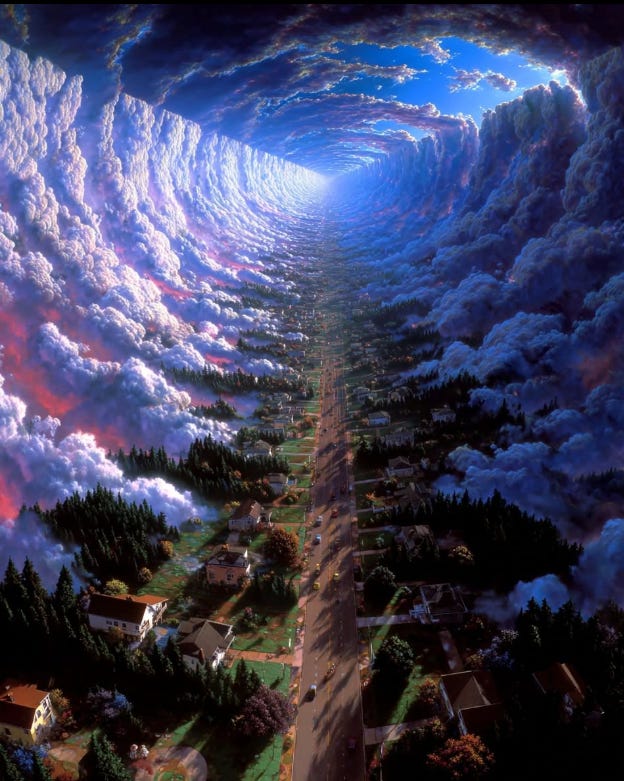
If you follow any content pages on social media, especially the more Boomerized platforms like Facebook, you’ll see a lot of this. This one in particular is a representative specimen. There’s a certain surrealistic quasi-kitsch to images like this. It’s the sort of thing one would expect from Thomas Kinkade if he’d done enough drugs to paint something slightly interesting. It has all the coziness and warmth of a Hallmark card, but the surreal elements get the warmth past your guard so you actually feel it. The “standing on the edge of heaven” quality lands only because the subject matter is slightly warped, so it gets past the bug zapper of cynicism that normally kills cliches before they can affect us. So, for a brief moment, we actually feel the heavenly, otherworldly aura that Kinkade’s kitsch vainly reaches for. It’s the same feeling one gets at finding a childhood favorite in an old stack of paperbacks or hearing the opening strains of Bach’s Cello Suite in G.
I said before that this forms a genre online and it absolutely does. “Liminal” or dreamlike AI-generated art of this kind thrives on social media for the same reason that Kinkade’s paintings were once popular: it’s just different enough to land a blow that would normally feel passe. Unsurprisingly, cliches are cliches because they appeal to something universal (or at least common) and this art is proof in the pudding. People generate acres and acres of this stuff using midjourney and ChatGPT because everyone seems to love it. For all the comparisons I’ve made to the much-maligned Kinkade, I can’t fault them for that.
So, what blow is landing here? What are these recombinant AI-paintings doing for us? What did that image do to me that made me squirrel it away on my Macbook? Why did I go to all the trouble of reverse-engineering the prompt that created it using ChatGPT so I could make one of my own?
To begin with, we get impressions from our experiences. An impression, in the sense I’m using it here, is a little bundle of gut feelings that builds up over time. Every experience has a “smell”, an aura, if you like. There’s a texture and feel. When a lot of experiences share the same “smell”, they collectively leave their scent behind. That left-over is an impression. You might almost say that the impression is what’s left when you take a set of experiences, and subtract everything makes them unique. It’s similar to taking a group of planets and subtracting all the things that are different about them; all you’re left with is an abstract sphere.
Various schools of thought have different names for this. Plato made impressions, or something like them, into Forms. We forget the Forms at birth until something reminds us of them. Say, a spherical object reminding us of the eternal sphere. Likewise, modern psychology has a few terms that are close to this. They say “affective schema” or “gist memory”. Not quite the same thing, though.
The impressions I’m talking about, however, are a lot more abstract than Plato’s eternal sphere. A sphere, after all, is easy to define. But impressions can be much harder to nail down because they track very particular feelings. I’m using the term closer to how the psychologists do.
For example, take the hundred times you sat down eating pizza with your grandparents watching Cops in their basement, and the few dozen times you sat around playing Mousetrap with your cousins while the grandparents watched, and then that one time in the pool... you get the idea. Take all the cozy wholesome experiences from that certain era of your childhood. All those experiences add up, and they all have in something in common. The impression is that feeling of warmth and acceptance and fun. The kind of cozy family atmosphere that goes from being the best thing in the world as a child to reviled in adolescence to wistfully missed as a grownup.
It can be negative, too. People who have been to war might have an impression of what war was like. That impression is not just a memory of cleaning a rifle, not just the sound of mortar fire or the smell of bodies burning. It’s what all those things had in common. The left over impression, the average, is the memory of “how war feels”.
Careful, now. I’m not talking about nostalgia. Nostalgia is a generic feeling of missing your past. I’m talking about something more specific. You can feel nostalgic for any time in your life. But each different part of your past leaves a very different impression. There’s a difference between pining for your childhood home and the impression of one part of your childhood.
So when we investigate what it is in us that a picture like this touches, it’s best to proceed from specific to general. One gets a whiff of chalk dust, grabs a thread, and follows that thread back to the spigot, which turns out to be fourth grade. One looks at an AI-generated picture like this, puts one’s finger on a thread and follows it back. What threads are here?
Well, if you grew up in a neighborhood like the one in the picture (minus the celestial fever dream), you probably have a set of experiences to go with it. Those memories might include above ground pools, croquet mallets, and drinking water straight from a hose in summer. They might also include later memories; Seven Minutes In Heaven, Truth Or Dare, illegally streaming music, your sixteenth birthday.
Notice what the threads are: houses, lawns, enjoyment, hobbies, cars, golden sunlight, a heavenly or boundless feeling. The semiotic space seems to spin around innocence and safety. When we follow all the threads to the center of the web, that’s what we find. Innocence, minus watever finally smashed it. The feeling that life has always been like this and always will be; my family will always be here; this will always be home; I will never die.
(If your own home wasn’t safe, you might not have this feeling. Instead, you might have had a normal friend with a normal house where their normal family did normal things. That might have seemed like Heaven on Earth.)
Now, I understand that there are some people in this world who can look at a picture like this, feel that familiar pang for the home-that-maybe-never-was, and just sit with it pleasantly aching for a while. I am not such a person. You see, people like me cannot just let that emotional knife sit there and bleed. Oh, no, we’ve got to twist it, because our abstract intellect is a cheeky Mephistopheles who needs to file an objection every time we innocently feel something.
As soon as I see that picture, Mephistopheles starts: “Objection, Your Honor. This can’t possibly last forever. This can’t be what death is like.” I try to argue back that it doesn’t matter whether it could last forever. It’s just an image, right? I just want to imagine that the golden summer sunsets of my childhood could stretch into a cozy bucolic eternity.
Of course, that doesn’t work on Mephy-meph. Little bastard is persistent.
“You see,” says Mephistopheles, “Suburbs come with a time stamp. The suburb is purely a creature of the 21st century. The suburb assumes the invention of the automobile; post-war land use policies; the emergence of the nuclear family; the internal combustion engine; the arrow of technological progress; the march of history. Every single facet of this image of yours is contingent, and is, historically, a flash in the pan.”
And now, since that was all so dense as to be incomprehensible, I’ll need to unpack it.
There are some images that are timeless, or at least feel that way. A throne; a stone palace; a mountain; a farm; a mill wheel. Humans sat on thrones and farmed for millennia, so those images have a certain feeling of eternity. A throne isn’t like a Barbie doll or a jet plane. It doesn’t feel contemporary. Tolkien’s poem about Durin the Deathless says, “A king he was on carven throne”, and we feel the endlessness of that, like looking down a long stone hallway at something older than memory. Durin wouldn’t be as compelling in a business suit, carrying a musket, or using a telegraph machine. Those things belong to a certain historical era, a certain time and place. They lack the feeling of aseity that comes with crowns and scythes. Of course, thrones and crowns are historically contingent too, but they feel timeless. They existed long enough to apparently defy historical situation.
But the suburb comes timestamped. Things like cars and two-way streets and cul de sacs made from asphalt stick out like a sore thumb. They existed for mere decades rather than millennia, so their temporality aches through their depictions. The compelling (if illusory) eternity of older symbols simply isn’t there.
Mephistopheles - that little shitass - gives his crooked grin and says, “The prosecution rests”. I can gaze wistfully at the AI suburb for a moment. But analytic thinking thrusts its icy little scalpel-fingers into the cracks, and the fantasy disintegrates. The impression turns out to be, unfortunately, an illusion. There never was any paradise. The thing sitting like lead in my chest is a phantasm, a vagary of memory that never was rooted in anything besides my own inability to properly archive the specifics.
Or is it?
Let me talk about those impressions a little bit more.
Recall what I said about impressions. They consist of commonalities not specifics. All those experiences have in common, not suburban living, but the scale and safety of childhood. Childhood is a small world. And, if you were blessed to have a normal childhood, it was, at least most of the time, a safe world. The smallness of childhood makes it feel like something that never ends. The sun goes down, but there is no finality in that sunset; it will rise tomorrow and you’ll wake up in your room and your parents will be there the way they always are. There are roads, but they’re not roads that carry you away from your parents’ house forever. Rather, they’re roads that might take you to a cul de sac you haven’t seen to have some childhood adventure of safe danger. There is a sense of innocent circularity, that all will be well in the end.
Is that feeling really an illusion? You certainly did experience those things, didn’t you? The impression is abstracted from real experiences, isn’t it? So it really did show up in those experiences, did it not? It showed up the same way the abstraction of “square” shows up whenever you see a square thing. Was it really there?
Yes, it was. It may not have lasted forever. It may have been indelibly marked by its contingent historical situation. It wasn’t eternal.
But why does it feel eternal?
No posts
Comments
Nothing yet. Say the first thing.
Sign in to join the conversation.