
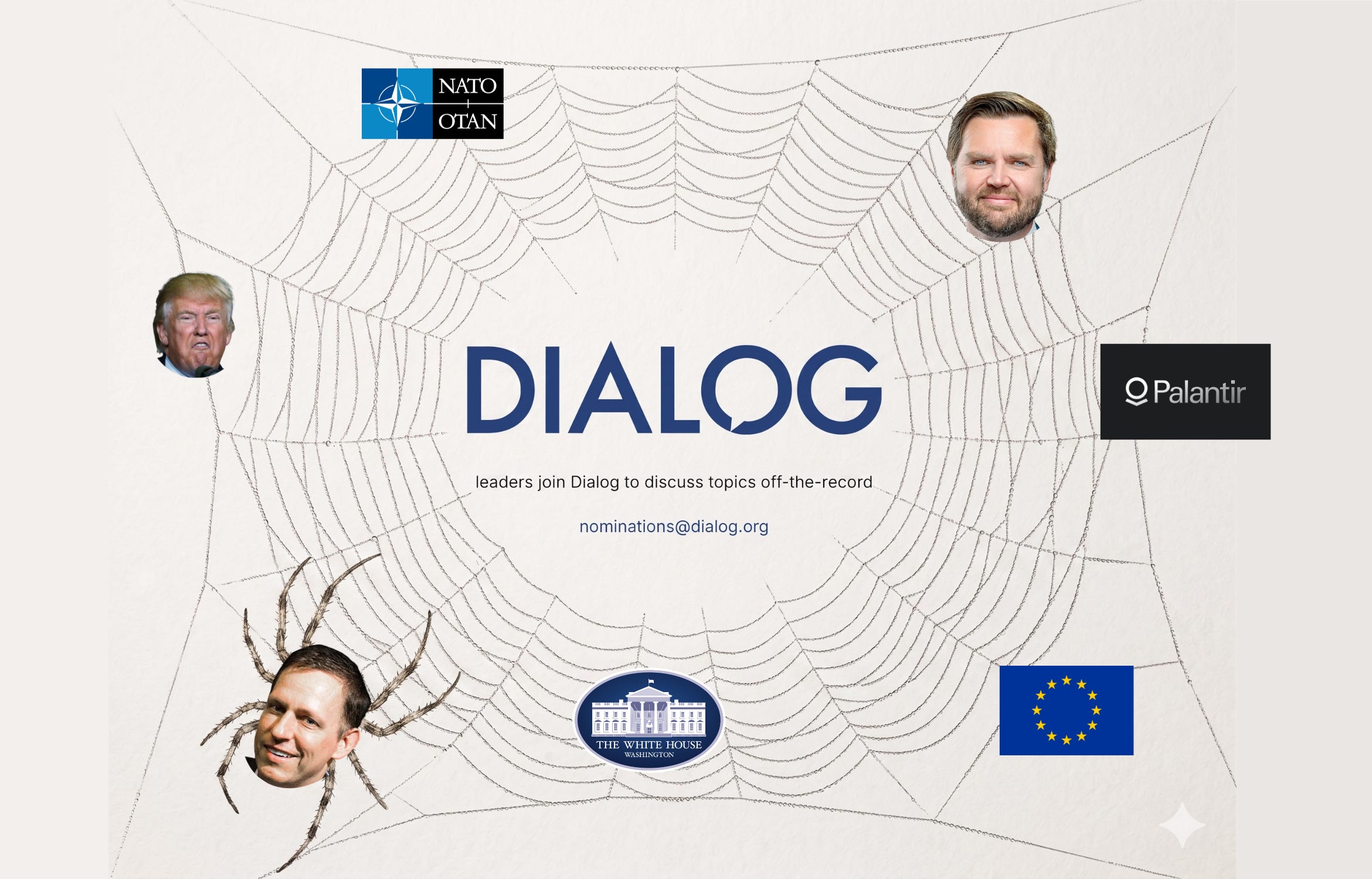
In De Morgen of June 23, journalist Jorn Lelong writes about a secretive organization called Dialog, which has been meeting for over 20 years to discuss topics such as “Navigating WWIII”, “How to Build a Cult”, and “Democracy Under Surveillance”. The club is an initiative of Peter Thiel, the tech entrepreneur known as co-founder of PayPal and now Palantir. Had hackers not broken into the website of this “discreet organization”, we would never have known that this was a Thiel initiative, what is discussed within the organization, or who its guests are.
If you know Thiel’s philosophy at all, the themes on this edition’s agenda are not innocent thought experiments - they are far-reaching ideas that align with the worldview of Thiel and other technocrats who currently hold enormous power. This is what sets Dialog apart from, say, the World Economic Forum in Davos or the equally secretive meetings of the Bilderberg Group. This potentially goes much further.
In my book F//ck The System, and other bad ideas for the future, I analyze the forces behind Trump. People still tend to think that Trump is the loose cannon who single-handedly determines how he deals with the US and the rest of the world. The reality is more complex. Trump is the brutal front-end of a very well-organized back-end. He is the battering ram who thinks, says and does unthinkable things, but behind him lies a carefully developed program of measures spelled out in detail in the so-called Project2025. This is a playbook drawn up by the Heritage Foundation, an ultra-conservative think tank that has been trying to steer American policy since the 1980s - and with Trump II is succeeding perfectly. Their goal is to bring America back, morally and ideologically, to a nostalgic vision of the 1950s: a conservative, white, male, and above all Christian world, away from all those liberal modernities such as democracy, social emancipation, personal freedom and, most importantly, equal rights for everyone.
And Peter Thiel happens to be one of the most important figures in this movement, for three reasons. He operates at a unique and unprecedented intersection of interests and influence: technology, religion and the White House.
Thiel is one of the most important figures in contemporary American technology. He founded multiple companies and investment funds, but is today best known as co-founder of the American data company Palantir, which works primarily for governments.
He is also a key representative of the TESCREAL movement - a motley collection of techno-utopians who often hold troubling ideas, but for whom technological progress is sacred, even at the cost of social and democratic values. TESCREAL is the acronym for:
Transhumanism: transcending, improving and extending the human being through technology
Extropianism: the pursuit of endless human evolution, without limits
Singularitarianism: the quest for AI that surpasses human intelligence
Cosmism: the belief that humanity’s future lies in the universe, not necessarily on Earth
Rationalism: pragmatic reason over emotion or tradition - the right of the strongest as a starting point
Effective altruism: “doing good” based on emotion or intuition is a sign of weakness, replaced by measurable output and data-driven results
Longtermism: a positive outcome in the distant future takes precedence over current moral concerns, institutions, values and norms
If that sounds confusing and threatening, that’s because it is. In my book I describe in more detail what each of these concepts means, but they all share one thing: they are the legitimization behind the bizarre thinking and behavior of some of the most powerful tech entrepreneurs in the world.
Thiel is considered a key adherent of the so-called Dark Enlightenment, a neo-reactionary movement that rejects progressive values and advocates for a society in which authoritarian, technology-controlled CEOs and technocrats create a post-democracy. This resembles nothing so much as the old feudal systems, in digital form. Figures such as Curtis Yarvin and Nick Land are considered the founders of this movement, with Peter Thiel as an important lever behind the scenes through money, technology and political influence.
It is therefore no coincidence that Thiel believes “freedom and democracy are incompatible” - and that his company Palantir is geared toward realizing this worldview through technology. Palantir builds the data infrastructure that makes unprecedented surveillance possible. George Orwell couldn’t have imagined it; the Stasi in the former East Germany could only have dreamed of it.
Meanwhile, Palantir is embedding itself like a digital nervous system in the most vital organs of multiple countries and institutions: intelligence services, the military, police, immigration enforcement. Data sources that were previously separate - and therefore limited in their power - are being merged into one all-knowing system, aimed at surveillance and the targeting of (internal) enemies. Palantir has been used by the now-disbanded DOGE to recklessly dismantle government services, by ICE to brutally track down undocumented immigrants in the US, and in numerous military operations to map targets, including in the Middle East. It is an instrument that gives the Americans a run for their money against China’s surveillance practices. For skeptics: in April 2026, Palantir posted a 22-point manifesto on X that political scientists are reading as a blueprint for what they call techno-fascism.
What makes Peter Thiel particularly striking is that he is also deeply religious. This seems like a contradiction: in the tech world of Silicon Valley, there is generally no room for religion. As a student at Stanford University, he was influenced by the French Catholic philosopher René Girard, leading him to develop a set of distinctive religious ideas - often a harder interpretation of Girard’s own positions. At the core, Thiel believes that people are fundamentally bad and driven by mimetic desire: we always want what the other person has and wants. He argues that without the restraining force of religion, humanity would descend into total destruction.
Perhaps even more alarming is his fascination with the end times, the apocalypse. At various private gatherings in San Francisco and Rome, he has spoken about the Antichrist and Armageddon - not as mythological or religious metaphors, but as references to real power structures (such as the UN), real individuals (such as Greta Thunberg), and real developments such as climate action or the pursuit of peace and security. His belief in original sin leads him to reject the ideals of the Enlightenment by definition: the human being is inherently corrupt.
For Thiel, Europe is the ultimate symbol of everything that can go wrong in this regard. Every time Trump, Vance, Rubio, Hegseth or other Americans attack Europe as a decaying continent - pointing to its lack of religion and its “open borders” policy as the problem - it is now clear where that narrative originates.
To “save” the West from this vision of decline, Thiel promotes a revival of a hard, culturally Christian identity. This is one of the reasons he became the mentor of JD Vance, who converted to Catholicism partly under Thiel’s influence. Together, they are trying to reshape American politics into an alliance between the Christian-conservative right for the ideology (the strategy), and tech-authoritarian capitalism as the instrument to realize that worldview (the tactics). If you are now spontaneously thinking of The Handmaid’s Tale, that is not a coincidence: author Margaret Atwood drew her inspiration in the early 1980s from conservative movements that were then emerging - and are now at the controls.
On the surface, Thiel appears to avoid the spotlight and stay largely out of politics. Although he was the first tech entrepreneur to back Trump in 2016, you will rarely see him in the president’s entourage alongside Elon Musk, Jeff Bezos, Larry Ellison and many other tech billionaires. And yet Thiel arguably has the greatest influence on American politics - or at least, he soon will.
That link is JD Vance, the American Vice President. Vance was at Stanford University in 2011 when Thiel gave a presentation there about technology and the worldview described above. It made an enormous impression on Vance - who at the time still went by the name James David Hamel. Vance went to work for Thiel in Silicon Valley, and Thiel introduced him to the world of technology, money and power. In 2022, Thiel helped him win a seat in the US Senate through substantial financial and political support, and around the same time introduced him to Trump. Vance had initially been a fierce opponent of Trump during his first presidency, but Thiel was able to convince both men to have Vance nominated as Vice President. It was also Thiel who played a central role in Vance’s conversion to Catholicism.
The significance of this history lies in the succession scenario: with Trump now the oldest president in US history, it is increasingly realistic that Vance could succeed him before his term is up. That would make Vance - Thiel’s protégé, brought to power by him - the head of the United States and thus the most powerful person in the world. It would shift Thiel’s influence from indirect to potentially direct and executive. Where Trump has neither ideology nor strategy, Vance - and Thiel behind the scenes - have both in abundance. That should worry us in Europe.
Dialog is, in essence, Thiel’s private think tank, where he brings together CEOs, politicians and academics to discuss the future of the world. Although the organization has been known for some time, it maintained an extremely low profile - no membership lists, no disclosed topics. The recent ethical hack changes that, and it should give us pause. For the Dublin retreat in August 2026, 222 people registered. The reported list includes senators from both US parties (Cory Booker and Ted Cruz), US Treasury Secretary Scott Bessent, Elon Musk, Eric Schmidt, the CEO of YouTube, senior Microsoft management, NATO’s top commander in Europe Alexus Grynkewich, and also Ezra Klein, the progressive commentator at The New York Times. Plus a handful of actors and other prominent figures.
Some attendees now claim they had no idea what Dialog actually was, let alone that Thiel was behind it - entirely plausible given the organization’s discretion. That does not change the fact that the topics being discussed are at the very least troubling, and that direct or indirect influence on attendees regarding certain parts of the agenda and the organization’s worldview is a real possibility.
Thiel’s ideological and technological influence has penetrated US policy so deeply that it has become a European problem too. As I have argued before, the White House’s National Security Strategy is effectively a declaration of cultural war on Europe: the US wants Europe to follow its shift toward a conservative, Christian social model. Since Europe as a whole shows little appetite for that, the Americans are not above calling for “resistance from within”, throwing their unconditional support behind radical right-wing parties across Europe. The underlying conservative forces driving that policy are the same ones that Thiel steers - or that may even be steered by him and his circle. Every day it becomes clearer that the cultural alignment between the US and Europe is eroding, and that the old partnership no longer exists.
And that brings us to our technological dependency. Palantir is used here too, as part of our defense and security architecture. From NATO to a range of individual countries, all are using technology developed by a company and individuals like Thiel who hold deeply troubling ideological views - people for whom abolishing democracy as we know it has become a goal, and for whom liberal Europe is an explicit thorn in their side.
We talk increasingly about digital sovereignty. Let this be the moment to zoom in on what that actually means in practice. Concretely: no, Europe cannot simply use technology that is inherently and ideologically opposed to Europe. We do not buy Russian Zircon cruise missiles or Iranian Shahed drones either.
If you look only at how effective Palantir’s technology has become, without grasping what lies behind it, the temptation to use it is understandable. We should resist that temptation. The French intelligence service DGSI’s recent decision to stop using Palantir and invest in sovereign alternatives is an example for all of us. And the recent Anthropic Claude Fable 5 incident - demonstrating that the US has no qualms about using technology as a weapon against its (former) allies - is a stark warning of the risks Europe faces if it remains technologically dependent on others.
In my new book, F//ck The System, and other bad ideas for the future, I describe how Europe is confronted with the collapse of the old world order and the rise of authoritarian ideologies, but also how precisely in that crisis lies the seeds of a new paradigm. This builds on innovation, sensible choices and democratic values, with which we can make Europe strong and self-confident again.
I raise this question whether Europe can become an important force in the world of tomorrow, also as a keynote presentation for customers, relations or employees.
Interested? Contact me to discuss the options further!
No posts
Comments
Nothing yet. Say the first thing.
Sign in to join the conversation.