
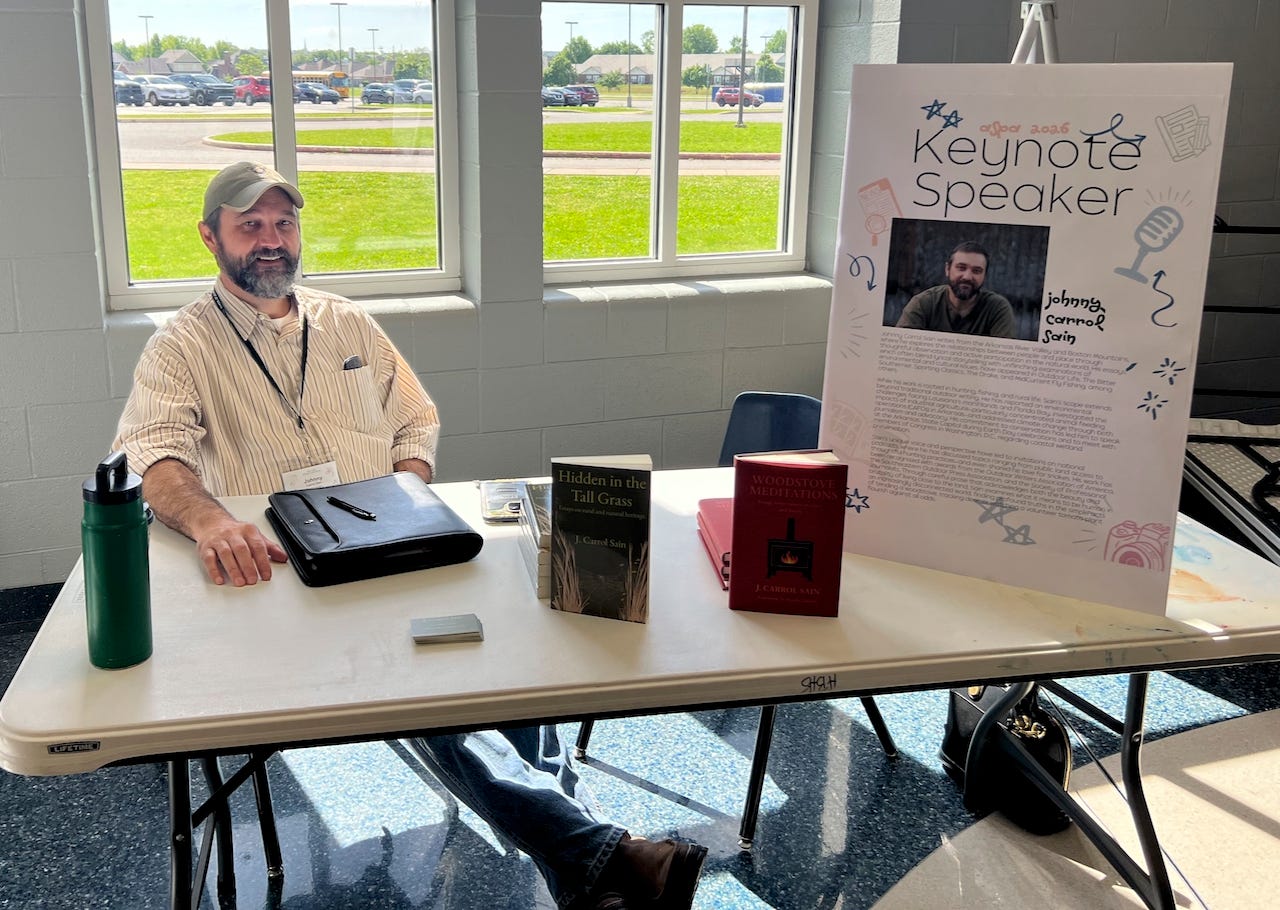
I wasn’t sure how the moonshine anecdote would go over with parents and teachers, and I suspect there was great surprise when I named James Baldwin as an inspiration. But it was an honor to deliver the keynote address to young journalists and storytellers at the 2026 Arkansas Scholastic Press Association convention this past weekend.
Let it be known, as it likely already is, that public speaking is not my strong suit. But I want to get better, and I look forward to more opportunities in the future. Below is the speech verbatim and in its entirety. I hope the young folks were inspired.
Good afternoon.
Thank you to the Arkansas Scholastic Press Association for the invitation to speak today. Truly, I am honored. I’m also a little nervous.
I have spoken in several university classrooms. I have spoken to members of Congress in Washington, D.C. I gave a speech on the steps of the Arkansas State Capitol some years ago. But this is my first-ever keynote address. And there’s lots of high school students and teachers in the audience. And all of my recurring nightmares include a bunch of high school students and teachers.
The most terrifying of those horrible dreams features me trying to fake my way through a public speaking assignment behind the podium at my high school alma mater.
We’re not in Atkins, Arkansas, and this is not 1980-something, so this isn’t quite my worst nightmare come to life. But the scene feels mighty familiar.
If, after my delivery, you are inclined to lay blame at the feet of someone for selecting me as keynote speaker, you should know those feet belong to Karla Sprague.
I met Karla some years ago at an Arkansas Society of Professional Journalists get-together. I don’t recall the nature of the event. Anyway, Karla was there introducing journalism students to working journalists and whatnot, and we happened to be seated at the same table. We hit it off, and then she started reading ol’ Johnny Carrol Sain’s work, and here we are today.
Have you ever noticed how rare it is for grown-ups to use their first and middle name regularly?
Man, I used to hate my middle name. It’s a hand-me-down. It was my dad’s middle name, too. I’m a junior.
From earliest memories, hearing my middle name jammed right behind my first name, typically with emphasis, meant bad news— “Johnny Carrol, get your hind-end back out here and finish splitting that kindling. Johnny Carrol, you need to explain this report card. Johnny Carrol, why is there a snapping turtle in the bathtub?”
And then in junior high, when my unisex middle name became widely known, the potential for name-based teasing doubled.
Come on now, I know the first thing y’all thought when you heard “Sain” was “insane.” You know you did. Everyone does.
I finally embraced my middle name well into adulthood, and for purely professional reasons. I have a famous relative also named Johnny Sain, middle name Franklin.
This crowd likely has not heard of him, but back in the 50s and 60s, he pitched in four World Series and coached in four more. He was one of the last pitchers to face Babe Ruth and one of the first to pitch to Jackie Robinson.
They made a little poem about him and his starting pitcher, Warren Spahn, the best known line is “Spahn and Sain better pray for rain.” Suffice to say, he was a very good baseball player, and that’s a tough act to follow on Google. I was always popping up on like the fourth page.
And if you don’t pop up quick in a Google search, do you even matter?
I kid, I kid. In truth, I believe Google is a ridiculous marker for validation. But we live in ridiculous times, don’t we?
We also, by many measures, live in spectacular times. We are, right now, living in the most democratized state of human communication the world has ever known.
It’s a double-edged sword, a good-news-bad-news situation, as a journalism professor once explained it to me. He said: The thing about the internet and social media is that now everyone has a VOICE. And the thing about the internet and social media is that now EVERYONE has a voice.
No matter how much I pine for the old days and the old ways of doing things, I owe a lot of my success as a writer to the digital age. While I’ve had several works published in print, the majority have been electronic. One of my first nationally published essays was digital. The subject was Scots-Irish culture.
As much as I love to talk about Scots-Irish culture, I’ll refrain from such here, mostly because we don’t have time to indulge my inexhaustible capacity to talk about Scots-Irish culture.
All you need to know for the purpose of understanding this forthcoming anecdote is that if you have lived in Arkansas, or really any rural area in the US—some metro areas for that matter, dependent on geography—you have been introduced and likely influenced, at least a little, by Scots-Irish culture.
So I write this essay about how Scots-Irish culture has not only shaped a lot of American culture in general over the near 250-years of our nation’s existence, but about how a lot of our political polarity at that time could be ascribed to some folks in this nation leaning more heavily into the Scots-Irish component than others.
The essay was picked up by a national publication only because I had found this Pennsylvania writer—a journalist and book author—on social media whom I enjoyed reading. And after reading some of my work this gentleman believed I possessed some storytelling ability that deserved a larger platform than the local publications I’d been writing for.
He vouched for me. More than that, actually. He gave me the editor’s email address and encouraged me to drop his name.
About the time the article was published, this Pennsylvania writer invited me to an annual gathering he hosts for various scribes, editors, and other assorted intellectual types.
At first, I declined the offer, citing some fictitious excuse. But the real reason was that I worried about being outclassed. I didn’t figure I’d have much in common with any of the “East Coast elites” I’d encounter there.
And coming from humble beginnings—I was raised in a blue-collar home, I’ve eaten a lot of commodity or government cheese (ask your grandparents about how good it was), and I was once a pig farmer for Pete’s sake. So this was, I thought, a reasonable concern.
But then I got to thinking about the potential networking opportunities, the chance to meet folks who could not only offer knowledge but maybe a byline. So we went—my wife, my youngest daughter, and myself—we drove 18 hours to an event that I figured to be simultaneously inspiring and terrifying.
And it was both.
Of course, everyone there was nice as could be, and all were amazed by how far we had driven to attend. I’m sure a few wondered “why” but no one asked that question specifically.
And then there was our host, my new friend and, unbeknownst to him at the time, a prospective mentor, touting me to one and all as the writer who created this interesting work about why rednecks and hillbillies and others of our ilk sometimes think like we do, act like we do, and vote like we do. He carried on about how this remarkably insightful piece was published in a fairly major outlet not known for publishing this kind of stuff written by my kind of people.
Lo and behold, some folks in attendance had already read the essay—which blew me away. And a lot of them wanted to discuss.
So there I am—fielding questions from folks who knew next to nothing about the ways and beliefs that shaped me and, by that, shaped the essay. And all the while I’m wondering why they care so much.
What made the story I had written and the corresponding conversation so infatuating for them?
Somewhere toward the end of the evening, revelation came in a backhanded manner. As one of the listeners rose to make her way to the kitchen, she said:
“You know, I never expected to hear such articulate speech draped in an accent like yours.”
I was, and am, fully aware of my drawl. But back home, I sounded like everybody else. Here, though—three hours from New York City and two hours from Philly—my voice surely sounded like cornbread crumbling into a glass of cold buttermilk.
Now, there was certainly an opportunity to take offense at the comment. But instead, I came away with two positive discoveries about myself from the experience:
I learned that I take immense pleasure, some would say outsized pleasure, in the subversive opportunities that present themselves openly when I am underestimated because of my accent, my appearance, or my birthplace.
I understood the power of authenticity. Those folks read and were listening to a real-live hillbilly explain why hillbillies are the way we are. Straight from the horse’s mouth. Had they ever come across something like this before?
My inherent authenticity turned out to be a quality that I had dismissed, or at least overlooked in my work. Turned out that a lot of my perceived shortcomings, the inadequacies that convinced me I could never attain the respect I desired as a writer, were in fact my strengths.
I discovered that words—the foundational force powering civilization—become even more influential when imbued with authenticity.
***
Whether written, spoken, or sung, words are the mechanism of creation.
Words inform and evoke emotions, and thus inspire action. Words carve and bind, they contour the malleable abstractions in our minds, giving them form and substance.
Yes, the material constructions of all that we see are the products of physical blood, sweat, and tears. But in the beginning was the idea, and the idea just sat there, in the ether of our minds.
The idea did not do anything until it was given spirit through breath, pen, or keyboard.
It’s crazy when you think about the history. Reading and writing—practices once reserved for only the privileged elite and powerful, abilities once considered near divination, are now so commonplace that, well, I don’t personally know any adults who can’t read or write. Not everyone does either of those well, but most are passable.
Maybe that’s why words today seem cheap. When ya’ll get out into the job market as writers and editors, you’ll see exactly what I’m talking about.
Anyway, everyone has a voice now, the good and the bad of our new reality, and there’s not much you can do to change this reality.
You’re up against the harsh dissonance of “influencers” and “content creators”—two labels I never want affixed to my name—and now it’s not just humans you’ll compete against, but synthetic intelligence.
But you, like me, have an ace in the hole you never even knew about. It’s an intrinsic quality that already sets you apart from everyone else.
It’s your perspective, your voice, your quintessence—your authenticity.
Because no one can tell the story or share the stories of other people like you.
And people are hungry for authenticity, starving for it.
I’d argue that the current deluge of information as well as the heaping mounds of churned drivel designed only to get you to “click” has, in fact generated opportunities aplenty for authentic voices.
I’d argue that this lack of authenticity among perspectives shared across almost all media is one reason, a huge reason, why media distrust is at an all-time high.
All of us here know that a journalist, a storyteller, should possess some universal characteristics—honesty, integrity, skepticism, research skills.
But authenticity—an understanding of people, place, and culture that cannot ever be second-hand, that springs from something so seemingly trivial as your lived experiences. That’s where credibility comes from, and that’s how people know that you know what you’re writing, talking, or even singing about.
Loretta Lynn’s music was incredible because she was, in fact, a coal miner’s daughter. Okay, that’s a dated reference. For modern versions, let’s go with Tyler Childers and Sturgill Simpson. They sing about Southern mountain culture with legitimacy because they are products of Southern mountain culture.
Some of my favorite writers are among those considered icons of authenticity. Mark Twain is one that most here are familiar with (and this is ironic, which he likely found humor in, since that’s not even his real name). Another is Ed Abbey, who still heavily influences my writing and my thinking.
But at the top of the pile is James Baldwin.
Anyone here familiar with James Baldwin?
Through the late 1950s and 60s, Baldwin was a leading voice in the Civil Rights Movement as a writer and speaker. His book, The Fire Next Time, published in 1963, was a landmark work on race in America. He was close to Martin Luther King Jr., Malcolm X, and Maya Angelou.
Baldwin was born in 1924 in Harlem, New York. The son of a poor family, the oldest of nine children, raised by a strict Baptist preacher stepfather who struggled with mental illness. At 14, Baldwin became a youth preacher in a Pentecostal church. He later said those three years in the pulpit were what made him a writer—learning the cadence, the rhythm, the power of language to move people.
After high school, he couldn’t afford college. He worked odd jobs, wrote at night, and in 1948, at age 24, he left for Paris. He later said his luck was running out in America—he feared he’d end up in jail, or dead.
Paris freed him. Distance from American racism gave him the perspective to write about it with clarity—I find it supremely interesting that he had to leave home to better understand his home. There might be a lesson there.
His first novel, Go Tell It on the Mountain, was semi-autobiographical. His essay collection Notes of a Native Son established him as one of the most important essayists in the country.
But his third book, titled Giovanni’s Room, published in 1956, was what cemented his prominence in my mind. The book dealt openly with homosexuality—his publisher rejected it, advised him to burn it to protect his reputation. Editors feared the explicit homosexual content and the shift from Black American themes to an all-white cast would alienate his audience.
Baldwin also knew it would reveal his own sexuality to his family.
He found another publisher and did it anyway.
James Baldwin was a poor Black gay kid from Harlem who refused to let anyone else tell his story, and in doing so, told America’s story back to itself.
That’s the definition of being true to yourself. I consider him the very definition of authenticity as a writer.
And I’ll share his quote here, which should guide all of us in our storytelling endeavors:
“The responsibility of a writer is to excavate the experience of the people who produced him.”
From my relatively privileged perspective, I can’t imagine the courage it took to not only write with that level of authenticity, but to live it. But that’s the level I aspire to.
And I challenge you, young communicators and storytellers, to tell your stories, to speak your truths about how the world looks from the perspective of the people who produced you, with the same conviction.
And who better than you?
Who better to tell the story about folks down in Fort Smith losing access to healthcare?
Who better to cover climate change and how it affects not only agriculture as a business, but the life of farm families, some on land running back generations, its effects on the mental and emotional well-being of the people?
Who better to chronicle stories about how the more marginalized ethnic groups in our region are navigating their day-to-day lives as the presence of a more robust and motivated Immigration and Customs Enforcement agency looms?
Who is more qualified to write about how a world changing at breakneck speed affects and is affected by your people?
Who better than you who call this place home?
Who better than you who are a part of these communities, who speak in these familiar tongues, whether it be Spanish or maybe a thick Ozarkian accent. Maybe with a drawl flowing slow as January molasses. Maybe with speech often cluttered with Archaic phrases, indecipherable to folks not from here.
I recall a piece of journalism I wrote for a regional publication, one based in a state north of here and in a zip code decidedly more urban than where I come from.
The editor assigned to me on that piece was an MIT graduate. Heck, I thought MIT alums only spoke and wrote in numbers—mathematicians, engineers, chemists, and such.
I don’t remember if we ever discussed this gentleman’s field of study, but he was from New Jersey, and to say that the way I wrote and said things was not the way he wrote and said things is a huge understatement.
We battled over a few items—I won some, and I lost some.
I never faced opposition to who I am like James Baldwin stared down. But I won a fight with the editor over using the word “reckon.” And that victory still brings a smile to my face.
And those are some of the fights you gotta pick in an industry that seems to actively work against idiosyncrasies. Sometimes it feels like they want everyone to think and sound the same because that’s safe. We’ve got all these rules and styles, and, man, it seems like they want to homogenize these stories we tell about ourselves and our places.
Now I see you instructors and editors out there frowning and maybe glowering at me. Let me clarify that I am not advocating for writers to go completely rogue.
You’ve got to follow some of the rules. Grammar, of course. AP style, Chicago style, or whatever guides for whatever publications, of course. Those guides help us communicate effectively.
But I’m also saying that the spirit of the law—effective communication that rings with authenticity—should always override the letter of the law.
Of course, a competent journalist or storyteller hailing from anywhere on the globe can come to a place and do a passable job. But that kind of journalism and storytelling lacks context and nuance.
For example: If you want to understand a lot of why western Arkansas and Appalachia are the way we are, you should possess some understanding of moonshine and its Celtic whisky origins.
Parents, teachers, bear with me. This is not gratuitous, and I am not at all advocating. There is a larger, looming point I’m gonna make.
The economic significance of whisky for poor folks in Scotland and Ireland and then moonshine in Appalachia and the Ozarks, the scofflaw subversiveness of distilling and selling it, how that led to its cultural significance, and how all of that played a role in why white whiskey was still illegal even after the end of prohibition.
You absolutely need to understand all of that to understand why it transcended the category of homemade alcoholic beverage.
And then you can begin to understand the cultural distrust—often warranted, sometimes not—of centralized authority and taxation from the crown of England to the halls of the US Congress.
You’ll begin to comprehend that this loathing was forged with every busted moonshine still and the jailing of every enterprising distiller.
And then you can understand how all of that history has absolutely carved so much of my people’s identity today—both good and bad.
Yeah, you can find a lot of that information online. But what you can’t find in a Google search is the bone-deep context flowing through the bloodlines of, say, the grandson of a general store owner from Newton County, Arkansas.
The grandson of a man who kept his family fed by bootlegging moonshine on the side.
A grandson who can also write from the perspective of witnessing the problems inherent to alcohol—addiction, family turmoil, death at a young age.
This grandson can also write about the desperation of rural poverty and how its toxic vines intertwine with a family tree stretching across generations, and how that has shaped families, places, culture, how all of that affects attitudes and ultimately the direction of our nation.
You can’t find all that on a Google search.
Unless you Google Johnny Carrol Sain.
***
Young journalists. Young storytellers of every type. This is where you come from, and these are your people.
Their perspective on the events of this world matter, and who better to communicate that perspective than you?
The stories of your place and your people matter. And who better to share these stories than you?
Don’t let the masters of media, the slaves to mass appeal, and the unquenchable thirst for “clicks” dictate the stories you tell.
Never retreat from who you are.
Understand that your words—maybe now more than ever—matter.
And now—right now—is the best time in human history to amplify stories and voices long muted.
There is absolutely no one more qualified to tell those stories than you.
Comments
Nothing yet. Say the first thing.
Sign in to join the conversation.