
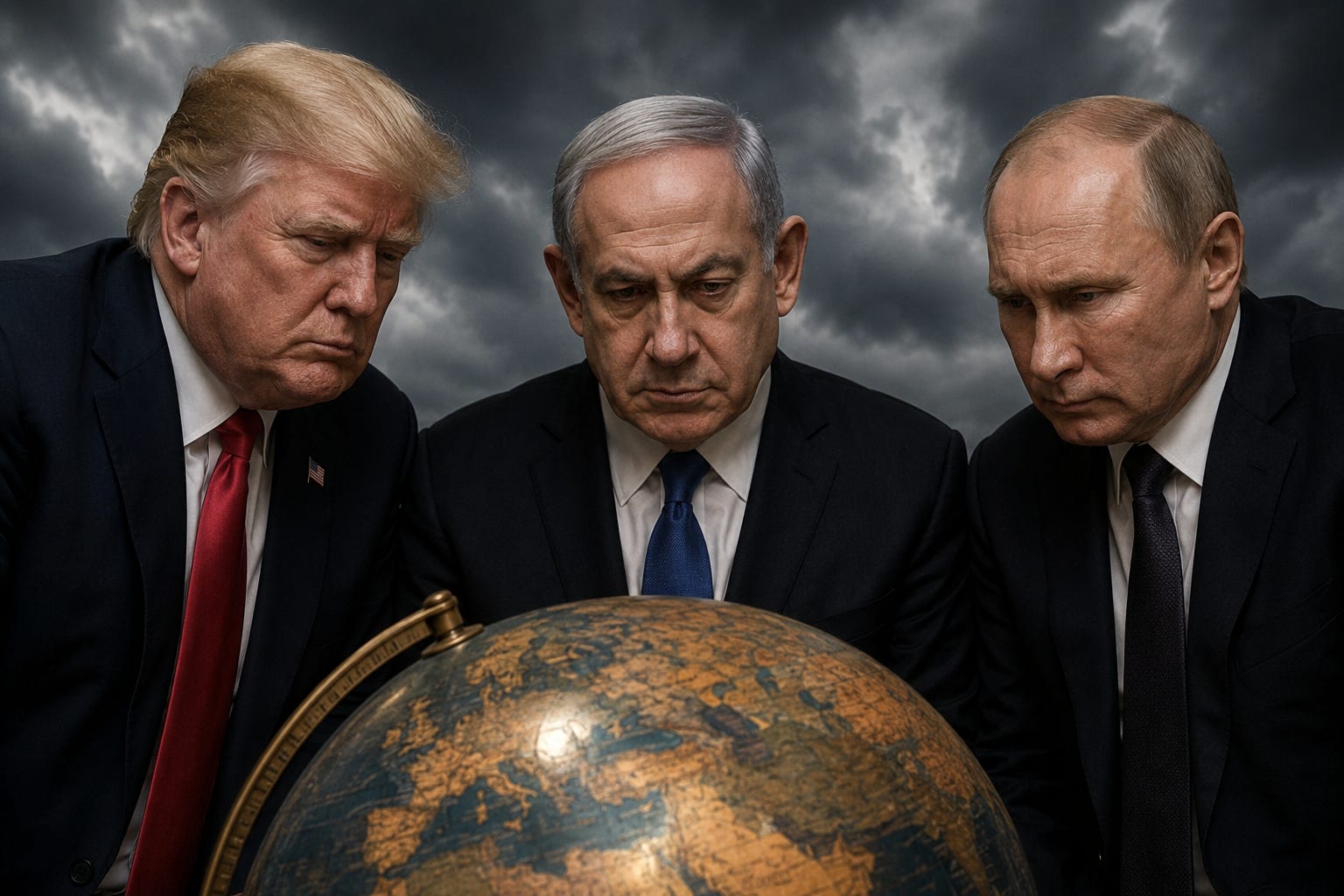
In the second decade of the twenty-first century, the world finds itself awash in strongmen—figures who dominate not only their nations’ politics but also the international imagination. From the gilded corridors of the White House to the bunkers beneath Moscow and the war rooms of Jerusalem, a certain model of leadership is ascendant. It is a model that mistakes clenching a fist for the practice of statecraft and, in doing so, risks forgetting the hard-earned lessons of the past.
What follows is an attempt to reckon with that confusion, and to ask what we have lost when power is mistaken for strategy.
Last week, I found myself reflecting on three men whose ghosts still stalk the margins of global affairs: Metternich, Castlereagh, and Bismarck. None were gentle souls. Bismarck was no stranger to the battlefield, Metternich made a vocation of shoring up an authoritarian order, and Castlereagh wielded British power with unsentimental efficiency. None of these men should be romanticised; their times were as bloody, their choices as ruthless, as any that followed. But all three understood something about power which seems increasingly difficult for contemporary political leaders to grasp.
The purpose of power, as they understood it, is not merely to win, nor to bask in the thrill of prevailing. It is to bend the arc of history toward a political settlement more advantageous—and more stable—than the chaos that preceded it. That sounds obvious. It isn’t.
Today, consider three very different leaders: Donald Trump, Benjamin Netanyahu and Vladimir Putin.
They lead radically different countries. One presides over the world’s pre-eminent military and economic power. Another governs a small but extraordinarily capable regional military state. The third commands the world’s largest nuclear arsenal and a revisionist great power attempting through force to rewrite the European security order. They are certainly not interchangeable—neither politically, nor morally. Each carries its own burdens, each acts from a different well of history and circumstance. But their approaches to international affairs share an important characteristic: all three have elevated coercion, personal authority, unpredictability—and the theatre of strength itself—to unusually prominent places at the centre of their diplomatic repertoire.
The distinction matters.
Because coercion can produce concessions; it can change behaviour; it can destroy military capabilities; it can seize territory; and it can frighten allies and enemies alike.
What it cannot do is produce order.
And this is where the ghosts of nineteenth-century statecraft begin to haunt our present moment, revealing uncomfortable truths.
Donald Trump’s conception of international politics has always been deeply transactional.
Countries are partners when they contribute sufficiently. Alliances are useful when their members pay enough. Tariffs are not simply instruments of economic policy but bargaining weapons. Military superiority strengthens the negotiating hand. Uncertainty itself becomes leverage. This logic is recognisable. Trump does not regard diplomacy as an elaborate system of permanent international relationships so much as a succession of negotiations.
What are you offering?
What am I getting?
Who possesses greater leverage?
And who needs the agreement more?
This mentality has sometimes generated results.
His pressure on NATO members contributed to a substantial increase in European defence commitments. By the 2026 NATO summit, allies were again trying to show they were responding to Trump’s demands for greater burden-sharing.
During his first presidency, the Abraham Accords demonstrated that unconventional diplomacy and a willingness to discard established assumptions could produce genuine diplomatic movement.
Trump’s great strength is therefore something many conventional diplomats lack: he is willing to challenge premises everyone else has quietly accepted.
That can be strategically useful.
But let’s not confuse disruption with statecraft. The two are not synonymous, despite the illusions of our age.
The limits of Trump’s method become clearer when an adversary cannot easily be compelled to accept his terms.
Iran provides an extraordinary contemporary example.
The Trump administration describes its approach explicitly as “peace through strength”: overwhelming military pressure accompanied by an offer to negotiate once the opposing side recognises American superiority.
But by August 2026, the Iran War illustrates the limits of that proposition. Negotiations have stalled, the Strait of Hormuz remains severely disrupted, and Trump has returned to language suggesting Iran must effectively surrender to American demands.
Military superiority has not automatically produced political compliance.
Here lies the central weakness of coercive diplomacy—a flaw as old as power itself.
The stronger power asks: How much punishment can I impose? Statecraft requires an additional question: What settlement can my opponent accept while still believing it has survived? Those are not the same question.
Trump possesses something Putin and Netanyahu can only envy: extraordinary strategic depth. The United States has continental scale, nuclear forces, global military reach, financial power, technological capacity, enormous food and energy resources, alliances spanning much of the developed world and a currency central to the international economy. Trump therefore possesses vastly more potential leverage than either of the other men considered here. Paradoxically, that very abundance—the luxury of overwhelming power—can seduce a leader into believing that compromise is unnecessary, almost unseemly. Why bargain patiently when you can escalate? Why accommodate when your opponent needs the agreement more than you do? Why distinguish between an opponent accepting an agreement and an opponent being publicly seen to capitulate? This is precisely where Trump’s diplomacy diverges from Bismarck’s Realpolitik. Bismarck knew when Germany had won enough. Trump frequently seems interested in discovering whether one more turn of the screw might produce something more.
Benjamin Netanyahu represents a different phenomenon. His worldview has been forged by Israel’s strategic geography and history. Israel is small. It lacks strategic depth. Its population is comparatively limited. Its leaders know that a serious military defeat could have existential implications. Israeli strategy has therefore traditionally emphasised deterrence, intelligence superiority, rapid mobilisation, pre-emption and the ability to take warfare onto enemy territory. Netanyahu has taken this logic further. Iran has dominated his strategic worldview for decades. Hamas, Hezbollah and other Iranian-aligned groups became elements of a broader perceived architecture of encirclement. After the trauma of October 7, 2023, the political space for accepting continuing threats diminished dramatically. The result has been the gradual emergence of something approaching a doctrine of permanent security enforcement.
Threats are no longer merely deterred.
They must increasingly be dismantled.
Hamas must be disarmed.
Hezbollah must be disarmed.
Iran’s nuclear and missile capabilities must be destroyed or permanently constrained.
Territory may be occupied until adversaries satisfy Israeli security requirements.
This logic is visible today. Netanyahu has rejected withdrawal from Israeli-held portions of Gaza until Hamas has completely disarmed, despite American efforts to advance a phased arrangement. Similar sequencing problems are complicating Israel’s withdrawal from southern Lebanon.
From Netanyahu’s perspective, there is a brutally rational argument behind this.
Israel withdrew from southern Lebanon in 2000. Hezbollah subsequently strengthened. Israel disengaged from Gaza in 2005. Hamas subsequently consolidated control. The lesson Netanyahu draws is therefore not that occupation necessarily produces security, but that territorial withdrawal without eliminating the underlying military threat merely postpones the next war.
The difficulty is that the alternative can become perpetual mobilisation.
Chatham House has described the emerging Israeli model as one in which permanent low- and medium-intensity conflict risks becoming institutionalised. Even while Israelis have continued to support important war aims, confidence that the government can deliver decisive strategic outcomes has weakened.
Here again, the distinction between military success and statecraft rears its head—reminding us that the destruction of an enemy is not the same as building a future.
Israel can destroy enormous quantities of enemy military infrastructure. It can penetrate intelligence networks, assassinate commanders, seize ground, and demonstrate extraordinary operational competence. Yet these tactical successes raise far deeper questions. What political system replaces the one that has been destroyed? Who governs Gaza? What political arrangement will eventually stabilise Lebanon? What relationship exists with Iran after the bombing stops? What happens if regime collapse does not occur? And how many generations can Israeli society remain mobilised against surrounding threats?
These are not military questions. They are questions of statecraft.
Netanyahu’s great strength is his extraordinarily clear perception of threats.
His corresponding weakness may be his difficulty imagining security as something constructed with adversaries rather than imposed upon them.
That risks transforming deterrence into an endless requirement to demonstrate deterrence.
A nation can win almost every battle and yet find itself condemned to endless war, victory dissolving into permanent crisis.
Vladimir Putin represents the third model.
Unlike Trump, he does not command the international system’s dominant power, nor, like Netanyahu, does he lead a geographically small state confronted by immediate existential vulnerability. Putin instead governs a former superpower determined to reverse what he considers an intolerable post-Cold War settlement. His international politics cannot be separated from his interpretation of Russia’s collapse in power during the 1990s: NATO enlargement, the disappearance of the Soviet sphere of influence, Western intervention in the Balkans, colour revolutions, American military predominance, and Western involvement in the post-Soviet space.
From Putin’s perspective, these are not discrete historical events. They form a narrative: Russia retreated, the West advanced, and Russian interests were ignored because Russia was weak.
The resulting doctrine is relatively straightforward.
Great powers acquire security by possessing power, buffers and recognised spheres of influence.
Georgia in 2008 demonstrated the principle. Crimea in 2014 demonstrated it more dramatically. Syria demonstrated Russia’s willingness to use limited expeditionary military power to preserve an ally and regain international influence. Ukraine after February 2022 represented the doctrine applied on a vastly greater and far more dangerous scale. More than four years later, Moscow’s negotiating position still demands profound Ukrainian concessions. In June 2026, the Kremlin reiterated that Kyiv must withdraw its forces from four Ukrainian regions claimed by Russia and formally abandon its NATO aspirations. This is negotiation, but in a very particular sense: the battlefield is intended to establish the facts around which diplomacy subsequently operates. Putin does not necessarily reject negotiations—he seeks to determine their starting conditions through force.
And he unquestionably appreciates history, albeit through an intensely Russian and frequently selective interpretation of it.
In that sense, he may superficially appear closest to Bismarck.
But there is a decisive difference.
Bismarck’s greatest diplomatic achievement came after his wars.
Following German unification in 1871, he spent much of his remaining career trying to reassure the other European powers that Germany did not intend continued expansion.
Putin has done almost the opposite.
Russia’s neighbours have increasingly concluded that Russian military power presents a direct threat.
That perception has produced precisely the strategic consequences Moscow claimed to fear: stronger NATO defence preparations, deeper Western military integration and the incorporation of previously non-aligned Finland and Sweden into NATO.
The Bismarckian objective was to prevent Germany’s opponents from combining against it.
Putin’s policies have, ironically, persuaded Europe that combining against Russia is not only prudent but essential—a self-fulfilling prophecy of encirclement.
That is not an insignificant distinction.
So which of these men is actually strongest?
It depends entirely on what we mean by strength.
Trump possesses the greatest structural power.
No other country represented here approaches the United States in the combined scale of its military, economy, technology, financial system, intelligence apparatus, alliance network and global reach. Yet American presidential power is institutionally constrained. Congress exists. Courts exist. Elections exist. Markets react. Allies can resist. Public opinion moves.
Trump may dominate the political theatre surrounding American foreign policy, but he does not possess America.
Putin possesses the greatest freedom of personal strategic action.
Russia’s political system allows him to sustain policies despite costs that would place enormous pressure upon leaders in many democracies.
He controls a nuclear great power with immense territory, significant natural resources and considerable defence-industrial capacity.
But Russia’s aggregate economic and alliance power remains far smaller than America’s.
Putin therefore exercises more concentrated political control over fewer strategic resources overall.
Netanyahu possesses the least structural power but perhaps the greatest record of translating limited national capabilities into immediate operational effects.
Israel has demonstrated the capacity to project military and intelligence power dramatically beyond what its population or geography might suggest.
But Israel’s strategic limitations are equally stark.
Its economy and manpower cannot indefinitely sustain permanent regional warfare without high cost. Its diplomatic freedom is constrained by its dependence on the United States. And its very military effectiveness can tempt governments into treating problems susceptible only to political settlement as though sufficient applications of military force will ultimately resolve them.
Three men.
Three different versions of strength.
But all confront the same problem.
Power, it turns out, generates diminishing returns when every international problem becomes a test of personal resolve—a gladiatorial contest played out on the world stage.
Something else connects these three leaders.
Foreign policy has become unusually personalised around each man.
Trump speaks about international relations through personal relationships: who respects him, who has treated America fairly, who can make a deal.
Putin’s interpretation of Russian national interest has become inseparable from the political system he constructed during more than a quarter-century at the centre of Russian power.
Netanyahu has dominated Israeli politics for so long that the distinction between his strategic worldview and Israel’s strategic direction has become increasingly difficult to separate.
This, I would argue, is where the real danger lies.
Because states possess permanent interests.
Leaders possess political interests and, by the very nature of being human, are temporary.
However, the permanent national interest and the temporary political interest do overlap. They are not identical. A leader seeking reelection may need confrontation. A leader protecting his political authority may find compromise dangerous. A leader whose reputation is constructed around strength may find publicly retreating from an unsuccessful policy extraordinarily difficult.
The more foreign policy becomes personalised—the more it is lived as the extension of a single man’s will—the more any act of international compromise risks being read as personal defeat, an intolerable humiliation.
And once that happens, diplomatic flexibility diminishes dramatically.
This does not require us to psychoanalyse Trump, Netanyahu or Putin.
Their internal motivations are ultimately unknowable.
The strategic issue is structural.
Political systems built heavily around personal leadership make it harder to separate the prestige of the leader from the prestige of the state.
And diplomacy often requires leaders to accept imperfect outcomes.
This brings us back to Bismarck.
It is fashionable to remember the phrase “blood and iron.” It is less fashionable to remember what came afterwards. Bismarck used war to transform the European balance of power.
Then he became extraordinarily cautious about using war again.
Why?
Because Germany had achieved its principal strategic objective. Further expansion threatened to unite Germany’s neighbours against it.
The revolutionary became the conservative. The disruptor became the custodian.
The man who had changed the European system subsequently devoted himself to preventing that system from turning against Germany.
That transition—from wielding power to seize an objective, to wielding restraint to preserve the resulting order—is among the hardest, and most neglected, in the craft of governing nations.
Trump has not demonstrated it.
Netanyahu has not demonstrated it.
Putin has not demonstrated it.
Each appears much more comfortable creating leverage than constructing equilibrium.
And that distinction may define our present international moment.
There is nothing inherently wrong with coercion. Diplomacy without credible power can become pleading. Deterrence requires consequences. Military force sometimes becomes unavoidable.
Metternich, Castlereagh and Bismarck all understood that.
The difference was that power existed within a larger political conception.
What happens afterwards? Where does the adversary fit? What equilibrium are we attempting to create? What outcome can the defeated state tolerate? What prevents today’s victory from becoming the foundation of tomorrow’s war?
Those questions appear increasingly absent from contemporary diplomacy.
Trump asks how much leverage America possesses.
Netanyahu asks how completely a threat can be removed.
Putin asks how much geopolitical reality can be altered through force.
All are legitimate strategic questions.
None of these questions, in isolation, is sufficient.
Because eventually someone has to ask the question that the architects of the post-Napoleonic settlement understood exceptionally well:
How do all the surviving powers live together after the confrontation ends?
That question requires something harder than strength. It requires restraint. It requires recognising legitimate interests other than one’s own. It requires occasionally allowing an opponent to claim something resembling victory.
It requires accepting that an imperfect settlement may be preferable to an unobtainable perfect one.
And above all it requires understanding that compromise is not necessarily weakness.
Sometimes compromise is how power is preserved.
This leaves us with an uncomfortable paradox.
Trump, Netanyahu and Putin have each built political authority partly around perceptions of strength. Yet an inability to compromise can ultimately become a source of strategic weakness.
The leader who can never retreat can be trapped.
The leader who can never concede can be manipulated.
The leader who must always escalate eventually encounters an adversary prepared to escalate too.
And the country whose diplomacy repeatedly demands capitulation eventually produces opponents who believe resistance is preferable to negotiation.
Metternich understood that France could not simply be permanently humiliated after Napoleon. Castlereagh understood that British interests required a European system other powers could accept. Bismarck understood that a powerful Germany had to reassure, not continuously frighten, its neighbours.
They did not pursue compromise because they were weak.
They compromised because they understood power.
That, perhaps, is the distinction our own age—so enamored of strength, so allergic to ambiguity—has forgotten.
The tragedy of contemporary international affairs is therefore not simply that today’s leaders are more belligerent.
Nor is it that military power has somehow displaced diplomacy.
It is that we have come to mistake the possession—and the theatrical demonstration—of power for the subtle, exhausting, and often thankless practice of statecraft itself.
They are not the same thing.
Trump commands more power than perhaps any individual leader on Earth.
Putin commands sufficient power to threaten the European order.
Netanyahu commands sufficient power to transform the military geography of the Middle East.
But history will judge them by something else. Not by how effectively they frightened their opponents. Not by the territories their forces occupied. Not by the targets they destroyed. Not even by the agreements they forced others to sign.
History’s more demanding question will be this:
What kind of political order did they leave behind?
That was ultimately the test faced by Metternich, Castlereagh and Bismarck.
It remains the test of statecraft today.
And strength alone has never been enough to pass it.
No posts
Comments
Nothing yet. Say the first thing.
Sign in to join the conversation.