
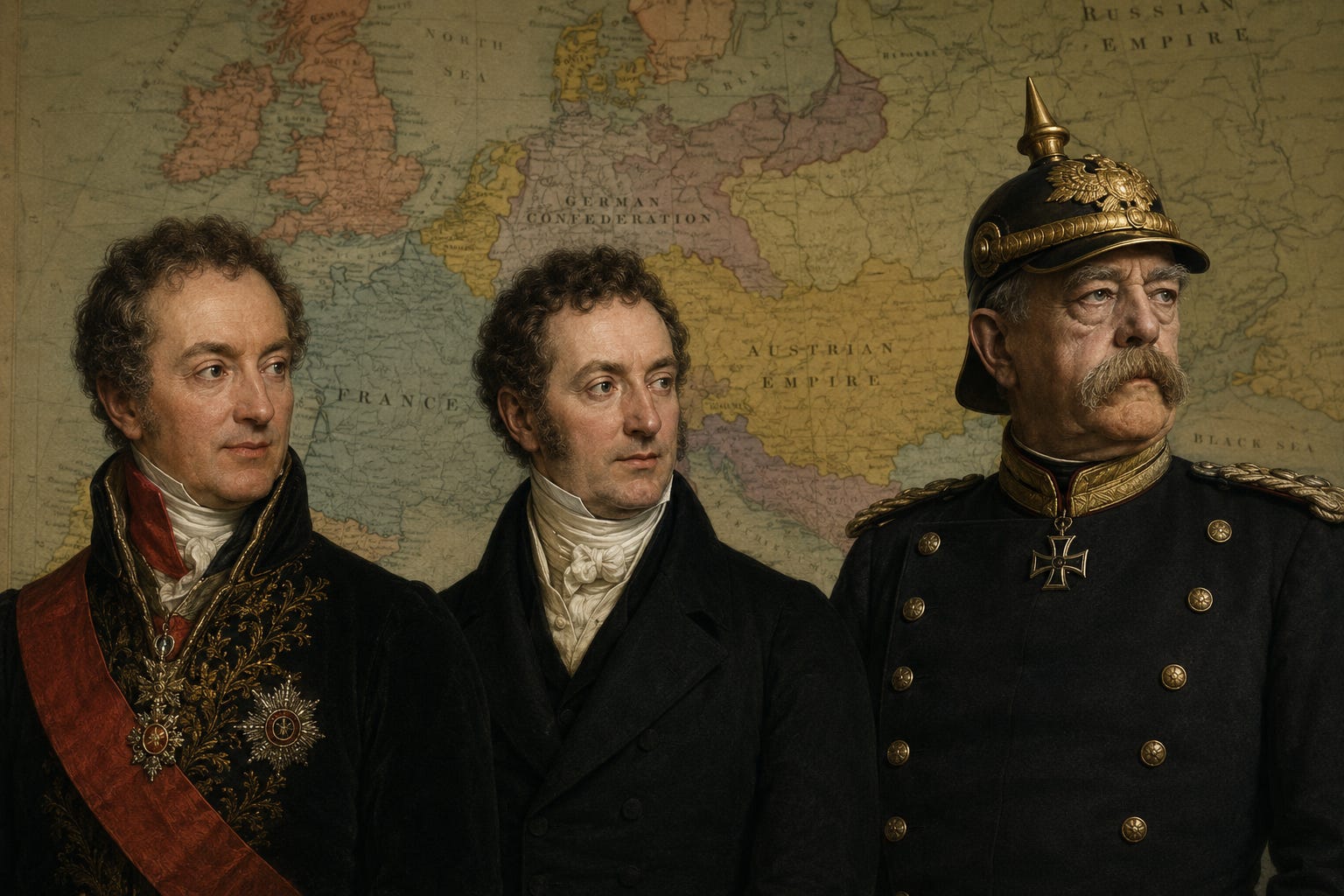
There was a time—not so long ago in historical terms—when international politics was managed by men who recognised that the world, with all its disorder and inertia, could not be remade overnight. They were not, it must be said, paragons of virtue. Nor, for that matter, were they especially agreeable. But they grasped a truth that feels increasingly absent from the choreography of contemporary diplomacy: that the management of power demands patience, an attunement to history, a willingness to compromise, and, most crucially, a vision of the international order one intends to shape.
Consider three figures separated by geography, personality, and circumstance: Klemens von Metternich, Lord Castlereagh and Otto von Bismarck. Metternich sought to preserve the European order after the Napoleonic Wars. Castlereagh helped construct the diplomatic settlement that followed Napoleon’s defeat. Decades later, Bismarck manipulated alliances and rivalries to establish and preserve the power of a newly unified Germany.
None was a saint. All were formidable. And all possessed something that appears increasingly rare today: statecraft.
We have plenty of diplomats. What we seem to have fewer of are statesmen capable of thinking beyond any immediate crisis.
Modern diplomacy has become increasingly transactional. Governments respond to events as they occur. Foreign ministers fly from one summit to another. Leaders issue statements. Officials negotiate communiqués. International organisations produce declarations.
But statecraft is something else entirely—a discipline at once more ambitious and more elusive. Statecraft begins with a question: what kind of international system do we want to exist five, ten or twenty years from now—and what must we do today to make that system possible?
Following the defeat of Napoleon, he recognised that simply punishing France would not necessarily produce a stable Europe. France had to be contained, but it also had to be reintegrated into the European system.
The genius of the post-Napoleonic settlement was therefore not simply victory. It was order—a concept now so often dismissed as reactionary, yet, in its time, the fragile scaffolding of peace.
The Congress of Vienna attempted to create an equilibrium in which no single power could dominate Europe again. That required compromise. It required restraint. And it required dealing with defeated enemies rather than permanently humiliating them.
That is an extraordinarily difficult political skill, and, completely lost on today’s political leadership.
Lord Castlereagh is perhaps the least remembered of the three today, yet his contribution to the European settlement was immense.
He understood that British power could not simply be imposed upon continental Europe. Britain needed allies. It needed legitimacy. And it needed a balance of power that other European states would accept as being in their interests.
This meant diplomacy remained not simply about getting Britain what Britain wanted. It was about constructing an arrangement in which other states could live with the outcome. That distinction is fundamental.
A successful diplomat does not simply defeat an opponent across the negotiating table. He creates an agreement that the opponent can accept without feeling that surrender is inevitable. That is how international orders become durable.
Bismarck represented a very different form of statecraft. He was ruthless, cynical and extraordinarily pragmatic.
His famous concept of Realpolitik has often been reduced to the idea that power is everything. That, of course, is far too reductive. Bismarck understood that power without diplomacy could be self-defeating.
After German unification in 1871, his central problem was no longer creating Germany. It was managing the consequences of German power. Bismarck recognised that Germany was powerful enough to frighten its neighbours but not powerful enough to dominate Europe indefinitely.
His response was an extraordinarily complex network of alliances designed to prevent Germany from becoming encircled. He sought to keep France isolated, Russia engaged and Austria-Hungary sufficiently close. His diplomacy was not about creating permanent friends. It was about foreclosing the possibility of permanent enemies—a subtle but vital distinction. And that distinction is enormously important.
The obvious answer is that modern politicians are simply less intelligent. I don’t believe that is true, although I have my suspicions from time to time. There are extraordinarily intelligent people in governments around the world. The problem is the system in which they operate.
Metternich, Castlereagh and Bismarck operated in political situations where leaders could think in terms of decades. Today’s politicians commonly operate inside environments measured in 24-hour news cycles, polling cycles, election cycles, and social-media cycles. The incentives are completely different.
A politician who makes a quiet compromise today may prevent a war ten years from now. But nobody will necessarily notice. A politician who publicly humiliates an adversary, however, can generate headlines tonight. President Donald J. Trump is arguably the poster child of this phenomenon. Modern politics, after all, rewards visibility above all else. Statecraft often requires invisibility.
The modern diplomat is increasingly required to respond instantly. Every crisis generates thousands of commentators. Every statement is analysed. Every concession can be portrayed as weakness. Every compromise can become a political liability.
This makes diplomacy extraordinarily difficult.
Metternich could negotiate privately. Castlereagh could negotiate privately. Bismarck could negotiate privately. They could explore possibilities without immediately having their every word broadcast to the world.
That privacy created something extremely valuable: strategic ambiguity—the grey zone in which real agreements are forged.
Diplomacy requires room to manoeuvre.
If every negotiating position is publicly declared as a matter of national honour, compromise becomes almost impossible. Modern communications technology has therefore produced a paradox. We can communicate more quickly than any previous generation. But we may have become less capable of communicating diplomatically.
The great diplomats of the nineteenth century understood history—not simply as an academic subject, but as a model for behaviour.
They understood that nations possess memories. They understood that borders, defeats, alliances, and humiliations create political consequences that can persist for generations. Furthermore, they understood that today’s enemy may become tomorrow’s ally. And tomorrow’s ally may become the next threat.
Contemporary foreign policy is often conducted as though every crisis is unprecedented.
It rarely is.
The names change. The technologies change. The geography changes. But the underlying problems of power, fear, ambition, insecurity, and miscalculation remain remarkably constant.
History doesn’t repeat itself perfectly. But it offers patterns—rough blueprints for navigating the recurring predicaments of power. And statecraft requires recognising those patterns.
Perhaps the greatest loss is the ability to imagine an international order. We have become very good at managing problems. We are much less good at asking what comes after the problem has been solved.
What happens after a war? What happens after a revolution? What happens when a great power rises? What happens when an enemy collapses? What happens when an alliance expands? What happens when the balance of power changes?
These are questions of statecraft, and they cannot be answered by simply reacting to the next headline.
The great diplomats understood that winning a war and winning the peace were entirely different things. Napoleon won extraordinary victories. He ultimately lost because he could not construct a sustainable European order. The victors of 1815 learned from that experience. That is one reason the settlement after Napoleon endured for decades. And perhaps why the harshness of the treatment of Germany post-World War I through the Treaty of Versailles ushered in an entirely new way of dealing with ‘the enemy ’.
There is another problem. We have increasingly confused morality with strategy.
Of course morality matters. Nations should have values. Human rights matter. International law matters. But diplomacy becomes impossible if governments cannot distinguish between what they believe is morally desirable and what is strategically achievable.
Metternich, Castlereagh, and Bismarck understood that international politics involved dealing with the world as it was—not simply the world as they wished it to be. This is not an argument for cynicism. It is an argument for realism.
The great statesman asks: what can actually be achieved? What will the other side accept? What will happen after the agreement is signed? What unintended consequences will follow? And perhaps most importantly: What does my opponent need in order to accept the settlement? That final question is often forgotten. And when looking at today’s wars in Ukraine and Iran, in which a zero-sum approach is adopted with expectations that one side clearly wins over the other; it should come as no surprise that future problems may emerge if and when the fighting stops. When nothing but intransigence is demonstrated, intransigence is paid back by more intransigence. Why? Because no one wants to be labelled the losing side.
There is a danger in romanticising these men. Bismarck’s Germany ultimately became part of a European system that failed catastrophically in 1914. Metternich’s conservative order could suppress political change but could not prevent nationalism and liberalism from transforming Europe. Castlereagh himself eventually became a tragic figure, destroyed in part by the pressures of domestic politics. So the lesson isn’t that we should reproduce nineteenth-century diplomacy. We cannot. Nor should we. The lesson is that we need to recover the intellectual habits of statecraft.
We need diplomats who understand history. Leaders who can think beyond election cycles. Negotiators who can distinguish between compromise and capitulation. Strategists who understand that power is not simply military. And politicians who understand that at times the greatest diplomatic victory is one that produces no headlines at all.
We are entering an era of extraordinary geopolitical uncertainty. The United States and China are competing for influence. Russia is challenging the European security order. Europe is struggling to restructure its strategic role. The Middle East remains profoundly unstable. Technology is transforming warfare. Artificial intelligence is changing the relationship between information and power. Energy, climate and resource security are becoming increasingly strategic. And middle powers are being forced to navigate between competing centres of power. This is precisely the environment in which statecraft matters.
Yet, we increasingly seem to have leaders who think in terms of the next election, the next poll or the next news cycle. That is dangerous. Because great-power competition cannot be managed by improvisation forever. Eventually, someone has to ask: what sort of world are we actually trying to build? That was the question Metternich understood. It was the question Castlereagh understood. It was the question Bismarck understood. They were not perfect men. They did not always make the right decisions. But they understood that diplomacy is not simply the art of responding to events. It was the art of designing the conditions in which future events would occur. Perhaps that is the real lost art of statecraft.
We have not run out of intelligent people. We have not run out of diplomats. We have not even run out of strategic thinkers. What we have lost is the political space for long-term statecraft. And unless we recover it, we may discover that the greatest geopolitical danger of the twenty-first century is not that we lack power. It is that we lack the wisdom to know what to do with it.
No posts
Comments
Nothing yet. Say the first thing.
Sign in to join the conversation.