
Drop Duchy used to be boring. Placing tiles earned you resources and units, but the loop didn’t hook. I tried to fix it by piling on more choices (a crime against design elegance), but it still wasn’t engaging. Then I came across a blog post about “resource crunch,” the hidden engine of solid RTS games. Suddenly, it clicked: strategy requires compelling choices, and compelling choices emerge from scarcity.
Before writing this piece, I attempted to find the blog post but was unsuccessful. It may have been removed from the internet now. It’s a bit sad because it has such a profound impact on my game designer’s life, and I’m often referencing it when I share feedback on friends’ games. I suppose the best I can do is to write my own version of it, relying heavily on my experience designing Drop Duchy.

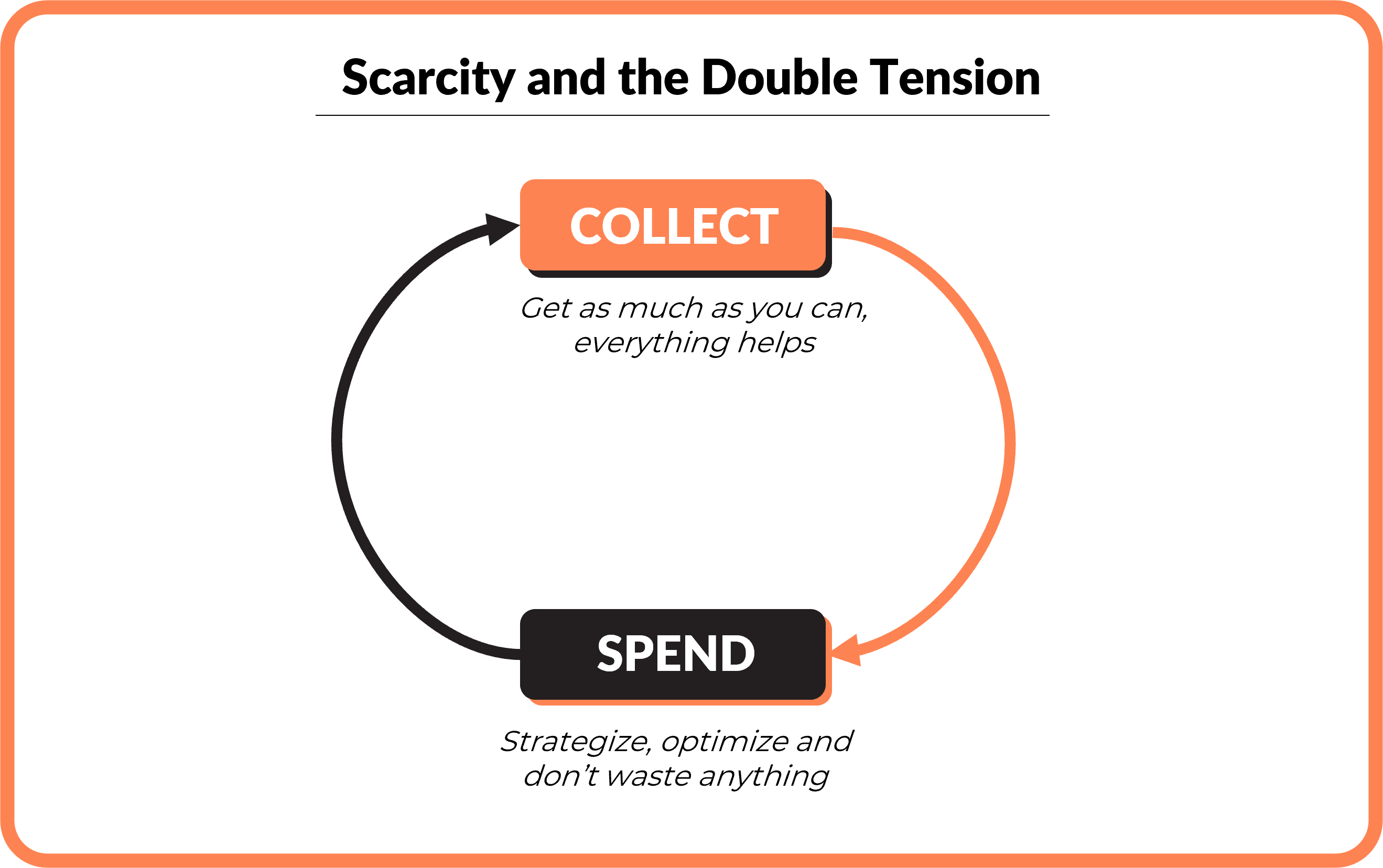
Scarcity creates a unique “double tension” that fuels motivation in two gameplay areas: collecting and spending.
First, when collecting resources, you pay closer attention because every unit of resource matters. In Drop Duchy, for instance, you collect resources by completing lines and triggering buildings’ effects. Knowing that resources are scarce pushes you to try to maximize both “sources” at once, which isn’t achievable if you don’t observe and plan.
Second, when spending resources, you must make careful choices precisely because resources are precious. You’re not an autopilot; you’re doing a mental list of every option and weighing which one is worth more. These two tensions feed each other in a continuous loop, keeping players in a state of flow where every decision has weight.
To increase scarcity, the immediate designer’s reflex is to change the balancing. And sure, balancing is necessary, but it’s not sufficient. For instance, ensuring that players have more cards to upgrade than resources at their disposal only matters if each card upgrade feels meaningful. If all roads seem to lead to the same place, players will just pick at random. The same applies if one path seems clearly superior; that option gets picked, and there’s no tension.
Likewise, simply raising prices doesn’t create compelling decisions—it makes the game harder but not more interesting. Your goal as the designer of a strategy game isn’t to use scarcity to starve players, but to present them with dilemmas that make them think.

To feel like true meaningful choices, spending resources must involve real opportunity costs. If a resource is dedicated to a single purpose, the choice is trivial: you either have it or you don’t. In that case, scarcity only helps to incentivize the grind, but you don’t feel strong emotions when spending it. In Drop Duchy, there is a single-use resource for the faction Republic, and it acts more as a power-gating mechanism than an additional strategic layer.
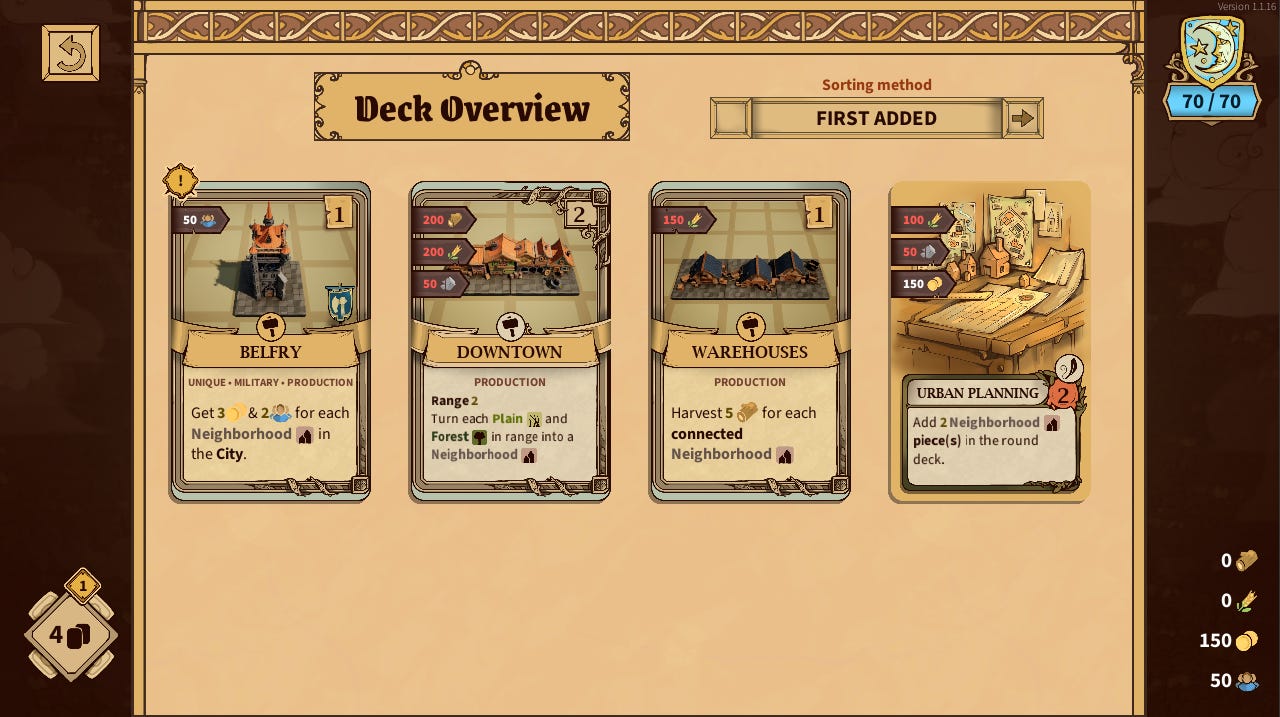
Complexity emerges when resources have multiple potential uses. Players must weigh trade-offs, deciding which goal to prioritize and which to sacrifice. For example, in Drop Duchy, gold can be used to upgrade cards or refill defense. However, you feel bad when you have to refill your defense because you’re explicitly seeing what you lose (an upgraded card). The threat of losing the run is distant and abstract, but this one is concrete, and you promise yourself that the next time, you’ll collect more gold, or avoid losing points of defense, or both. It motivates you to do better so that you won’t feel the pain of abandoning a compelling option again.
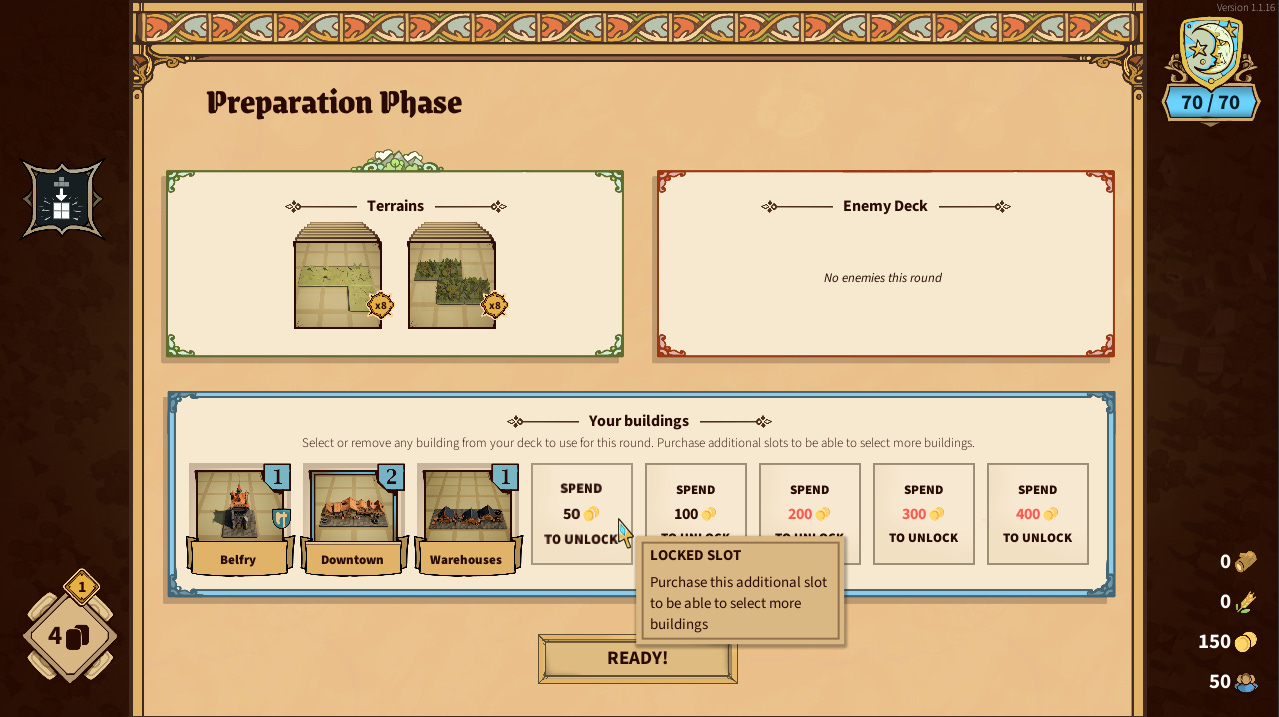
Early on, Drop Duchy was correctly balanced, but it lacked the mechanics that introduced such opportunity costs. For instance, buildings were unlimited: each round, you’d see all of them. Adding a slot system introduced scarcity, forcing players to make meaningful trade-offs: do you take more production or military? Short-term power or long-term growth? Pay to unlock one more slot or pay to upgrade current buildings? Now that you’re not guaranteed to see your buildings all the time, picking which to upgrade depends a lot on which you intend to select in the future rounds. Spending resources became less about what you gain and more about what you won’t get: that tension is a powerful motivator.

Once you adopt this mindset, you realize that everything is a resource (not just economic currencies), and therefore, each is an opportunity to create scarcity and deepen the strategy. What do you think is the most crucial resource in Drop Duchy? The grid space. You have a limited number of spots, and what you put in each shapes every decision. At first, it’s wide open, but as the round progresses, that resource is more and more scarce.
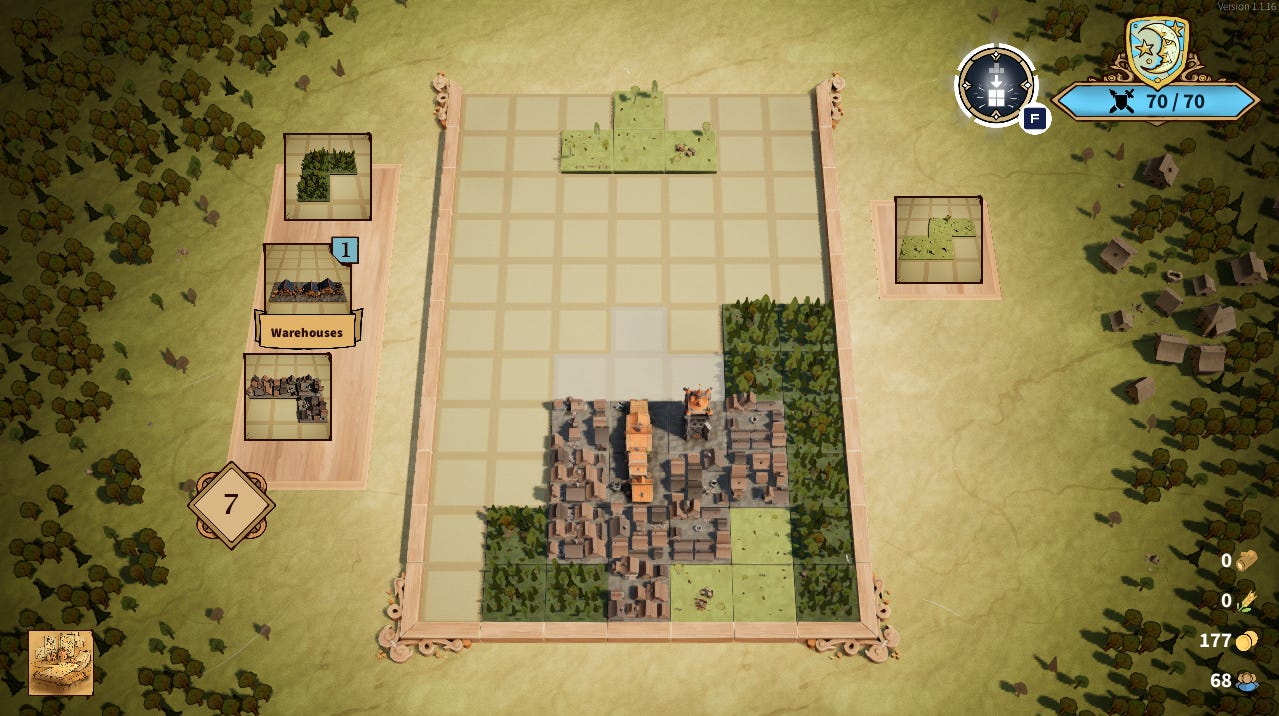
Additionally, each piece brings its own rules, lending “meaning” to each of these spots. This one is adjacent to a forest, but also aligned with an Alarm Tower and also connected to a river. As players accumulate multiple buildings and technology cards, maximizing every piece becomes impossible. Sometimes you find a perfect placement (which feels great!), and other times you must choose the least bad option.
In most cases, you’re sitting in between, trying your best to arrange the grid in a way that yields you more than if you placed it semi-randomly. Obviously, as a designer, you want the game to reward players for optimizing: it’s the reason why most card effects we designed aren’t “yes/no” but “for each”. Pieces that always trigger or are too flexible remove depth; carefully designed rules create meaningful tension. You want to tickle that feeling of “I could have done better” after each round.
Quick note before ending this article: irreversibility is a good (albeit risky) tool to heighten the stakes. In Drop Duchy, once a piece is placed, it cannot be moved. Randomness adds an element of risk, requiring players to plan for uncertainty and adapt to unexpected outcomes. Do you opt for the low-return safe military building placement, or gamble on a risky spot hoping the right tile comes later? Making choices when you don’t have all the information can be frustrating, but consequences matter when it comes to creating an engaging decision.

If your strategy game feels flat, the problem is likely not a lack of choices, but a lack of meaningful ones. Balancing better or adding more options rarely helps. You have to sit down and evaluate the whole chain of “cause & consequences” of the decisions you present to the player: what makes “collecting” more compelling is often a stronger “spending”. And vice versa.
I hope you liked this piece. I’m glad I took the time to write it after such a long drought on the Arcade Artificer. If you’d like to read more about game design, based on my learnings on Drop Duchy or not, let me know in the comments (and make sure to subscribe too). See you!
Comments
Nothing yet. Say the first thing.
Sign in to join the conversation.