
WASHINGTON, District of Columbia—If RFK Jr. is serious about adding autism to the “Table Injuries” of the Vaccine Injury Compensation Program, the world of the Vaccine Court is about to radically change. For those not as familiar, I’d like to explain two important facts about the Vaccine Court, but first let’s review what RFK Jr actually said.
Here’s what Secretary Kennedy wrote on X:
The 1986 Vaccine Act gave vaccine makers immunity against lawsuits by children who suffer vaccine injuries. The statute, and numerous subsequent court decisions, recognized that vaccines, like all medicines, are, in the words of the American Academy of Pediatrics case, “unavoidably unsafe,” and that a percentage of vaccinated children will suffer injuries or death. Congress, therefore, simultaneously created the Vaccine Injury Compensation Program (VICP), which obliged HHS to compensate injured children. In the words of then Labor and Public Welfare Committee Chairman Senator Edward Kennedy, “when ... children are the victims of an appropriate and rational national policy, a compassionate [g]overnment will assist them in their hour of need.” Under the VICP, vaccine victims can petition for compensation to the so-called “Vaccine Court,” which pays out awards from a trust fund endowed by a 75-cent surcharge on every vaccine. Congress intended that injured children be compensated “quickly and fairly” for injuries, “either presumed or proven to be causally connected to vaccines,” with doubts about causation resolved in favor of the victim. To date, the Vaccine Court has paid out $5.4 billion to 12,000 petitioners. But the VICP no longer functions to achieve its Congressional intent. Instead, the VICP has devolved into a morass of inefficiency, favoritism, and outright corruption as government lawyers and the Special Masters who serve as Vaccine Court judges prioritize the solvency of the HHS Trust Fund, over their duty to compensate victims. The structure itself hobbles claimants. The defendant is HHS, not the vaccine makers; and claimants are therefore facing the monumental power and bottomless pockets of the U.S. government represented by the Department of Justice. Furthermore, most of the Special Masters come from government, legal, or political posts, and typically display an extreme bias that favors the government side. There is no discovery, and the rules of evidence do not apply. The government lawyers do not allow children’s attorneys access to the Vaccine Safety Datalink, a taxpayer-funded CDC surveillance system that houses the best data on vaccine injuries. Attorney compensation is in the hands of notoriously biased Special Masters and often hostile government attorneys, who can leverage this power to turn petitioner attorneys against their clients’ interests. The VICP routinely dismisses meritorious cases outright or drags them out for years. Instead of “quickly and fairly” awarding compensation, Special Masters dismiss over half of the cases. Most of those that proceed typically take 5+ years to resolve, with many languishing for more than 10 years as parents struggle to care for children suffering with often extreme disabilities. Petitioners’ attorneys complain that the Special Masters make punitive downward adjustments to attorneys’ fees and medical expert fees to punish effective advocacy. Expert witnesses for injured children complain that they suffer intimidation and even threats that they will lose professional status or NIH funding if they testify for injured children. The government pays its own medical expert witnesses promptly while simultaneously slow-walking payments for petitioners’ experts—sometimes for years. The VICP is broken, and I intend to fix it. I will not allow the VICP to continue to ignore its mandate and fail its mission of quickly and fairly compensating vaccine-injured individuals. I am grateful to be working with @AGPamBondi and HHS staff to fix the VISP. Together, we will steer the Vaccine Court back to its original Congressional intent.
If vaccines cause autism, you’d think “vaccine court” would be a great place to find the evidence for it. Compensated claims typically include extensive details about timelines, medical tests, and doctors’ opinions. They read more like case reports in medical journals than legal settlements.
Established through the National Childhood Vaccine Injury Act of 1986, the original purpose of the vaccine court (officially called the United States Court of Federal Claims special masters) was to quickly and expeditiously pay any claims made by American citizens for vaccine injury. The vaccine court is buried within the Department of Health and Human Services (HHS), and when you petition the vaccine court because of a vaccine injury, you’re actually suing the federal government, and the lawyer representing the government (and therefore opposing your claim) will be a Department of Justice lawyer. Due process in vaccine court is nonexistent. There’s no jury, just a single court-appointed “special master” who hears your case and makes a decision.
Since 1989, when the vaccine court began to operate, these special masters have awarded more than $5.0 billion to vaccine-injured Americans (children and adults). Of the total cases filed since the court came into existence in 1998, there have been over 1,400 claims filed for death and 27,000 filed for injury. The DTP vaccine is the most common vaccine for claims to be filed against, with MMR in second place. Of the people who file claims with the court, approximately 34 percent end up receiving compensation.
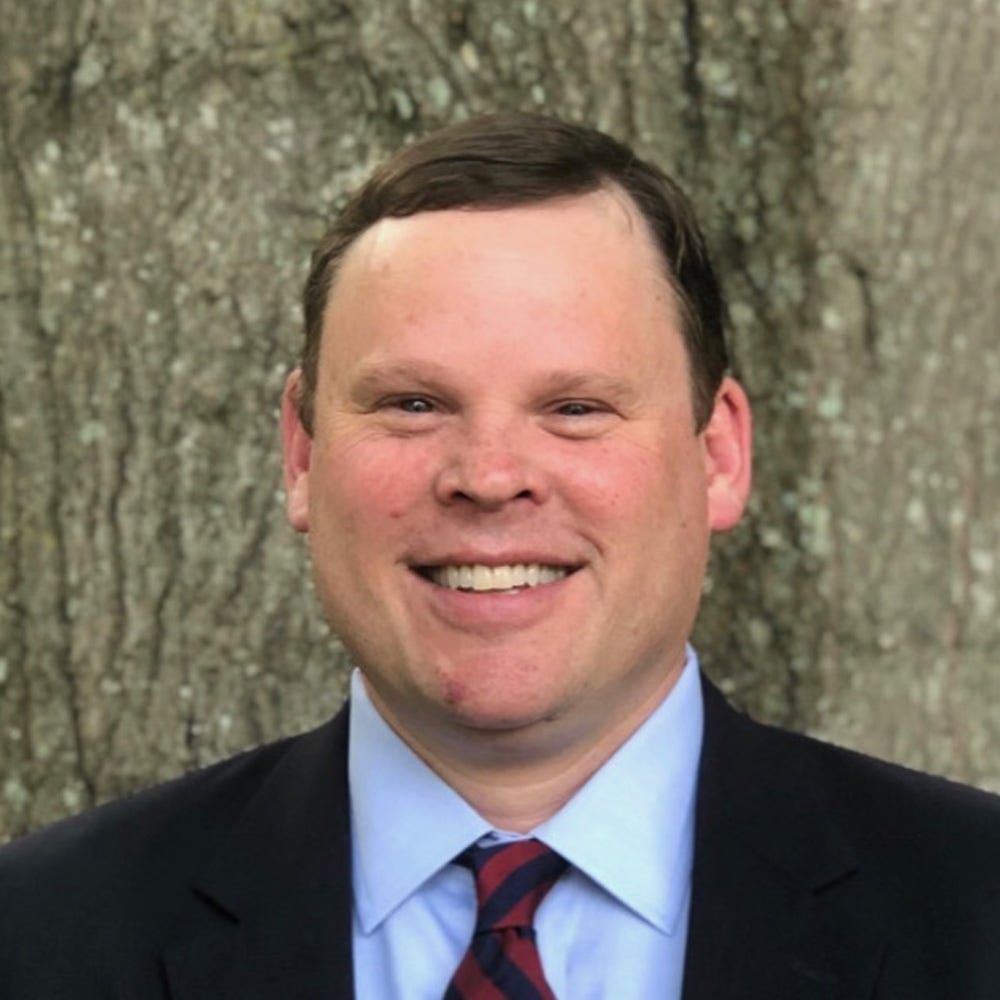
Rolf Hazlehurst, an assistant attorney general from Tennessee, has been an outspoken critic of the vaccine court, particularly since he had to fight his way through it as a claimant on behalf of his son Yates, who he believes developed autism as a result of his vaccinations. In a memorandum to the US Congress in 2013, Rolf Hazlehurst described the court:
Vaccine court is not a court of law. It is an administrative proceeding in which the most basic rules of law do not apply. In vaccine court, the Rules of Discovery, Evidence and Civil Procedure do not apply. There is also no judge or jury. In vaccine court, the American legal system has been replaced by what is known as a special master. A special master is an appointed government attorney.
This may seem like an elementary question, but it’s not. The purpose of the vaccine court is to protect the vaccine program, not to monitor vaccine safety or mete out justice. The year the vaccine court began operating—1989—is important to this story, because that’s also the birth year many point to as the beginning of a meteoric rise in the number of children with autism. Three other potentially monumental things happened in 1989: the hepatitis B vaccine was licensed, the Hib vaccine was licensed, and, for the first time, a second dose of the MMR vaccine was recommended for all American children.
When the vaccine court was established in 1986, there were only three vaccines given in the United States—DTP, polio, and MMR—and vaccinations rates hovered between 50 and 60 percent nationally. Today, there are eleven vaccines for children, given in multiple doses, with vaccination rates hovering around 90 percent nationally. There is an enormous difference between the market the vaccine court was created to “protect” and the market today. In raw numbers there are nearly four times as many vaccine doses given each year to children than there were in 1986, even though the US population has only grown by 0.3 in that same time period. I wrote an article about the passage of this bill, which was largely spearheaded by Congressman Henry Waxman. Here’s an excerpt from that article:
On October 20, 1986, the Los Angeles Times ran a story regarding a controversial bill making its way through Congress, the headline shouted:
REAGAN LIKELY TO VETO VACCINE COMPENSATION BILL
The story went on to explain the highly divisive nature of the bill, intended to shield vaccine makers from liability, and the Reagan administration was speaking out to express their opposition:
In a strongly worded letter to House Speaker Tip O'Neil, the then secretary of the Department of Health and Human Services, Otis R. Bowen said, "The bill is likely to do little to assure the vaccine supply or to improve our childhood immunization efforts."
Assistant Attorney General John R. Bolton, writing to the Head of the House Judiciary Committee on behalf of the Department of Justice, said the White House opposed the legislation because it was creating, "a major new entitlement program for which no legitimate need has been demonstrated."
Ronald Reagan himself was troubled by the vaccine compensation bill and was quoted as saying, "Although the goal of compensating those persons is a worthy one, the program has…serious deficiencies."
The Reagan administration seemed to be particularly concerned with two issues: who was going to pay for the compensation required for vaccine injury, and the precedent of the federal government indemnifying private companies from liability.
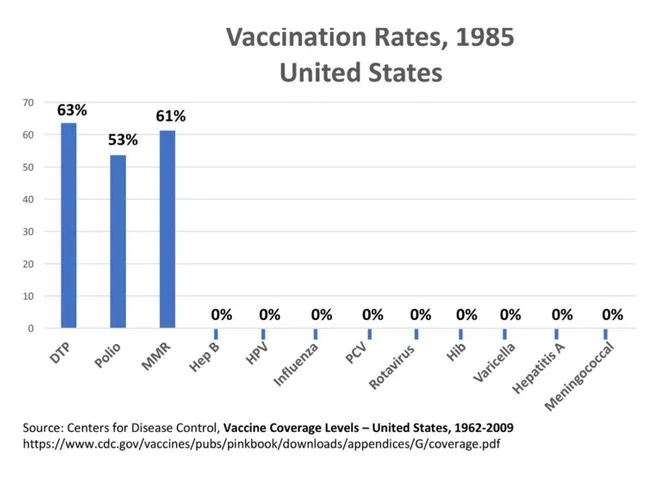
Beginning in 1989, the US vaccine schedule quickly morphed from the one the vaccine court was created to support to a far larger schedule with more complexity.
When the court was established, the word “autism” was never even discussed. By the late 2000s autism almost brought the entire court, and the vaccine program, to a screeching halt.
Few people know that the vaccine court amended its rules in 1995 to make it harder to win a claim in vaccine court, largely due to the increasing number of claims made as the vaccine schedule became bloated. By revising its Vaccine Injury Table—a list of “accepted” injuries from various vaccines, the court quietly made the standard for proving a vaccine injury much higher. As one simple example, claims for DPT shots causing brain injury were paid on roughly 25 percent of filed cases before the 1995 changes and only 5.4 percent of cases after the change were made, a decrease of more than 80 percent. Testifying before Congress in 1999, Barbara Loe Fisher, the president of the National Vaccine Information Center, explained:
The principal reason why the Vaccine Injury Compensation Program has become highly adversarial and is turning away three out of four claimants is that the Department of Health and Human Services (DHHS), with the assistance of the Department of Justice (DOJ), has wielded its discretionary authority to all but eliminate a just list of compensable events in the Vaccine Injury Table, thereby destroying the guiding tenet of presumption.
Recognizing vaccine injury is no easy task; few doctors are able to recognize any of the signs. The United States has a vaccine injury reporting system called the Vaccine Adverse Event Reporting System (VAERS) database. Estimates are that VAERS captures roughly 1 percent of all vaccine injuries. How many vaccine injuries actually make it into vaccine court? A fraction of a fraction of a fraction of 1 percent. (I can’t find any accurate data, but the number is clearly tiny or the vaccine court would have exploded in size.)
The burden is on the parents to track “adverse events,” despite the fact that pediatricians almost never explain all of the possible side effects. Parents might be told to expect redness at the injection site, swelling, maybe some fussiness or mild fever. Nothing some infant Tylenol can’t fix.
Perusing the website of a vaccine court attorney today, you can see how strongly the decks are stacked against those injured by vaccines. Richard Gage & Associates, one of the top vaccine lawyers in the country, lets potential clients know that “obtaining compensation for a vaccine injury is a complex, sometimes extremely difficult process.” Parents of a child who received compensation shared their view about what the experience was like:
DOJ [Department of Justice] attorneys were disrespectful and combative. . . . The Compensation Program should be about compensation and not about defense of the vaccine program.
A critical report from November 2014 about the vaccine court produced by the General Accountability Office (a federal agency) found the court wasn’t accomplishing what it had been purportedly created to do: to make vaccine injury compensation quick and fair. The report noted that most claims take “multiple years to adjudicate” with 51 percent taking more than five years.
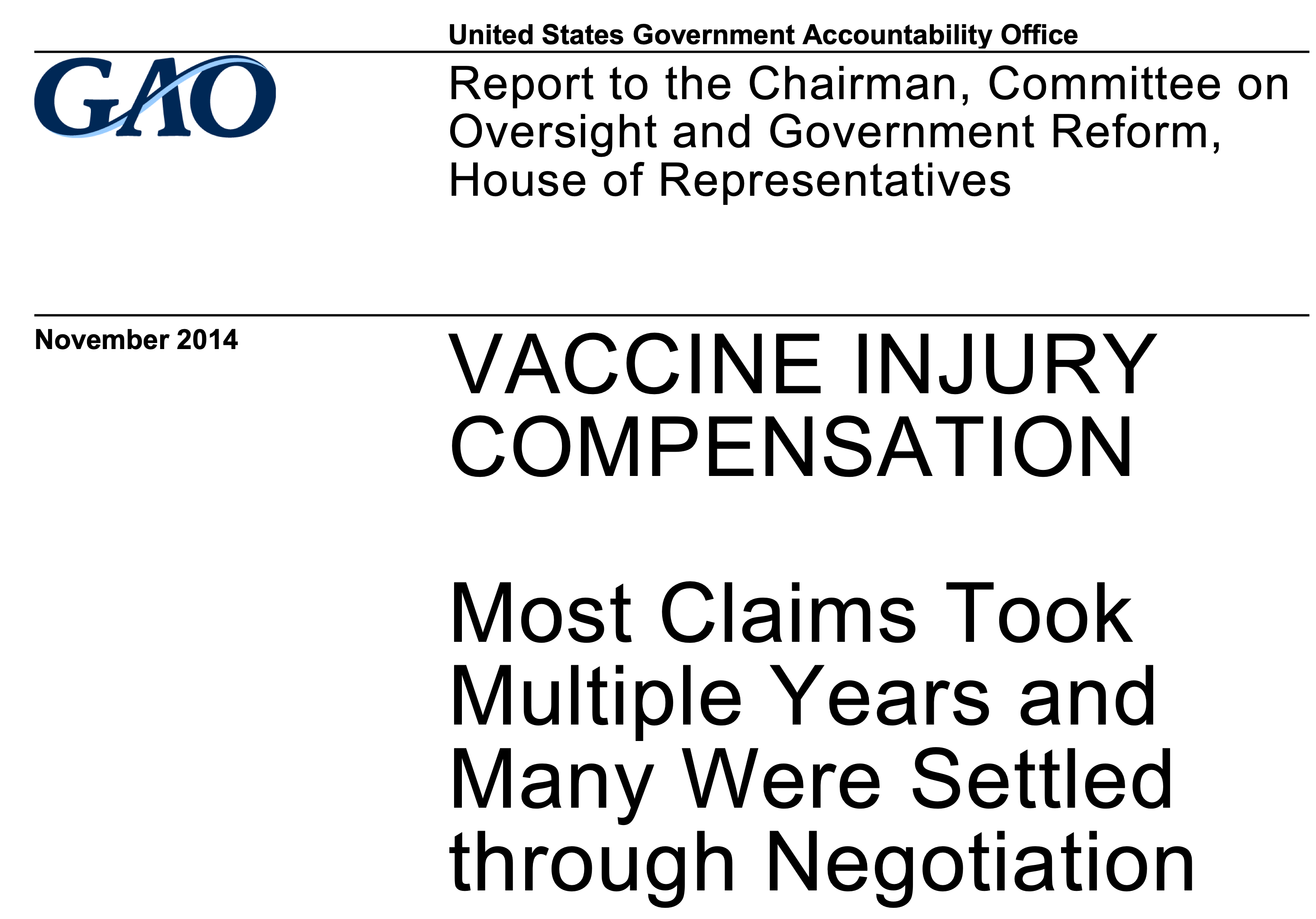
Parents who have filed claims in the court report that the compensation program has an “adversarial environment” and a statute of limitations (three years from the date of injuries being exhibited) that reduces the likelihood that parents can even file claims.
As Mr. Hazlehurst’s memo further explains:
The procedural “catch 22” of vaccine court works as follows. Under the Vaccine Act, before the parents of a vaccine-injured child may file a lawsuit in a court of law, they must first timely file a claim in vaccine court. However, the Vaccine Act has a 3-year statute of limitations, which begins to run upon the first symptom of injury. Under the CDC vaccine schedule children receive their first vaccinations either at birth or 2 months of age. However, in most cases, children are not diagnosed with autism until they are 3 or 4 years old. Therefore, by the time the child is diagnosed with autism, the statute of limitations has run in vaccine court and the parents are forever denied the right to proceed with a lawsuit in a court of law.
In a 1998 article for the Washington Post, journalist Arthur Allen criticized the changing standards of the vaccine court and explained the excruciating (and ultimately losing) journey of a family whose son had become extremely disabled from the DPT vaccine. With the changes to the Vaccine Injury Table, Mr. Allen noted, “the burden of proof in most cases now lies with the petitioners, and that is a tricky business, because proof is an elusive matter in ailments of the brain.” Mr. Allen caught the former medical director of the Vaccine Injury Compensation Program, Dr. Geoffrey Evans, in a vulnerable moment, explaining the true purpose of the vaccine court:
There’s a larger issue, too. They want parents to immunize their children, and for that they want the record to show that vaccines are safe. “I’m not going to say that awarding too many people will undermine vaccine safety, but I look on the Internet, and I see that our statistics are taken out of context,” says [Dr. Geoffrey] Evans, the medical director of the compensation program.
I want to highlight something Mr. Allen wrote above: “They want the record to show that vaccines are safe.” Dr. Evans viewed his job as protecting the vaccine program, and he made it clear that awarding “too many people” for vaccine injury could very much “undermine” vaccine safety.
Why does this matter? Because shortly after Dr. Evans made this comment, the court was flooded with claims—claims from way “too many people” for something that no one had even discussed when the vaccine court was created in 1986 (because it barely existed): autism.
Mary Holland, an NYU Law Professor and Lou Conte, a prison guard, had one thing in common: they were both parents of children with autism. Soon after the Hannah Poling case became worldwide news they went to work, asking a simple question, “Is the Vaccine Injury Compensation Program (‘VICP’) of the U.S. Court of Federal Claims a fair forum?” They decided to conduct an investigation, and possibly publish a study, depending on what they found.
Are the cases of “autism” that the VICP [Vaccine Injury Compensation Program] rejected in the Omnibus Autism Proceeding really different from the cases of “encephalopathy” and “residual seizure disorder” that the VICP has compensated before and since? Is it possible the VICP rejected cases of “autism” because of the hot-button label and not because of real differences in injuries or evidence?
Of course, they soon discovered what you probably have already deduced: that the court has in fact been compensating cases of autism called other things since the inception of the program. After digging through thousands of claims, many with sealed and confidential decisions that kept firm conclusions from being drawn, they were still able to find eighty-three cases of children with an autism diagnosis who had been compensated for “vaccine induced brain damage.”
Holland and Conte began to compile their results in earnest. For a court that had recently reassured the world that vaccines don’t cause autism, this was a devastating finding. Worse for the vaccine court, the study authors decided to include interview responses they received from some of the families who had received compensation from the court in their study. The study authors asked, “How is your child’s life today?” Some of the responses follow:
· “[She] is profoundly autistic. [She] is non-verbal, has major behavioral issues, is self-injurious . . . classic and very severe autism.”
· “[He] has no speech, no functional use of his hands. . . . He is not potty trained. He is very sensory defensive, flaps his hands, and makes moaning noises.”
· “[She] is a ‘giant baby.’ . . . She functions at the level of a 2-year old. . . . [She] has frequent periods of frustration, extreme rage, and self-injurious behavior.”
Those are parental responses from just three of the eighty-three compensated children. The study authors also asked, “Was your child’s claim resolved fairly?” One family responded, “No, it was a war.” Another noted, “The attorney for the government was absolutely horrible. She was cold, insulting, and did whatever she could to keep us from getting compensated.”
Keep in mind that these eighty-three cases were a fraction of compensated cases, the majority of which remain sealed and confidential to this day. There could be hundreds more; we just don’t know. Discussing this report in their book Vaccine Injuries, Louis Conte and Tony Lyons explained that “despite requests filed under the Freedom of Information Act, the government blocked investigative access to the vast majority of cases.” Conte and Lyons also reached out to former vaccine court employees and reported on those findings:
One retired employee stated emphatically that the development of autism in the presence of severe encephalopathy was understood by those in the program on both sides of the bar. . . . Another retired employee also confirmed that autism was seen as an indication of brain damage in vaccine injury.
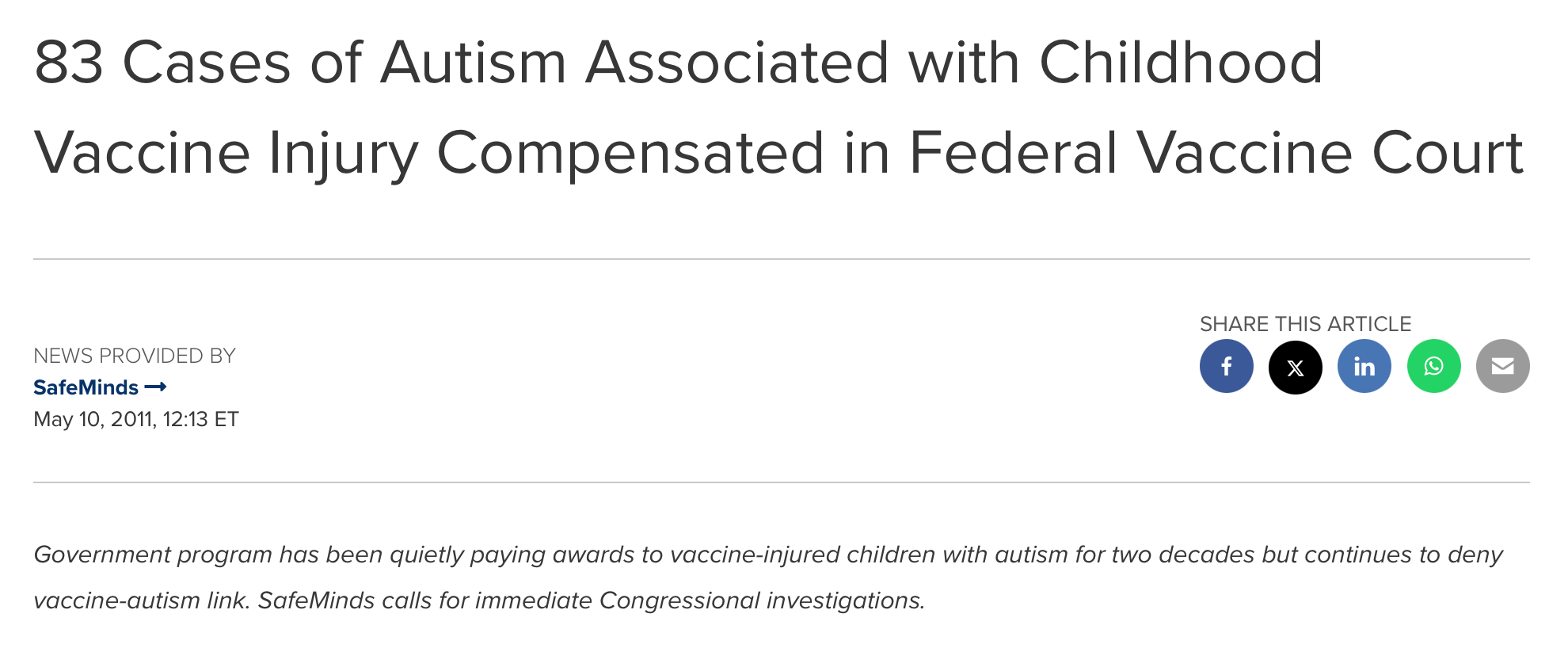
The study spearheaded by Ms. Holland and Mr. Conte was front-page news. Published in the spring of 2011 in the Pace Environmental Law Review, “Unanswered Questions from the Vaccine Injury Compensation Program: A Review of Compensated Cases of Vaccine-Induced Brain Injury” challenged the legitimacy of the vaccine court and showed that the courts had found, at least eighty-three times, that the medical standard for vaccines causing autism had been met. One report excerpt explained:
It is notable that over a twenty-year period the VICP did not publicly acknowledge an apparent vaccine-encephalopathy-autism link. While in the early years of the program there might have been no particular attention to this association, certainly by the late 1990’s, the question of vaccine injury and autism was one of general public interest. The findings of so many cases of autism among compensated cases calls into question HHS’s assertions on the topic.
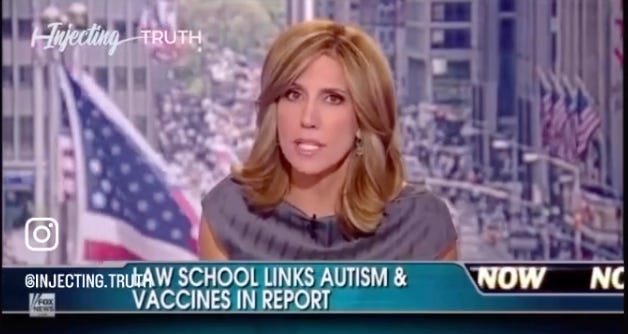
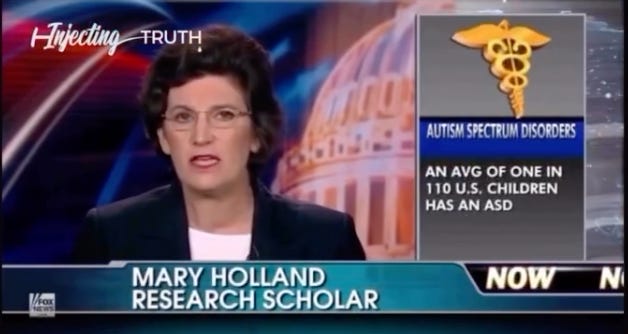
Fox News broke the “bombshell report” on their May 16, 2011, nightly news broadcast. Lead reporter Alisyn Camerota noted that “the Feds have been quietly compensating children injured by vaccines; these are children who have autism. All of this despite the public denials.” Ms. Camerota explained she had interviewed one of the compensated parents, who told Fox News she had been told to stay quiet and that she feared losing the annuity she received from the government for her child’s vaccine injury by publicly commenting. Ms. Camerota explained that the federal government had issued a statement in response to the study, affirming that vaccines don’t cause autism. (Author’s note: any evidence of this national story has been largely scrubbed from the Internet!) Finally, Ms. Holland appeared on screen and issued an eloquent rebuke of the federal government’s public position:
Remember that these case decisions that were compensated by the federal government were based on science. They had ample scientific and medical evidence before them. We rely on the fact that the government used the best science available to decide that these were cases of vaccine injury. What we’ve added to this debate, Alisyn, is that these kids have autism. In addition, there are an awful lot of kids whose families allege that they have autism and when they use that word, they didn’t get compensation.
Many of the families of the eighty-three children joined Ms. Holland and her coauthors in a public press conference on the steps of the vaccine court. They demanded a congressional investigation. They said the vaccine court isn’t working. They explained the vaccine court’s “dirty secret,” that children with vaccine-induced autism are routinely compensated, meeting the vaccine court’s high hurdle for proof, so long as they avoid the word autism. It was a bombshell, the kind of study published in a peer-reviewed law journal that on perhaps any other topic would produce an immediate congressional investigation, like the Flint drinking water crisis in 2016. Except it didn’t.
You can listen to my podcast interview with Mary Holland:
·
SEPTEMBER 18, 2024

The Vaccine Court has been a nightmare for autism parents. Is RFK Jr about to change everything? Time will tell.
J.B. Handley is the proud father of a child with Autism. He spent his career in the private equity industry and received his undergraduate degree with honors from Stanford University. His first book, How to End the Autism Epidemic, was published in September 2018. The book has sold more than 75,000 copies, was an NPD Bookscan and Publisher’s Weekly Bestseller, broke the Top 40 on Amazon, and has more than 1,000 Five-star reviews. Mr. Handley and his nonspeaking son are also the authors of Underestimated: An Autism Miracle and co-produced the film SPELLERS, available now on YouTube.
No posts
Comments
Nothing yet. Say the first thing.
Sign in to join the conversation.