
LOS ANGELES, California—Unvaccinated kids are…healthier, according to EIGHT studies that have been published in the scientific literature. Anyone in the scientific community knows that getting a study published that portrays vaccines in a negative light is nearly impossible, which means these studies likely represent a tip of the iceberg.

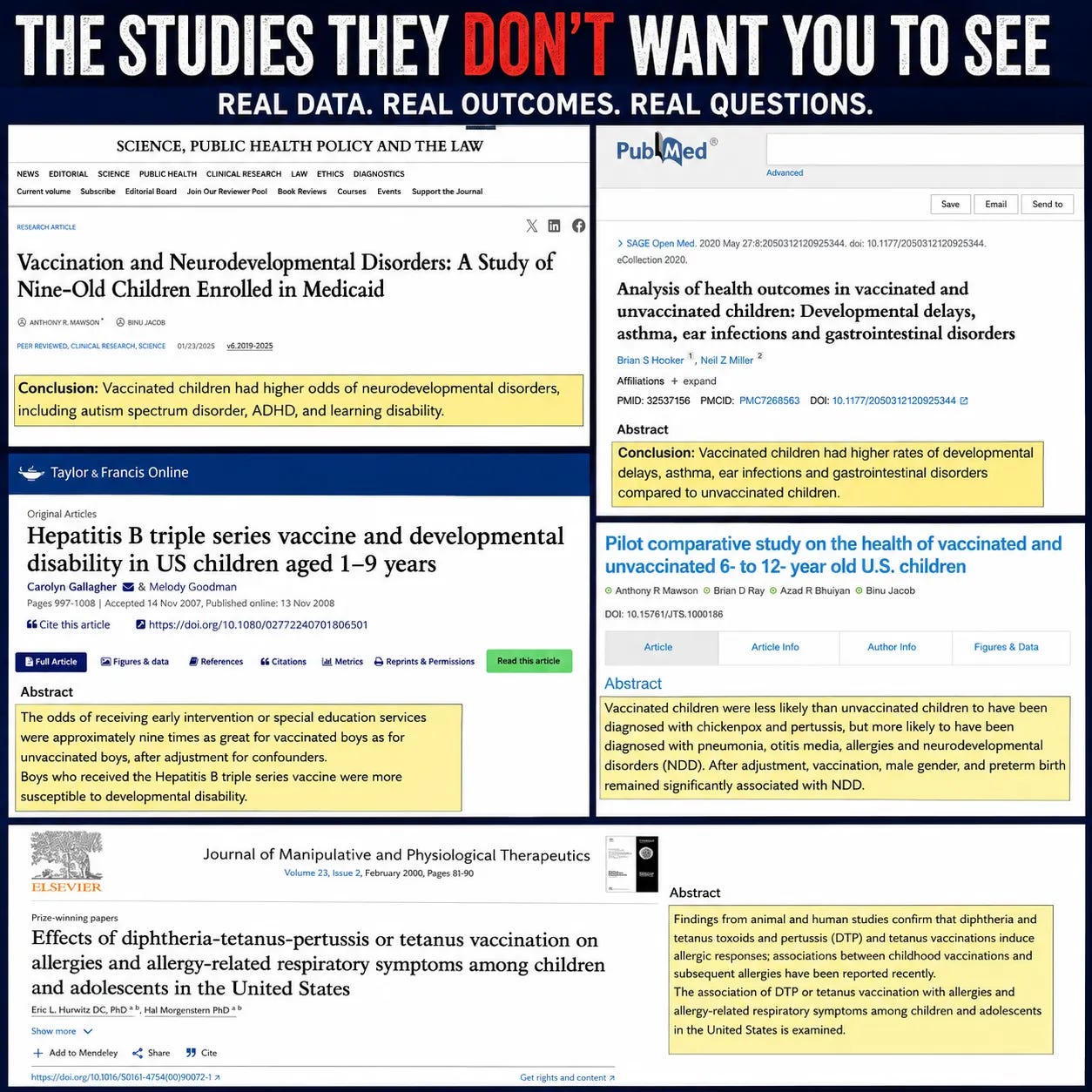
The first study that compared children who had received a vaccine with children that hadn’t was published in 2000. Although autism wasn’t something the study considered, it was still revealing. Titled “Effects of Diphtheria-Tetanus-Pertussis or Tetanus Vaccination on Allergies and Allergy-Related Respiratory Symptoms among Children and Adolescents in the United States,” this study from the UCLA school of public health did look specifically at the DTP vaccine to see if it might be responsible for allergies and allergy-related symptoms, such as asthma. Looking at more than thirteen thousand children, the study found that:

DTP or tetanus vaccination in US children is associated with lifetime history of asthma or other allergies and allergy-related symptoms. . . . Assuming that the estimated vaccination effect is unbiased, 50% of diagnosed asthma cases (2.93 million) in US children and adolescents would be prevented if the DTP or tetanus vaccination was not administered.
So the first study to ever compare a group that received a vaccine with a group that didn’t found a dramatic difference in rates of asthma and allergies among the vaccinated group, so much so that they thought not getting the DTP vaccine might reduce cases of asthma by 50 percent! Note that many children with autism suffer from what are known as comorbid conditions, such as asthma, allergies, and other autoimmune conditions.
In 2008 in the second study ever looking at a group of children who didn’t receive a vaccine, public health researchers Carolyn Gallagher and Melody Goodman from SUNY Stony Brook looked at the possible relationship between the hepatitis B vaccine and special education.Were children who received the full series of hepatitis B vaccines (three separate vaccines, the first one often given on day one of life) more likely to end up in special education classes than children who didn’t receive any hepatitis B vaccines? The study, “Hepatitis B Triple Series Vaccine and Developmental Disability in US Children Aged 1–9 Years,” was published in the journal Toxicological and Environmental Chemistry, and the results were pretty clear: The full series of hepatitis B led to a ninefold greater likelihood of receiving special education:

This study found statistically significant evidence to suggest that boys in United States who were vaccinated with the triple series Hepatitis B vaccine . . . were more susceptible to developmental disability than were unvaccinated boys. . . . The odds of receiving EIS [special education] were approximately nine times as great for vaccinated boys (n = 46) as for unvaccinated boys (n = 7), after adjustment for confounders.
The same researchers from SUNY Stony Brook published another study in 2010, this time looking at the relationship between receiving the hepatitis B series and autism. Published in the prestigious Journal of Toxicology and Environmental Health, “Hepatitis B Vaccination of Male Neonates and Autism Diagnosis” once again reached very clear conclusions:
“Boys vaccinated as neonates had threefold greater odds for autism diagnosis compared to boys never vaccinated or vaccinated after the first month of life.”
Journalist David Kirby appreciated the significance of the new findings, writing in the Huffington Post:
[The study] will be among the first university-based population studies to suggest an association between a vaccine and an increased risk for autism. And that would be in direct contradiction to all those MMR and thimerosal studies that purportedly found no such link.
The two Goodman and Gallagher articles about hepatitis B raise many concerns. I’ve met pediatricians who feel that the hepatitis B vaccine specifically has triggered the epidemic of neurological disorders and autoimmunity we now see in our children. Hepatitis B was the first vaccine introduced after Congress indemnified vaccine makers from liability in 1986. The vaccine has a high dose of aluminum, which I believe is the primary cause of autism and it’s often given to babies on day one of life, which many immunologists feel is a huge mistake. These two studies raise major concerns, but I’m guessing you never knew either of these studies existed, which supports my point about scientists and PR firms.
In 2017, however, something amazing happened. Two separate studies comparing vaccinated and completely unvaccinated children actually got published. Unlike the Goodman and Gallagher studies above, which only explored a single vaccine (the rest of a child’s vaccine status was simply not considered), these two new studies met the “gold standard”—they found children who had never received any vaccines and looked at their health outcomes in a variety of ways. The public health researchers from Jackson State University originally planned to publish a single study, until they looked at the data on children born prematurely, noting that the data on the difference in health outcomes for vaccinated versus unvaccinated premature infants was so dramatic it deserved its own study.

Published in the Journal of Translational Science, the first groundbreaking study was called, “Pilot Comparative Study on the Health of Vaccinated and Unvaccinated 6- to 12-Year-Old U.S. Children,” and its results were so devastating to the US vaccine program that there wasn’t a single media outlet in the country that covered its release.The results of comparing vaccinated children to completely unvaccinated children were no surprise to me, my wife, or any of the autism parents I know, but perhaps would surprise others:

The vaccinated were less likely than the unvaccinated to have been diagnosed with chickenpox and pertussis, but more likely to have been diagnosed with pneumonia, otitis media, allergies and NDD [neurodevelopmental disorders]. After adjustment, vaccination, male gender, and preterm birth remained significantly associated with NDD.
Specifically, vaccinated children were found to have a fourfold higher likelihood of having autism. I’m reminded of a quote by Dr. Daniel Neides of the Cleveland Clinic, who wondered if we were making trade-offs that aren’t worth it. He said,
“Some of the vaccines have helped reduce the incidence of childhood communicable diseases [like chickenpox and pertussis from the study above] . . . but not at the expense of neurologic diseases like autism and ADHD increasing at alarming rates.”
Simultaneously, the Jackson State authors published a study in the same journal just looking at children born prematurely, titled, “Preterm Birth, Vaccination and Neurodevelopmental Disorders: A Cross-Sectional Study of 6- to 12-Year-Old Vaccinated and Unvaccinated Children.” The results were disturbing, as the researchers found children born prematurely and vaccinated were fourteen times more likely to develop a neurodevelopmental disorder! The authors were appropriately concerned:
Preterm birth coupled with vaccination, however, was associated with a synergistic increase in the odds of NDD, suggesting the possibility that vaccination could precipitate adverse neurodevelopmental outcomes in preterm infants. These results provide clues to the epidemiology and causation of NDD but question the safety of current vaccination programs for preterm infants.
In 2020, Dr Brian Hooker Neil Miller took the study of unvaccinated children to a new level by looking at actual data from a pediatrician’s office who had a large number of unvaccinated patients. The study, Analysis of health outcomes in vaccinated and unvaccinated children: Developmental delays, asthma, ear infections and gastrointestinal disordersconcluded exactly what by now is a pretty familiar refrain:
Vaccination before 1 year of age was associated with increased odds of developmental delays (OR = 2.18, 95% CI 1.47-3.24), asthma (OR = 4.49, 95% CI 2.04-9.88) and ear infections (OR = 2.13, 95% CI 1.63-2.78). In a quartile analysis, subjects were grouped by number of vaccine doses received in the first year of life. Higher odds ratios were observed in Quartiles 3 and 4 (where more vaccine doses were received) for all four health conditions considered, as compared to Quartile 1. In a temporal analysis, developmental delays showed a linear increase as the age cut-offs increased from 6 to 12 to 18 to 24 months of age (ORs = 1.95, 2.18, 2.92 and 3.51, respectively). Slightly higher ORs were also observed for all four health conditions when time permitted for a diagnosis was extended from ⩾ 3 years of age to ⩾ 5 years of age.
Conclusion: In this study, which only allowed for the calculation of unadjusted observational associations, higher ORs were observed within the vaccinated versus unvaccinated group for developmental delays, asthma and ear infections. Further study is necessary to understand the full spectrum of health effects associated with childhood vaccination.
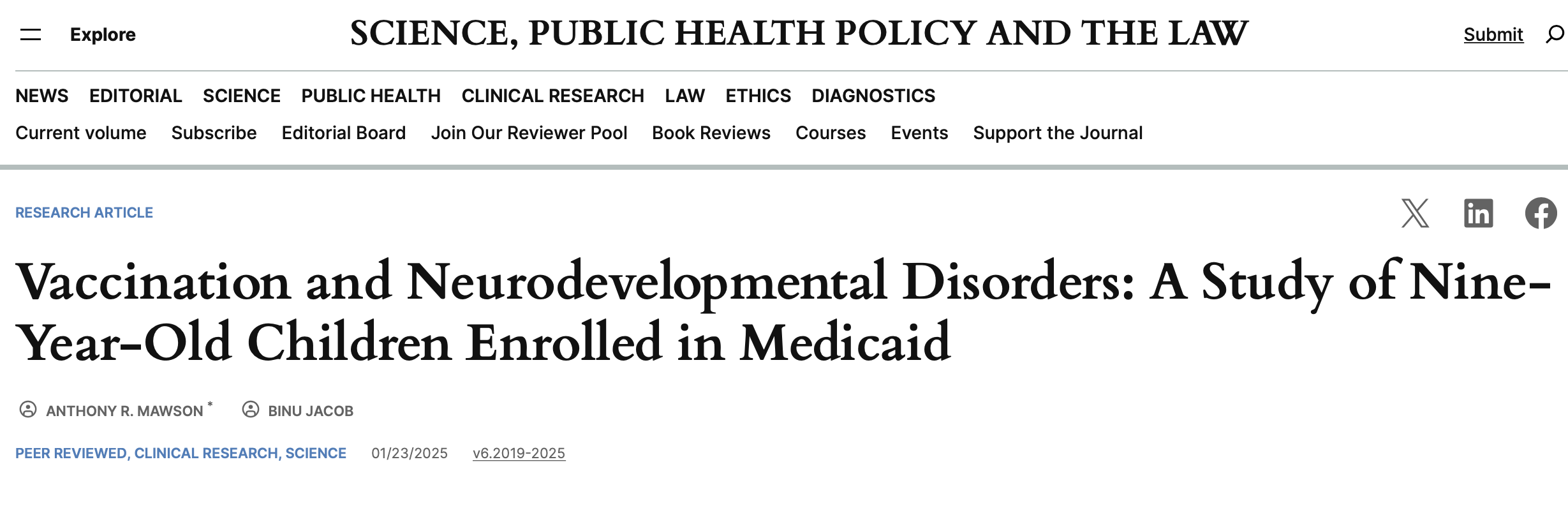
In January 2025, Dr. Tony Mawson and colleagues published another study, this time using a gigantic and highly credible dataset including more than 4,600 unvaccinated children, to support many of the previous conclusions they reached. Titled Vaccination and Neurodevelopmental Disorders: A Study of Nine-Year-Old Children Enrolled in Medicaid, the study looked at the data of 47,155 children enrolled in the Florida State Medicaid program. The study’s method:
Vaccination uptake was measured by numbers of healthcare visits that included vaccination-related procedures and diagnoses. Cross-sectional analyses were performed to calculate prevalence odds ratios (Aims 1-2). A retrospective cohort design was used to compute relative risks specifically of ASD (Aim 3).
As you might expect by now, the results supported what we are seeing in the unvaccinated populations:
The analysis of claims data for 47,155 nine-year-old children revealed that: 1) vaccination was associated with significantly increased odds for all measured NDDs; 2) among children born preterm and vaccinated, 39.9% were diagnosed with at least one NDD compared to 15.7% among those born preterm and unvaccinated (OR 3.58, 95% CI: 2.80, 4.57); and 3) the relative risk of ASD increased according to the number of visits that included vaccinations. Children with just one vaccination visit were 1.7 times more likely to have been diagnosed with ASD than the unvaccinated (95% CI: 1.21, 2.35) whereas those with 11 or more visits were 4.4 times more likely to have been diagnosed with ASD than those with no visit for vaccination (95% CI: 2.85, 6.84).
I’ll pull out the part of that conclusion that hits me hardest as an autism parent:
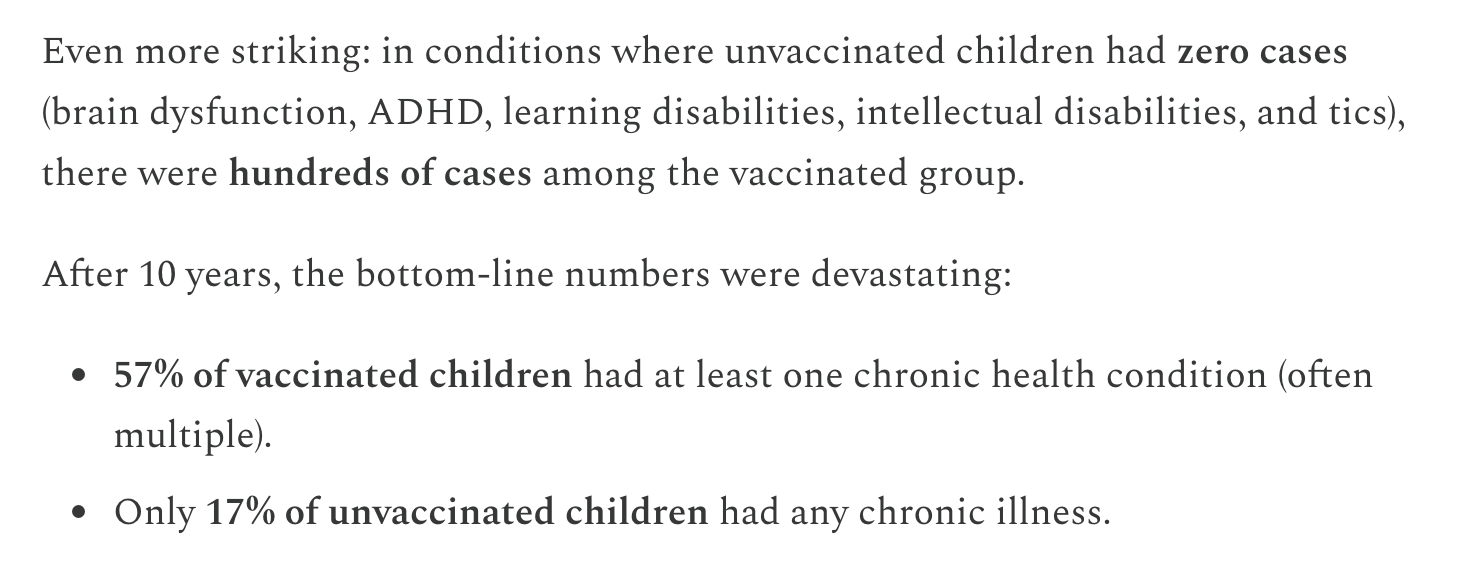
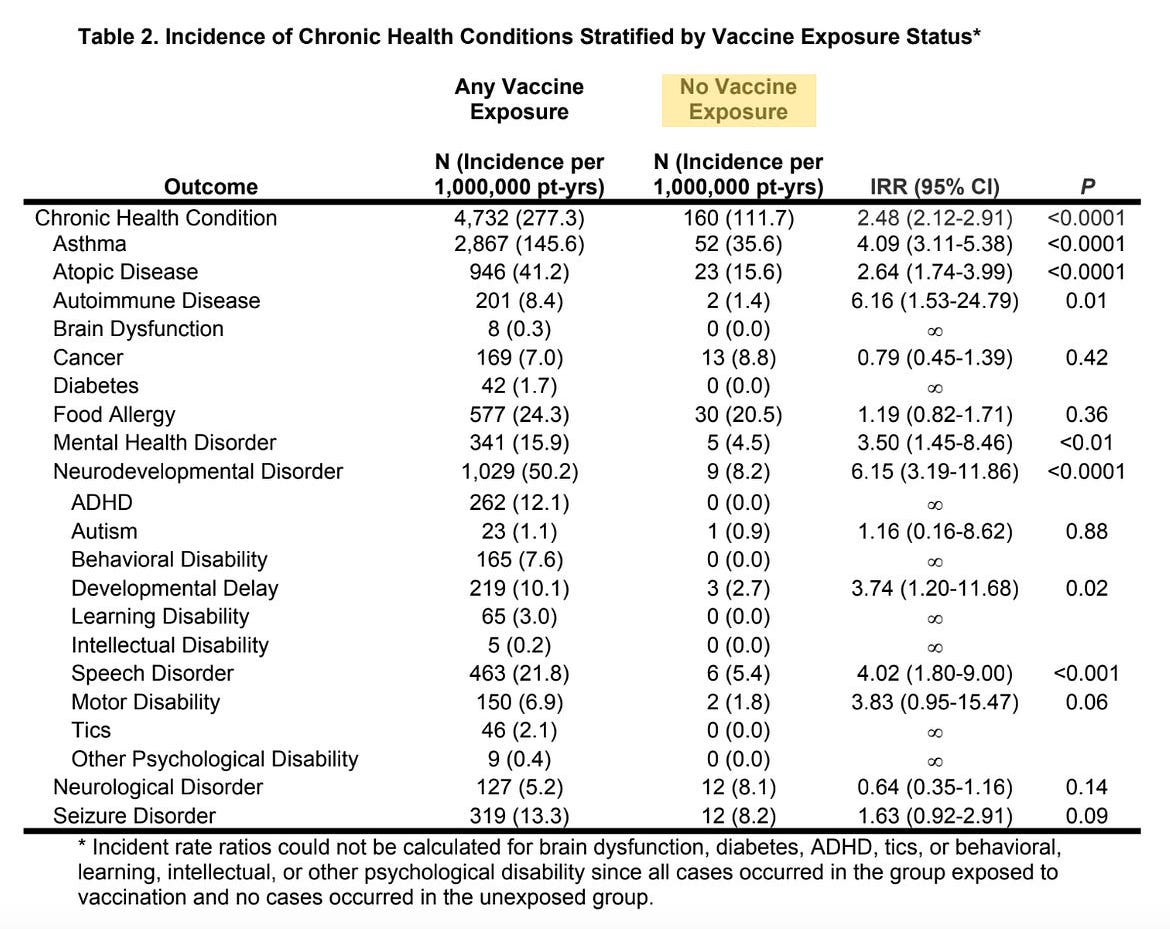
In the 8th study—18,468 children were included in this study by Detroit's Henry Ford Health System, the largest ever, and of course the results were devastating and consistent with the previous seven studies:
“Compared to unvaccinated children, those who received one or more vaccines had dramatically higher rates of chronic illness:
329% more asthma
203% more atopic disease
496% more autoimmune disease
453% more neurodevelopmental disorders
• including 228% more developmental delays
• and 347% more speech disorders”
Author Nicholas Hulscher, MPH noted:
Eight separate studies, all comparing a group of children vaccinated with a group of children unvaccinated, at least for a single vaccine. I’m guessing that for most readers this is the first time you’ve read about any of these studies. I think a fair question would be, “Why?” The answer is simple:

J.B. Handley is the proud father of a child with Autism. He spent his career in the private equity industry and received his undergraduate degree with honors from Stanford University. His first book, How to End the Autism Epidemic, was published in September 2018. The book has sold more than 75,000 copies, was an NPD Bookscan and Publisher’s Weekly Bestseller, broke the Top 40 on Amazon, and has more than 1,000 Five-star reviews. Mr. Handley and his nonspeaking son are also the authors of Underestimated: An Autism Miracle and co-produced the film SPELLERS, available now on YouTube.
No posts
Comments
Nothing yet. Say the first thing.
Sign in to join the conversation.