
Go looking for Dizzy Gillespie’s first big band and you will not find it.
It played the American South for most of a season in 1945, seventeen or so men with his name on the marquee and his money behind it. The North Carolina Collection at Chapel Hill still logs one of the nights: a dance and show at the Charlotte Armory, the Nicholas Brothers headlining, and a twenty-seven-year-old Gillespie still playing a straight horn. The bent bell was eight years off, the product of a 1953 accident involving a dancer and a trumpet left on a stand.
A room, a date, a bill. That is close to the whole archive.
Because in the standard session index for Dizzy Gillespie, there is no recording by a Gillespie orchestra between the small-group dates of spring 1945 and a studio session on February 22, 1946. No sides. No broadcast. No collector’s acetate surfacing decades later, the way one did for the Onyx Club band.
The most photographed face in the history of jazz led a big band across a summer of one-nighters, and there is no evidence it made a sound.
1945 is supposed to be the triumph. It is the year the records got made, the ones that turned a rumor circulating on Fifty-second Street into a documented American music. In February, Groovin’ High. In May, “Salt Peanuts,” “Hot House,” “Shaw ‘Nuff.” In June, Town Hall, with Charlie Parker and a twenty-one-year-old Max Roach. He also cut a ballad that year, I Can’t Get Started, proving the new music could hold a melody as well as detonate one.
Every one of those is a small group. Six men, five men, sometimes four.
Bebop’s founding documents are quintet records because quintets could be paid for, not because Gillespie preferred them. His ambition, from the moment he had any leverage at all, was an orchestra. Alyn Shipton’s biography puts it plainly: Gillespie wanted to succeed where Billy Eckstine’s pioneering bop big band had struggled, and he “quietly hoped that a big modern jazz band would finally catch on.”
So in the middle of his best year on record, he stopped making records and got on a bus.
The vehicle was a traveling revue called Hepsations of 1945. The Nicholas Brothers headlined. Patterson & Jackson, a comedy duo, worked the middle. Gillespie’s orchestra was the pit band and the closer: it accompanied the singers and the dancers, and then, after the show, it played for dancing.
That second job is the whole story.
The package tour was the standard economic unit of Black entertainment in 1945, a self-contained evening you could drop into an armory, a ballroom, a tobacco warehouse, a segregated municipal auditorium, and turn a profit on a percentage of the door. The math only worked if the room stayed full after the acts came off. People paid to dance. That was not an aesthetic preference. That was the product.
And you cannot lindy hop to bebop. Not the fast heads, not the phrase lengths, not the way a Gillespie chart pulls the ground out from under a four-beat bar. Howard Johnson, in the saxophone section, remembered what the rooms did with it: audiences would listen, stand around, applaud, and try to pretend they understood it. Ella Fitzgerald’s biographer Stuart Nicholson wrote that the band’s sound “had confused and confounded the southerners.”
Now consider who was standing on those floors. This was the segregated South. The people declining to dance were Black southerners, the exact constituency that bebop mythology assigns to the music as its natural home. They were not confused because they were unsophisticated. They were annoyed because they had bought a dance and been handed a concert.
There is a colder reason the Hepsations was doomed before the bus left, and it has nothing to do with taste.
The tour ended. The band ended with it, dissolved in the same year it was formed. The Smithsonian’s biographical note on Gillespie, written for the archive of his business papers, disposes of the whole episode in a single clause: the band “was quickly downsized into a quintet due to financial problems.”
That quintet was Charlie Parker, Bud Powell, Ray Brown, and Max Roach.
The consolation prize for the failure of the Hepsations was arguably the greatest small group ever assembled in American music, working the Three Deuces on Fifty-second Street. Gillespie experienced it as a demotion. His memoir treats the quintet as what he settled for. He was already planning the next orchestra.
Then the quintet went west, Billy Berg’s in Hollywood, December 10, 1945 into early February, and that trip produced its own disaster, which is a different story. By the time Gillespie came back east the personnel were scattering. His account of it is one of the quietly devastating sentences in the memoir: Kenny Clarke had gone with Red Allen, Max Roach had gone with Benny Carter, and “both of them had better jobs than playing for peanuts with me.”
The peanuts belonged to the man who wrote “Salt Peanuts.”
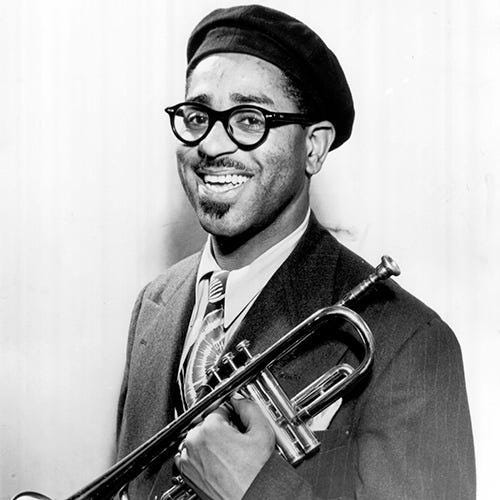
In 1946 he built the second orchestra. This is the famous one: Milt Jackson, Ray Brown, Kenny Clarke, James Moody, John Lewis, and eventually Chano Pozo. Ira Gitler said hearing it live was like getting hit by Joe Louis in the solar plexus. It is the band that made “Manteca,” played Carnegie Hall, carried bebop to Europe.
Milt Jackson’s summary of its first year, as Shipton records it: “You see Dizzy lost a hundred thousand dollars, like that first year.”
A hundred thousand 1946 dollars. That figure is one musician’s recollection rather than an audited number, and it deserves the hedge. Nobody who was there disputes the direction of the arrow.
When Gillespie took the second band south in 1946 and 1947, he did not repeat the mistake. He hired Ella Fitzgerald to go with them, to break up what Nicholson called the unrelieved diet of bop. He had learned the wrong lesson and the right one simultaneously: that the music could not sell itself, and that he would keep paying for it anyway.
We treat recorded evidence as though it were the same thing as history. It is a record of what somebody was willing to finance.
The 1945 orchestra is missing from the discographies for the same reason it collapsed. No label wanted to press it, no promoter wanted to hold it, and the format Gillespie believed in was the one format the American economy of 1945 had just stopped paying for. What survives from that year, the quintet sides everyone teaches, survives partly because five men were cheap. Bebop’s canonical instrumentation is, among other things, a budget.
He spent the next forty-five years trying to buy his way out of that constraint. He started a record label to own his own masters and lost it. He let the State Department pay for an orchestra when nobody else would, and lost that too when the appropriation ran dry. He found a model that finally worked in 1988, with five years left to live.
The paperwork documenting all of it, the contracts and itineraries and financials, twenty cubic feet now sitting in the Archives Center of the National Museum of American History, survives only because his last manager pulled it out of the garbage. The finding aid notes the rescue in the dry tone archivists reserve for miracles: much of the paper was saved by Charles Fishman when Gillespie tried to throw it in the trash.
He thought only the music mattered. The receipts say otherwise.
Next in Behind the Cheeks: the greatest band he ever led, destroyed by a labor dispute and a promoter who ran.
No posts
Comments
Nothing yet. Say the first thing.
Sign in to join the conversation.