
“Back, back into your disguises.”
I’m not really a Christopher Nolan Guy, and I don’t really understand people who are.
Now don’t get me wrong here, he’s a quality filmmaker. I readily gave Oppenheimer five stars. I’d throw Memento on at the drop of a hat. Dark Knight was a cultural touchstone of my youth and I consider it worthy of its pedigree. Even the famously-inscrutable (not nearly as complex as some think) Tenet impressed me more than I assumed was possible on my first viewing. Actually though, I think I’ve gotten the most mileage, in personal terms, out of Dunkirk. Not the movie, but the associated stories I can tell. I worked at a multiplex during the initial theatrical run, big and purpose-built, complete with an IMAX theater. The sound tuning on that one was so bass-forward that when bombs would go off in the IMAX, it would audibly shake the marquee posters riveted into the front facade of the building. We never got so many complaints about a single film. No, sir, we can’t turn the volume down. That’s how Christopher Nolan wanted it. Want a refund?
This story, in addition to reliably getting laughs and mouths wide open in shock, illustrates both why I am not a Christopher Nolan Guy, and also why I make a point of seeing his movies whenever he makes one.
Nolan is the youngest and most vital among a diminishing class of auteur able to mobilize massive resources, money, materials, technology, and performers, in service of whatever he wants to do. He is free to follow his muse wherever it leads and the studios will readily open their checkbooks to finance that journey. He’s literally inviting me to watch him set hundreds of millions of dollars on fire in service of whatever his current fixation happens to be. How am I not going to watch that?
However, a creative environment where nobody can tell you “no” means a body of work that lives and dies on the decision-maker’s personal taste. I find Nolan compelling as a craftsman. As a tastemaker? Up and down. Balls and strikes. Nothing to ever make me roll my eyes, but nothing to compel and thrill me in the way my true favorites do. The skeptics paint him as a man devoid of an artistic spark. The cold, technical, cerebral bard we deserve in a STEM epoch devoid of higher ideals. I watch guys build cars and write software for robotic golf clubs on YouTube, also my favorite filmmaker is Michael Mann, so clearly I have no issue with watching a technician solve hard, fast physics problems and then broadcast it as entertainment.
The flip side of the coin, however, seems to draw more ire. “Nolan Bros” are one of those demographics of allegedly-insufferable people that are supposed to be ubiquitous, but I have never once met. I know fans, but they’re fans of Nolan in the same way people are fans of, say, The Grateful Dead. I could see myself sharing their passion, but only if I was someone else. I suppose, as much as they befuddle me with their love for the artistic tastes of a man I consider to be pretty much equivalent to a tub of vanilla ice cream in that department, I envy the Nolan Bros for their ability to get excited, rather than simply interested. In theory, though, I should be excited for The Odyssey. As a former Percy Jackson Kid I retain a fondness for Greek mythology and better yet, it’s one of mankind’s great stories still lacking a definitive adaptation in film. Cohenheads will no doubt reach for Oh Brother Where Art Thou? But that film’s central conceit is that the best way to adapt the Homeric epic is to do so in a way which dodges the astronomical costs involved. Doing it straight up is nigh impossible before we even leave the begging for a budget stage and actually start trying to shoot the movie. It’s the sort of epic task a guy like Nolan should be ideally suited for. Cut through the studio risk mitigation and give us that singular vision of brave Odysseus and his long, strange trip home.
I am bound and determined to discuss the primary text (the film) and only the primary text in these reviews. If I bring up concepts or companion/ comparison works, it’s solely to illustrate my own headspace. The Odyssey is making this difficult simply because, as the tentpole blockbuster of midsummer, it has arrived at the end of a monthslong hype parade of extrapolation, speculation, and interpretation of what this film (which was released mere days ago at time of writing) is be, would be, or must be. A lot of people were very confident that this film was going to exist pro or contra some specific politic or worldview literal months in advance of our being able to watch the thing.
This makes it, in short, gut-bustingly funny that after all the sturm-und-drang about the film and its cast, The Odyssey is… A Monster Movie! And a great one, at that! The iconic monsters of this myth, exiled for too long into the Dungeons and Dragons bestiary, recapture some ability to awe, to shock, to inspire genuine fear. This is a true credit to Nolan the Craftsman and Nolan the Spender of Money. No actors reacting in a vacuum to as-of-yet unfinished VFX blobs represented by tennis balls on a Burbank sound stage. By God we are gonna rig up that twenty-five foot puppet inside a musty cave to ensure that this Cyclops has gravitas! This is not a level fourteen miniboss encounter for parties of three or more, this is a borderline kaiju and you will feel its heft. It’s a neat heuristic for the film as a whole. When a scene or concept is a problem which can be tackled by Nolan the engineer, it’s smashing expectations. The evocative imagery of the myth comes to life because the money was spent and the hard, practical problems were solved. It’s charming, to me, because that’s ultimately the legacy of the 20th century’s stabs at mythic filmmaking. You get this sort of Ratatouille flashback of lil Chris Nolan in front of the family TV, watching Jason and the Argonauts, totally enraptured. How did they get those skeletons to move?
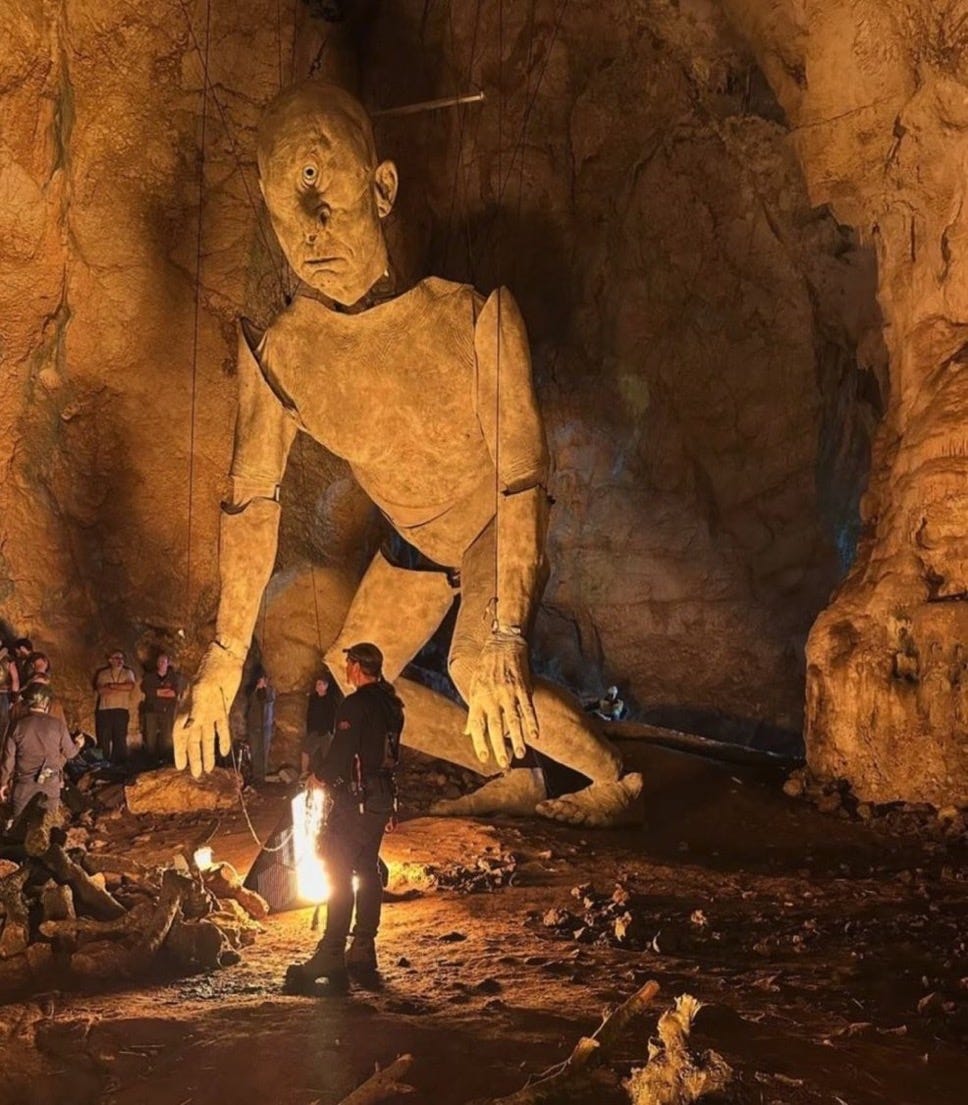
Nolan gets a lot more than the skeletons to move. The Laestrygonians, the Lands of the Dead, Circe, oh my God, Circe. Christopher Cronenberg, more like. Excellent. The Syclla may actually stick with me more than any other monster in the lineup despite maybe thirty seconds of screentime simply because it is such a nice nutshell illustration of how this approach both highlights Nolan’s strengths and reveals his weaknesses. One the one hand its an instantly iconic and genuinely skin-crawling depiction of a monster which always struck me as a bit ambiguous in its proportions and dimensions, Nolan makes a boss call and it pays off. On the other, it demonstrates that for all his technical might, Nolan is all thumbs in setting up a proper scare. There’s never the fake out, or an attempt to wrong-foot the audience. You always know when a camera is lingering just a touch too long on some poor crest-helmeted goon about to die horribly. That’s probably for the best, given this film’s ambition to fill multiplexes the world over, but once again we confront the limits of the singular vision we are being served here. Nolan the Engineer is in peak form, Nolan the Artist remains streaky.
The nice thing about a massive budget sensibly spent is that one can hire people to cover for their weak points and Nolan most certainly does that. Anne Hathaway is Anne Hathaway, no real need for further comment, beyond any reproach from me and certainly not in need of any praise, still hoopin like year twenty LeBron, let’s move on. Tom Holland should fire his agent because he’s thirty years old and still playing these impotent angsty teens/early twentysomethings but I’m sure the checks are good. The strategy of pretending to be twenty until you’re forty worked well enough for Leonardo DiCaprio once upon a time, I suppose. Give it a pass, not like Telemachus has too much of a role in this story beyond Wanting His Dad To Come Home, anyway. It’s the little turns that stand out in a big, bold, epic production. The human moments against the canvas of mythic grudges and trials. John Leguizamo doing career-best work in this one was not on my bingo card but in retrospect, he’s an obvious Nolan Guy, think Josh Hartnett in Oppenheimer or noted guy-who-is-also-in-this-movie Benny Safdie. I’m on record saying Benny ought to act while he’s young and photogenic and he’s good here but in a vacuum, and with minimal intent to mock and jeer; it is so so funny to cast Benny Safdie as Bronze Age Darth Vader. But it works! Same with Jon Bernthal as the lemme tell you somethin’ King of Sparta, who proves an able tag-team partner for scene stealing turns from Lupita Nyong’o.
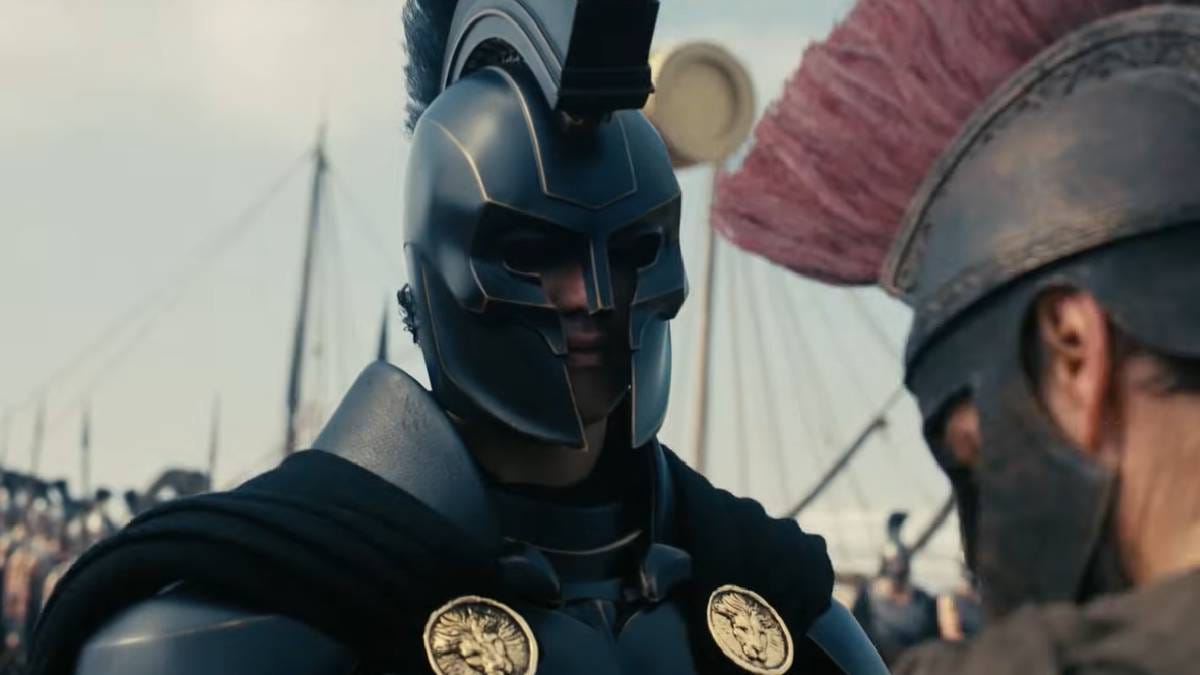
If we’re talking scene-stealers, however, tribute must be paid to Elliot Page. Simply tremendous. People had questions, both bad faith ones and justified ones, about how Nolan was going to deploy both Page and Nyong’o and I found them among the best performances in the ensemble. The same cannot be said for Robert Pattinson or Zendaya, but that’s less a problem with his performance and more with the script. An Odyssey where the gods and their agendas are more or less obscure means we need a human face the audience will want to see punched before the credits roll and Bob Patt certainly has that in spades but that doesn’t mean his slimy scheming ever scans as a genuine threat. I frankly did not think Nolan would be so bold as to attempt any serious departure from the accepted ending of the myth, and he didn’t surprise me. Maybe we really should have gotten some member of the Actors Guild of Great Britain to wear a toga, shoot lightning from their hands and introduce themselves as Lord Raiden Zeus or Aquaman Poseidon. As it stands we have Zendaya doing the “feel guilty” face as Ambiguous Athena. Still not dumping my stock in either actor ahead of Dune: Part Three. Swaggy Bobby is about to Freak It as Scytale, bookheads know.
Can’t have an Odyssey without Odysseus, of course, and Matt Damon finds himself with a tough road to hoe as marquee leading man gigs go (and that’s before we count all the times he had to be wet and miserable). He’s tasked with finding the sweet spot between popular myth and Nolan’s own distinct insight into this immortal story and the real world history around it. The resulting performance is a hero of simple nobility rather than stirring oratory (save one notable exception at the last possible moment). In this way he’s an able avatar for his director. Whether he’s the Odysseus of your childhood imaginings is ultimately up to you, and therein lies the rub with the whole production, doesn’t it? Mythology belongs to everyone, both as individuals and as a collective civilization. The problem of adapting a text so universal is that everyone will come into it with their own baggage. This makes Nolan’s approach, of simply calling his own shots and accepting the reactions as a fait accompli, all the more laudatory. I do not agree with all the choices made. There is a persistent feeling of bloat, a sense of cleverness over transcendent pathos, and a compelling discussion to be had about imposing modern morality onto premodern peoples. But I cannot help but respect and admire the confidence, vision, and commitment.
In the course of watching this film I think it finally clicked for me why I find Nolan compelling as a director even if I feel consistently out of step with him as a creative. He’s not unlike Odysseus himself. Exemplary in some ways, flawed in others, but committed to the struggle and eminently worth rooting for.
I rate this movie four lotus flowers out of five.
No posts
Comments
Nothing yet. Say the first thing.
Sign in to join the conversation.