
Gmail invitations once sold for $150 on eBay. Dropbox users earned 500MB of storage for each successful referral. Clubhouse reached a $4 billion valuation before losing 80% of its users within months.
These stories reveal the double-edged nature of exclusivity marketing: it can rocket a company to success or become the very thing that kills it.

Microsoft recently restructured its startup program. As of July 2025, investor-backed startups receive up to $150,000 in Azure credits through an invite-only track, while others get up to $5,000 through self-service.
Microsoft is not alone in this, thousands of founders still chase artificial scarcity as their primary growth strategy. Yet data from the past decade reveals a troubling pattern: majority of invite-only platforms that achieved initial viral success failed to maintain relevance within 24 months of opening access. The question facing executives in 2025 is not whether exclusivity works, but when and how to deploy it strategically.
The answer lies in understanding what killed the last wave of invite-only startups.
To understand why founders keep treating exclusivity as a product feature rather than a growth tactic, we need to go back to where it started. Paul Buchheit sat in Google's offices in 2004, staring at 300 ancient Pentium III computers nobody else wanted. Gmail was supposed to launch with a gigabyte of storage per user, an absurd promise when Hotmail & Yahoo offered 2-4 megabytes.
"We couldn't get many machines because people thought we couldn't launch," Buchheit later recalled. His solution was not strategic but it was desperate. They'd limit access, invite-only, until they could handle more users.
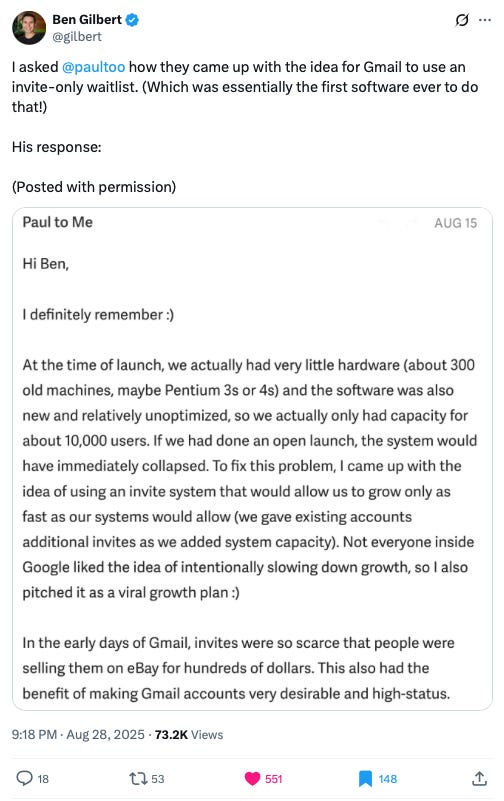
What happened next rewrote the marketing playbook. According to PC World magazine, Gmail invitations were selling on eBay for as much as US$150. People were paying premium prices for free email accounts. The technical limitation had accidentally created the most powerful marketing force in tech: artificial scarcity that became an exclusive access marketing phenomenon.
Every founder knows about FOMO. But exclusivity does something different. When you can't get in, you start wondering if you're good enough. That velvet rope makes people question their worth.
And the interesting thing is, Once you're in, you become part of the system. You become their unpaid marketing machine that reduce the CAC, improves their chances of success and validating your status by bringing others into the fold. This mirrors other irrational business behaviors we've explored (see "The People Paradox").
Consumer behavior research reveals that artificial scarcity triggers measurable neurological responses. Research shows FOMO marketing can increases engagement rates by 30% and conversion rates by 29%, though Harvard Business Review notes that 45% of FOMO-driven purchases lead to buyer's remorse.
Dropbox watched Gmail's success and built their own version. They grew from 100,000 to 4 million registered users in 15 months, achieving 3900% growth. But while Gmail had server problems, Dropbox manufactured scarcity on purpose.
Their math was pretty simple. As Drew Houston showed in his 2010 Startup Lessons Learned presentation, Google AdWords cost them $233-388 per customer but their product cost $99 per year. This way, they were bleeding money.
So they changed the game and started giving users free storage for inviting friends. Both people get 500 MB and users could earn up to 16 GB in total. Suddenly, customers became the marketing department.
The key difference: Gmail's exclusivity solved a technical problem. Dropbox's exclusivity encouraged product adoption. Both aligned scarcity with genuine business needs, not just hype. This aligns with the principle of building communities that actually work - creating genuine value for members rather than artificial barriers.
Clubhouse shows what happens when you confuse tactics with strategy. By February 2021, they had over 10 million weekly active users and a $4 billion valuation including celebrity endorsements from Elon Musk and Oprah Winfrey. It was a perfect pandemic timing and the most exclusive platform in tech at the time.
Six months later, the party was over.
According to a Business Insider poll, 88% of 5,000 participants abandoned Clubhouse, calling it "just a fad." When they finally opened access in July 2021, 10 million people sat on the waitlist and most never converted to active users.
Downloads plummeted from 10 million in February to 900,000 by April and monthly active users dropped 70%. The company that built its identity on exclusivity couldn't survive becoming inclusive. This pattern of rapid rise and fall echoes what happened to OnePlus, though OnePlus at least had a product beyond the velvet rope.
The core mistake: Clubhouse's exclusivity was the product. When everyone could join, there was nothing special left. Gmail had email, Dropbox had storage but Clubhouse had a velvet rope around an empty room.
Modern startups face different challenges than Gmail did in 2004. Today's reality:
Why limit access when infrastructure is unlimited?
Creating intentional communities (quality over quantity)
Building network effects through curation
Managing user education and onboarding
Positioning as premium or exclusive brand
Your key questions:
What genuine value does exclusivity add for users?
How will limiting access improve the product experience?
What's the specific exit strategy and timeline?
Can the product survive when exclusivity ends?
Modern examples that work:
B2B platforms using invite-only for quality control
Creator tools launching with select power users
Communities where curation enhances value
Products requiring intensive onboarding
The difference is these use exclusivity as a tool, not the product. For startups considering invite-only launches, here's a practical framework:
Red flags to avoid:
Exclusivity is your primary value proposition
No clear timeline for opening access
Your market has strong, open incumbents
You're manufacturing scarcity just for hype
No plan for maintaining momentum post-launch
Execution tactics:
Set clear capacity milestones for expanding access
Give users meaningful rewards for inviting others
Create value that persists after exclusivity ends
Plan your "open to all" announcement as carefully as your launch
Track engagement metrics, not just signup numbers
Invite-only marketing is psychological manipulation wrapped in strategy. It works precisely because it exploits our deepest social anxieties about belonging and status. Every founder preaches democratization while building walls.
But here's what the success stories teach us: sustainable invite-only strategies serve real purposes beyond hype. Gmail managed infrastructure, Dropbox incentivized product adoption and OnePlus controlled inventory while building community.
Are you using exclusivity to build something valuable, or to hide that you haven't built anything valuable yet? Because velvet ropes only work when there's something worth seeing on the other side.
The market is getting smarter and users who've been burned by exclusive-then-dead platforms are skeptical. If you choose invite-only marketing, make sure your scarcity serves your users, not just your marketing metrics. Build products people want even when everyone can have them.
That's the paradox of exclusivity: The best invite-only products are the ones that don't need to be.
Comments
Nothing yet. Say the first thing.
Sign in to join the conversation.