
1.
With a narcissist-buffoon-emperor currently in the White House, it’s easy to forget that, in many ways, the President of the United States is a figurehead. Trump did this, Trump said that, the reflecting pool, the ballroom, the Kennedy Center, the late-night tweet-storms, the unparalleled corruption — sometimes it can seem like everything that’s going on is just him being cray-cray or racist.
But that is not so.
Behind the scenes, in this administration as in all other ones, are thousands of government officials, think-tankers, lobbyists, bureaucrats, industry organizations, nonprofits, ‘special interest groups,’ diplomats, activists, and countless other constellations of Washingtonians, each with their own agendas and interests. The cliché of the ‘bandwagon’ is a useful one (I just image-searched a picture of one myself): the president is the guy with the reins, and the voters are the horses, but on the wagon are dozens of hangers-on who are fortunate enough to be along for the ride. They’ve made whatever compromises, alliances, and deals they need to, and for now, they have the one thing everyone in DC wants: power.

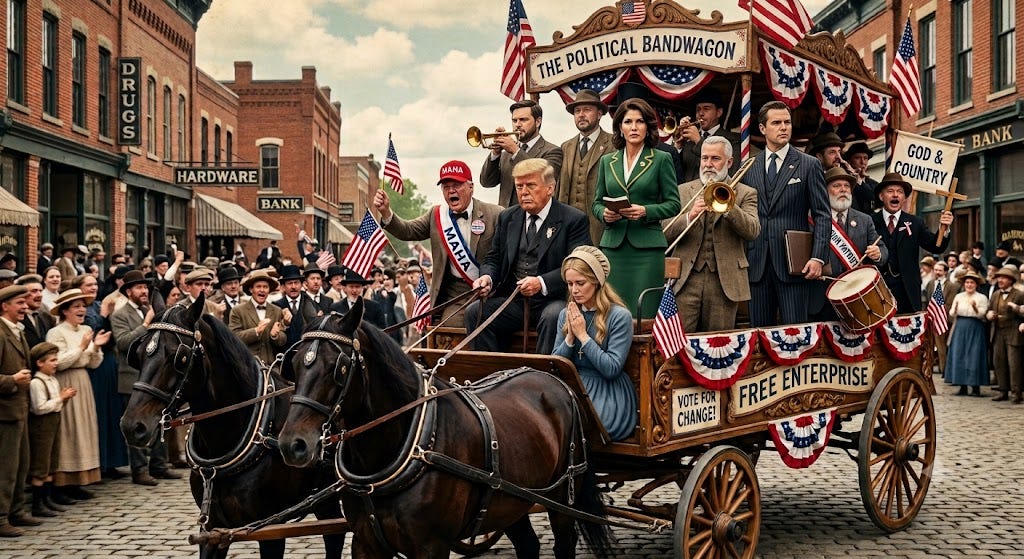
This, incidentally, is why I never care about the individual merits of a primary election candidate, and only about their electability. Sure, in solid blue districts, the differences between a DSA leftist and a DNC centrist are relevant. But in purple districts and presidential races, what matters most is that the leader gets the Democratic bandwagon into office. (This isn’t an argument for the centrist, by the way; it may be that an inspiring radical is more electable than a boring moderate. Sometimes.) I’d vote for an armadillo against a Republican, because around that armadillo will be a legion of policy wonks who will move the needle to the left.
2.
Which brings me to the subject of this week’s newsletter: the Office of Management and Budget’s proposed “Regulation for Federal Financial Assistance,” an outrageous, unconstitutional, incredibly self-destructive proposed rule that would devastate American scientific leadership to promote political and religious extremism. The public comment period on the proposal closes next week.
Are you yawning yet? That is precisely the point. When this administration wants its actions to get headlines, they give them names like ‘One Beautiful Bill’ or ‘Department of Government Efficiency.’ When they want to avoid the headlines and make massive changes to the government, they propose a ‘Regulation for Federal Financial Assistance’ that quietly undoes 100 years of federal scientific grantmaking.
In this case, the RFFA is a product of the post-liberal, nationalist (but intelligent, not MAGA) wing of the Trump coalition — specifically Russell Vought, a primary author of Project 2025, who I first wrote about in 2024, before he ascended to prominence. Vought is now the head of OMB, which in the past has acted like a company’s internal Controller, making sure the receipts are turned in on time, but which under Vought has become the central locus for destroying the administrative state (for better or for worse), the excesses of DOGE, and the War on Science. Exactly as Project 2025 set out, of course, back when Trump said he’d never heard of it.
As this longform report by ProPublica thoroughly details, Vought has become “the shadow president,” not merely implementing Trump’s broad directives but creating many specific ones of his own and, with ruthless efficiency, eliminating anyone who does not conform to the new order, in which civil servants, as such, no longer exist. But close your eyes: I bet you can’t even picture what he looks like, or pronounce his last name (“vote”). Gemini had trouble putting him in the bandwagon. That is all on purpose.
Both in office and out of it, Vought is the personification of the hyper-conservative pencil-necked nerds who pontificate about zeroing out anti-malaria programs, dismantling the Consumer Finance Protection Bureau, or ending “DEI.” But Vought has actually done it. Behind the scenes, he was the brains behind DOGE; Elon was just there to showboat and get agencies off his companies’ backs. As the ProPublica report puts it, Vought “has frozen vast sums of federal spending, terminated tens of thousands of federal workers and, in a few cases, brought entire agencies to a standstill.” In one widely-circulated quote, Vought said “we want the bureaucrats to be traumatically affected. When they wake up in the morning, we want them to not want to go to work, because they are increasingly viewed as the villains.”
Well, mission accomplished.
Vought is also an avowed Christian Nationalist, saying at one point “the phrasing is too accurate to run away from the term. … I’m a Christian. I am a nationalist. We were meant to be a Christian nation.” This is clear throughout Project 2025, which seamlessly integrates hard-right small-government cuts with hard-right Christian theocratic spending (on religious schools, on a ‘Department of Life’, etc.).
This is who is behind the RFFA.
3.
Now, before I start ringing alarm bells, the RFFA is going to be challenged in court by universities, nonprofits, and a good-governance groups, and even with this Supreme Court, I’d be surprised if it is allowed to take effect as written. It’s a massive power grab not only away from administrative agencies and the scientific community but from Congress as well, which has already explicitly rejected some of the provisions included in it. (Not to get into the weeds, but most current debate about the power of administrative agencies like OMB has to do with when Congress is silent – not when Congress has explicitly rejected steps the agency wants to take.) At the very least, a lot of lawyers are going to be paid to argue about it for a long time — paid mostly by you and me, of course.
But there is something to be done now: the proposed rule is open for public comment until 11:59 PM EDT on July 13, 2026. Please submit yours here. It won’t really matter; this administration doesn’t give a shit about public comments, and they’re going to ram the rule through no matter what anyone says. But, like calls to your representative, comments do get counted, and the count counts in the view of history, even if not to this regime.
Okay, let’s get to the details.
Fundamentally, the RFFA shifts federal science funding from a peer-review model to a political-review model. (Government funds roughly 40% of scientific research in America, a wildly successful and ROI-generating policy that has been in place since World War II.) Currently, funding decisions are made by panels scientific experts who judge a proposal based on its scientific rigor, but under the RFFA, these peer review reports would be advisory only.
Instead, agencies — with OMB overseeing them — would make the grant decisions, based on a combination of political factors, including (in the words of a George Washington University analysis) “institutional direct cost rates, perceived ‘questionable practices,’ and alignment with administration priorities, among others. All discretionary grants would require pre‑issuance review by senior political appointees.”
Moreover, these political appointees would be empowered to cancel grants with no notice, even if years of research would be thrown out as a result, if a project is deemed “inconsistent with evolving agency priorities or the national interest.” In other words, for any reason at all. As someone who works at an interdisciplinary center with a lot of scientists, I can say how completely untenable this is; it’s clearly meant as a ‘stick’ to coerce academic institutions to do whatever the administration wants to do.
Obviously, ‘questionable practices’ include diversity, equity, and inclusion programs and “gender ideology.” The RFFA says that “unlawful identity-based” DEI policies “wasted a great amount of taxpayer resources and caused great harm to public trust in government,” but we all know why they’re really against DEI and trans people, right?
There are a few other relevant provisions, banning a variety of expenses from being recouped and allowing international partnerships “only if the Federal agency determines that such elements are justified, consistent with program objectives, and in the national interest of the United States.”
But this proposed rule is the essence of authoritarianism. Gone is the Moynihanian principle that “Everyone is entitled to his own opinion, but not to his own facts.” Instead, to receive government funding, one most agree that Oceania has always been at war with Eurasia, and that whatever the regime in power says is true, is in fact true. Replacing peer review with political review is a direct attack on the idea of science and the institution of the university, both of which Vought, Project 2025, and Christian Nationalists despise. As they’ve said for years.
4.
Am I exaggerating here? I don’t think so. On the contrary, the more one understands about the context of the RFFA, the more sense it makes.
A year ago, I wrote in these pages about the antipathy that post-liberals and nationalists have toward small-l liberal education, especially at the university level. Way back in 2021, J.D. Vance – fresh out of Yale Law School – gave a talk entitled “Universities are the Enemy” in which he said:
I think if any of us want to do the things that we want to do for our country and for the people who live in it, we have to honestly and aggressively attack the universities in this country… Maybe it’s time to seize the endowments, penalize them for being on the wrong side of some of these culture war issues.
Which, of course, is exactly what has transpired already and what the RFFA would institutionalize. You can watch the whole thing here, by the way:
Why this antipathy toward universities?
As I wrote last year, there are many reasons for it. Some are purely political: if a Mussolini or a Putin wants absolute power, then all those who question the leader must be silenced. Intellectuals question things, which is why Orban’s Hungary destroyed its once-proud universities and Pinochet’s Chile disappeared intellectuals. But it’s also the case that universities question moral values, religious myths, and claims to absolute truth. For nationalists, fascists, postliberals, and National Conservatives, from Yoram Hazony to Andor’s Dedra Meero, they encourage “chaos.”
Colleges and universities “make it impossible for conservative ideas to ultimately carry the day” Vance says in his speech — not because conservative ideas do not hold up to rational argumentation, but simply as a matter of power. There’s no engagement here with the substance of what universities teach; there’s simply an attack on universities because they undermine conservative values., Vance sets up a zero-sum kulturkampf between conservative values and the university as if it’s some kind of wrestling match.
But I don’t think the political explanation is sufficient.
Knowing what we know now about Vance’s self-mythology and Vought’s many statements, we need to understand this attack on the university as an attack on liberal democracy, in the name of Christian Nationalism. First, universities are emblematic of ‘cosmopolitan elites’ (often code for you-know-who) who don’t understand America, who compete for status and prestige (insert Vance’s misreading of Rene Girard here) instead of enduring values like faith and family. This is a kulturkampf, a cultural war as old as the Republic.
Second, universities challenge religion as both a source of truth and a methodology for knowing it. They do this on the humanities side, as they explore and describe non-religious narratives and sources of meaning, and on the scientific side, as they fund research that leads where the facts lead, rather than the way religion instructs.
Third, and I think this is most important, this is not some rational philosophical debate. Religion is often described as being a matter of “belief,” but it is not primarily a cognitive affair — it is an emotional matter first and foremost. Vance converted to Catholicism at a time of personal crisis, as he was disillusioned by the elite institutions to which he had escaped after being disillusioned by his family and upbringing. Vought was a deacon in his Baptist Church, when to Wheaton (the “evangelical Harvard”), and, as reported by Politico, grew up in a family that was itself shaped by crisis: in 1981, Vought’s stepsister died in a car crash, and his father underwent a religious awakening.
I’ve been writing this same thing about religion for twenty years. In 2010, I wrote it about Tim LaHaye, author of the apocalyptic Left Behind series. Two years ago, I wrote it about an inspiring video of a kid playing baseball. Earlier today, I mentioned it in a lecture about psychedelic historiography. Religion endures because it gets into your kischkes, into your guts. It is trans-rational and sub-rational. It is about grief and loneliness and joy and meaning, not what may or may not have happened at the Red Sea or Golgotha. For God’s sake, literally, Vought’s father turned to religion after the death of a child. Of course he did! And of course the solace he gained from religion became laminated in dogma, faith, and the false idea that the only alternative to traditional religion is nihilism and despair.
And yet, again and again, religion is presented as about belief, as if it’s some philosophical position. This past week, New York magazine did an excellent investigation into the young Catholic intellectuals seeking to take over the Republican party. Yet the motivations of these people remained unexplored, as if there religious faith is no different from their political philosophy. This mistakes both politics and religion. Have liberals not learned, both positively from Obama and negatively from Trump, that political affiliation is largely a matter of affect, not reason? Likewise religious affiliation.
Now, I don’t want to suggest that the harm to science is, itself, insufficient reason to oppose this move. It is — read this excellent take by Katelyn Jetelina for why. Even if there were no wider agenda, the RFFA is itself intensely (self-)destructive. University of Pennsylvania medical school professor Scott Halpern told the university newspaper that he was in “shock, frankly, that a political system would see fit to propose taking on unprecedented control of the scientific process…. It really is mind-boggling that politicians would find it appropriate to control the questions that get asked and the methods used to answer them given their complete — in most cases — naivete about what the scientific process entails,” he said.
Only it’s not naivete — it’s antipathy. It’s a deliberate attack on the ways of thinking and acting that brought us modern medicine, the internet, and also, saith the traditional religious, a loss of meaning and values. They hate the contemporary world, with its technology, feminism, multiculturalism, gay marriage, anomie, nihilism, and free scientific inquiry unconstrained by Biblical text or values. Of course, traditionalists are wrong that religious values are the only things standing between society and nihilism. But they are right in the context of their own experience.
I have spent much of my life rejecting the either/or of the traditionalist. One of the core both/ands around which I have built my personal and professional life is that one can have the meaning-making, community-building, and holiness-enabling benefits of religion without traditional strictures, prejudices, and errors — and with scientific inquiry, deep pluralism, and freedom. Nothing about my conception of God is threatened by scientific research — on the contrary, it can only be enhanced and refined by a greater understanding of the truth.
But I can guarantee that this is not how Russell Vought or JD Vance conceives of the matter. Woven through their nationalism (often racially defined) is a hyper-traditionalist Christianity that rejects not only ‘wokeness’ but the scientific method itself. And they will stay on the Trump bandwagon as long as they can, so long as it gives them a chance to force their worldview on the rest of us.
Here’s that link to comment on the RFFA again.
Thanks for reading Both/And with Jay Michaelson! This post is public so feel free to share it.
As I have mentioned in the last two newsletters, I think this story has been wildly underreported — though it has received some coverage. I hope you’ll share this post to raise awareness about the proposed rule and what it represents. The ProPublica report is the definitive account of Vought; I hope you’ll read it, or watch this 18-minute video they made based on it:
Here again is the excellent but incomplete New York magazine article on young hyper-conservative Catholics hoping to take over MAGA and the GOP.
In other news:
Is DayQuil a scam? Maybe. (From The Argument )
Here’s one of the rare, both-sides takes on the hard left vs. moderate debate in the Democratic Party, courtesy of The Big Picture .
Here’s a comprehensive assessment of the most corrupt president in history by an order of magnitude, from the New Yorker. And as a footnote, here’s how his pathetic ‘America 250 Fair’ was actually yet another instance of it.
For an antidote to all this, I just came across this clip from a 2018 TED talk by Emily Levine, and it reminded me of all that I consider true and sacred. If you’ve got four minutes, consider spending them here:
Comments
Nothing yet. Say the first thing.
Sign in to join the conversation.