
“A successful lawsuit is the one worn by a policeman.” — Robert Frost
Four distinct honours exist for the contemporary writer of independent or alternative literature: 1) assassination (the ultimate); 2) imprisonment (great); 3) litigation (very good); 4) cancellation. Why? Because in an era where the public’s interest in literature is conspicuously waning, censorship from all sides of the political spectrum threatens honest expression; and getting “noticed” amid the utter saturation of would-be creatives grows more elusive by the minute, any of these four, if you’re the careerist type, promises near instantaneous attention and opportunities (and some pretty bitchin’ sections in one’s future Wiki page).
Okay, it might be a little extreme to covet assassination—or even Salman Rushdie-esque attempts—as a part of one’s career trajectory, but the point stands that most writers, for better or worse, are looking for a way to get noticed. What’s more, indie and alternative writers, who typically flirt with risqué ideas, unconventional mechanics, and guerilla marketing tactics, are particularly inclined to welcome imperilment in their professional lives. And because obscurity is such a possibility in this industry, and because royalties relative to the average cost of living in the West have begun to resemble airplane peanuts and other similarly clichéd and/or insulting forms of nourishment,1 your average indie writer, short of being one of God’s chosen trust fund kids, simply has nothing to lose when faced with most forms of legal opposition or the oft-undervalued “bad press.” In this sense, the most convenient thing you can do for an indie writer’s career is to publicly or legally challenge them.
This should be self-evident by now, but editors and publishers—and even fellow professional writers—continue to make the same mistake over and over by falling into this trap.2 Despite how long they’ve known the playbook for, they’ll still get sucked into public meltdowns on X, article-based feuds, guest-panel tirades at popular conventions. A few recent examples of this inability to restrain themselves abound: Hiding Press couldn’t help but issue a statement about not wanting to associate with (alleged) “edgelords” after axing Emmalea Russo’s Magenta. BitMap Books publicly disavowed Moses Norton after old tweets of his resurfaced, and they required that he donate his royalties to charity, which he then turned around and refused to do, causing them to have to pivot as well and lose public trust.3 But, of course, the stealthier alternative of “silent dropping” still exists, such as in the case of Tarpaulin Press, who couldn’t help but secretly disavow Gina Tron’s award-winning Suspect (which they had awarded their annual book prize in 2020 and agreed to publish) after false online accusations accused her of involvement in a late friend’s overdose. In these cases, they bet on the writer staying silent, but the end result was unwanted negative publicity for the press.
And sure—the more money’s involved, the more pressure there will be for a writer to relent in times of dispute. But with the career-ruining implications of “cancellation” growing weaker by the day,4 and cultural moments growing shorter in tenure each year—not to mention the ever-increasing utility of alternative publishing methods—the pressures publishers and their affiliates used to be able to exert on their stables of creatives appear to be flagging, and the power seems to be shifting from the accusers to the accused.5
That, then, brings us to my situation.
Recently, I made international news when River Page of The Free Press wrote a story on my 21st-century equivalent of the Ern Malley Hoax: Echolalia Review: An Anti-Poetry Collection. The story covered how, over the course of 2023 and 2024, I submitted intentionally awful, parodic poems under pen names including, but not limited to, Adele Nwankwo, B. H. Fein, and Claire Brooke Hawksmouth (aka Sky Child), and had assembled all of the poems under the Jasper Ceylon pen name, with the intention of showing how poetry editors favour identity politics over actual artistic merit. One of these poems, “Shakespeare’s Cumslut,” had even gotten nominated for the 2025 Best of the Net Awards before being reported and removed from the running. So when the story finally dropped, word got out quickly. I felt as if I’d made it into the public consciousness in a small capacity. And, ironically, the reason I’d gotten River’s attention in the first place was all because of the original public meltdowns on X of one Chris Talbot-Heindl, editor of The Bitchin’ Kitsch, whom I’d fooled with my “Decolonizing a stray” poem. When I was able to show these rants to podcasters and other media members, they saw that my work had struck some sort of chord, good or bad, and had agreed to give me a platform. Chris, in essence, with her/their inability to resist flaming me online, was really the one who’d helped launch me.
However, one complication had arisen during the writing of the article: Calamari Archive, the original publisher of Femoid, the novel I’d written concurrently with my Echolalia Review, had dropped the project right after Femoid’s release. Publishers do drop books from time to time. Sometimes, it’s even justified, in the case of types like Cat Corrain, who misbehave despite having big-time international deals involving lots of “Big 5” publisher money. The vast majority of publisher contracts account for this situational dropping. But what was weird about my situation was that Femoid wasn’t dropped because of my poetic antics. Femoid was dropped (largely) because I was a white male writer.
Right before the article was released, I had contacted Derek White of Calamari Archive about the publicity opportunity. I said in an email that an offer had come up to cover one of my other projects, and that I thought it might be an opportunity for the press to get some free coverage for the novel and the rest of its stellar catalogue. CA had published many world-renowned artists, and they deserved praise, but it wasn’t Derek’s policy to promote. So I figured I would at least provide him with the option of being featured in the article to show that pen names could be used for “good” purposes, too. At the time, to Derek, I was S.A.B. Marcie, a pen name I had notified him was a nom de plume necessary for privacy, which was true. I had invented this persona not to perpetrate the same type of ruse I had in poetry in the world of prose, but to accompany a serious work that had important implications—the exact opposite, if anything, of a ruse. “S.A.B. Marcie” was a fusion of my name with my ex-girlfriend’s, as a nod to the fact that the events of the book in many ways encapsulated our time together. And as I was writing the first draft, it had become obvious to us that the book would be too controversial to be associated with a white male writer, so I ultimately elected to use her half of the pen name as the identity that was to represent the manuscript.6
I had anticipated a bit of friction during my Skype call with Derek, and I was prepared to take my lumps while proving to “D” that Femoid was real, that I stood by it, and that it had been informed by actual life experiences, shared and individual. I’d gone so far as to show photographic proof. But what came next was disappointing.7 Before I’d even had a chance to bring up my Jasper Ceylon-based hijinks, or defend my intentions, Derek began insulting me on the basis of my Marcie “deception” and my actual identity. He told me in no uncertain terms that he never would have accepted the book for publication if I’d submitted it under a white male name, or even if I’d been working as a creative duo with my biracial ex-girlfriend. As has been quoted in another capacity in the Free Press article, he told me that he’d previously chosen to publish less work from white male authors, specifically. He was also dogged in his insistence that my ex-girlfriend didn’t exist, despite my having shown him proof of our relationship. I was called names. I was accused of having “Dimes Square politics” (lol). It went on for a while, and the rest of it hardly bears repeating here. He then proceeded to delete all the files for the novel on the spot and scrub it from his website and the retailers it was listed with. I was left with one singular PDF of the completed book, and I was told that he never wanted to speak to me again.8
So things didn’t exactly go to plan. Maybe he was justified in feeling deceived by my Marcie persona, despite the fact that his press encouraged “posthumanistic + anon/pseudonymous works, with an emphasis more on the art itself than on the humans making it.” After all, we’d worked off and on for roughly three months refining the manuscript, and he’d spent many hours helping me trim the book down and make it more digestible.9 Derek is a good editor. For his involvement in the project, I was—and am—genuinely thankful. And it would be wrong of me not to acknowledge his efforts or his feelings on the fiasco. Editors have the right to not want to be associated with certain types of writers, as much as we may enshrine (or hope to enshrine) concepts of free speech in contemporary publishing. In fact, I’ve tried to say positive things about him in interviews since, and I’ve expressed to the people in his retinue that I’d be more than willing to discuss the matter with him and try to make amends, but that hasn’t led anywhere. Too bad.10
So Femoid now belonged to me, and according to Calamari Archive’s copyright policies, I was the full owner of the book. The primary reason I had submitted to Calamari Archive in the first place was because the press’ publishing manifesto was centered around creative freedom. At the time of my book’s acceptance, their policy regarding copyright was as follows: “Calamari has no interest in rights, only art and writer’s rites [sic], bringing an artist’s work into fruition. We don’t comply with copywrong law, nor do we think that the publisher should have any rights over a book or piece of art, not even one-time rights. The artist that makes the art should always be the keeper of all rights, to do whatever they want with it.”
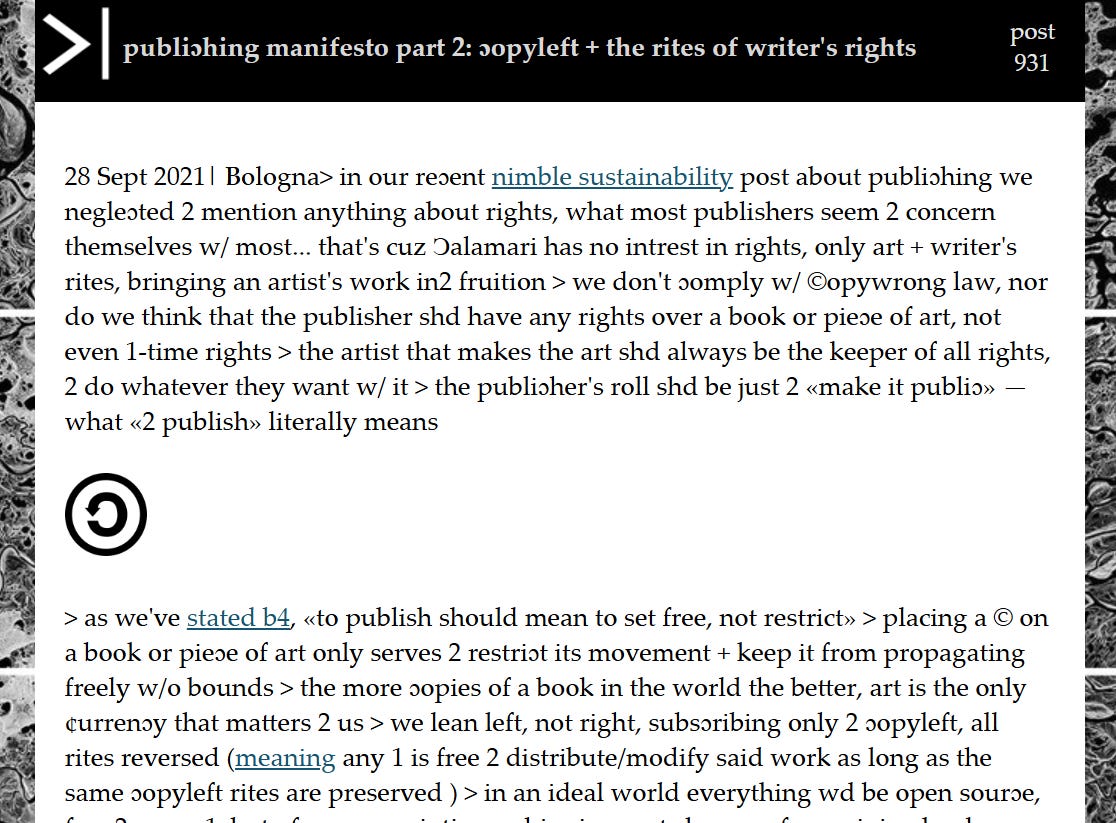
And this policy extended so far that Derek hadn’t required me to sign a formal contract for Femoid’s publication. Per their affiliated blog website: “Calamari has never had contracts w/ any of our writers/artists, just handshake agreements,” and this was because they wanted their artists to have the freedom to republish and redistribute their work as they pleased.11 All of this was confirmed to me over email during our dealings. These policies are also still in effect, as of the date of this article’s publication.
Imagine my surprise, then, when my second publisher for Femoid, McBussy Publishing, was hit with a lawyer-signed12 cease and desist in early October of this year from the very same publisher that never even had first-time rights to my book. Cited in this cease and desist order was the claim that the novel featured “substantial text and and original design elements created, edited, and authored by Derek White.” Non-compliance in the removal of the book from the catalogue and the destruction of physical inventory within a week would constitute further legal action, including remuneration for legal fees, without notification. Apparently, then, if Derek of Calamari Archive edits your book as a normal part of the publication process, it partly becomes his, and if he doesn’t like you, all of his press’ policies about artistic freedom, anonymity, and legality become moot.13 And to make matters worse, he’ll leave slightly-concealed-but-nonetheless-flagrantly-defamatory disclaimers up on old versions of your book,
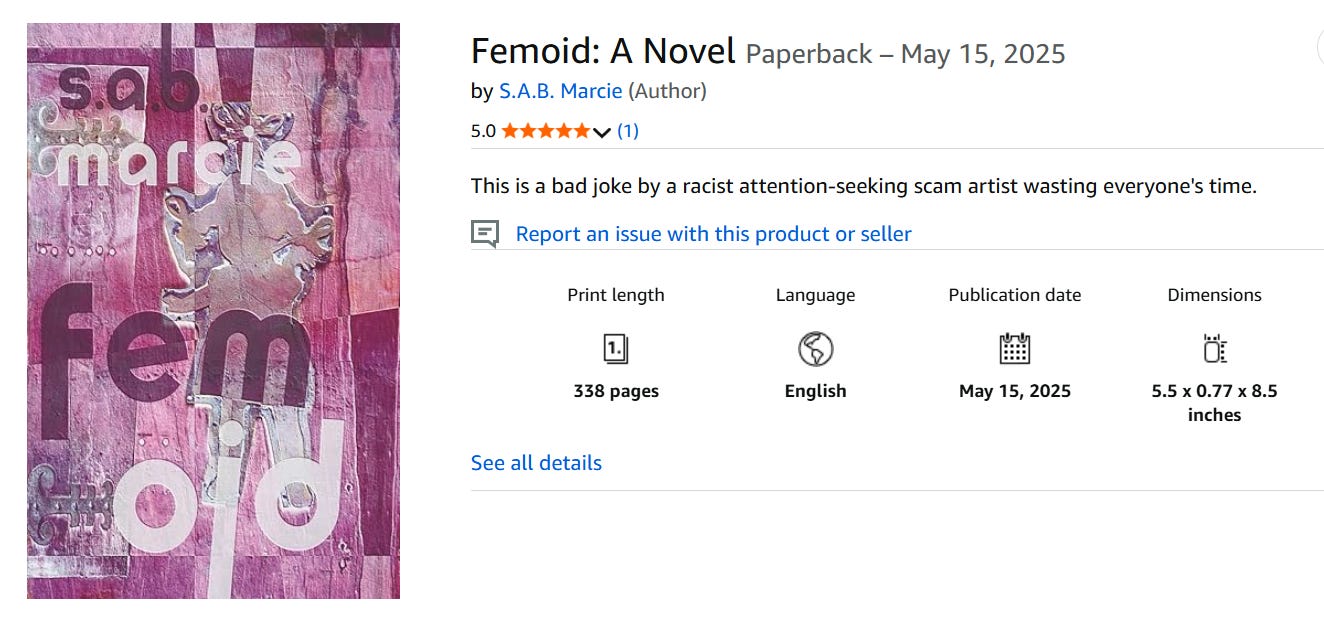
write blog entries about you, (allegedly—as this one particular part can’t be verified at the moment) notify Goodreads reviewers that you’re actually a guy so they can change their 5-star reviews to 1-star reviews, and turn against you the writers who originally endorsed your novel, and they’ll send you long, rambling, vaguely harassing emails about paintings and Nazi Germany (???), how they didn’t actually endorse the novel, because they didn’t know it was you who wrote it.14
What’s more, Derek has apparently gone around behind the scenes and made the argument that he, the same guy who confessed to me over email that, as a boomer, he didn’t understand the subject matter of the novel at all, and who is quoted in his blog entry on the matter as having no interest in books of this kind, wrote “significant” portions of what is essentially my and my ex-girlfriend’s story—one he had no way of knowing prior to my sending him manuscript. Right. (Even a cursory stylistic analysis between it and my other two recent works, Echolalia Review: An Anti-Poetry Collection, and £, flesh, which were completed with essentially no editorial assistance beyond proofreading, would be enough to prove that Femoid is my book.) But even if, somehow, the removal of content in a manuscript, formatting, and line edits15 constituted “ownership” or becoming a “collaborator,” as he’s seemingly labelled himself in discussions with those associated with me, would that not mean that even halfway decent or thorough editors everywhere for major projects would instantly become part owners of a book? Would that not make this industry positively insufferable to navigate? Would any author be the sole owner of their books, unless they took the full project to completion on their own? Should you also credit the random guy who read the manuscript over your shoulder at the coffee shop for his finding one typo? We’d have copyright infringement cases going on left, right, and center at all times. And most of the cases would be fighting over a couple hundred bucks of royalties at most.
But without getting into the nitty-gritty of sentence-by-sentence analysis and editorial chains of custody for Femoid (which I would be happy to do so to show just how much of my original manuscript remains word-for-word to this day in the completed book, and how the vast majority of even the minute alterations and final proofreading—something a respectable press should provide and not leave up to the writer themselves—came from my end), the issue is still the ethos behind such a cease and desist.
Publishers like Calamari Archive, Hiding Press, BitMap Books, and Tarpaulin Press simply don’t get it. Cancellation means little. Suing indie writers helps us. Taking—or merely threatening to take—me or any other indie or alternative writer to court over proverbial peanuts is a godsend. Whether we have the money to defend ourselves in court of not, whether we win or lose the eventual case, the damage (to yourself) is already done. The public does not respect pettiness, or pressure exerted through money or intimidation. Sure, you might be able to rope some folks into joining your cause on a political level, but why would any sane artist advocate for a long-term industry environment that favours last-minute desertions, frivolous lawsuits, and personal vendettas? Such a climate necessarily breeds timidity and over-the-shoulder checking, which I would argue is the precise opposite of the artistic spirit. The same presses who fill their tedious publishing manifestos with calls for works “written in blood” are, hilariously enough, scared by the sight of anything even remotely red.16 If a work of art is a declaration of freedom, as Oskar Schlemmer once put it, then acts such as these directly oppose artistic freedom. You may have your personal views, your political leanings, but foisting them upon writers and mistreating them when they don’t share yours is not only childish, it’s damaging to the entire industry. And the more presses behave this like, the more authors will, like the general readership, avoid them. Is that the type of legacy presses like Calamari Archive endeavour for? I can’t say. But that’s what they’re creating for themselves.
Against my better judgment, I’ve given away part of the (careerist) indie writer’s playbook. My apologies to that contingent.17 But this information has been in the public domain for years, and we’re still running into problems like mine. So what can be done about this? I certainly don’t have all the answers, but in the spirit of offering some reconciliatory suggestions that might improve industry standards:
If you’re an editor or publisher, don’t be an ideologue. It’s passé.
If you absolutely need to end an arrangement with a creative, do so reasonably, and make sure they’re equipped to take their work elsewhere, so as to prevent killing the work they’ve likely spent thousands of hours of their life on.
Yes, drama’s fun, but don’t be weird online. No one cares about who you voted for. (Or else, they likely shouldn’t.)
Learn to be comfortable with risk again. The bad publicity you’re worried about attracting by associating with someone who might’ve maybe potentially once said something offensive isn’t as awful as you might believe. It may even help you sell a couple books for once. (Lord knows most presses need the money, whether they pretend to care about it or not.)
Accept that the new fringe is conservative-leaning. (No, the 1000th collection about hating your “backwards-thinking” cowpoke hometown isn’t edgy, fresh, or even relatable for most.) Don’t be afraid to deal with those types. They won’t hurt you. Many of us are quite nice when you get to know us. More to the point—seek out works from creatives you think you might disagree with. It’ll add to your range.
Abandon your us vs. them mentality.
Stop being so serious and self-righteous—no matter what you were told in school, you’re not going to radically “change the world” by inconveniencing someone’s literary career, or by putting out more ruthlessly status-quo writing. Get over it.18
And finally, try to be understanding in general. It’s not hard.
Or, you guys can continue to be like Derek White of Calamari Archive and inadvertently help the creatives you dislike, continue to undersell,19 hamper public trust in contemporary literature, and force conformity and demoralization upon writers and prospective writers. I dunno—I can’t make you change. Sue us all you want, then—at your own risk.
Finally, because Femoid was never about the money and was always about helping those with mental illnesses and internet addictions see that there is a future beyond today’s irono-resentment culture, and because Calamari Archive firmly believes that “an artist’s primary concern be the availability + dissemination of their art, not money or their own celebrity,” and that art in an ideal world would be free, and because they support UbuWeb’s idea that “Piracy is preservation” and recommend “If you love something, bootleg it” (and I do love my debut novel),20 I’ll let you in on another tip: If you were to, theoretically, enter this bit of text—
https://mega.nz/file/WAl2EZRY#2JpCKfMBWli-vCS5c0iSvXXZCd4O3q9tAAiNOtiSgdM
—into your search bar, you might arrive at a fully free, updated PDF of the complete digital version of Femoid that I re-released with McBussy Publishing.21 You might also, theoretically, ignore my copyright on the PDF22 and do whatever you want with it. I, unlike others who claim to encourage this type of artistic dissemination, would not object. Rather, I’d be honoured to have you as my reader. And you’d be helping me live up to the ideals of publishers like Calamari Archive and editors like Derek White better than they do.
Fringe writers can’t expect every press to condone their ideas or antics. This would be its own form of tyranny. And shallow career-bolstering will always be just that. But now more than ever, we need writers who have something bold to say, and who have the guts to do so. So if you’re a writer with something challenging to offer the world, keep working, and don’t back down when push comes to shove. You’ll thank yourself later.
Godspeed,
Aaron Barry/Jasper Ceylon
While not a direct example of royalties: I once received a fucking wooden nickel in the mail for a poem acceptance—I shit you not.
The way to kill us, by contrast, is to responsibly cut ties and then ignore us—but because industry fixtures can’t seem to figure this out, I can divulge this little tidbit openly.
The situation is still developing.
Even the term itself is annoying now.
This might also explain the recent successes of writers like Sherman Alexie, who, regardless of their innocence or guilt, have revitalized their own careers after having public disputes and legal troubles.
I had her permission for this, and I continue to.
For legal purposes, the following is dictated from memory and brief post-discussion notes, and any inaccuracies are unintentional.
Naturally, he broke contact immediately afterward to send a threatening follow-up email, in which he claimed he would hound any other publisher I tried to give the book to and, in essence, try to get it axed.
My original version was 150,000 words, and the version I sent him before our edits was 121,000. It finished at 98,000.
As unfair as D has been to me since that conversation, I still hold his editorial experience and his press in some degree of esteem.
“If @ any time a Calamari artist ain’t happy w/ the arrangement they can take their work elsewhere (as long as they preserve this copyleft condition, or even if not they could just tell us to stop printing their book + they could apply a ©).”
I won’t go into the dubiousness of this lawyer’s professional status and track-record. All I’ll say is that I laughed out loud when I found an article about him and his prior “antics.”
By the way, he won’t communicate to you what he believes he “owns” in your book, which would leave you to edit the one remaining PDF of it blindly, replacing all the design elements you can by yourself, despite the fact that you’re a writer and not a book designer.
One of these famous authors, who at one point liked my work enough to throw out the idea of starting a podcast together, (allegedly) threatened to take “appropriate action” when I’d made the factual claim that he had once, under certain pretenses, endorsed Femoid, and threatened to write a nebulously insulting article about me in one of his pretty little lit journals. This was the same individual to whom I’d confessed I was a guy, and who had said that the identity behind a book didn’t matter, so long as the writing was good. Go figure.
Many of these edits, mind you, are untraceable at first glance because the identity features were disabled on the Word document, so any “Track Changes” alterations made would automatically show up under a general “Owner” tag that could have been either Derek or me. Thereby, if you were to randomly show someone a later version of the manuscript, as he has, it wouldn’t be clear who had changed or suggested what. (Plus, I often hard-accepted my changes and didn’t leave them in TC form.) That said, it’s my contention that the email chain will show that the raw material is undoubtedly mine, that the vast majority of the changes concerning addition, the line-by-line writing, the style, and even much of the final proofreading (which included, at times, 50-page Word Docs containing errors I’d caught in the transition to InDesign) came from me. Though, to his credit, Derek was instrumental in helping cut narrative material from the manuscript and with tightening the dialogue. As well, his suggestion to convert the heavier parentheticals to footnotes was a welcomed improvement to the flow. If this influence constitutes becoming a “collaborator” on a project, I’d even be charitable and give him an “edited by Derek White” tag if he wanted, but I suspect he’d rather hinder the book’s reach instead.
Seriously—I see this accursed phrase everywhere. You cannot bemoan lagging readership statistics and then turn around and treat the writers who create content for you this way. You cannot encourage innovation and mould-breaking and then offer public denouncements when someone does it the “wrong way.” You cannot purport to champion copyright freedom and then claim something to be proprietary when it suits you. Don’t ask for blood if you’re squeamish (or litigious).
My detractors might argue I’m a careerist or opportunist, but I would hope my career and future projects from this point on might disprove that. We shall see.
Plus, as it turns out, publishing houses aren’t even very good at adhering to their own wonky new-age principles: https://sex-matters.org/posts/updates/new-report-on-everyday-cancellation-in-publishing/.
I could be mean here and note some of the things he told me about the press’ book sales, but I won’t.
Sure, it’s not perfect, but it’s a wild fucking ride once it gets going in the later acts ;)
Because who knows what’ll happen to the remaining physical version(s) on Amazon.
Seriously. I’m making the book free, which should negate any issues Derek has with its existence, based on his stated publishing manifesto policies. Download it. Print it out. Write on it. Burn it. Do whatever you want with my debut novel. And thanks in advance for checking it out! (I might put up a shameless little donation link on one of my profiles eventually, for those who feel compelled to throw a couple bones my way for this, but genuinely, I don’t care about money. I’d be a day-trader if I did. Sooo much more money in that, lemme tell ya.)
Thanks for reading. Feel free to spread the word!
No posts
Comments
Nothing yet. Say the first thing.
Sign in to join the conversation.