
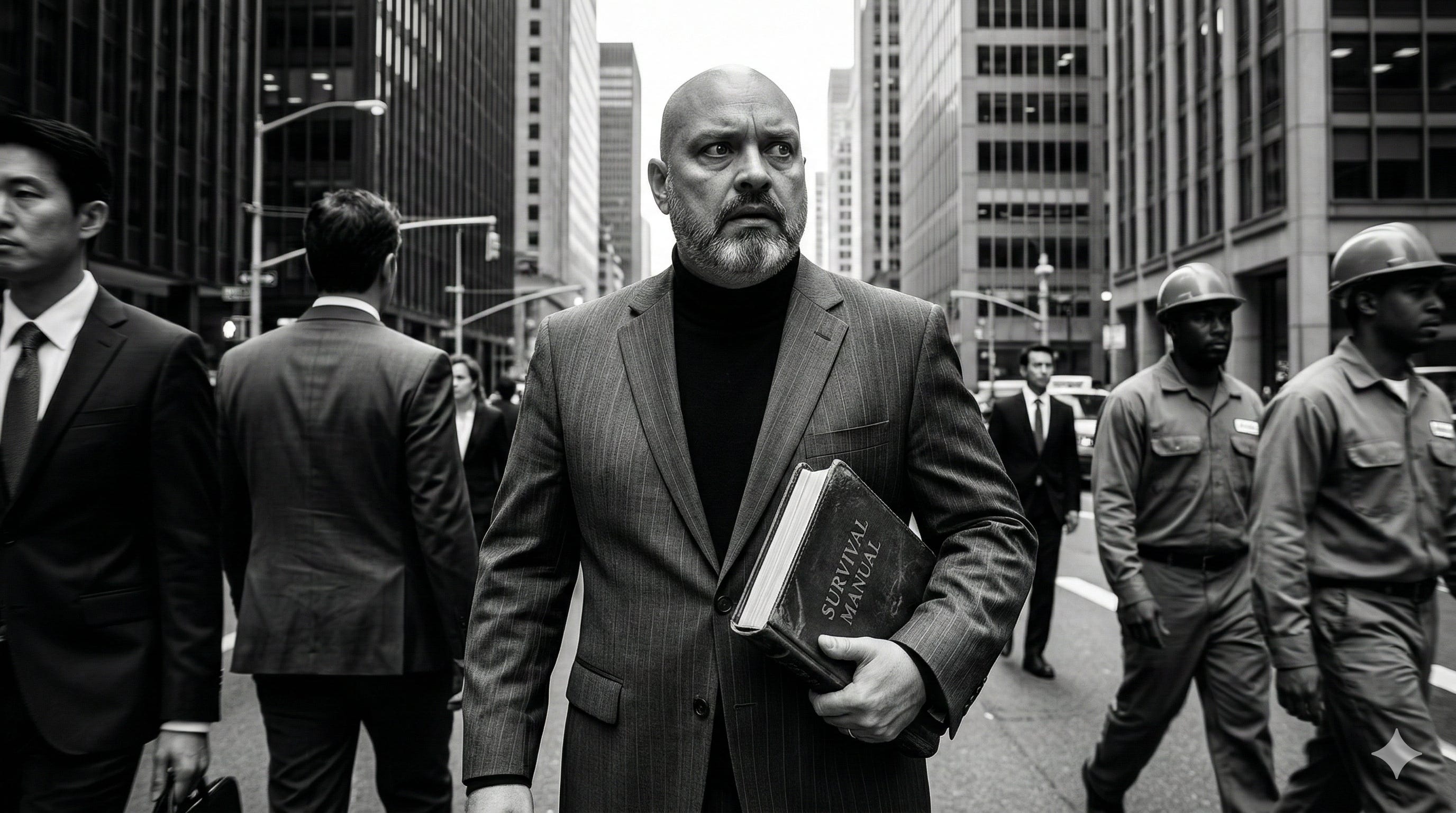
Everyone’s talking about AI taking jobs.
They’re not wrong. But they’re not telling you the whole story either.
Yes, AI will replace as many as two million manufacturing workers by 2026. Yes, 89% of HR leaders expect AI to impact jobs in 2026. Yes, younger workers in tech are already feeling it: unemployment among 20- to 30-year-olds in tech-exposed occupations has risen by almost 3 percentage points since the start of 2025.
But here’s what nobody’s saying out loud: the jobs that come back won’t look anything like the jobs that disappeared.
And for millions of us, they won’t come back at all.
Let me tell you what’s happening behind the scenes while everyone panics about robots taking their jobs.
The AI funding frenzy is collapsing.
Pitchbook reported that nearly two-thirds of deal value in the U.S. went to AI and Machine Learning startups in the first half of 2025, up from 23% in 2023. But the cracks are showing. At Yale’s CEO Summit in June 2025, 40% of CEOs raised significant concerns about the direction of AI exuberance, believing a correction to be imminent.
And they should be worried: Ali Ghodsi, CEO of $134 billion software firm Databricks, blasted the trend, stating “Companies that are worth billions of dollars with zero revenue, that’s clearly a bubble, right, and it’s, like, insane.” In private conversations, venture capitalists express exhaustion with the hype cycle, telling him they’re considering taking breaks from investing.
He was right.
The financial reality is stark. Reports estimate that AI-related capital expenditures surpassed the U.S. consumer as the primary driver of economic growth in the first half of 2025, accounting for 1.1% of GDP growth.
But here’s the problem: OpenAI is committed to investing $300 billion in computing power with Oracle over the next five years, averaging $60 billion per year, while losing billions of dollars annually with projected revenues of only $13 billion in 2025. The math doesn’t work. And despite $30–40 billion in enterprise GenAI investment, MIT research from August 2025 found that 95% of organizations are getting zero return.
Companies are drowning in debt to build data centers. VCs are exhausted. And the money is running out.
Remember the dot-com bubble?
Everyone thought the internet would replace everything. It didn’t. It became a tool. Essential, yes. But a tool.
AI will follow the same path.
One in 10 job postings in advanced economies now require at least one new skill, with professional, technical, and managerial roles seeing the most demand for new skills. And here’s the kicker: job postings that include a new skill tend to pay about 3 percent more, with openings requiring four or more new skills paying up to 15 percent more in the United Kingdom and 8.5 percent more in the United States.
The jobs that come back will require AI skills. Prompting. Integration. Understanding how to use the tools without letting them replace human judgment.
But they’ll still need humans.
Wages are rising for AI-powered workers even in the most highly automatable roles, according to PwC’s 2025 Global AI Jobs Barometer. Why? Because AI systems can’t replace the messy, complicated, relationship-driven work that actually moves businesses forward.
The newness will wear off. Companies will remember that humans solve problems AI can’t touch. And AI will settle into being what it actually is: another tool, like email or spreadsheets.
The job market will never be the same.
Not because AI destroyed it. Because the entire concept of “jobs” is already broken.
Traditional employment — the 40-year career, the pension, the loyalty contract — that’s dead for most of us over 40. And it’s dying for everyone else too.
Nearly 55,000 job cuts were directly attributed to AI in 2025, out of a total 1.17 million layoffs. But AI isn’t the real culprit. Companies were already cutting costs, already consolidating, already looking for excuses to reduce headcount.
AI just made it easier to justify.
And when the bubble bursts and the funding dries up and 98% of AI startups fail, those jobs aren’t coming back in the traditional sense.
Here’s where it gets interesting.
In 2025, more than 70 million Americans are estimated to be part of the gig economy, representing approximately 36 percent of the total workforce. By 2027? It’s projected that nearly 87 million people, about half of all workers in the country, will be freelancing.
This isn’t a side hustle trend. This is the future of work.
People are building businesses. Creating side hustles. Consulting. Freelancing. Hiring each other for things they can’t do themselves.
Carry says freelancers earned about $1.3 trillion in combined income in 2024–2025. And the highest earners? Over 4.7 million independent workers in the U.S. earned over $100,000 in 2024, a significant rise from 3 million in 2020.
This isn’t poverty work. This isn’t desperation.
This is people taking control when traditional employment failed them.
Think about it.
You lose your job to AI or cost-cutting or “not a culture fit.” Instead of sending 800 applications and getting ghosted, you start building.
You offer consulting in the thing you’ve been doing for 20 years. You create content teaching others what you know. You freelance on platforms connecting you with clients globally. You build digital products. You provide services.
And when you need something you can’t do? You hire someone else who’s building their own thing.
The Interview Guys say 54 percent of freelancers now report advanced AI skills compared to just 38 percent of full-time employees. Freelancers are adapting faster. Learning faster. Building faster.
Because they have to.
Freelancers with specialized AI and prompt engineering skills are commanding a 56% wage premium over traditional roles. The people who figure this out early won’t just survive. They’ll thrive.
Multiple income streams. No single point of failure. No boss who can fire you when the stock price drops.
It’s not perfect. OysterLink says only 40% of American gig economy workers have access to medical insurance. There’s no safety net. No benefits. No guaranteed paycheck.
But it’s real. And it’s happening whether traditional employment comes back or not.
Look, I’m not going to pretend I have all the answers.
I sent 850 applications and got rejected by every single one. I’m 57. I had a heart attack from the stress of my job hunt in 2022. I went bankrupt from the medical bills. 2025 and 2026 weren’t much better.
I gave up on the job market.
But I’m making $1,500-$5,500/month now through content creation, ghostwriting, coaching, and courses. Not because the job market finally said yes. Because I stopped asking for permission.
And I’m not alone.
Over at Over 40 and Unemployed, we’re almost a thousand people having these exact conversations. Will AI replace us? Will traditional jobs come back? What does income look like when employment is dead?
Some people think AI is the end. Some think it’s the beginning. Some think the bubble will burst and take everything with it.
We don’t have consensus. But we’re figuring it out together.
Join us. It’s free. It’s honest. And nobody’s pretending to have it all figured out.
Because here’s the truth: jobs aren’t coming back the way we think they will.
But income? Income we can build ourselves.
Comments
Nothing yet. Say the first thing.
Sign in to join the conversation.