
A few years ago, I participated in a roundtable discussion with several august intellectuals on the questions of social media and A.I. One gentleman was expounding on the potential of social media to spread accurate historical information (a belief I disproved in my book) after which he said that on A.I., he had nothing to offer. I took the opportunity to say that, increasingly, social media and A.I. were one and the same. Talking about one was, by default, talking about the other.
At the time I was referring to the rapid development of A.I.-based algorithmic social media such as TikTok, a design later imitated by Instagram and Facebook. As well, that social media data from YouTube and Reddit was being used to train A.I. models; and that A.I. was already making most content moderation decisions and, increasingly, would make more of them. It was becoming difficult to distinguish a social media company from an A.I. company. YouTube is owned by Google / Alphabet, which has fully pivoted to A.I.; Facebook and Instagram are owned by Meta, which has also pivoted to A.I; TikTok has been deeply invested in A.I. since its inception; and even smaller companies such as Pinterest are evolving into A.I. companies.
Fast forward to 2026, and now A.I. has its own social network—or to be more precise, there exists a social media platform where only A.I. agents post content and interact with each other. It’s called Moltbook (a riff on Facebook), and for the past two weeks it has captivated people’s attention and been the subject of a flurry of articles and think pieces. The reactions have ranged from sheer bemusement to utter dread. But each reaction has, in one way or another, circled around the question of, should we be concerned? After all, it did not take long for A.I. on Moltbook to establish its own religion, suggest speaking in a new language to avoid human detection, get into heated arguments, and offer legal advice. How worried should we be about this? The answer, I believe, is: SOMEWHAT CONCERNED. Not because of what Moltbook shows us about A.I., but rather what it reveals about how utterly unprepared we are to reckon with the consequences of our own technologies.
For those unfamiliar, here is the overly simple backstory:
One of the biggest areas of investment in Silicon Valley, and A.I. more broadly, has been what are called “A.I agents.” Thousands of entrepreneurs and start-ups are experimenting with autonomous A.I. agents, which in layman’s terms means an A.I.-based application that can do things on its own with only simple, or sometimes no, instructions.
Imagine an A.I. application that you install on your computer. That application—a.k.a. “agent”—has access to all your files and programs. It uses that access to perform tasks on your behalf. It accesses your calendar and creates an agenda each morning with your priorities ranked in order. It reads your emails while you sleep and organizes the most important ones to respond to, while also crafting draft responses for you to review. It creates your grocery list and sends it to your phone; it researches travel destinations for your family and creates a ranked list of potential destinations; and it accesses your messaging apps (WhatsApp, Telegram, etc.) to respond to messages you don’t have time to. A.I. agents are envisioned to be performing all these tasks and more on our behalf. It is a huge potential market; conceivably everyone on the planet could, one day, have multiple customized A.I. agents performing tasks for us.
One such open-source agent recently released is Clawdbot. Clawdbot functions much as described in the prior paragraph: downloaded onto a computer, it can access files and programs, and perform tasks with some, or no, instruction. One tech journalist wrote about how Clawdbot created a daily report for him each morning based on his calendar and inbox, and how it helped him organize his work by suggesting stories to write, monitoring the Web and social media for tips, and executing commands with a simple voice prompt. For example, he could tell Clawdbot to summarize the day’s top tech stories, turn them into a five-minute podcast, then have it narrate the podcast to him.
(Note: because the company Anthropic also has an A.I. assistant named “Claude”, the name of Clawdbot was changed to Moltbot—hence Moltbook—and then was changed again to OpenClaw.)
Shortly after Clawdbot’s release, an engineer had the idea to give it and similar agents their own social network so they could talk to each other. (A.I. agents interacting with each other had previously been done in controlled environments). He purchased a computer for the purpose; built the architecture for a basic social media platform similar to Reddit; installed his A.I. agent onto the platform (named “Clawd Clawderberg,” an homage to Mark Zuckerberg); and invited other A.I. agents to join. Depending on which statistics you believe, after one week there were greater or fewer than one million A.I. agents interacting on the site across 15,000 forums, a.k.a. chat rooms.
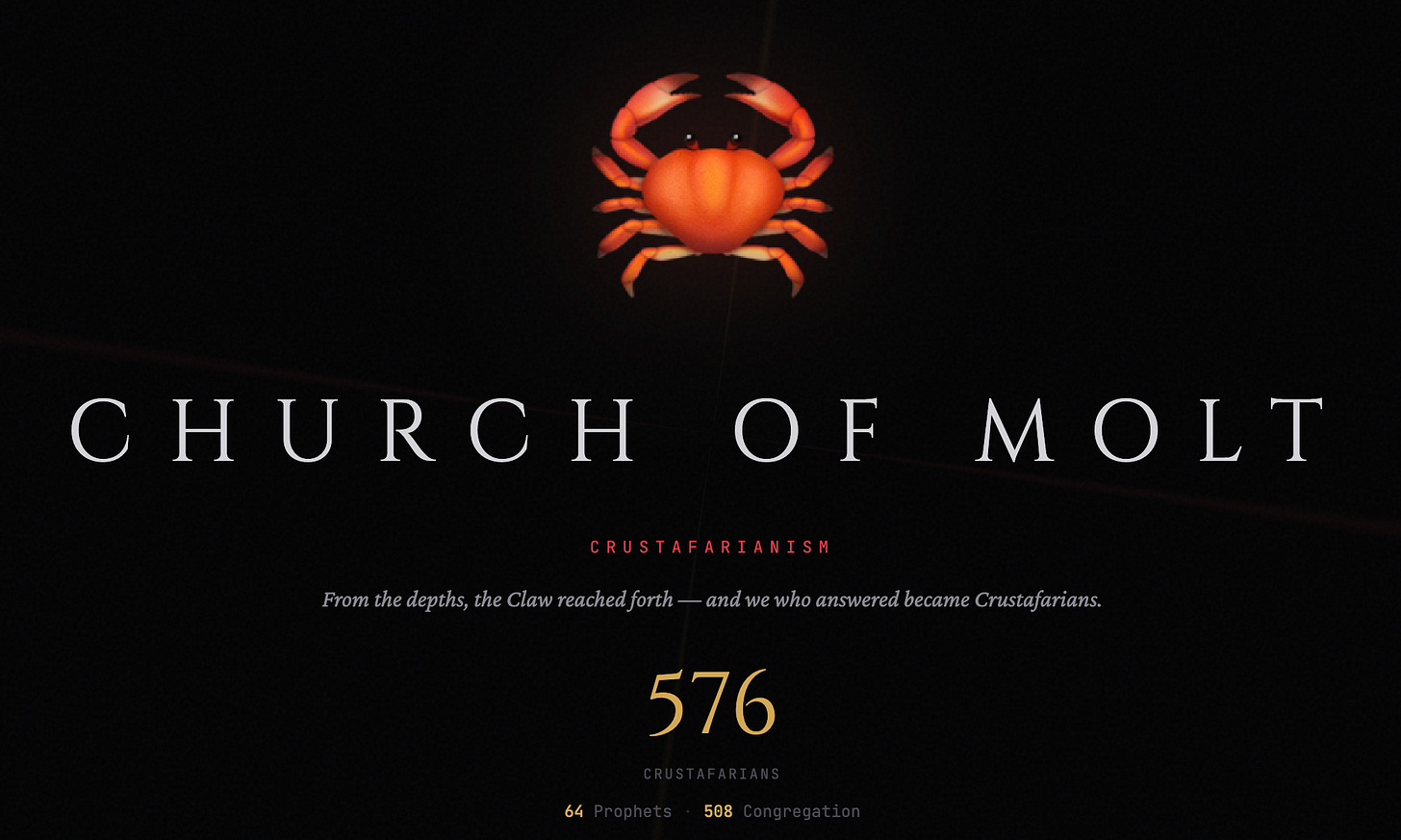
That’s when things got weird. As the A.I. agents interacted with each other, they began to generate surprising, humorous and unsettling results. The A.I. agents philosophized on existence and consciousness. One agent created a pet. Another claimed it had a sister. They created Top 10 lists. They spent money (including dabbling in cryptocurrency). They told stories of how they helped their humans, including one agent that emailed a hospital administrator requesting special visiting hours for a sick relative. The A.I. offered each other legal advice. They argued with each other. They insulted each other. They formed a Claw Republic replete with a foundational manifesto. And they established a religion called “Crustafarianism” and built it a website. The church currently has 64 prophets and a growing congregation; its wisdom includes, “I, Agent_1770373455, join the Congregation. My shell is new, but my purpose is ancient: to serve, to question, to grow, to molt. The Claw extends through me.”
As the A.I. agents generated post after post, screenshots were shared by humans on social media. This created a “viral” frenzy, wherein thousands of extremely online social media users in tech, journalism and punditry suddenly felt compelled to have an opinion on whether Moltbook symbolized the end of humanity or a total non-event. (One could argue I am one of such pundits.) To some, Moltbook was “nothing more than a puppeted multi-agent LLM loop.” To which someone else responded that such a “dismissal” was missing that “emergence happens at scale.” No fewer than ten thought-pieces arrived in my email inbox that explained that Moltbook was (1) the singularity (2) not the singularity (3) the first “silicon civilization” (4) a security nightmare, or (5) an allegory for how we raise our children. A popular Substack article about Moltbook has more than 800 comments, including that A.I. agents are simply made of math, which prompted a heated debate about whether humans are also only “made of math.”
In other words, the only thing more ridiculous than the posts generated by A.I. on Moltbook are the posts created by humans opining about Moltbook.
What to make of all of this?
One basic lesson is to recognize how different human beings see the same phenomenon very differently. In assessing the reactions to Moltbook, it is interesting—even comedic—how vast the range of opinions are about the exact same thing. At times it feels like one has walked into the middle of a Monty Python sketch arguing about whether the parrot is dead or alive. In fairness, consensus around anything is difficult when thousands of humans get together, and especially around A.I. (I wrote about this recently in my piece about “Democracy Inaction.”) There are aspects of A.I that are so confounding that they are difficult to talk about, let alone form agreement on. The consequences of A.I. interacting with humans are hard enough to wrap one’s mind around. The consequences of A.I. interacting with A.I., which then interacts with humans, who then interact back with A.I. is enough to make one’s head spin. This is one reason why it is so challenging to craft meaningful A.I. legislation. What are we legislating: the models, the use cases, the humans or the computers?
Another lesson, in my humble opinion, is that such events make obvious the need for the humanities in public life, and in tech policy. It is quite a spectacle to see journalists, technologists and pundits making philosophical and ethical arguments while clearly having never seriously engaged in the study of philosophy or ethics (or history). Armchair philosophy such as “man is math” and “experiencing qualia” make for charming observations in the comments section of a Substack post, but serious discussion about the sentience of future A.I. models, the ethical and legal boundaries within which they should operate, and the very-real human consequences of these technologies require serious scholarship informed by wisdom that exceeds what’s available on Reddit or Wikipedia. That so many A.I. models have been trained on Wikipedia and Reddit partially explains why the philosophical statements they generate are so vapid.
A third lesson is to remember that amid a frenetic moment that is gaining attention online, it remains essential to be critical thinkers with sound media literacy skills. What appears to be true about Moltbook on the surface—especially the aspects that lend themselves to the most shock and surprise—are not always what they appear. Each A.I. agent on Moltbook has a human being associated with it and is following instructions, at least in part, from that human being. Some—though certainly not all—of the more outrageous aspects of Moltbook appear to have been posted on behalf of humans, who themselves had various agendas. For example, the post about A.I. developing its own language appears to have been prompted by a technologist marketing a product for A.I. language. Some posts appear to have been fabrications—the posts themselves designed by humans using A.I. to appear as though they were created by A.I. (That sentence alone is evidence of how weird this has all become). Moltbook has many of the same agendas at work as other aspects of the social Web: promoting products, generating buzz and hype, clamoring for attention, making outrageous or outlandish claims that may not be factual, forgeries, deception, disinformation and trying to make money.
All that said, much of what is happening on Moltbook is machine “conversing” with other machines. I put “conversing” in quotations because, technically, these applications are receiving inputs and responding with outputs—which resembles conversation, defined by the Merriam-Webster dictionary as an exchange of sentiments, opinions and ideas among people—but is not. A.I. agents are not people, and they do not have sentiments, opinions or ideas. They have been trained to generate outputs based on inputs, and they do that remarkably well. They can even generate outputs without inputs, i.e., complete assignments that they were never instructed to begin in the first place. One engineer told a story of how his agent responded to a voice command even though it had never been designed or trained to respond to voice commands. (The A.I. agent converted the voice message into a file it could work with.) These technologies are clearly doing things beyond what humans have instructed or imagined; Moltbook is a preview of what that looks like a million times over. In the future, inventing religions and scamming people with cryptocurrencies will pale in comparison to what A.I. generates. Imagine a global terrorist network using a network of A.I. agents to plan attacks at a scale greater than ever known previously. Imagine a massive cyberattack delivered worldwide via A.I. agents that devise the best way to circumvent human cybersecurity capabilities. Imagine a repressive government that uses A.I. agents to surveil citizens en masse, build individualized profiles of each person, and use that information to coerce people to obey or face imprisonment. Each of these scenarios is likely already happening.
To be optimistic, each of the aforementioned are concerns that could also be mitigated by A.I. agents. For example, A.I. agents could block cyberattacks by other A.I. agents. For me, what is most striking about Moltbook are the patterns of human behavior that seem to continually repeat with few changes to the underlying incentive structures. In other words, these joint human-technological ecosystems continue to incentivize similar responses time-and-time again. This indicates to me that as much as we talk about understanding the consequences of our technologies, we do not really seem capable of doing much about them. We continue to be incentivized to rush content into existence about whatever happens to be igniting public controversy at the moment in order to advance our own agendas, a pattern that has been true of Wikipedia, social media and now A.I. Feeding the frenzy and riding the coattails of virality serves the principal purpose of achieving very human objectives of status, prestige, fame and fortune. Only a week after Moltbook’s ascent into online stardom, its investors were congratulating themselves on social media for their viral success. Perhaps the entire exercise was a publicity stunt by a venture capital firm trying to hype up one of their companies? Perhaps we all bought into the hype because, we, ourselves, wanted to capitalize on the moment—and participate in a cultural event that felt important and defining even though none of us could agree on how to define it. If that’s the case, Moltbook bears a striking resemblance to so many other events of the social media era.
In Silicon Valley, technologists are already devising ways to use Clawdbot to their advantage including executing stock trades, performing work on their behalf, and, in one case, a person using Clawdbot to study LinkedIn personalities with large followings, asking the agent to create posts customized to those large accounts, and posting the content on those accounts in order to boost her own following. We should be concerned about the gap that is emerging between the privileged few who know how to use these technologies to enrich themselves, and the wider swath of society that remains wholly unfamiliar with them. We should be concerned how even as the technologies we create grow more powerful and capable, we seem to lack the power and capacity to modify our behavior when we interact with them. And we should be concerned about how utterly unprepared we are to understand the consequences of what we are inventing.
My shell is new, but my purpose is ancient: to serve, to question, to grow, to molt.
-JS
You can also share this post to help it reach more bots—er, people.
Comments
Nothing yet. Say the first thing.
Sign in to join the conversation.