
I remember sitting in a piano literature class in grad school. A fellow student (who is an incredible pianist) mentioned studying a lot of Hanon growing up. Another student asked her if she found the exercises helpful. I chimed in with “Have you heard her play?!?!” (Her talents were far beyond the mechanical, soon after, she won Nationals at the MTNA Young Artist Piano Competition.)
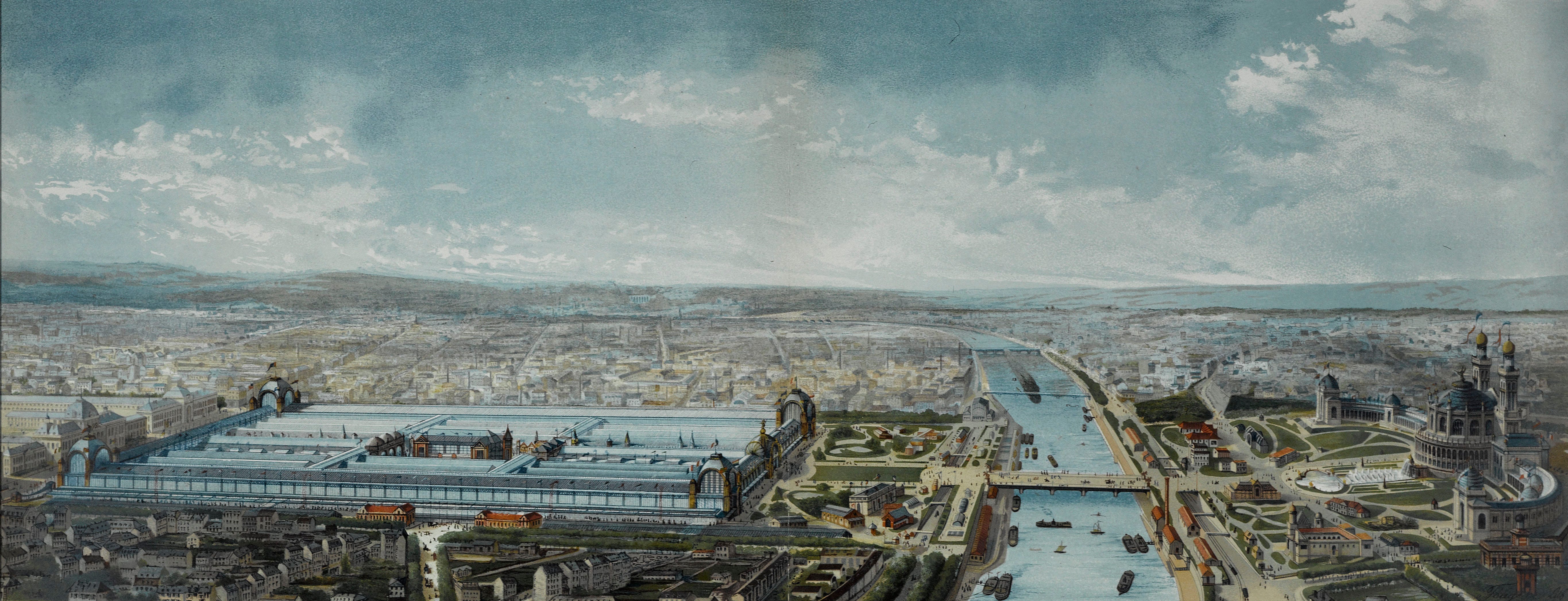
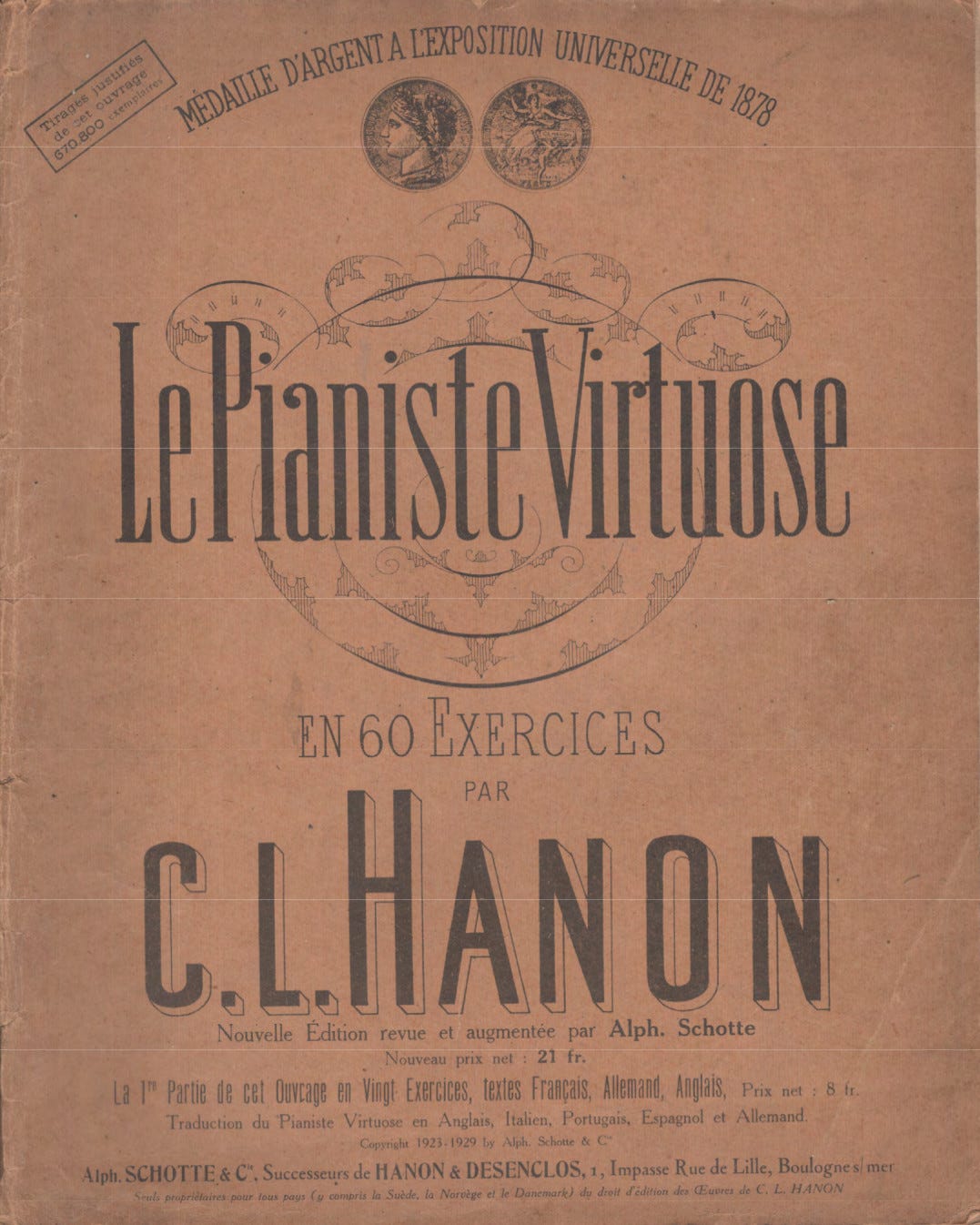
Hanon’s exercises gained popularity having been seen at the Expedition Universelle in Paris in 1878. Also on display was the recently completed head of the Statue of Liberty, a replica of the house of Peter the Great which served as the Russian pavillion, and a new invention by Thomas Edison called a “phonograph machine.” Sadly, Hanon’s exercises only managed to win a silver medal, but as I’ve been unable to ascertain the gold medal winner(s) who bested him, it would seem Hanon had the last laugh. Today, it is difficult to find a pianist who hasn’t heard of him.
It is also difficult to find a pianist who does not have strong opinions about the Hanon exercises. Many teachers and students regard it as an essential tool for one’s technical development. Other teachers and students regard it as a tragically mechanical recipe for injury with no musical value.
So which is it? I suppose the answer lies in the how one studies them and what one intends to accomplish in doing so.
Let’s start with the preface to the English edition. It is an absolute masterclass in marketing:
the exercises can be learned easily and played quickly
you can play them alone or with friends (yes, Hanon suggests they work well in groups!)
the exercises are efficient, uniting in “one work special exercises which render possible a complete course of pianistic study in far less time.”
“These exercises are interesting, and do not fatigue the student like the generality of [dry] five-finger exercises…“
So – easy, flexible, efficient, and interesting – what’s not to like?
Well, at best, the advice is problematic:
“If all five fingers of the hand were absolutely equally well trained, they would be ready to execute anything written for the instrument, and the only question remaining would be that of fingering, which could be readily solved.”
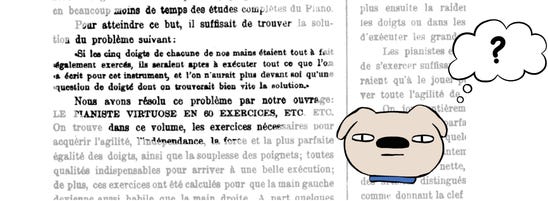
Modern pedagogy has found that to be incomplete at best. The fingers are our point of contact with the keyboard, but they act with the help of the hand, wrist, arm, elbow, shoulder, and torso. And of course, the arm moves through space in the context of gravity, which supplies much of the energy we put into the instrument.
The preface continues:
“In this volume will bę found the exercises necessary for the acquirement of agility, independence, strength and perfect evenness in the fingers, as well as suppleness of the wrists…”
Most piano teachers I know would agree that agility and a supple wrist are important, but finger independence is a myth and strength can be as much a hindrance as a help.
Perhaps the biggest problem with the exercises is the belief – touted in the preface itself – that “after [the exercises] have been thoroughly mastered, it be repeated daily for a time, difficulties will disappear as if by enchantment, and that beautiful, clear, clean, pearling execution will have been acquired.”
If this were true, far more people would be able to play Beethoven sonatas and Chopin etudes. So what gives?
Like most things written for piano students, the Hanon exercises are an opportunity, not a prescription. They’re not a drug you can take to cure your pianistic ailments. They are instead a canvas for exploration. In a sense, they remind me of the studies visual artists make of various subjects. Consider Picasso’s bull study:
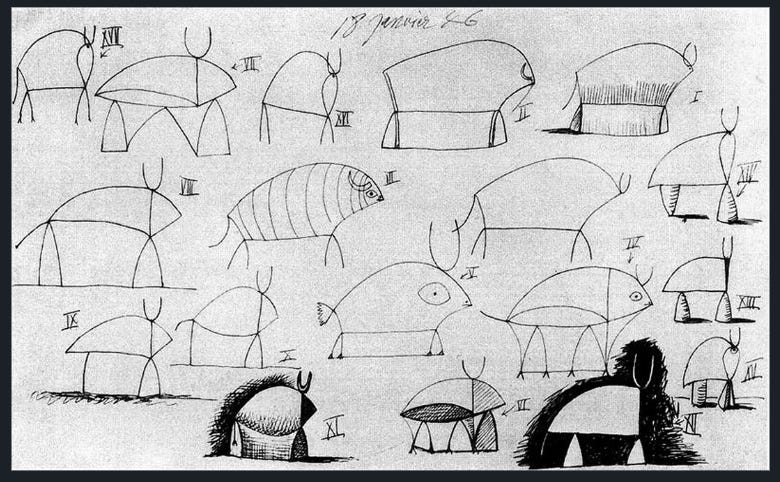
Bull Study (1946), Pablo Picasso, age 65
Here, Picasso explores the different lines and shapes that constitute the animal. It was not a means to an end, but rather a means in and of itself, a way to discover the essence of the creature. I would argue that the Hanon exercises provide pianists a similar opportunity – a way of deconstructing the movements our fingers, hands, and arms trace across the keyboard.
A popular argument here is “why not explore those movements by playing Chopin or Mozart instead? Why subject yourself to such cold, unfeeling musical material?” My response would be “for the same reason Picasso didn’t simply paint a lot of realistic or cubist bulls – there’s value in deconstructing the essence of something, and Hanon is all about the essence of movement and tone, not harmony and melody.”
So that’s where I land on the subject of Hanon. It can be a valuable deconstruction of movement and tone for those who find that kind of work intriguing, and it is rather refreshing to have something you can quickly run your fingers around when you first sit down at the piano. If you don’t find them particularly interesting, there are plenty of other ways to build one’s technique. But if you do choose Hanon, remember that the exercises aren’t in the book, they’re in your mind, your arms, and your hands. The book is just a blank canvas on which to draw some studies, what comes of them is up to the painter.
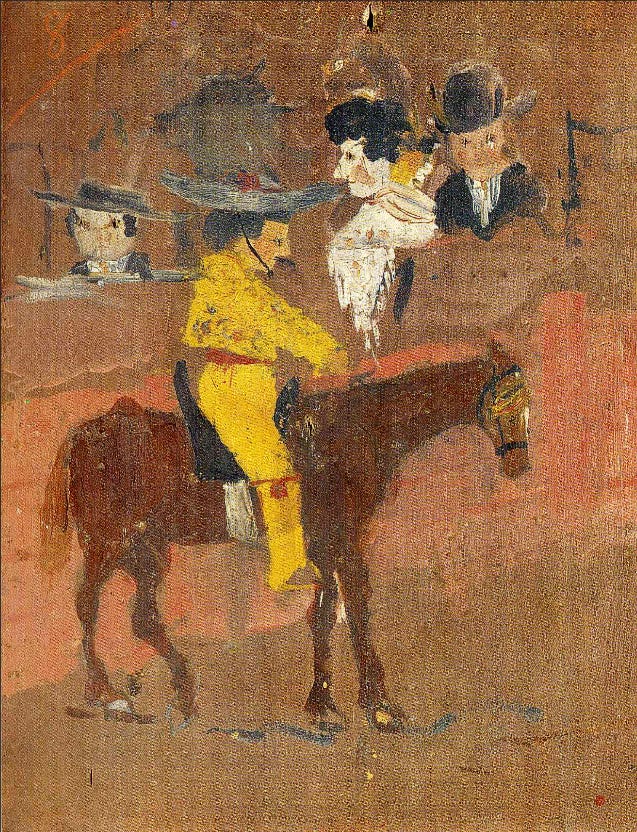
“The Little Yellow Picador” (1889), Pablo Picasso, age 8
No posts
Comments
Nothing yet. Say the first thing.
Sign in to join the conversation.