
In June 2024, the College Board fired ETS. That’s not how the press releases phrased it, but it’s what happened: after decades of paying the Educational Testing Service to build and score the SAT, the College Board moved the whole operation in-house onto its digital Bluebook platform. The contract had been worth roughly $300 million a year to ETS, about 30 percent of its revenue. Buyouts and layoffs followed in Princeton.
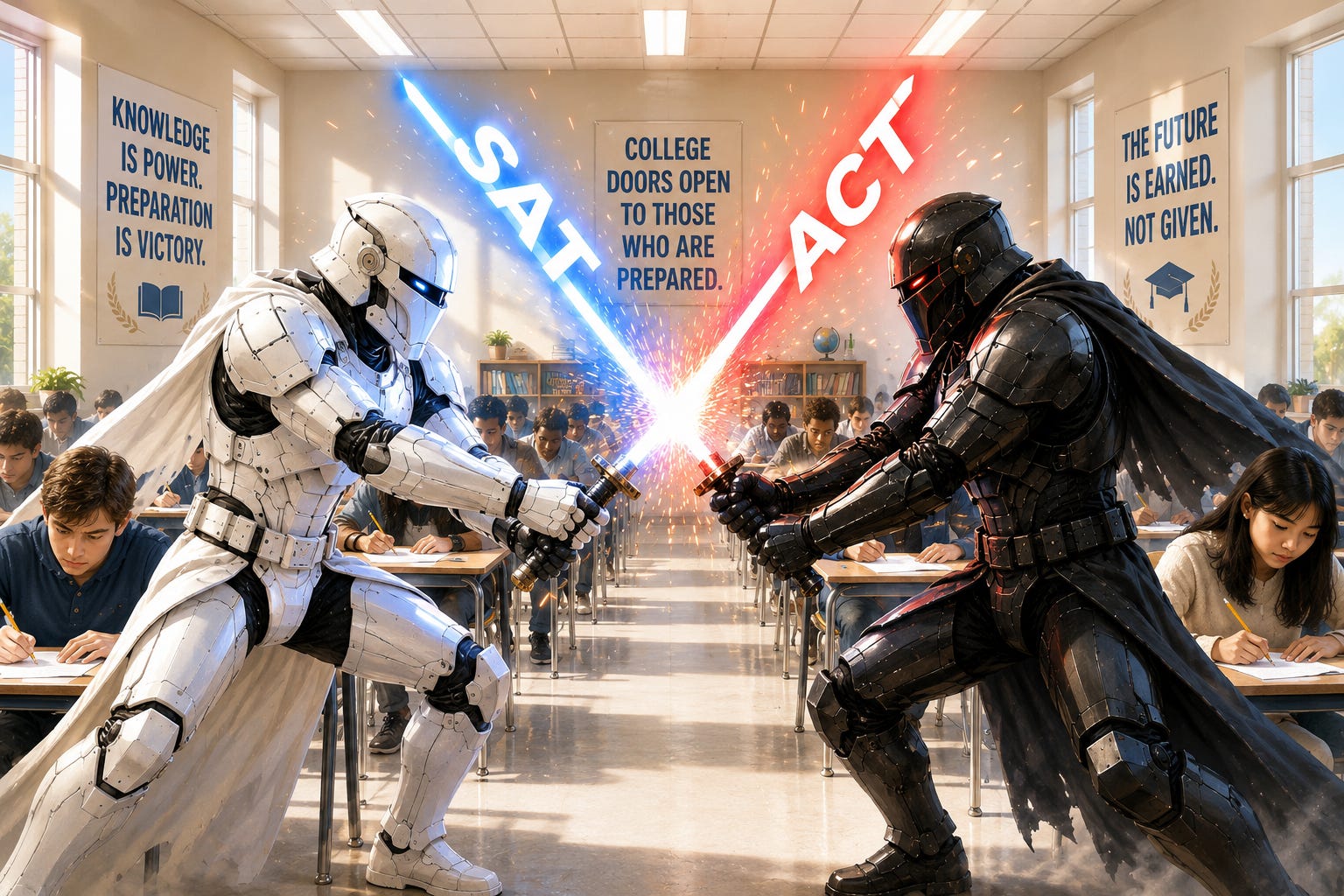
Two years later, almost to the day, ETS bought the ACT. The organization created in 1947 largely to build and run the SAT now owns the SAT’s only real competitor. The fallen empire bought the Rebel Alliance.
Some history first: ETS was founded when the College Board, the American Council on Education, and the Carnegie Foundation pooled their testing operations into one nonprofit outside Princeton. For most of living memory, “the SAT people” meant ETS: the College Board owned the brand, while ETS wrote the questions and shipped the booklets, building an empire of its own along the way with the GRE, the TOEFL, and the Praxis. The unraveling was gradual, then sudden. In 2002, the College Board handed the scoring of the new SAT writing test to Pearson, an early sign the marriage was negotiable. When the SAT went digital in 2024, the College Board built the platform itself and discovered it no longer needed its 77-year partner for much beyond AP and CLEP work. ETS, suddenly a testing giant without an admissions test, went shopping.
The ACT, meanwhile, was having its own identity crisis. Founded in 1959 by Iowa professor E.F. Lindquist as a curriculum-based alternative to the SAT, it actually surpassed its rival in annual test takers in the mid-2010s. Then the test-optional wave hit, volumes fell, and in 2024 the nonprofit was sold to Nexus Capital Management, a Los Angeles private equity firm, which converted it to a for-profit. On June 30, Nexus sold the testing business to ETS and kept Encoura, the ACT’s enrollment-data arm. Three owners in three years: Iowa nonprofit, LA private equity, Princeton nonprofit. Students taking the test notice none of it.
Over the weeks that followed the transaction, I saw a variety of takes, including a polished one from a test-prep software vendor assuring me the real story is the “assessment ecosystem”: WorkKeys, career-readiness credentials, the future-of-work apparatus that came along in the deal. They’re not entirely wrong; the combined organization reaches some 35 million learners a year, and workforce credentialing is clearly where both companies see growth. But for the families in my offices, the ecosystem talk skips the only question that matters: what happens to the paper test?
The ACT is the last major admissions exam you can take with a pencil, and I watch every week why students keep choosing it. On paper, they underline, cross out wrong answers, and scribble geometry right next to the figure; their pacing is visible at a glance. On screen, the annotation tools are clunky, the charts are harder to work through, and two-plus hours of reading on a monitor produces a fatigue no amount of practice fully trains away. When our students try both formats, paper usually wins, and their scores tend to agree.
Which is why the new owner makes me nervous. The GRE, the TOEFL, the Praxis: every ETS test went digital years ago, and the digital ACT already runs on Pearson’s TestNav platform. If any company in America is inclined to look at a warehouse of paper booklets and see nothing but logistics costs, it’s the one that just took over in Iowa City.
But paper isn’t the ACT’s legacy problem. Paper is the ACT’s moat. The moment both tests are screen-delivered they effectively converge, and the ACT becomes a slightly longer digital SAT with an optional science section — just as colleges reinstate testing requirements and roughly 1.4 million students a year still sit for the exam, many precisely because it’s the test that still feels like a test.
ETS, of all organizations, should understand what happens when your offering becomes interchangeable. The College Board decided its partner of 77 years was replaceable, and replaced it; that lesson cost ETS a third of its revenue. So far, the new owners have promised students that nothing changes. Pray they don’t alter the deal any further.
The Generative AI Learning Penalty: Evidence from Chinese Secondary Education: Generative AI makes homework look better while making students learn less. Tracking 26,811 Chinese students in grades 7-12 over 30 months across nine subjects, economists David Strömberg, Victor Lei, and Yanhui Wu found that adopting AI raised homework scores by 18% and cut completion time by 30%, yet lowered monthly closed-book exam scores by 20% within six months. On high-stakes entrance exams, scores fell by 18 to 24%, with the full penalty surfacing only after roughly two years. The damage concentrated among the estimated 80% of AI users whose pattern — very fast homework paired with high marks — suggested they were outsourcing the work rather than doing it; students who kept their completion times comparable to non-users saw only small losses. Declines were steepest in social science, followed by STEM and languages, and hit junior students, high achievers, and boys the hardest. If China is seeing these results, given how their authoritarian government cracks down on everything, just imagine how our kids are doing. China is ahead of us on limiting social media usage for children. I wouldn’t be surprised if they start limiting AI usage.
AI Is Overhauling the Way Professors Teach. Here’s How: The integration of generative AI in higher education is reshaping teaching methodologies, with over 80% of professors actively trying to "AI-proof" their assignments. Faculty members express ambivalence, with a significant portion (65%) reporting incidents of student cheating using AI. Innovative approaches include in-class paper writing, peer feedback using AI, and the development of assignments that encourage student engagement and curiosity about the subject matter. This shift aims to cultivate critical thinking and authenticity in student work, moving away from traditional grading metrics toward assessment methods like oral presentations and reflective discussions. Notably, nearly half of instructors have embraced AI to enhance course design, with examples of using AI for visual aids in biology or coding assistance in computer science illustrating the potential for these tools to foster deeper learning experiences. I’m glad to see that some teachers are redesigning how they teach. It will be a major topic of discussion at my company’s next teacher summit prior to the start of the school year.
Ford rehires human engineers after AI fails to match quality checks: The integration of AI in Ford's operations aimed to enhance productivity and reduce costs, yet the company found that AI-driven quality checks could not replicate the expertise of seasoned human engineers. Following the realization that over 300 veteran quality inspectors needed to be rehired due to the shortcomings of automated systems, Ford's vice president emphasized the importance of experienced human oversight in training AI to maintain high-quality standards. This shift not only supports the notion that technology should augment rather than replace skilled workers but also highlights a critical need for hands-on experience in engineering fields. With Ford now leading the US JD Power Initial Quality Study for the first time since 2010, this strategy reflects the growing emphasis on blending human expertise with technological advancements to achieve best-in-class quality in product design and manufacturing. Another example of why I do not believe AI will lead to massive job loss in the long term.
Exclusive | Meet the rich kids of summer who fly private planes to $20K+ sleepaway camps for 'elite' friendships and life-building skills: High-end summer camps have emerged as vital platforms for networking and relationship building among affluent families, significantly impacting children's social and professional development. Parents are increasingly investing substantial sums — up to $40,000 per child — into these experiences, not only for recreational activities like waterskiing and arts but also for the connections their children forge with peers from elite backgrounds. Data indicates that while 24.6 million children express a desire to attend camps, 38% of families cite high costs as a barrier, resulting in only 13% of low- and middle-income children participating, compared to 45% from high-income homes. This underscores the role of socioeconomic status in access to opportunities that may influence future career paths and social networks, prompting discussions about equitable access to similar developmental experiences for all students. Both of my children have gone to summer camp for years. Thankfully, none as expensive as this. Regardless, they have made friendships that will last a lifetime and have done their fair share of networking. My son and daughter have as many friends in New York City, if not more, as they do in Florida, all made through connections at summer camp. One of my daughter’s bunk mates comes from a famous billion-dollar family. Hopefully she’ll get a ride on the family jet someday.
Some of the nation’s rich are letting AI teach their kids: Wealthy families are increasingly opting for AI-driven educational models, enrolling their children in institutions like Forge Prep and Alpha School, which charge upwards of $75,000 annually. These schools are leveraging AI tutors and project-based learning to reshape education, with proponents arguing that traditional schooling is inadequate for fostering critical thinking and adaptability. However, the lack of transparency in performance metrics raises concerns, as there is no substantial evidence to demonstrate improved educational outcomes from these AI-centric methods. Furthermore, Alpha School's policy of avoiding "hot-button social issues" could limit students' understanding of important historical and social contexts, potentially affecting their comprehensive education as they progress through their schooling. This trend highlights the growing divide in educational access and approaches, raising questions about the future of learning in an increasingly tech-oriented society. I’ve written in several of my Substacks about Alpha, and my belief that they are making mostly hollow promises. Much of what’s being said about these schools mirrors the false guarantees we see all the time (you can get a good look at a t-bone by …). I recently wrote a blog about SAT/ACT score guarantees, buyer beware.
Students Sue University for Mandating Transgender Ideology: A group of students at the University of Minnesota has initiated legal action against the institution, asserting that its policies on gender identity and preferred pronouns infringe upon their First Amendment rights. The lawsuit, filed on June 18, challenges specific policies that mandate the use of preferred pronouns and categorize non-compliance as sexual harassment, effectively silencing dissenting views on gender identity. With nearly 20 complaints lodged under these policies in just two years, students express concerns that they may face disciplinary action for inadvertently offending someone, undermining their ability to engage with diverse speakers, including those who advocate against transgender ideology. This case could have significant implications across educational institutions nationwide, highlighting a growing tension between free speech rights and adherence to gender identity policies in academic settings. Personally, I do not use pronouns in any of my signatures and refuse to put them on a name badge. I have very mixed feelings on this topic. Ultimately, I believe that people should be free to live their lives however they want, but they do not get to impose their reality on others (i.e., transgirls should not be allowed to compete in girls’ sports).
M.I.T. Didn’t Publish an Antisemitism Report. A Professor Wrote His Own: The recent developments at MIT highlight critical discussions around campus climate and the treatment of Jews, particularly following the intense protests related to Gaza. Professor Yossi Sheffi, after witnessing a hostile environment for Jews and Israelis post the October 2023 Hamas attack, authored a self-published book titled “Unsafe at M.I.T.: A Chronicle of a Campus War on the Jews.” In this work, he chronicles numerous incidents of harassment and neglect, addressing a lack of formal institutional acknowledgment compared to other universities like Harvard and Columbia, which have taken steps to address campus antisemitism. Notably, 96% of Jewish undergraduates and 93% of Jewish graduate students reported feeling satisfied at M.I.T. in a 2026 survey, an increase from prior years, suggesting that while there are ongoing issues, there may also be positive developments in the campus climate. It is always disheartening to see such esteemed institutions hiding blatant racism.
University of Michigan offering 'early decision' again despite pushback: The University of Michigan is reinstating its binding "early decision" admissions policy, a move that has sparked concerns among faculty about its implications for equity in the admissions process. Nearly 75% of the Faculty Senate, which includes over 1,300 members, expressed worries that this practice favors affluent families and was adopted without sufficient consultation. In the 2026-27 admissions cycle, a significant number — over 108,666 applicants — submitted applications, with 71,893 applying for early decision or early action. Despite initial confusion during rollout, with many applicants receiving deferred decisions only to be accepted shortly after, the program is positioned as beneficial for high-achieving students who can commit early and enjoy their senior year stress-free. However, disparities remain, particularly for students reliant on financial aid, as early decision may disadvantage those who cannot afford to risk a binding commitment without knowing their financial aid package. Early decision has always provided an admissions advantage to students who applied. UF and FSU have both added early decision this year. Many colleges fill the majority of their freshman class with early decision applicants. If you really want to go someplace that offers early decision, you pretty much have to apply early decision to maximize your chance for admission.
Gambling disorder diagnoses spike in states that legalized sports betting, study shows: The legalization of sports betting across many U.S. states has led to a significant increase in gambling disorder diagnoses, rising over 60% since 2018, particularly among young men aged 18 to 29. In states that legalized sports betting, rates climbed from 3.0 to 4.8 per 100,000 people, contrasting sharply with a 30% decline in gambling disorder cases in states where sports betting remains illegal. This trend highlights the urgent need for awareness and preventive measures as young adults are increasingly exposed to online gambling platforms that facilitate rapid betting and increase addiction risk. Furthermore, a concerning statistic reveals that only 3-10% of those with gambling disorders seek treatment, indicating a gap in support and intervention resources that can be addressed through educational initiatives and awareness programs. Gambling is the silent killer. I wrote a Substack about this previously. As Kalshi and Polymarket gained traction, the epidemic is only going to get worse.
What I’m Watching: Silo is back on Apple TV for season 3 and I’m excited. I’ve only watched the first episode, but I’m looking forward to the rest.
What I’m Reading: I’m still reading Read Your Mind by Oz Pearlman. I’m only about 20% through the book. It’s been slow reading as I’ve been on vacation and focusing on other things. So far, I’m not that impressed with the book. Most of what he’s saying seems pretty logical to me. I’m hoping there are deeper insights later in the book that I can put to better use and share.
My Favorite Recent Podcast: The Acquired podcast is one of my absolute favorites — it blends business analysis with long-form storytelling, and each episode is a deep dive into a single great company. This month’s episode covers Disney, and what a story it is. Walt Disney was a visionary: humble beginnings, multiple business failures, and then he hit it big with Mickey Mouse. Fun fact: in the 1920s, the average person went to the movies 42 times a year. Once television arrived, that number dropped fast, but Disney was primed to take advantage — first with the cartoons that ran before feature films, then by turning those characters into the “IP flywheel” so many companies have tried to emulate since.
No posts
Comments
Nothing yet. Say the first thing.
Sign in to join the conversation.