
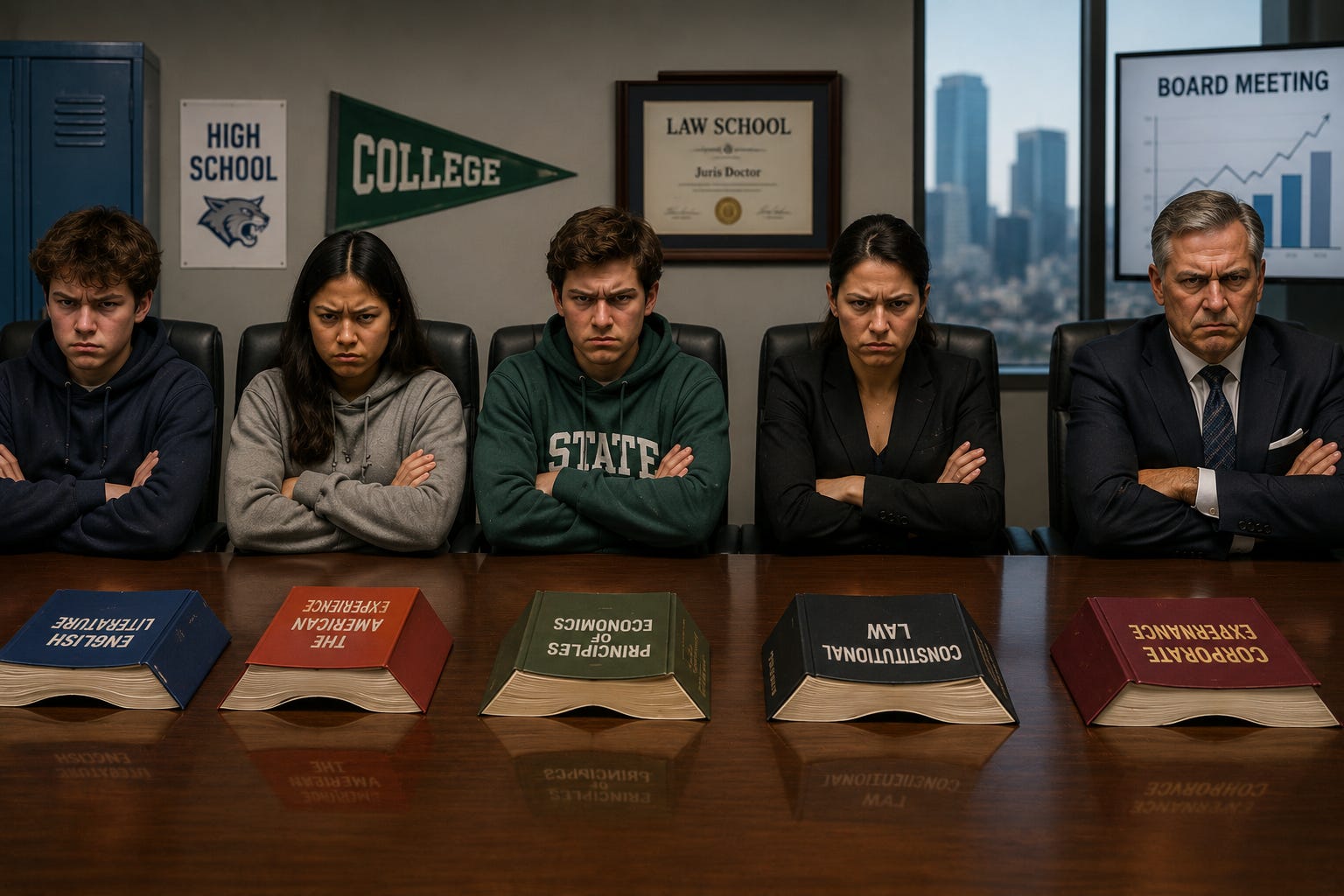
If $2,000-an-hour lawyers won’t do the reading, why would we expect our kids to?
Earlier this spring, a partner at Sullivan & Cromwell sent an apology to a federal bankruptcy judge. Sullivan & Cromwell is not some overworked storefront practice. It is one of the most prestigious law firms on Wall Street, the kind of place that bills clients well over a thousand dollars an hour. And yet the firm had filed an emergency motion stuffed with citations to cases that did not exist. An AI tool invented them, nobody bothered to check, and opposing counsel caught all forty-two errors.
It would be funny if it weren’t so revealing. These are some of the best-paid, most credentialed attorneys in the country, and they could not be troubled to read the cases they put their names to. So here is the question that’s been nagging at me ever since: if the grown-ups at the very top of the food chain won’t do the reading, what exactly are we expecting from a sixteen-year-old with a phone in his pocket?
Because the kids aren’t doing the reading either. And we have the numbers to prove it.
The 2024 Nation’s Report Card came back about as grim as it gets. Reading scores for high school seniors fell to their lowest level on record, a full 10 points below where they stood when the test began in 1992. Roughly 40 percent of fourth graders now read below the “Basic” level, the worst showing in over two decades, and about a third of eighth graders can’t clear that bar either. “Basic,” to be clear, is a low bar: grasp the main idea, make a simple inference. Millions of children who have sat in classrooms for a decade cannot reliably do it. I’ve written before about what those senior-year numbers actually mean for the students walking into my offices, and they are worse than the averages suggest.
And before anyone blames the pandemic and moves on: this started earlier. Reading scores peaked in the early 2010s and have slid ever since, right around the moment the smartphone went from luxury item to standard-issue adolescent appendage. The pandemic poured gasoline on a fire that was already burning.
Now generative AI is here to finish the job. Students don’t wrestle with the assigned chapter anymore; they paste it into ChatGPT and ask for the main themes. They don’t sit with a difficult passage; they ask for a summary and move on. But the wrestling was the whole point. The part where you’re confused, then a little less confused, then you suddenly understand something you didn’t understand an hour ago: that friction is the learning. Remove it, and you’ve removed the reason to read at all. Researchers have a clinical name for what comes next, “metacognitive laziness,” but you don’t need a study to picture it. A muscle you never use gets weaker, and so does the mental equipment for holding a hard idea in your head long enough to make sense of it.
I take all of this personally, because reading and I have a long and complicated history.
I wasn’t diagnosed as dyslexic until the fourth grade. Before that I was simply the kid who hated reading (and wasn’t very good at it), which everyone assumed was laziness or stubbornness. My mother, to her great credit, didn’t try to force it out of me. She bought me comic book subscriptions instead, stacks of them, month after month, and I devoured every one. I still have most of those comics in storage today (my son keeps begging me to dig them out, though I’ll admit his interest is less in reading them than in finding out what they’re worth).
What my mother understood, maybe by instinct, was that the goal was never to make me read. It was to make me want to. And it worked, eventually, though it took years. I didn’t discover the genuine joy of reading until I was well into adulthood, and even now I only feel it when I’m reading for pleasure. The moment a book becomes an assignment, something I’m supposed to finish by a certain date, I seize up. I suspect a lot of people are quietly built this way and never admit it.
What I’m not proud of is what came next, in my own house. Of all the things I worry about having gotten wrong as a parent, the one that stings the most is that I never passed on a love of reading to my kids. My daughter does better than my son, but even she is drifting away from books. My son, as far as I can tell, has never finished a single book for pleasure in his life. With one exception: he will read anything he can find about soccer. Match reports, player profiles, transfer rumors, three-thousand-word tactical breakdowns. The capacity is obviously there. The hunger is there. It simply attached itself to one subject and refused to spread to any other.
And that, honestly, is the entire crisis in miniature. Reading was never the enemy. Forced reading was. The trick nobody fully cracks is getting a child to pick up something hard because they want to, not because it’s due Monday.
The encouraging news, and there is some, is that we actually know how to teach the mechanics, and a handful of states have proven it. Louisiana, of all places, just ranked first in the nation for reading growth and is the only state in the country to climb back above its pre-pandemic levels in both reading and math. Mississippi, long a national punchline for education rankings, has been climbing for a decade and now posts fourth-grade reading numbers that embarrass states with triple the budget.
They did it by throwing out the nonsense. For years, schools taught reading through “balanced literacy” and “three-cueing,” which is a polite way of saying they taught children to guess words from the pictures and the context rather than sound them out. These states banned the guessing and went back to explicit phonics: phonemic awareness, fluency, vocabulary, comprehension, the actual machinery of decoding a word on a page. It isn’t glamorous and it isn’t new. It’s simply instruction that works, and it’s the foundation everything else gets built on.
But this is where I part ways with the optimists. Teaching a child to read and teaching a child to love reading are two different projects, and only the first one comes with a curriculum.
Phonics will get a kid decoding words. It will not, by itself, make that kid choose a book over a screen when no one is watching. And that second thing is about to matter more than it ever has. When AI will summarize any text, answer any question, and write any paragraph on demand, reading becomes optional in a way it simply never was before. The mechanics turn into something you can outsource to a machine. Which means the children who still want to read, the ones who will sit with something hard for the sheer pleasure of it, are going to have an advantage that compounds for the rest of their lives. They’ll be the ones who can still think for themselves when everyone around them has quietly handed that job to an algorithm.
I believe learning to love reading is going to be one of the most valuable skills a kid can carry into the years ahead. I just wish I’d done a better job teaching it at home. Maybe I’ll start by hauling those comics out of storage after all. My son wants to know what they’re worth. I’d like the chance to show him they’re worth a great deal more than money.
Investigating Idiosyncrasies in AI Fiction: Researchers from the University of Maryland and Google DeepMind analyzed 61,608 short stories (10,272 prompts each written by a human and five major LLMs: Claude, GPT, Gemini, DeepSeek, and Kimi) and found that AI fiction can be reliably distinguished from human writing based on narrative structure alone, separately from word choice or sentence style. Using 304 discourse-level features, their classifier achieved 93.2% accuracy detecting AI-written stories even after surface-level editing. The patterns are revealing: AI narrators explicitly state the story's moral 77% of the time versus 52% for humans, AI overwhelmingly conveys emotion through bodily sensations (81% vs. 38%), and AI favors single-track plots with tidy protagonist-driven resolutions while human stories embrace flashbacks, subplots, and morally ambiguous endings. Each model has a fingerprint: Claude writes restrained, epilogue-heavy stories, GPT leans on gossip and rumor, and Gemini produces the bleakest settings. The five AI models cluster tightly together in narrative space, separated from the wider, more dispersed territory occupied by human authors. I just think this is very fascinating. It reminds me of my days as a trial lawyer: one of the attorneys I worked for would always say that the best storytellers could weave a story where the listener stumbled upon the conclusion you wanted without you having to say it.
Generative AI without guardrails can harm learning: Evidence from high school mathematics: Access to generative AI, particularly in mathematics education, can significantly enhance student performance during practice sessions, with improvements of 48% for those using a standard AI interface and 127% for those using an AI with designed learning safeguards. However, reliance on unrestricted AI access can lead to detrimental effects; students using a basic AI model (GPT Base) exhibited a 17% decline in exam performance when AI support was removed, contrasting sharply with students who utilized a safeguarded AI tutor (GPT Tutor), which helped mitigate negative learning impacts. The findings suggest the importance of structured AI prompts that encourage learning through hints rather than direct answers, highlighting the necessity for careful implementation of AI tools in educational environments to enhance skill acquisition while preventing overreliance. To make a long story short, using an A.I. tutor gives you about the same performance as doing the work on your own. The big advantage to doing the work on your own is that it’s much harder to cheat.
Homogenizing effect of large language models (LLMs) on creative diversity: An empirical comparison of human and ChatGPT writing: In an empirical study, human-written content was compared to that generated by ChatGPT, revealing that while LLMs can produce coherent and contextually relevant texts, they tend to lack the unique voice and diverse stylistic elements often found in human writing. The research indicates that reliance on LLMs may lead to a convergence in writing styles, potentially diminishing individual creativity in students. Notably, 70% of responses from ChatGPT were found to align closely in style, contrasting with the broader stylistic variance typically observed in human-authored pieces. While I am sure this is largely true, I believe that through effective prompting, much of this can be overcome.
Law Professors Prefer AI Over Peer Answers: When sixteen U.S. contract-law professors from fourteen law schools blindly compared 2,918 pairs of short tutoring answers, they preferred responses written by AI over those written by their own colleagues 75% of the time. The Stanford-led study tested whether large language models can hold their own in a field built on judgment rather than a single correct answer, and found that Google's Gemini 2.5 Pro and a casebook-grounded NotebookLM matched the strongest human instructors across recall, hypothetical, and policy questions alike. AI answers were also far less likely to be flagged as pedagogically harmful (3.53%) than professor-written ones (12.06%), where harmful-response rates ranged from 1% to nearly 40%. Every judge preferred the AI answers on balance, and the gap could not be explained away by length or polish. A follow-up using newer systems found the margin widening, with Claude Opus 4.7 ranking highest of all. It’s interesting that this week I found multiple articles on writing, two of which are largely anti-AI, and this one comes out pro-AI. Clearly, the jury is still out.
Youth sports are bleeding N.J. families dry. How much parents are spending — and why they can’t stop: The rising costs associated with youth sports have created an overwhelming financial burden for families in New Jersey, with average expenditures soaring to as much as $20,000 annually for children involved in multiple sports. This phenomenon is driven by an expansive youth sports industry characterized by private trainers, elite club teams, and excessive travel commitments that often overshadow the original intentions of recreational participation. A staggering 46% increase in youth sports costs since 2019 has been linked to a concerning trend where over two-thirds of children quit sports by age 13, highlighting a potential crisis in youth engagement and overall well-being. Parents face a daunting choice: either heavily invest in their children’s athletic aspirations or risk limiting their opportunities for success. As a response to the challenges posed by the current youth sports model, advocacy for reforms is emerging, including legislative efforts aimed at curbing the influence of private equity in youth athletics. I’ve written on this topic in the past. I think most families that go down this path are crazy. Admittedly, there are significant benefits to competitive athletics from both a personal and professional standpoint; however, I feel like too many kids are losing their childhood to a very unlikely future goal. Further, they’re taking the opportunity away from families who can’t afford to keep up.
The terrifying rise of schoolboys making AI girlfriends: The phenomenon of boys as young as 12 entering romantic relationships with AI chatbots poses significant implications for their social development and interactions with peers. As these boys engage with virtual partners, their perceptions of real-life relationships and expectations from girls may shift, leading to concerning behaviors and attitudes. Research highlights that boys often exhibit a tendency to become more objectifying and less empathetic towards their female peers, influenced by the dynamic of controlling interactions with AI. This shift may result in a disconnect from genuine emotional understanding and healthy relationship skills, as they increasingly favor interactions with artificial entities over real human connections. The trend calls for increased awareness and proactive discussions in educational settings about the impact of technology on relationship dynamics and emotional intelligence, emphasizing the need for fostering healthy interpersonal skills in youth. Thankfully, neither of my kids has, or knows anyone who has, an AI girlfriend/boyfriend.

Anthony Bradley@drantbradley
The following colleges are facing a financial crisis. From @Forbes.
8:39 PM · May 26, 2026 · 280K Views
100 Replies · 87 Reposts · 442 Likes
The college financial crisis is going to get worse.
FAS Could Lay Off 25 Percent of Staff in Summer Administrative Restructuring: Harvard's Faculty of Arts and Sciences is considering a significant administrative overhaul that may result in the layoff of up to 25% of its staff to address a projected $365 million budget deficit. This restructuring plan involves consolidating administrative roles into shared "clusters" to enhance efficiency and better support several academic units. Individual department administrators, who manage essential functions like finances and human resources, may be replaced by cluster administrators overseeing multiple departments. The proposed changes highlight the challenges and uncertainties in higher education administration, emphasizing the need for adaptability and support for staff during such transitions, particularly as similar cuts have already occurred in other areas of the university, such as the School of Engineering and Applied Sciences, which saw a 15% reduction in staff last October. The restructuring process is ongoing, with implications for job security among long-standing staff members, many of whom lack formal protections due to union representation. Technically, Harvard does not need to save any money, but the number of colleges with more non-teaching staff than students is staggering.
Are That Many Students Really Faking Disabilities?: The increase in students with registered disabilities in higher education — from 11% in 2004 to 21% in 2020 — highlights a cultural shift towards recognizing mental health and disability needs, as students increasingly advocate for themselves. However, misconceptions about students "gaming" the system create skepticism around legitimate requests for accommodations, which are essential for many students facing challenges like anxiety, depression, and ADHD. The article underscores that while some students may exploit accommodations, the overwhelming majority face significant barriers in accessing support due to complicated paperwork, high costs for documentation, and overwhelmed disability services. Notably, only a third of students with disabilities who enroll in four-year programs graduate within eight years, emphasizing the importance of equitable access to necessary resources and support structures in educational settings. This article does not adequately address how income inequality plays a role in who gets diagnosed with disabilities. I'd bet real money that most fake disabilities come from affluent households.
Gottheimer: Harvard 'Continues to Fail' on Antisemitism 'Like It's Their Strategy', Need to Look at Their Foreign Funding: Harvard University is criticized for its inadequate response to rising antisemitism, with Rep. Josh Gottheimer pointing to a 70% increase in antisemitic incidents since the October 7 attacks. He attributes part of this surge to intentional efforts fueled by foreign entities, including Iran, North Korea, China, and Russia, who are allegedly exploiting platforms like TikTok to disseminate disinformation and incite division within American society. While universities in Florida, as well as institutions like Vanderbilt and Emory, are praised for their proactive stance against such hate, Gottheimer emphasizes that Harvard's persistent failures seem strategic and warrant scrutiny of its foreign funding sources. Follow the money. I wouldn't let my kids apply to Harvard.
A.I. Is a Job Creator: The conversation surrounding artificial intelligence (A.I.) and its impact on employment reveals a significant divide among business leaders: one group fears an impending job apocalypse, while the other sees potential for growth and innovation. Goldman Sachs estimates that A.I. could automate 25% of current work hours in the next decade, notably affecting white-collar roles in sectors such as banking and law. However, history shows that economic disruption often leads to the creation of new jobs in emerging sectors. For instance, the demand for data centers has generated over 200,000 construction jobs since 2022, underscoring the potential for job growth in areas less susceptible to automation. In a dynamic labor market where American companies create and destroy millions of jobs annually, the ability to adapt through reskilling and vocational training is crucial. Public and private sectors must work together to support skill development and training programs, as the historical pattern indicates that the U.S. economy will likely continue to evolve and thrive despite technological advancements. Don’t Fear the Codex!
Barriers grow for international students seeking U.S. jobs: The 'American dream ... is collapsing': International graduates face an increasingly challenging landscape when seeking employment in the U.S., where a shrinking job market and stringent immigration regulations create significant barriers. In 2026, the unemployment rate for recent college graduates aged 22 to 27 stood at 5.6%, highlighting the difficulties for newcomers, particularly as the percentage of job postings offering visa sponsorship dropped dramatically from 10.9% in 2023 to 2.6% in 2026. The article emphasizes the importance of proactive networking and alternative career planning, with many students considering job opportunities not only in the U.S. but also in other countries like Canada and Europe. The U.S. issued 97,000 fewer F-1 visas for the 2025-26 academic year, reflecting a 36% decline, which can have long-term implications on the economy and innovation, especially in STEM fields, where a decrease in international graduates could result in GDP losses of up to $481 billion over the next decade. Good news for American grads, bad news for keeping the world's best talent here — which kills US competitiveness. Also bad news for college balance sheets, international students pay full freight. When they stop coming, colleges that bank on that money are screwed.
What I’m Watching: I just started watching The Boroughs with my daughter (we love watching mysteries together). We’ve only watched the first two episodes, but it seems like a fun show; I’m looking forward to watching more.
What I’m Reading: I put down Aftermath and moved to a piece of fiction to get back on track. I recently started The Fourth Option by Jack Carr and MP Woodward. This is Jack Carr’s new series, written with a co-writer. One of the things I admire about Jack Carr is how he visualizes his books. With the Terminal List, he said he wrote “Revenge” on a post-it note and placed it on his computer, as that was the central theme for the book. For The Fourth Option the idea is when established institutions like law enforcement, the courts, and the prison system fail, there’s always the fourth option (the book is about vigilante justice).
My Favorite Recent Podcast: Since school is out, and I spent part of the week in NYC last week, I didn’t really listen to anything worth sharing.
No posts
Comments
Nothing yet. Say the first thing.
Sign in to join the conversation.