
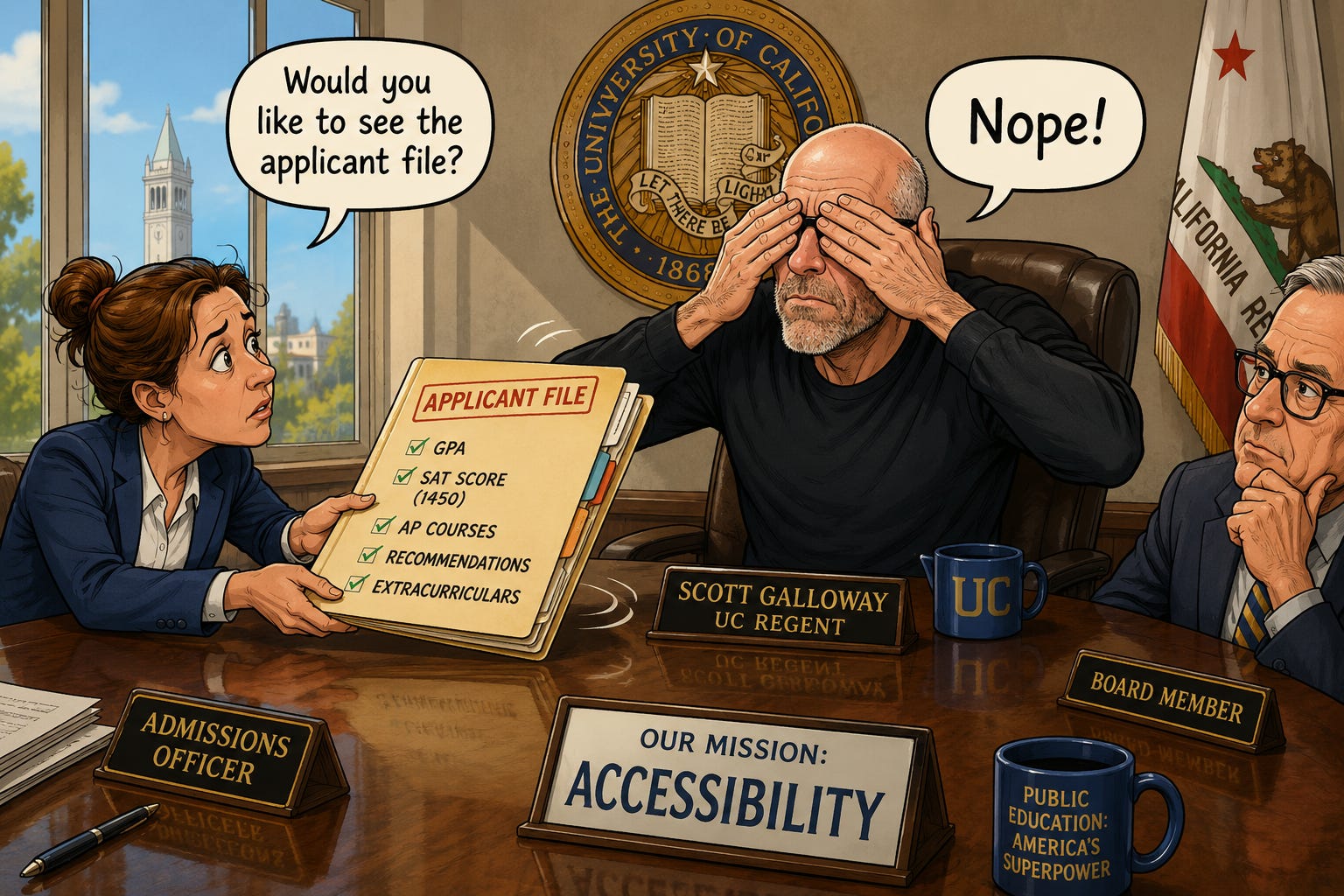
An open letter to Scott Galloway, newly appointed to the University of California Board of Regents
Congratulations, Professor Galloway. Last week Governor Newsom appointed you to the UC Board of Regents, and within hours you posted your mission statement:
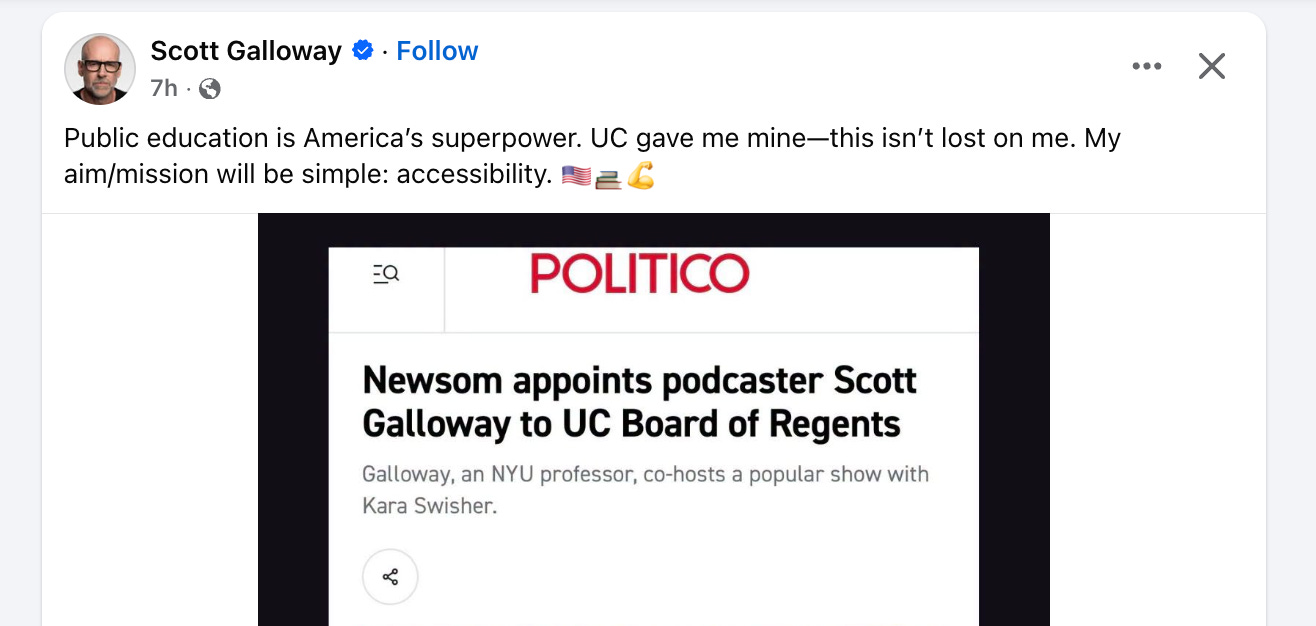
I want to talk to you about that last word, because it’s being interpreted as you having already made your decision on test-blind admissions. You’ll be seated, pending Senate confirmation, just as the fight lands on the table: UC announced in June that it would review whether to reinstate standardized testing, the faculty committee running that review imploded in July, and the new board chair responded by fast-tracking a recommendation to June 2027. You will be in the room. So let me make the case to you plainly: vote to bring back the tests. Not in spite of your mission. Because of it.
Start with what you’ve gotten right, which is plenty. Selective colleges have spent three decades behaving like luxury houses, hoarding prestige through manufactured scarcity. When you told a TED audience “We’re public servants, not f***ing Chanel bags,” you said in nine words what most of us in education have spent careers dancing around, and the numbers back you up; Ivy League seats grew just 14 percent over thirty years while high school graduates grew 44 percent. And you have a valid point about what public higher education is for: giving unremarkable kids a shot at being remarkable.
You know that story personally. By your own accounting, you graduated from public high school with a 3.2 GPA and an 1130 SAT, got rejected by UCLA, got in on appeal, hit academic probation four times, and limped out with a 2.27. Then came Berkeley Haas and, eventually, a career explaining markets to the rest of us. “UCLA took a chance on me,” you told the alumni magazine, “and everything else in my life has been downstream from that chance.”
But look closely at the chance UCLA actually took. The admissions officer who called you had your whole file. She knew about the grades. She knew about the 1130, a score you’ve noted put you in the 85th percentile nationally. She let you in anyway, as “a son of a single mother and the great state of California.” That was an informed bet on an unremarkable kid. Test-blind admissions is something else entirely: under current policy, a UC reader is forbidden from seeing a score even when the student wants to show it. The system that took an informed chance on you now takes guesses.
You would never run a business this way. You’ve described ranking your most valuable people at L2 and finding they had three things in common: world-class universities, athletic backgrounds, and being women, then screening candidates for “two of the three.” Your podcast co-host is a summa cum laude Princeton classicist. And when you did bet on someone without credentials — your chief of staff never finished college — she was someone you’d known for twenty-five years. Full information, deliberate exceptions. Nobody who stakes his own money on talent volunteers to see less evidence of it. Test-blind asks UC to do exactly that, permanently, at scale.
Now, accessibility. UC Berkeley alone enrolls a higher share of Pell Grant students than all eight Ivy League schools combined. Systemwide, more than a third of undergraduates have Pell Grants and 42 percent are first-generation. Tuition is free for California families earning under $80,000, and 52 percent of in-state undergraduates pay no tuition at all. The top 9 percent of every California high school class is guaranteed a seat. Enrollment just hit a record 301,093 students, and the system is adding 23,000 more California undergraduates by 2030, which is your own grow-the-freshman-class prescription, already funded and underway. That is not a system with an accessibility crisis.
The crisis is preparedness. At UC San Diego, freshmen placing below middle-school level in math grew roughly thirtyfold since the system went test-blind, from half a percent in 2020 to nearly 12 percent last fall, and one in four students in the campus’s most remedial math course had a perfect 4.0 in high school math. More than 1,400 UC faculty, including seven of the system’s nine math department chairs, have signed a letter asking for the tests back. The average high school GPA nationally climbed from 3.17 to 3.36 across a decade in which measured achievement fell. UC threw away its calibrated instrument at the precise moment the remaining one started lying.
And here is the finding I most want you to sit with, because it inverts the assumption behind your mission statement: the test was the accessibility tool. UC’s own faculty task force concluded in 2020 that scores predicted student success better than high school grades, and better still for low-income, first-generation, and underrepresented students; roughly a quarter of the low-income students admitted in 2018 earned their guaranteed spot through a test-score pathway that no longer exists. The Regents ignored their own experts, 23-0. Dartmouth’s economists later found disadvantaged applicants withholding scores that would have gotten them in. MIT’s admissions dean said reinstating the requirement “actually increases access,” because a test is the one credential a talented kid at an under-resourced school can earn without AP courses or a private counselor. Yes, wealth correlates with scores. It correlates with every other admissions signal more. In my experience over the years, the families best equipped to game a test-free process are precisely the ones who need no help; I watched test-optional play out at places like Vanderbilt, and the beneficiaries were never the kids the policy was named for.
There’s one more cost, and it’s the cruelest. UC’s task force also ran the completion numbers: the lowest-scoring admits dropped out within a year at a 35 percent rate and barely half graduated within seven years, while the highest scorers were retained at 97 percent and graduated at 92. A student admitted past their preparation doesn’t beat those odds because the campus is prestigious; the odds travel with them. Meanwhile courses pace to the students in them, so 900-plus freshmen in remedial math at a single campus pull faculty into reteaching algebra while majors harden their weed-out gates. The genuinely accessible route UC built (the community college transfer path nearly a third of entering students take) produces graduates. The test-blind shortcut produces kids who leave a flagship with debt and no degree, when the same kid, placed where preparation could compound, might have been your kind of late bloomer. Admitting an unprepared eighteen-year-old to a campus where the data says they’ll fail isn’t opening a door. It’s walking them into one.
You’ve built a career telling institutions to face their own numbers. UC’s numbers have now been produced twice, by its own faculty, five years apart, and shrugged off both times. You were the unremarkable kid the instrument helped make legible. The chance UCLA took on you was a calculated one. From your seat on the board, you can make sure the next kid gets the same calculation — and the same chance.

levent@__alpoge__
hello there the jacobian conjecture is false thanx to my close friend akhil for asking about it and my other close friend fable for working during the world cup final ((1+xy)^3 z + y^2 (1+xy) (4+3xy), y + 3 x (1+xy)^2 z + 3 x y^2 (4+3xy), 2 x - 3 x^2 y - x^3 z): \C^3\to \C^3,
2:19 AM · Jul 20, 2026 · 27M Views
1.61K Replies · 4.89K Reposts · 40.2K Likes
For those who have no idea what this means (myself included), Claude’s most advanced model, Fable 5, has proved an 87-year-old math theory to be wrong. I don’t think anyone has an idea of the discoveries that AI will uncover — it’s exciting and frightening at the same time!
AI Can’t Fix the Student-Motivation Problem: The advent of AI in education, exemplified by tools like Khanmigo from Khan Academy, promises personalized learning experiences; however, these tools have not significantly engaged students. Despite a rapid increase in access — from 40,000 to nearly 1 million users in just one year — actual student uptake has stagnated due to a fundamental issue: motivation. AI may excel at delivering tailored educational content but falls short in inspiring students to confront the challenges of learning. The crucial takeaway is that while technology can enhance educational delivery, it cannot replace the intrinsic drive necessary for students to engage in their own learning journey. This disconnect suggests that support systems fostering motivation and engagement are vital in leveraging AI's potential effectively. This is obvious. For the vast majority of students, apparently there is a ton of venture capital money out there trying to figure out how to build an AI that can tutor as well as a human being. I’m not confident anyone will crack that code anytime soon.
Jevons Paradox: More Evidence of a Positive Employment Effect of AI Adoption: The integration of AI in workplaces has been linked to a 10% growth in employee headcount over two years following adoption, according to a study by Ramp examining 21,559 U.S. firms. This growth is predominantly driven by companies that invest heavily in AI, particularly in entry-level positions, which increased by approximately 12%. The findings suggest that rather than displacing workers, AI complements job growth, presenting a promising landscape for future employment opportunities. As AI continues to reshape industries, understanding its positive impact on workforce expansion can guide educational initiatives that prepare students for evolving job markets. Those who have been reading my Substack for a while know the term Jevons Paradox. I’ve written on this topic on more than one occasion, including my theme piece: Don’t Fear the Codex.
Florida state board bans undocumented students from college system: The Florida State Board of Education has approved a policy prohibiting undocumented students from enrolling in any of the 28 institutions within the Florida College System, which may significantly impact enrollment numbers. An estimated 50,000 students identified as undocumented in 2023, and the new policy could lead to a loss of approximately $15 million in tuition and fee revenue annually for the state’s college system. Furthermore, similar restrictions are anticipated for Florida’s public university system, following a recent vote that seeks to bar any student “present in the United States unlawfully.” This shift in policy aligns with broader legislative trends in the state, including the repeal of a statute allowing certain undocumented students to access in-state tuition. These developments highlight an evolving landscape in higher education access that may affect students’ educational trajectories, emphasizing the need for guidance on available resources and future options. I have very mixed feelings on this.
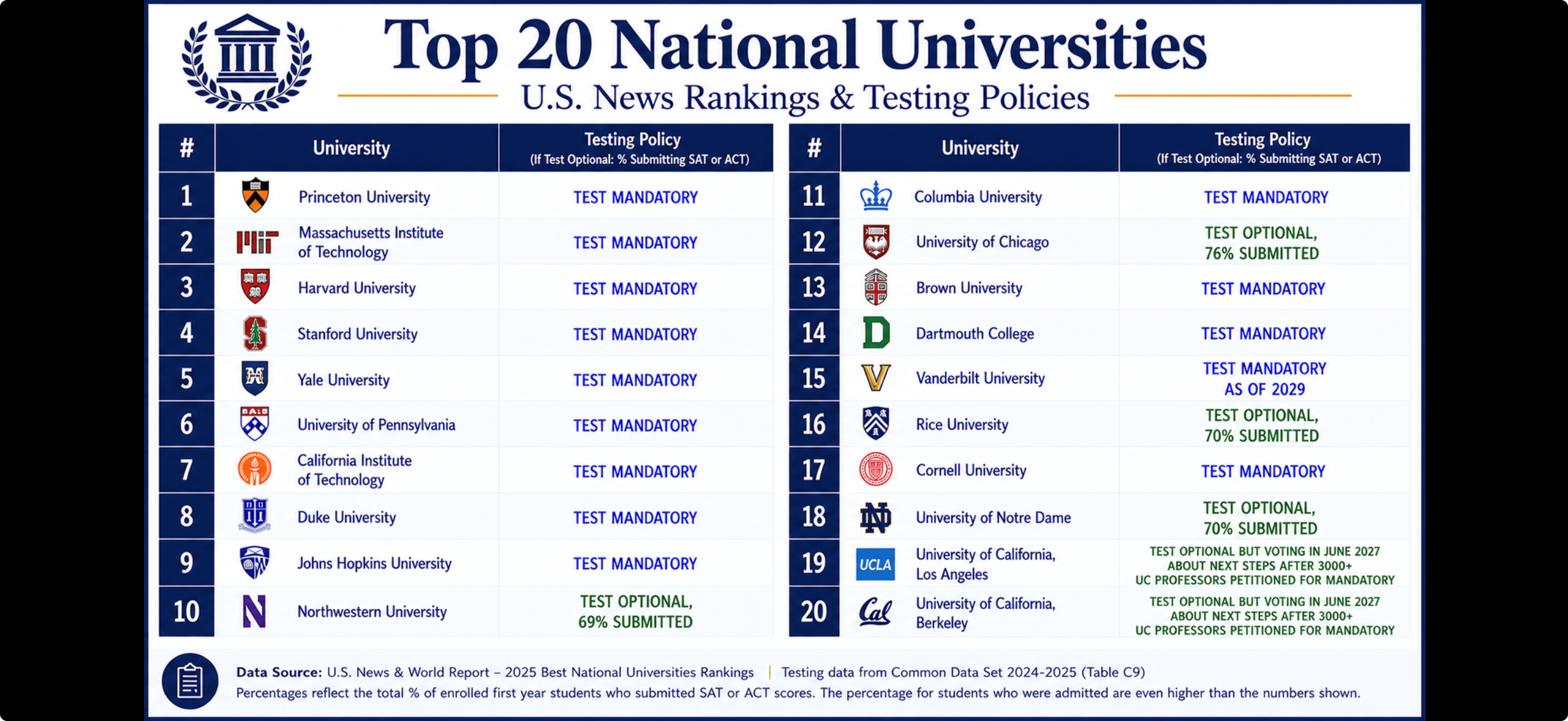
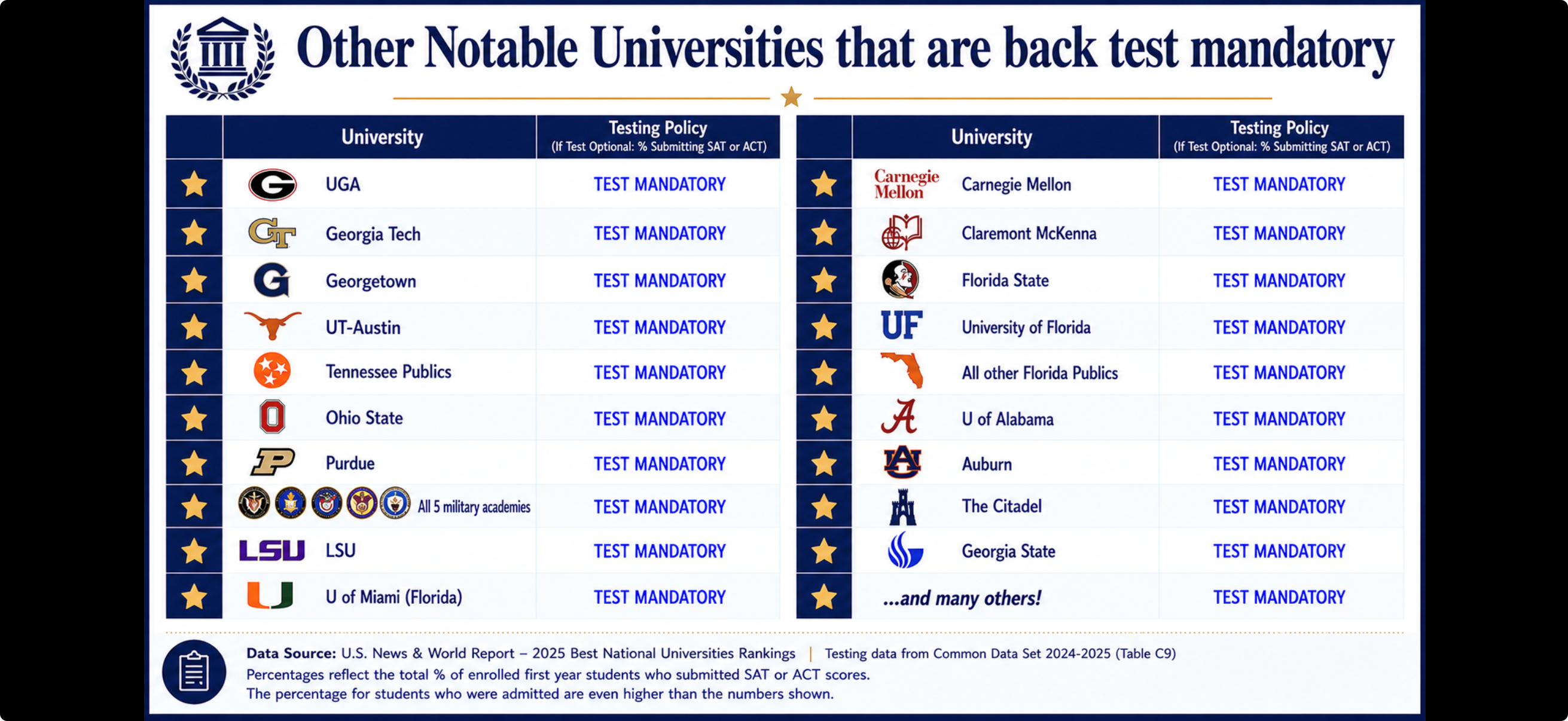
Vanderbilt to reinstate standardized testing requirement for fall 2029 applicants: Vanderbilt University will reinstate the requirement for standardized test scores for undergraduate applicants starting with the fall 2029 admissions cycle. This decision comes after a thorough review of its test-optional policy, initially adopted in response to the COVID-19 pandemic in 2020. The university found that standardized tests, when integrated into a holistic admissions process alongside a student’s academic history and application elements, are valuable in identifying students likely to excel academically at Vanderbilt. While the test-optional policy remains effective for students applying for fall 2027 and 2028, the shift to requiring scores signals a return to traditional evaluation methods, potentially influencing students' preparation strategies and academic planning moving forward. This reinstatement underscores the importance of standardized testing in predicting collegiate success and encourages a comprehensive approach to college readiness, combining test preparation with the development of strong academic records. And another one bites the dust. Test optional is dying a little more every day. My friends had Edison Prep put together the following charts:
42% of adults rely on their parents for financial support—there are no 'bad guys' here, says financial therapist: A significant 42% of American adults currently depend on parental financial support, highlighting the evolving dynamics of family finance, especially among younger generations: 72% of Gen Z, over half of millennials, and a third of Generation X rely on this assistance. Understanding the emotional landscape surrounding financial gifts is crucial; parents may struggle with feelings of guilt or control, while children may feel entitled or ashamed. Effective communication is key to avoiding misunderstandings and ensuring that financial support is viewed as a temporary aid for achieving long-term goals, such as home ownership or educational advancement. Experts advocate for proactive discussions about financial planning, allowing families to navigate support expectations while safeguarding parents’ long-term financial health, especially in light of impending retirement or caring for elderly relatives. Engaging with financial professionals can also provide clarity and structure to these familial financial arrangements. I wrote about this to some degree in my last piece. Most of Gen Z and millennials need to set realistic expectations for a life they want to live.
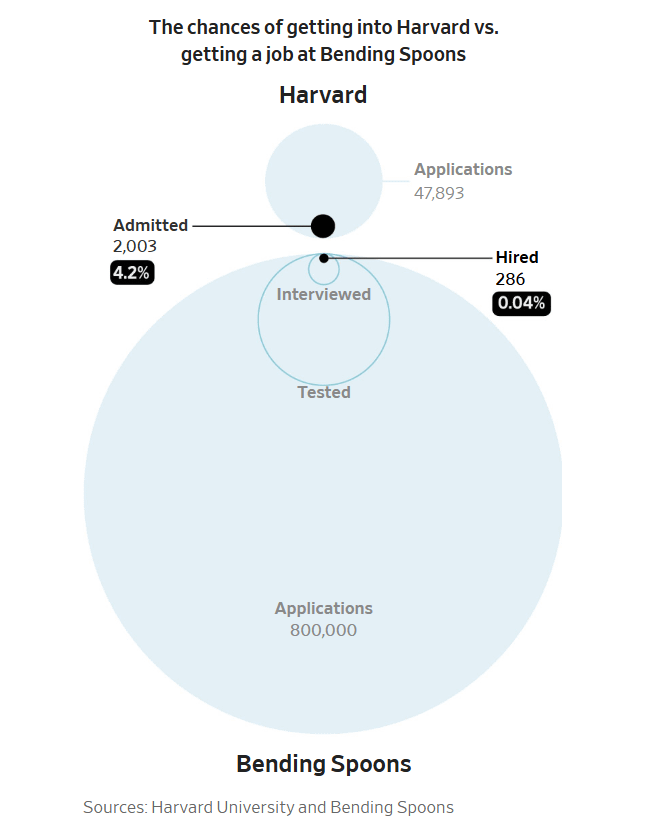
The Mind-Bending Company That Gets a Million Job Applications — and Rejects 99.9%: Bending Spoons, a tech startup based in Milan, has adopted a remarkably stringent hiring process, accepting only 0.04% of applicants — significantly more selective than elite universities like Harvard. Last year, it received 800,000 applications but only hired 286 individuals, employing a scientific approach to interviews and evaluations that prioritizes reasoning, judgment, and speed of learning. The company conducts a rigorous series of assessments that filter candidates down from 60,000 to 3,300 before interviews, emphasizing that traditional interview methods are often non-predictive. Additionally, the executives at Bending Spoons aim to identify and nurture exceptionally talented young professionals, often with no prior work experience, by granting them significant responsibilities and ongoing performance evaluations. This model challenges conventional recruitment and talent development strategies, suggesting that organizations can benefit from focusing on data-driven assessments and early career talent development. I’ve been using Evernote for years. I love Bending Spoons!
What I’m Watching: Over the weekend, I watched Masters of the Universe. While the movie was pretty stupid, I must admit I enjoyed it for nostalgia’s sake. It brought me back to being a kid and watching He-Man on Saturday mornings. Dolph Lundgren’s cameo was a nice touch. He played He-Man in the 80s version of the movie.
What I’m Reading: I honestly haven’t picked up a book in a few weeks. I need to get motivated.
My Favorite Recent Podcast: Since both of my kids have been in camp, I have not been spending much time in the car, which means I have not listened to very many podcasts. While I still listen regularly, nothing has caught my attention worth sharing.
No posts
Comments
Nothing yet. Say the first thing.
Sign in to join the conversation.