
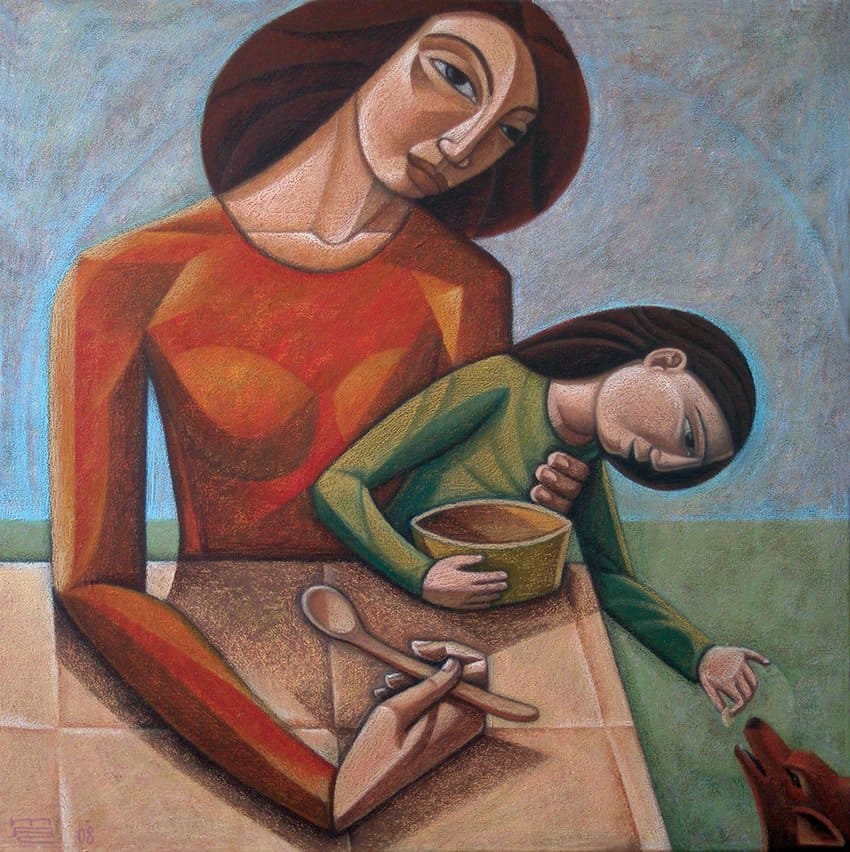
Matthew narrates a surprising and quite miraculous encounter given the fact that the Hebrew Bible says every last one of the Canaanites had been “utterly destroyed” by the command of Israel’s God.
The lectionary Gospel passage for this coming Sunday is the surprising encounter in Matthew 15:
Just then a Canaanite woman from that region came out and started shouting, “Have mercy on me, Lord, Son of David; my daughter is tormented by a demon.” But he did not answer her at all. And his disciples came and urged him, saying, “Send her away, for she keeps shouting after us.” He answered, “I was sent only to the lost sheep of the house of Israel.” But she came and knelt before him, saying, “Lord, help me.” He answered, “It is not fair to take the children’s food and throw it to the dogs.” She said, “Yes, Lord, yet even the dogs eat the crumbs that fall from their masters’ table.” Then Jesus answered her, “Woman, great is your faith! Let it be done for you as you wish.” And her daughter was healed from that moment.
Here in the Gospel of Matthew, Jesus has just been in Gennesaret where a Pharisee’s question about handwashing leads him to declare, “It is not what goes into the mouth that defiles a person, but what comes out of the mouth; this defiles a person.” Unlike the Pharisees, the disciples do not understand Jesus. “Explain to us what you said,” Peter asks Jesus. Instead Jesus takes them on a field trip into Gentile territory. Tyre and Sidon are in Lebanon.
By automobile from the Sea of Galilee, it is a seven hour trip.
This is a deliberate journey, not a detour.
Despite what appears to us as his reluctance to minister to Gentiles, Jesus does not make such an expedition without that very expectation. When they arrive in the pagan district, a woman immediately encounters them.
“And behold,” Matthew writes, announcing her appearance into the story.
The woman “cries out” to Jesus. And the Greek word is ekrazen, meaning “to shout.” Across ethnic lines, across religious divides, across gender boundaries, she shouts at Jesus. She is uncouth; so much so, you would expect that what comes out of her mouth is defilement. Instead, her utterance is a miracle, ”Have mercy on me, O LORD, Son of David.”
In the Gospel of Mark, this encounter happens in a home into which Jesus has snuck. “But,” Mark reports, “Jesus could not be hidden.” How did she find him at that place, inside that particular home? Remember how she addresses him. Jesus is God. Jesus is God living the human life. Jesus is one person— God the Son— in two natures, human and divine. Therefore, this mother has not found Jesus; he has hidden himself in order to be found by her. He’s calibrated this long journey and arranged this encounter for us.
When she pleads with Jesus to deliver her daughter, he initially answers her not a word. As always, the disciples rush to fill the silence and what comes out of their mouth is defilement, “Send her away, for she is bothering us.”
But she does not move.
She remains fixed before him as though she knows him better than the disciples do.
Next Jesus announces, “I was sent only to the lost sheep of the house of Israel.” And whether Jesus says it to her or to us, Matthew does not reveal. Not only is not clear to whom Jesus is speaking, it is not true. Already in Matthew’s Gospel Jesus has healed a Roman centurion’s child. Don’t forget— Matthew begins his Gospel with a long, unconventional genealogy that includes in it names like Tamar and Rahab and Ruth, pagan names— Gentile women without whom there would have been no house of Israel. Just as Moses is an Israelite with an Egyptian name. the house of Israel is itself both Gentile and Jew.
The determined mother responds to him not with words but with her body. She prostrates herself before him, a posture that matches her confession. “LORD, help me,” she replies. Again, she knows Israel’s Messiah is also her Maker, and she persists like she’s completely confident about his character— like she’s known him her whole life.
What Jesus says next is exactly the defilement in his disciples’ hearts, an ethnic slur. “It is not right to take the children’s bread,” Jesus says, “and throw it to the dogs.”
But she does not miss a beat. It is as if she knows not only his identity but his nature. She comes right back at Jesus, once again calling him LORD. “Yes, LORD,” she replies, “yet even the dogs eat the crumbs that fall from their masters’ table.”
In other words, “even if I am a dog, I am your dog— I belong to you.”
According to a literal reading of the Old Testament, this encounter, which nets this mother a miracle for her daughter, should be an impossibility. The exorcism itself should not be necessary because there should exist no Canaanite daughter to be possessed by a demon in the first place. Somehow there is not just this Canaanite woman but a Canaanite girl and, presumably, a Canaanite father. Maybe there are even Canaanite grandparents on both sides, siblings of the girl even. Somehow there are at least three (perhaps as many as seven or more) Canaanites.
This is surprising because the Bible says there should be zero.
Comments
Nothing yet. Say the first thing.
Sign in to join the conversation.