
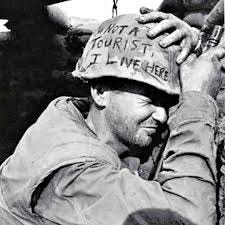
I went months without hearing a single song, long enough that I’d forgotten music altogether, unconsciously left it behind. The early days of Iraq. An enterprising young Marine covertly collected everyone’s digital music to build an illegal library on the operational shared drive, hidden in layers of obscure folders. I was one of only a few officers lucky enough to be read in, because the Lance Corporal Mafia does not trust “The Os”, with good reason. Just plug your earphones into your government laptop, follow the map, click any of 1,000s of songs and don’t get caught. Me sitting in the tactical operations center, watching battles on grainy feeds, tracking carnage, night-vision buildings evaporating into smoking holes, one ear plugged into my laptop and the other listening to radio traffic from the units.
Why can’t there be music in combat? One Marine unit assaulted an enemy position to the symphony of .50 caliber machine guns and AC/DC thumping in time with glorious effect. My first song, after a lifetime without a song: Guns ‘n’ Roses’ “November Rain.” A random choice, but rarely have I romanticized a song like that one. It was a gift, a message, a promise, a tattered letter from the past, and a prophecy, made sweeter by the fact that I was getting one over on the man. A magical machine to take me anywhere I wanted to go: to breathe beside my sleeping wife in the waking moments of the warm dawn, to walk barefoot across the cool lawn with my son on my back, to sit poolside with strong cold drinks in the sacrament of the sun.
I am there and I am here. The bleak realities of men hellbent on shedding blood must first be filtered through a sanitizing story before they can be memorialized. The carnage is too blunt for the unbaptized. Caught up in wartime fervor, the myth of ‘us and them.’ We cling to it long after its potency expires.
James Webb, Vietnam veteran, journalist, political advocate, and author, published an article in Parade Magazine that I have read every Memorial Day since 2001, a tradition started by my old friend The Night Clerk, when we were young Marine officers together, “The Price of Duty.” It tells the story of a devoted father, himself a WWII veteran, and his son, who volunteered for Vietnam. The Night Clerk sends me the article every single year, a few days before Memorial Day, without fail. In an act of enduring love, he will not allow me to forget.
In the summer of 1967, Troy Liverman took a photo of his son holding a sign that read “BEFORE.” There would be no “AFTER.”
The ragged colors still wave on the quiet battlefield. The survivors toast the fallen with tentative mourning, petrified to admit that they dare not ask the fateful question, for the unspoken answer known to every man is clear, during the wars of our lifetime:
It was not worth the price.
But action and passion demand a relentless surging forward. To stop in the midst, even for a thought, is to die in place. Caught in an ambush, tactically or existentially, the man’s only chance of survival is through it.
Adlai Stevenson requoted in the 1950s what was originally a 1920s advertisement written by George W. Cecil. Printed and framed, the paper yellowing at the edges, it was a gift to me when I was a young captain, unceremoniously handed over to me by a Force Recon Marine 1stSgt who simply said, “This is how it goes, sir.”
“On the plains of hesitation lie the blackened bones of countless millions who at the dawn of victory lay down to rest, and in resting died.”
The story tells us that the soldier leaves the battlefield, that bloody place, and leaves that place in that place. He returns home to hoist his children in the air and spin around in joy, to take his pretty wife dancing, and to feel the satisfaction of having done his duty.
But the truth is that the man cuts chunks of flesh and heart from his own body and buries them on the battlefield. He claims heavy souvenirs to carry home in their stead. He leaves parts of himself in the fields of blood and brings parts of the battle home. It is a grisly trade made by men who deal in lead.
Home is no place for battlefield souvenirs. And the man is now incomplete.
The din of ‘homecoming’ quickly quiets. No more parades. A sheet of newspaper blows down an empty street where once throngs cheered, real or imagined.
The man wants to feel fully alive again; he longs to be home, and, at a deeper level, he longs to return there. So, he is not whole. He languishes in a space that is neither ‘this’ nor ‘that.’ He hates. His revulsion at the pretense of society turns to anger and self-pity, and from despair, he either self-destructs or rewrites his story as a romantic tragedy, that of the good-hearted hero with Shakespearean flaws.
Larry Lively, mentor to The Night Clerk in the early days, spent multiple tours in Vietnam working out a toast:
“Here’s to it, and here’s to it again; and damn the man who gets to it, for he may never get to it to do it again.”
On a day like Memorial Day, the man dusts off the myths of duty and patriotism. He remembers, relives, and silently wonders whether the life he lives pays homage to the brothers he has buried. Is he grateful enough? Does he remember often enough? Does his work mean anything? When’s the last time he called to check on his brother’s widow?
Am I alive enough to honor the dead?
Time doesn’t heal it. The years have a density that buries the most acute moments and muffles the cries of the most tragic. Time turns down the volume on a track that ceaselessly plays. No man can remember enough, because re-member-ing is the reassembly of parts into their original whole. To remember them is to try in vain to put together the parts forever lost, and it is to see the empty spaces that will never be filled. If the man is ever to live again, he must fill the empty spaces to complete himself. He will try with pursuit, ambition, adrenaline, sex, booze, a family he can scarcely keep together, movement, heavy weights to carry, repetition of a fiction he recites, clutching a season that has passed, the heroin of harrowing music on dark nights, the words he whispers when he thinks no one can hear him. But to truly fill the empty spaces, he must call on the very thing that keeps the memories alive, that unassailable resolve that twists hot in his chest, an echo in a canyon: brotherly love.
A recent conversation with friends: grief is the evidence of love, or it is love that has nowhere to go, or, in the case of Troy Liverman, it is love that plants a garden on a grave. The man must open himself to the beauty and mystery of brotherly love, that strange and singular bond forged when men work or fight or bleed together for a common purpose, a purpose that, when distilled into its essence, is always a form of love. It is this love he knows best. It will lead him to the garden where the man’s soul can embrace those brothers in his midst. They’ve gone before us, an advanced party, to survey and reckon the land until we join them. Because that was not the end, nor is this, for we shall march in rank forever, until the end of all things.
Life, liberty, and the pursuit of happiness. Our collective ideal captures the fundamental elements of existence, unencumbered humanity, and reasoned volition toward what is good, for each of us and ours. You could render the ideal, as philosopher Dr. David Bentley Hart does in “The Experience of God”, as the conditions proper to the full exploration of “Being, Consciousness, & Bliss.” The ideal hovers venerated above the masticating reality of living in the systems our System creates, and we use it to varnish our moral turpitude and to justify our imperial acquisitiveness. I participate in and defend the very systems that perpetuate a descent into the slow death of slavery, at least at the visceral level of life, where the man lives his days, and where one by one those ideals are amputated, his horizon shrinking interminably toward a final flicker of light followed by darkness.
What now, once the myth of patriotic duty is worn threadbare by the cost of service, not merely in blood and treasure, but in the lost assurance that I both represent and embody that noble ideal? When the good man crosses the globe to fight a bad enemy, he often discovers that he is not merely capable, and not merely willing, to commit the type of violence he once relegated to his enemy, but he is emboldened with a kind of lust for it. The man discovers that an enemy acts on his home soil exactly as he would if invaded by a foreign army, regardless of their propaganda, their noble “reasons”, their empty promises to liberate him from the only life he’s ever known. Acting as the man would if in his enemy’s place, the man will answer him with a disproportionate violence he may never have imagined existed.
Who then is good? And who bad? It is apropos that veteran homecoming is referred to as “reintegration” by the institution; the government has a special knack for naming a thing the opposite of what it really is. For many, homecoming is the abject failure of integration, in degrees, that bifurcates a personality into two opposing views of oneself, one the dutiful citizen and the other the monster of the battlefield. Joker said it in Full Metal Jacket, responding to a question regarding the incongruity of a peace sign and the words “Born to Kill” on his helmet. It represents the “duality of man.”
The unwitting veteran is shocked and overwhelmed at his intrinsic duplicity, and becomes mired in a losing battle between “either/or.” To survive, he must realize that it is a whole human who is “both/and”, the citizen and the monster, the saint and the sinner. This is true integration and is the truth of us all.
Perhaps my gnawing sense of betrayal has less to do with unrequited wartime loss, in its personal and most encompassing senses, and more with filtering my experiences and those of others through the wrong lens.
When viewed through an ideological lens, it is painfully evident that our wars are not fought for such lofty ideals, and the cost is too high. But if filtered through a pragmatic imperial lens, it’s simply the cost of doing business on a global scale. Geopolitical manipulation, policed lines of communication, international footprints, and the dirty tricks of the intelligence space all help maintain the U.S. dollar as the world’s reserve currency, among other things, thereby creating the conditions we have enjoyed for several generations. We must have skin in the game to perpetuate the stunted education, entitled sloth, and distracted self-obsession of the American masses. Losing a few thousand of the martial class here and there seems a reasonable ante. Hell, it’s a staple tradition of the nation-state. This leads to an inevitable collapse, but in the meantime, the machine functions as designed. We could just call it what it is and dispense with the romanticizing. Mercenaries don’t need flags and fables; they simply need to get paid.
An ugly truth is better than a beautiful lie.
Life’s a game, and a long one;
Love’s a drink, and a strong one;
He stops to think, and he thinks so;
He barely blinks, but he shoots low.
There is redemption found at the primordial beginning, in the untwisted purity of spontaneously busting out the Running Man in the middle of the living room when the music comes on, before the ‘self’ obscures the ‘me’, before the ‘I’ crowds out the ‘we.’ My son did this very thing once, when he was young, to a song called “The Promise.” It was so pure and free that I burst into laughter and joined him. When I remember it now, it brings me to tears.
That is what it means to memorialize. We memorialize by infusing memory with myth and imagination. It is to curate the raw footage of memory with a soundtrack of meaning that defies reduction, suffused with an unnamed emotion that is at once laughter and tears, both noisy silence and peaceful clamor, grief and love.
The man can pick it up, and the man can lay it down. The meek of the scriptures may not be those without power, but those monsters who hold their power in check, operate as good citizens, and simply remain capable of doing what duty requires in dire times.
“Every time I pass Johnny Liverman’s grave in my strolls through Arlington, I think of son and father, father and son. I am thankful I lived to bury a father who had entered his dotage, and I pray that when I am a very old man, my son may likewise bury me. But always in my heart I will honor Johnny and the others like him, who got straight with themselves, who disregarded shrapnel and gunshot wounds and went back to finish the job. Who gave us everything they had. And who, as we grow old, will always be 19.”1
It’s always you and me; it’s always us; it’s always about the love of the man who will see it through to the end, regardless of cost, whether he ever gets to it to do it again.
https://www.jameswebb.com/articles/military-and-veterans/the-price-of-duty
The Hard Routine: A man willing to bleed to upset his status quo is dangerous
·
Mar 25
I knew it was happening, I didn’t care, and I did nothing to stop it. That’s not entirely true. I did care, but I pretended like I didn’t. I’d become disenchanted with my life’s rhythm: fruitless plans, evaporating side-hustles, relationship reruns, and an old house sagging into decay around me. I convinced myself that grinding harder on the same tired …
Vodka Communion - How the Quarter Bottle I Almost Didn't Finish Saved My Ass
·
December 14, 2025

The Seduction Hotel bar, maybe 2015. A bright, loud place where I know no one yet everyone swears they’ve seen me before. San Antonio, New Orleans, snapshots of some city that I think was Cincinnati but how in hell would I have ended up in Cincinnati? A Thursday that tastes like every Thursday since 2013 or 2008 or whenever I lost co…
Comments
Nothing yet. Say the first thing.
Sign in to join the conversation.