
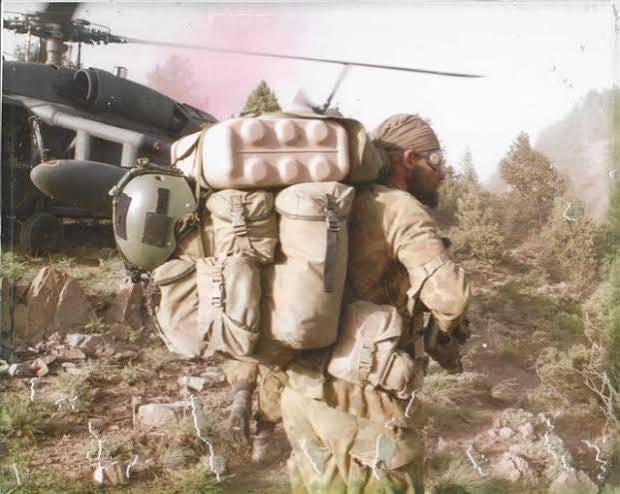
The Marine’s Hymn is an ode to the fighting man, whose exploits in the air, on land, and sea are carried out at great sacrifice to keep his honor clean. The Marine is the “first to fight.” The streets of heaven are purportedly guarded by United States Marines.
The myth of the Marine creates a mindset in every Marine of bold men doing brave exploits for a higher cause. The mythos is a “law” unto itself, compelling Marines toward a specific perspective and congruent behavior. To do anything less is to dishonor not only yourself, but the Corps as an institution and every surly Marine who has ever served.
Marines are encouraged to study the traits of true leaders who embody the ethos, to meditate on the Law of the Marine.
The Law of God (universal) is the cause-and-effect relationship that governs our elegant universe and the nature of human relationship to all created things.
Reduced to ten commandments, the Law of Moses is the signifying law that the Old Testament warrior Joshua insists a man “meditate on day and night” so that he “acts in accordance” and becomes prosperous and successful. Joshua encourages a man so oriented not to be dismayed or afraid, but strong and courageous.
To “meditate day and night” sounds like the lifestyle of an uber-monk, but how our minds function reveals otherwise. Joshua was no monk. He led the Israelites into Canaan as their military commander, sacked cities, ousted some 31 kings, and took Jericho.
So what does a savage warrior like Joshua gain from meditation?
Fearlessness.
We become what we habitually think about. The tape running continuously in our minds is not conscious thought, but a subconscious flow of images and ideas generated from my worldview—what I really believe.
As I do my day, I may expect to encounter a limitless number of idiots and assholes, or I may expect to depend on the kindness of strangers. In either case, I am certain to be correct.
My experience of the world provides evidence for a preconceived notion about the nature of things: what I truly believe about people, my relationship to my fellow man, the world’s systems, and God. From a more self-centric angle, my experience is rooted in whether I believe I have the existential juice to do something worthwhile.
I experience what I expect.
These are the conversations we have with ourselves, all day, every day.
Our conscious thought, when unfettered from the task at hand, chooses a single idea to hook and fixate on, reeling it into the mind. Once we masticate and release it, we choose another. These ideas are replayed and reevaluated: a play cast with new characters committing the same crimes, uplifting moments of connection to a benevolent humanity, or the sudden seizure of a bright knowing that you’re going to pull it off.
To “meditate day and night” on the ineffable truth of universal law is to change, through practice, the reservoir from which our ideas and images surface. Mythos becomes ethos becomes pathos. It’s like choosing a song to get stuck in your head, one that plays without conscious thought.
But to understand how my experience of the world is governed by this system, I must recognize that I have more than one mind.
Our bodies have a mind of their own that interacts with the brain. Habits live in our bodies. The “body-mind” has a memory, preferences, capacity, and traumas that live in our muscles and connective tissues. These present as automated reactions, movement patterns, and chronic knots.
Our gut is called the “second brain” because 70% of neurological signaling originates in our guts. The gut is the source of mood, mental clarity or fog, edginess or relaxation, the experience of “good” and “bad.” What I feed it creates the world in which I live.
Our reptilian and mammalian brains operate beneath the neocortex. The reptilian brain drives instinct, impulse, and survival. Our mammalian brain has implicit memory; it “reads” people and deals not in language but in behavior and emotion—the “gut feeling” that is so often true about people, regardless of what they say. These are our “body-minds.”1
These patterns run deep.
These are the “laws” we live by.
The body-mind is retrained slowly, requiring the patience of a strength athlete. The brain-mind thinks. The body-mind believes because it knows. I do not experience the world through what I think, but through what I believe.
Integration of the two minds requires conscious effort and aligned action. Like a musician learning guitar, the conscious mind must focus what it learns through the fingers. Once the body has memorized it, conscious attention is no longer needed. This is embodied knowledge: brain-hand integration, habituated movement, a program that runs autonomously when triggered.
Our lives run on such programs: lighting a cigarette after a meal, driving a car, and reacting to a challenge at work or an inconvenience in the day. Ninety percent of my behavior is automated.
The path to a richer life begins in imagination, the spirit of the rational mind. From it, I may envision a different version of life: sweeter, fuller, infused with possibility and novelty, or with the assurance that the city I intend to sack will indeed fall. I may envision reconciliation with an old severance or escape from a lifestyle that’s killing me.
But the path to a truer life is found through the body, learning to attend to signals that originate in the gut and muscles. This is a deeper method of “reading,” discerning the prose, fiction, and occasional poetry that people write with their faces and bodies.
This is finding rhythm in the churn.
The power of the conscious mind is limited; the force of will burns out quickly. But I can harness it to direct and orient my body. First, I examine what I believe, as evidenced by how my body behaves. Second, I imagine an alternative universe based on a new belief. I shift my focus toward that belief and recruit my body through repeated action.
At first, the actions are conscious and cumbersome, like learning a new chord on guitar or pausing to read the checkout guy as a human being. Over time, my body memorizes them, and I move through the world in a new way, with a newfound freedom.
Intentional focus on the highest truth—what often emerges from my lowest brain—turns down the volume on noise. Like a lifter who focuses on the heavy staples of strength rather than the gym bro who avoids them for auxiliary pumps. The gym bro may appear strong but lacks the raw function of strength in real life. When the heavy things must be carried, the work is not done well, or at all, or ends in injury.
Most actors don’t do their own stunts.
Contemplation on the “law” is the embodiment of truth. It trains a man to move well under load.
A man whose body knows how to move under load is unafraid.
Life is a game of minutes. The totality of life’s churn is felt not in its lyrics, but in its funky-ass baseline. Our bodies move to beats, not lyrics.
Hips betray; eyes don’t lie; 200# always weighs 200#.
Rhythm is something I first attend to consciously, but then feel. The beat that “goes on” is an automated cadence. I’ve heard it said that how you spend your days is how you spend your life. Disrupting an unsatisfactory rhythm requires upsetting the status quo.
Rearrange the furniture. Jettison the flotsam. Exchange one thing for another.
It’s direct, simple, pure. It is the opposite of the culture in which we live.
The cacophony of today’s culture screams from every screen, post, and conversation: conform, worship, optimize, or die. Be a provider, protector, predator, soft, strong, vulnerable, stoic. Shut up and perform.
I’m weighed, measured, and found wanting before I even open my mouth. Too fat, too soft, too toxic, too privileged, too broken, too masculine. Lose the weight, get ripped, climb the ladder, stack the wins, eat the right shit, watch the right feeds, pick a side, have the correct opinion, all while they tell me the marrow of my manhood is intimidating to the unwashed masses and I should apologize for existing.
Work until your body breaks, smile while you do it, and expect nothing back. Not respect. Not desire. Not even a genuine thank you. Just grind, provide, repeat, then die quietly so no one is inconvenienced by your absence.
F*ck that noise.
Hemingway once said his goal was to write one true sentence every day.
Seek what’s true. Gaze at it. Put your hands to it. Blood in muscles, butterflies in your stomach, bone deep.
Write one true sentence every day.
Six-Minute X-Ray, Chase Hughes, Evergreen Press, 2020, (Pp. 9-10)
Comments
Nothing yet. Say the first thing.
Sign in to join the conversation.