
If you’d like to support Bullfish Hole, you can become a subscriber with the button below.
I recently read Chuck Dixon’s 2026 Guns of Mars, a pulp sci-fi throwback set on the Mars of Edgar Rice Burroughs’s Barsoom stories: A slowly dying planet inhabited by a civilization of red men, tribes of green four-armed warriors, and various multilegged monsters.
Dixon’s story takes place 1,000 years after Burroughs’s stories, when civilization has long since collapsed and Mars is even harsher. It’s a post-apocalyptic Western that borrows a lot from Leone’s The Good, The Bad, and the Ugly. We have three cynical, self-interested characters searching for treasure, making and breaking alliances of convenience.
I’m a fan of Dixon but think this is one of his more middling works. Most chapters have the same structure: Meet threat, remorselessly kill threat, and either make or break a deal. It’s numbing after a while.
Dixon has written Conan, the Punisher, and a series of novels about his vigilante character Levon Cade. So cold-blooded killers are his forte. But those characters are more likeable, or at least more interesting. The Punisher is fighting a war. Conan has a brutish sense of honor and a capacity for mirth. Cade has a moral code, loves his daughter, and speaks of Jesus with a simple hillbilly theology I find endearing.
The characters in Guns are pure situational self-interest. It’s The Good, The Bad, and The Ugly without the pathos of Tuco or charisma of Blondie. Everyone is Angel Eyes, and life is too cheap to matter. I couldn’t care much whether any of them got the treasure.
It was my first Barsoom novel; I knew of Burroughs’s books only through cultural osmosis and Disney’s utterly forgettable 2012 John Carter film. So, after finishing Guns of Mars, I decided to compare it to the original Barsoom novel, A Princess of Mars.
Princess was stranger than I expected. While it has a plot with romance and plenty of action beats, large swaths of the narrative are the earthman John Carter describing the culture and institutions of his Martian hosts. It reads more like classic anthropology than a lot of modern anthropology does, including a chapter titled “Child-Rearing on Mars.” If any of you are nerds for world-building, here lies a rich vein of the stuff, imaginative and detailed.
But there are also some surprising emotional notes. The chapter “Sola Tells Me Her Story” is heart-breaking and reminds one of a passage from A Song of Ice and Fire. The green Martians Sola and Tars Tarkas have more depth than one might expect from a savage foreign race in a pulp adventure tale.
While I generally prefer Dixon’s spare prose to Burroughs’s wordiness, the latter makes more sense when you recall that the protagonist is a 19th century Virginia gentleman, a Confederate veteran starting over in Arizona Territory. One virtue of the audiobook version I’ve been listening to is that narrator Macleod Andrews does a passable Virginia accent and sells the rhythm of the old-fashioned language.
The book is out of copyright, so you can also get the full text for free at Project Gutenberg.
For a more extensive review, see “Revisiting Barsoom” by Peter C. Meilaender at From My Bookshelf.
Turning back to Chuck Dixon, here’s a Youtube video where he explains why the Disney adaptation of A Princess of Mars was such a disaster. One obvious problem is that they didn’t even put Mars in the title—who under 60 had heard of John Carter?
But now, apparently, there’s an animated series in the works.
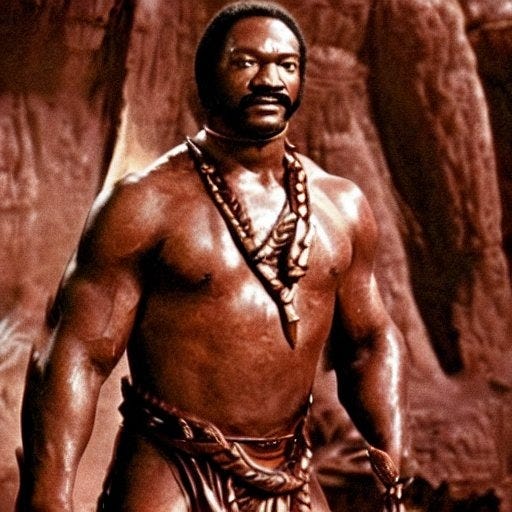
In my preferred alternate history, we would have had a 2006 adaptation starring Nathan Fillion and Morena Baccarin from Firefly—and also a low-budget 70s adaptation with Jim Brown and Pam Grier.

On Mars in real life: A major problem for colonization is that it lacks a magnetic field to protect from solar radiation and keep its atmosphere from blowing off. Thus we have Bamford and colleagues on “How to Create an Artificial Magnetosphere for Mars.”
On the possibilities for colonization, see also Peter Hague at Planetocracy on “Why Mars?”
I just learned of the existence of the Himalayan Jumping Spider. It lives throughout the Himalaya mountains, including the slopes of Everest, at elevations of up to 20,000 feet—making it perhaps the highest dwelling creature on earth. It feeds on a kind of fly that in turn eats little organic bits the wind sweeps up the mountain in a high-altitude version of marine snow.
While we’re on weird critters: my son is of late enamored with the vampire squid, a bizarre deep-sea cephalopod:
It’s covered with glow-in-the-dark spots, and it can hoist its cape-like webbed arms over its head to transform into a pumpkin shape complete with outward-pointing fleshy spines…if it gets really annoyed, the Vampire Squid can release a sticky cloud of luminous mucus that glows for nearly 10 minutes, presumably long enough for the Vampire Squid to make a get-away into the inky darkness.
Also in sea animal news: Scientists recently found an enormous icefish breeding ground below the Antarctic Ice that’s sixty miles across and contains tens of millions of nests (h/t Hbdchick).
This video explains that the elusive colossal squid was only elusive because human submersibles kept using blindingly bright flood lights; turn off the lights and the squids show up.
In the latest weird macabre orca behavior, they’ve been observed playing a game wherein one orca holds a dead sunfish while another rams into it so fast that it explodes. H/t @biotay on X, who provides a video clip here.
Pigs don’t seem so weird by comparison, but they are strangely adaptable. According to Mr. Pitbull Stories on X, feral pigs have learned to survive the cold winters of the Canadian prairie by “cutting down cattails with their teeth, piling them into mounts, tunneling underneath, and letting the snow bury the structure into an insulated den that steams in the cold. Researchers at the University of Saskatchewan call these shelters pigloos.”
Related: A study on the “Population Structure and Reproductive Ecology” of Canadian feral pigs found their fertility similar to those in warmer regions, but first-year mortality for offspring was higher. I suppose that means greater selection pressure—but selection for what?
One perennial social media debate starts when someone laments the young aren’t as rich as their parents or grandparents. Then someone counters that older generations had similar median incomes and far lower standards of living when they were that age. What they considered luxuries, more recent generations consider necessities.
People really are blind to the fantastic increase in wealth across recent history. But there’s a counterargument from Johann Kurtz, who argues that younger cohorts clearly suffer from a lack of social capital, and that this has financial consequences:
My argument is that previous generations received an enormous stock of social capital: trusted neighbors, functional public schools, a productive courtship culture, predictable career arcs, and a public square in which children could roam and adults could be relied upon. That stock, once given for free, has now been substantially liquidated.
Instead, the young must now buy back, item by item and at retail prices, what their grandparents received as a bounty of prior civilizational investments. The young must do so out of incomes that rose modestly while the prices of the essential elements of life rose radically. Price indexes measure the individual cost of discrete goods, but they are not intended to convey the total cost of personally repurchasing a destroyed commons.
For example, parents in current year are more likely to pay a lot for childcare, which a generation prior was more often provided by a large network of kin, neighbors, and friends, if not by a full-time stay-at-home mom.
And the Great Sort increasingly means that smart and conscientious people are crowding into the same locations, and if you want your kids to have good peers or at least a neighborhood that’s not “loud and crime-y,” you have to pay more for it. It’s less a matter of young folks having a strong preference for bigger homes than of “expensive square footage” being purchased as “a hedge against public dysfunction.”
The loss of social capital is definitely a real trend, as real as the great increase in material wealth. I’m not sure how much the former claws back the latter, as Kurtz claims, versus being just a separate dimension along which we can experience gain and loss. I’m also not sure how much perception of economic woes is actually due to declining social capital, versus just the hedonic treadmill of rising expectations.
On material wealth, see also the claim that groceries, relative to average wages, are more affordable than ever. H/t Astral Star Codex
Exactly how much did material living standards rise in the 20th century? This new paper by Verónica Bäcker-Peral and Benjamin Wittenbrink uses an innovative method of measurement: Tracking product descriptions in the Sears catalog in an attempt to build a price index that adjusts for quality of goods. From the tweet summary:
Using 5.1 million Sears catalog listings, we build a quality-adjusted price index for consumer goods, 1900–1990. Two headline findings: growth was much larger than official statistics imply, and its peak came before WWII, not after.
What does quality change look like? For $5.98, Sears sold a gingham dress in 1922; a silk-and-wool dress with embroidered sleeves in 1925; and an all-silk dress with a more ornate cut in 1928. The sticker price never moved. The product transformed.
h/t Tanner Greer.
The early twentieth century was a period of fantastical change and economic growth. In America, millions who grew up using outhouses by the light of oil lamps lived to see plumbing and electrification, as well as the proliferation of automobiles. They gained forms of wealth they never even imagined as children. Which brings me to my next topic:
Arnold Kling has been posting a series of written history lectures on “America: 1898 to 1914” and its follow-up, “America:1914-1930.”
The former period, especially, gets little attention in popular consciousness. But it was a time of profound transformation. America on the cusp of the 20th century seems foreign even by the standards of the 1950s. For one, it was a far more local world. Thus Kling considers the circumstances and outlooks of several hypothetical characters: A white farmer in Kansas, a black sharecropper in Mississippi, a Boston Brahmin, an Italian immigrant in a New York slum.
My favorite entry deals with the diffusion of new technology, using the narrative device of our Kansas farmer visiting the 1904 World’s Fair in St. Louis. Here he sees the technologies that will remake his world—electrics lights, electric stoves, telephones, automobiles, a wireless telegraph—as well as a presentation on the germ theory of disease. But these innovations won’t become part of the daily life of most Americans for a decade to come:
The history of technology is not, in the main, the history of invention. It is the history of diffusion — the long, uneven, socially stratified process by which things that exist in laboratories and exhibitions and wealthy households gradually reach everyone else. The gap between the moment a technology becomes possible and the moment it becomes ordinary is almost always longer, and far more interesting, than the invention itself. And that gap is not distributed equally. It follows lines of wealth, geography, race, and infrastructure in patterns that are largely predictable and occasionally harsh.
Bottlenecks include infrastructure (someone has to build those power plants and power lines), high initial prices, “the gap between a technology being scientifically understood and that understanding being translated into practice,” and “the gap between a technology being available and people knowing what to do with it.”
The latter is particularly interesting. When the phonograph was new, it wasn’t clear that recording and selling music for personal consumption was where the action was at. The technology for the music and film industries sat around a while before anyone figured those industries out.
There’s probably something analogous going on with AI in our own time. Which brings me to the other interesting thing about Kling’s series: It was coauthored with Claude AI. Kling shares his process in “Working with Claude on History Lectures.” I refer to Kling as author, but his role seems closer to editor: Prompting Claude, providing feedback and occasional pushback (the model has a “capitalism evil” bias), and doing some rewriting of bits that are too verbose or stylistically “AI.”
I’m surprised at how good the results are. And a little disconcerted. What are my loom skills in the age of the spinning jenny?
Deivon Drago writes about competing interpretations of quantum mechanics and why he thinks a modified version of Zurek’s quantum decoherence is the best answer. I don’t know enough physics to judge. But I’ve long been frustrated with those who seem too glib about concepts like wave function collapse or “before time began.” My read of the Bohr-Einstein debates is that Einstein didn’t think theory should just be high-precision divination, and I’m sympathetic to the notion theory ought to render the universe understandable.
How does one become successful at creative work? Age of Infovores reviews some ideas from “Don’t Trust Your Gut.” He mentions a few examples of creators who only grudgingly released a work that turned out to be a huge hit. It’s good to keep in mind that for every clueless vanity project, there’s someone hiding his best stuff from sight because his internal critic is too harsh.
In the past month, the United State Post Office has lost two of my packages, so I’m unusually primed for the question of why organizations grow ever more dysfunctional. For an answer, see Ben Landau-Taylor on “Parasite Load.”
Think academic hiring is biased against women? Steve Stewart-Williams reports on evidence to the contrary, including fake job application studies that show a fairly strong bias against men.
Ruxandra Teslo says AI won’t be the magic some people think, because “Intelligence is not the main bottleneck” for solving many real-world problems. Congratulations, now you can do drug discovery three times as fast, but testing and approval still requires expensive clinical trials and dealing with sluggish government bureaucracy. She also notes:
Walking around the world today one might notice that it is weirdly unchanged. LLMs can spawn agents and write complex applications, yet something as mundane as customer service still hasn’t been automated well.
Compare to Claude & Kling’s essay on the slow diffusion of new technology.
Ted Goia talks about Netflix’s cratering stock price, the result of cratering subscriber numbers. He sees this as the collapse of “Audience Capture” as a business model.
The idea is that the audience got captured years ago with cheap subscription prices, and now the platform can squeeze them mercilessly—offering less and charging more. Netflix has been pursuing this agenda for several years now.
Ah, but Netflix isn’t the only company building its future on audience capture.
When I consulted at BCG we called it a milking strategy, where you raised prices and reduced capital investment in a business—which was now your cash cow. You squeeze all the money you can from it, for as long as you can.
But back then we realized that milking only worked in the short term. Eventually you killed the cow.
And now for something completely different: Kudos to the BBC for this massive and free collection of sound effects. The many categories include 716 clock sounds, 617 footsteps, and 2,963 machines.
This past week there’s been some awful flooding in West Virginia, particularly in Upshur and Lewis Counties. Homes, businesses, and hospitals inundated, cars swept away, and two confirmed dead. You can donate to a relief fund via United Way.
Thanks for reading!
Substacks cited above: Arnold Kling ; Ruxandra Teslo ; Peter Hague ; Peter C. Meilaender ; Deivon Drago ; Age of Infovores ; Steve Stewart-Williams ; Ben Landau-Taylor ; Ted Gioia
Comments
Nothing yet. Say the first thing.
Sign in to join the conversation.