
Russia has authorized the Central Bank, Sberbank, and other financial institutions to shoot down incoming drones. Bypassing traditional state security, bank tellers and accountants will now receive weapons and combat training paid for directly by their employers, according to lawmaker Anatoly Aksakov. [1] Is the state of Russian air defense really this desperate, or is a different motive at play?
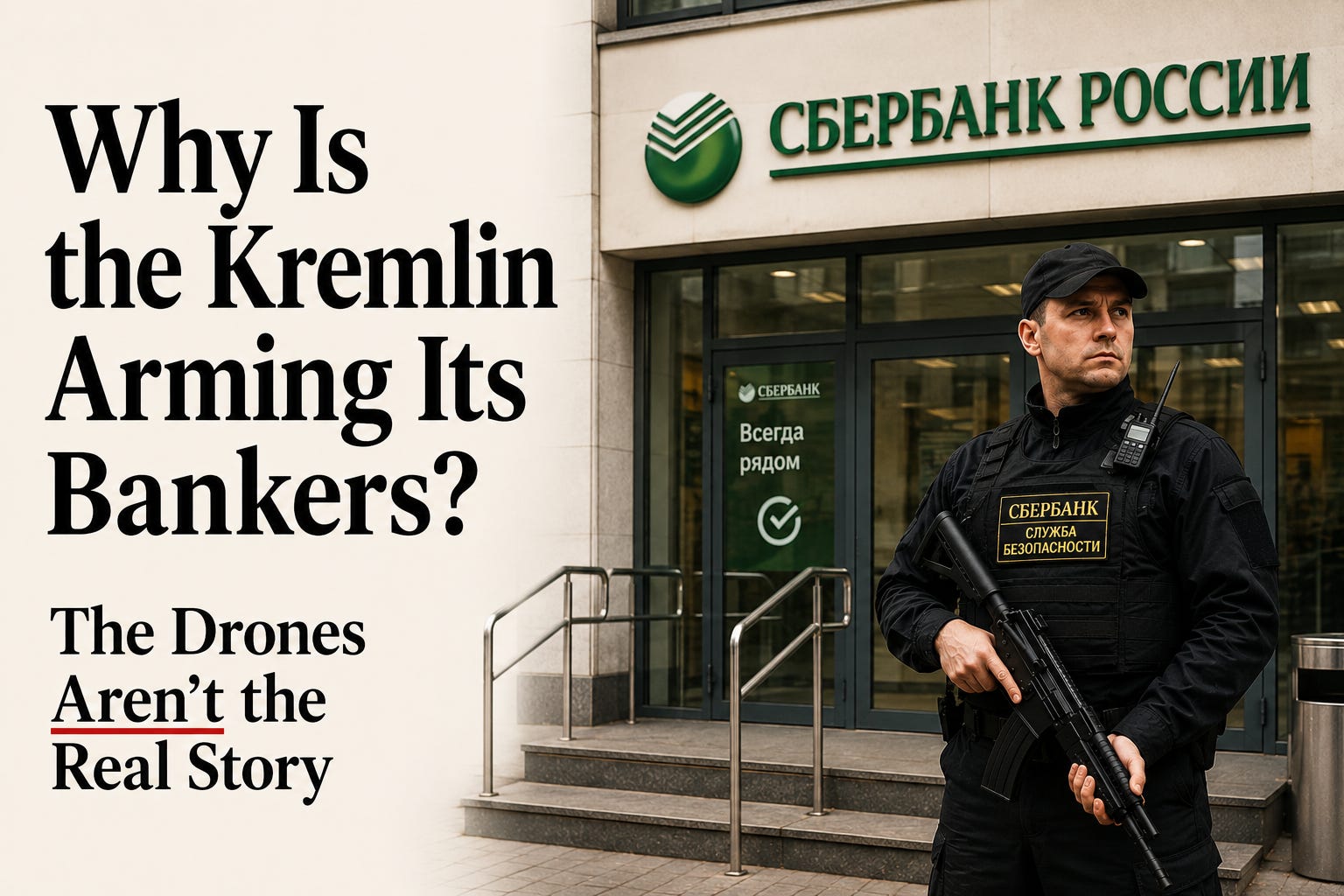
An armed man walks into a bank… The teller says to him quietly, “You’re late to work today.”
Consider this contrast as context: During a July 7 drone attack in the Volgograd region, a hunter named Mikhail fired at a drone with his own legally owned rifle. Police confiscated the weapon, fined him, and a court later rejected his appeal - despite his pleas that he was trying to protect the motherland. [2] If a citizen defending his village is prosecuted and made an example out of, why would arming bankers now be encouraged?
Ukrainian drones have scorched Russian refineries and factories for years, but only financial institutions are now authorized to shoot back. Ukraine targets commercial supply chains, like Wildberries, but not commercial banks. Why leave retailers exposed while arming bank personnel? In all cases, drones are not the biggest problem that Russia’s banks face today - but the retailers they’ve already hit are.
VTB, Russia’s second-largest bank controlling a fifth of the market, is already restructuring loans for Wildberries sellers whose inventory burned in Ukrainian strikes. [5] But the bank’s core exposure runs far deeper: Wildberries itself is VTB’s largest corporate borrower, owing the state lender $7.3 billion.
Check out the live broadcast above and subscribe so you never miss a stream! You will be happy you did!
The attacks on Wildberries are not about attacking “Russia’s Amazon”: they are a strategic assault on Russia’s banking sector. And that assault is landing at the worst possible moment.
Money is leaving the banking system for physical cash at an extraordinary rate. Cash in circulation hit a record high at the end of July, and Sberbank executives called the shift a worrying trend.[3] By August 13, Russian banks had hit their largest structural liquidity deficit since March 2022. [4]
This is amidst a climate where, according to Ukrainian intelligence reports, there are worsening balance sheets, caused by rising bad loans, across Russia, including at Sberbank. [6] The drones hit the warehouses, and then the damage reaches the banks as the liquidity crisis in Russia spreads.
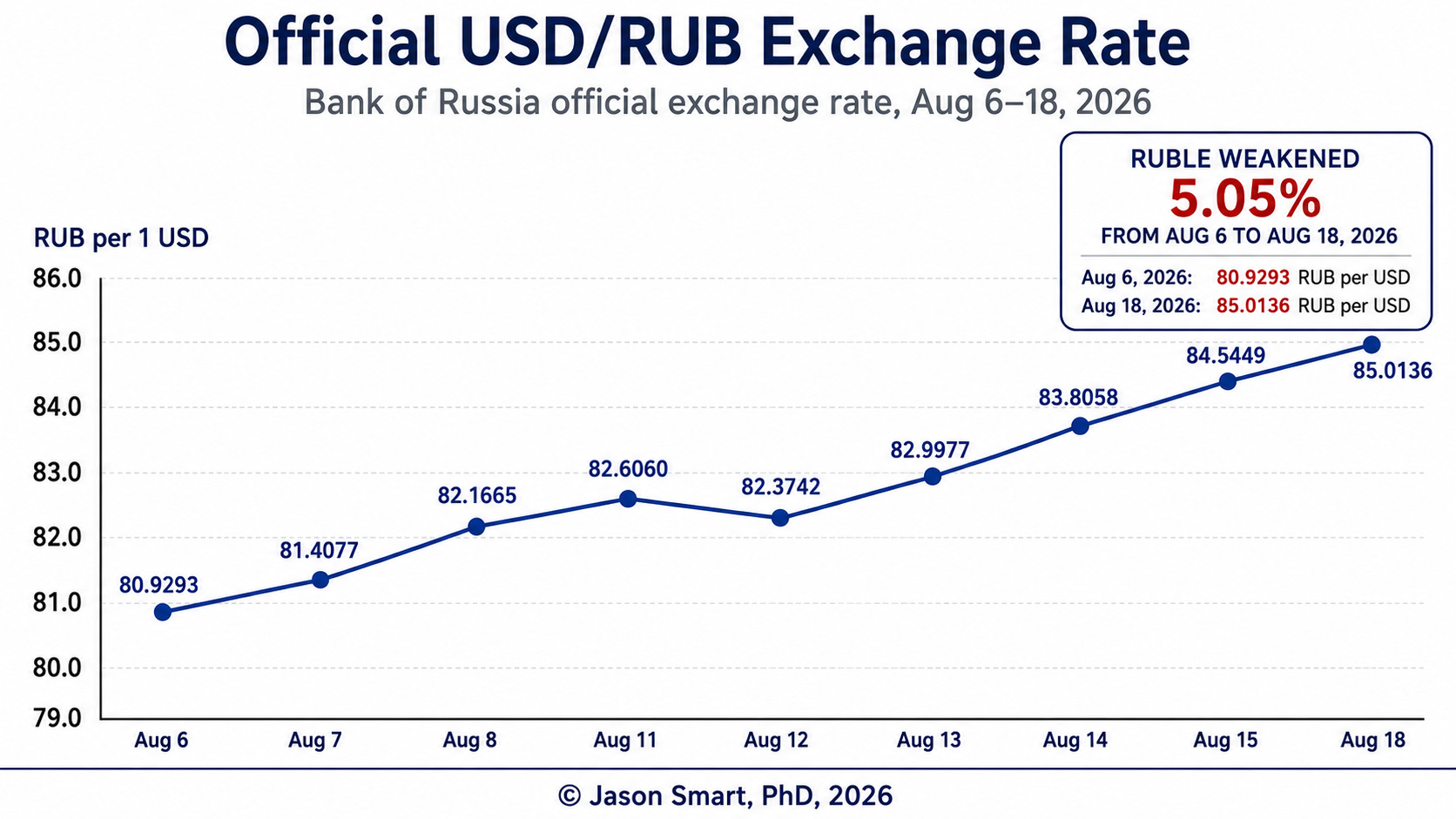
The ruble's 5% drop underscores the deep financial vulnerabilities threatening Russia's domestic stability. (Chart: Jason Jay Smart)
As the banks are having money problems, Russia is tightening its grip on every channel that moves money outside the regulated system. On August 7, the Federal Security Service (FSB), in what it called an anti-fraud operation, shut nine unregistered crypto exchanges in Moscow City, detaining more than 20 employees and blocking dozens more from being able to reach their exchange offices where they traded rubles for crypto. [7]
But was it really about fraud? And was it really a coincidence that it went down amidst a larger surge in people selling off rubles?
Sberbank’s chief financial officer, Taras Skvortsov, says cash is leaving the system so quickly that July became the worst month in 6 years outside the usual December surge. He expects about $44.8 billion (3.8 trillion rubles) to move into physical cash during 2026 and warned that some banks may need greater Central Bank support if the outflow continues. [8] That support is already being tested.
The strain on the financial system is reaching a breaking point. By August 13, commercial banks owed the Central Bank $31.8 billion (2.7 trillion rubles) more than they deposited, expanding the sector’s liquidity deficit to over four times its level at the start of the year. [4][6]
In light of these problems, Russia already has mechanisms for slowing some cash withdrawals. Under anti-fraud rules introduced in 2025, banks can cap suspicious ATM withdrawals for 48 hours, although larger withdrawals remain available inside branches.[9] Those rules were created to combat fraud, and there is no evidence that armed bank employees are intended to stop depositors.
With all of these serious economic problems on the balance sheets: Why the sudden urgency to have the bankers go mano-a-mano with the drones?
There is no urgency about fighting drones.
Rather, there is an urgency in Moscow to have banks fund their own armed guards to secure physical money reserves against domestic volatility in Russia.
Moscow can hand out rifles, deploy jammers, and fortify bank branches, but state force cannot command trust. Once depositors decide cash in hand is safer than money in an account, every new restriction only speeds up the stampede. Should panic take hold, the drone above the roof will be the least of the Kremlin’s worries. The far greater threat is the angry mob outside the banks’ locked doors.
RBC, “Путин наделил ЦБ и «Сбер» правом самостоятельно сбивать дроны,” June 10, 2026.
https://www.rbc.ru/politics/10/06/2026/6a297c0c9a79476d2329a020
Fontanka, “Охотника из Волгоградской области оштрафовали за стрельбу. Он пытался сбить беспилотник,” August 17, 2026.
RBC, “Спрос на наличные в июле подскочил в полтора раза,” August 3, 2026.
https://www.rbc.ru/finances/03/08/2026/6a706e8a9a7947935e349002
RBC, “Структурный дефицит ликвидности достиг максимума с марта 2022 года,” August 14, 2026.
https://www.rbc.ru/finances/14/08/2026/6a7dc2b49a7947b3d49250c4
Gazeta.ru, “Продавцы с WB попросили в крупном банке помощь с кредитами на 200 млн рублей,” August 10, 2026.
https://www.gazeta.ru/business/news/2026/08/10/29078095.shtml
Ukrinform, “Кредитна криза дісталася найбільших банків Росії — розвідка,” August 7, 2026.
RBC, “В «Москва-Сити» задержали более 20 сотрудников криптообменников,” August 7, 2026.
https://www.rbc.ru/politics/07/08/2026/6a7580c79a7947d534a3f6fa
Interfax, “Сбербанк ждет рост наличных в обращении в 2026г на 3,8 трлн руб.,” July 29, 2026.
Bank of Russia, “Банк России определил признаки мошеннических операций при снятии наличных в банкоматах,” August 21, 2025.
No posts
Comments
Nothing yet. Say the first thing.
Sign in to join the conversation.