
If capturing a single net square kilometer costsyou 2,700 soldiers, your country is not winning a war. Your country is being liquidated.
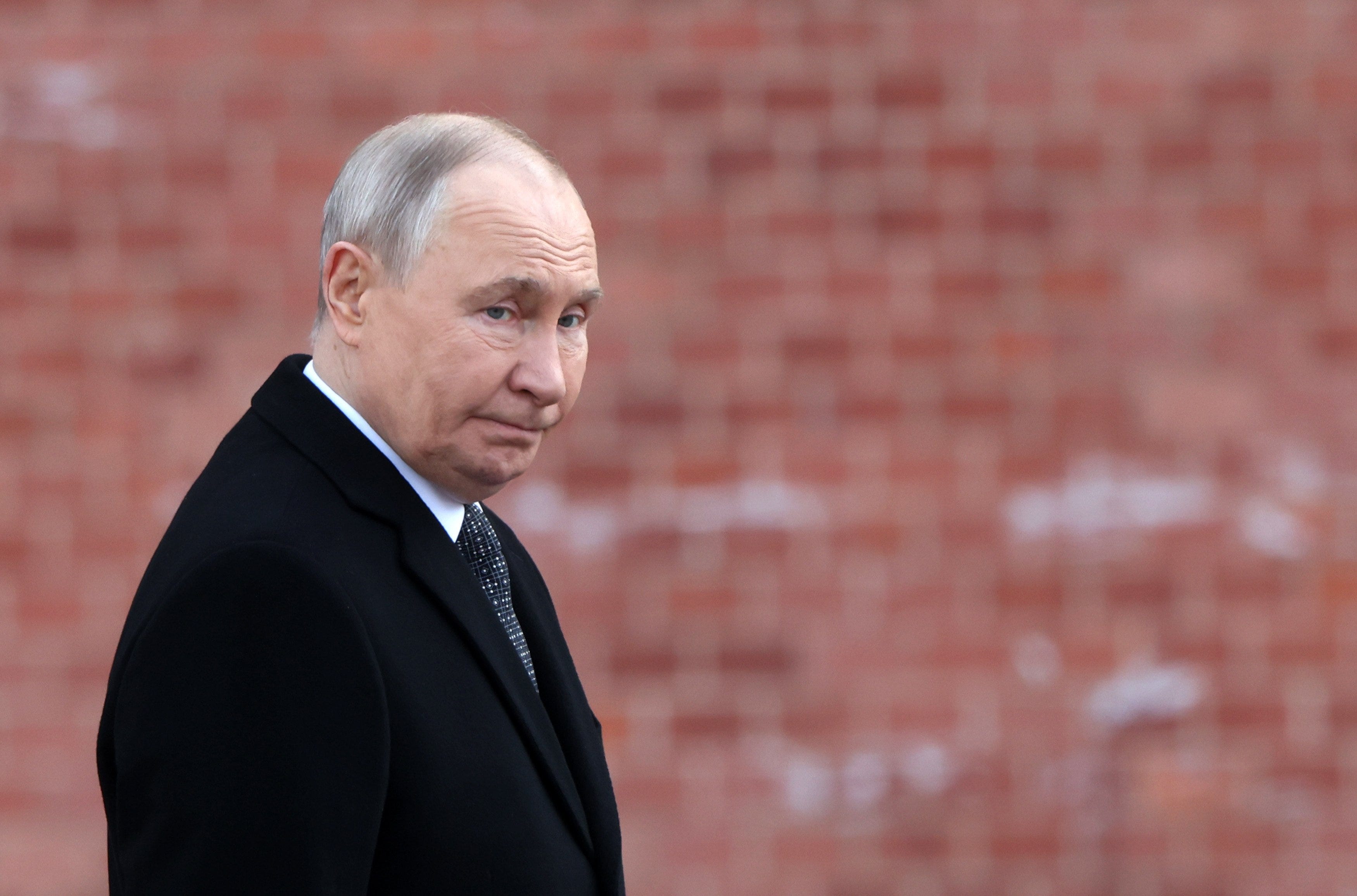
Putin visits the tomb of the unknown soldier in Moscow ahead of fourth anniversary of Russia’s war in Ukraine (Photo by Getty Images)
Behind Moscow's noise about slow battlefield progress lies a fatal, unavoidable arithmetic. The Kremlin is burning through its finite human, material, and financial capital to purchase tiny strips of dirt it cannot keep. Ukraine is not simply defending lines on a map. It is systematically dismantling Russia's structural capacity to function as a modern state.
Russian ground operations are an exercise in extreme, self-destructive inefficiency: Out of 627 km² (242 sq mi) where Moscow's forces recently advanced or infiltrated, net territorial control expanded by a mere 81 km² (31 sq mi).
- Only 13% of Russian frontline movement translates into actual territorial expansion.
- Moscow suffers roughly 2,700 casualties for every single net km² gained (7,100 per net sq mi).
- The Kremlin's yearly losses of roughly 416,000 casualties rival the bloodletting of the 5-month Battle of the Somme, paid just to secure less than 0.8 percent of Ukrainian land.
To put these numbers in perspective, taking the rest of the Donbas at today's pace would require 14.6 million casualties and 37 years of continuous fighting. Conquering all of Ukraine would demand over 1.3 billion casualties across 3,300 years, a human cost nine times Russia's current population.
Meanwhile, Ukrainian counterattacks routinely erase months of Russian gains in days. A single Ukrainian counter-operation near Oleksandrivka liberated 745 km² (288 sq mi), recovering 9.2 times Russia's total net gains across the entire front line in a single stroke.
While Moscow forcibly recruits around 221,000 soldiers to plug frontline holes, it cannot rebuild the heavy force required to keep them alive. Vehicle and fuel tanker losses are running 3.8 times higher than mid-2025 levels. Raw recruits are stepping directly into an armored graveyard without transport, radar, or air defense.
Simultaneously, Ukraine is severing the support network long before replacements reach the front line.
- Deep precision strikes against Russian energy infrastructure are landing at 11 times the 2025 pace.
- A major oil refinery takes up to 6 months to repair with sanctioned parts, while a Ukrainian drone destroys it in 6 seconds.
The financial and political foundations of the invasion are buckling under the weight of compounding losses.
- By midyear, Russia had blown past its planned full-year budget deficit by 50 percent, driven by a 23 percent drop in oil and gas revenues alongside skyrocketing war spending.
- A single strike on Wildberries destroyed $5.7 billion USD in goods, representing an economic collateral loss of $70 million USD per net km² gained ($182 million USD per net sq mi).
- Russian Black Sea Fleet operating freedom dropped from 90 percent down to 25 percent. Moving ships to Novorossiysk provided no sanctuary, as Ukrainian strikes hit naval infrastructure, oil terminals handling 40 percent of Russian grain, and shadow-fleet tankers.
The political fallout has reached the Kremlin's inner circle. Ukrainian strikes recently disabled S-400 air defense launchers just 19 km (12 mi) from Putin's Gelendzhik palace. To travel inside his own country, the Russian president now relies on decoy motorcades, secret routes, and armored trains. Putin, ever paranoid, now has plenty to worry about.
Moscow is spending exponentially more resources to achieve exponentially smaller results. It replaces infantry faster than armor, burns treasury reserves faster than tax collection, and loses high-value strategic assets faster than industry can rebuild them.
This war is no longer about conquering Ukraine. It has become a self-inflicted engine of state dismantlement.
No posts
Comments
Nothing yet. Say the first thing.
Sign in to join the conversation.