
This week on AI Inside, we had a LOT to cover. Anthropic went from being the “responsible AI” company to being at the center of a geopolitical power struggle in about two weeks. Meta launched its own brand of smart glasses at $299. Google lost two of its most important AI researchers in the same week. And my new favorite website turns live baseball games into 8-bit pixel art. Let’s get into it.
But first, a huge thank you to our newest patron, Clay Archer, for supporting the show! If you want to join Clay and the rest of our amazing community, head to patreon.com/aiinsideshow for ad-free episodes, The NEW AI Inside Daily podcast, a Discord community, and more.
Trump sat down with Axios for “The Axios Show” this week and confirmed that about a week ago, he had reached the point of viewing Anthropic as a national security threat. “Well, not now, but a week ago, maybe.” He said it’s fine now because he met Dario Amodei at the G7 and found him “nice” and “smart.” Trump also confirmed it was “a competitor and a part owner” who flagged Anthropic to the White House. He didn’t name Amazon, but as we discussed last week, it most certainly was.
Gizmodo ran a piece asking why Amazon’s CEO would tattle to Trump. Here’s what apparently happened: Andy Jassy was already on a call with White House officials about something unrelated, and brought up a jailbreak vulnerability his security team had found in Anthropic’s new Fable 5 model. The White House told him to flag it to Treasury Secretary Scott Bessent, which he did same day. That led to the order to pull the models later that Friday. Anthropic says the technique Amazon flagged could only identify “a small number of previously known, minor vulnerabilities” that other frontier models could also find. Apparently, inside Amazon, employees have been joking that the company “snitched” on Anthropic.
Meanwhile, Senator Mark Warner, vice chair of the Senate Intelligence Committee, revealed that NSA Director General Joshua Rudd briefed lawmakers on an authorized red-team exercise involving Anthropic’s Mythos model. Rudd said: “This tool broke into almost all of our classified systems, not in weeks, but in hours.” The Economist editor who published that quote cautioned that it shouldn’t be read literally, because the results depended on Mythos working alongside other tools in a particular setup. Warner was actually praising Anthropic when he cited the test, using it to argue for faster pre-release testing. But once “broke into almost all of our classified systems” was out there, the political reality shifted. Red-team exercises are designed to find vulnerabilities, that’s the whole point.
Anthropic is updating its privacy policy to allow identity and age verification for Claude users “in certain circumstances.” Some users could be asked to upload a government-issued passport or driver’s license, plus a selfie that generates a facial geometry template considered biometric data. This only applies to consumer plans (Free, Pro, Max), not Business.
Anthropic spokesperson Thariq Shihipar says this is for a “small subset of users” flagged for potentially fraudulent activity, meant as an appeals process rather than just banning people.
The identity verification provider is Persona, backed by Founders Fund, Peter Thiel’s investment firm. Thiel also invests in Anthropic. Discord previously chose Persona for age verification and delayed the rollout after backlash over the Thiel connection. Here’s something to consider: even if the ID verification is just for fraud prevention, it also creates the technical framework you’d need to comply with nationality-based access restrictions. If the government says “only U.S. citizens can use these models,” you need a way to verify citizenship. And now Anthropic has one.
Meta launched its own brand of smart glasses. No Ray-Ban or Oakley branding. Three frame styles: the Adventurer (clean rectangular), the Fury (boxier, bolder), and the Glasses by Kylie, a slim oval frame designed with Kylie Jenner. The Adventurer and Fury are $299. The Kylie model is $399 and includes an option to use Kylie Jenner’s voice as the on-board Meta AI assistant. Hardware specs match the Ray-Ban Meta Gen 2 glasses, which start at $359, so you’re basically getting the same tech for $60 less by dropping the Ray-Ban name.
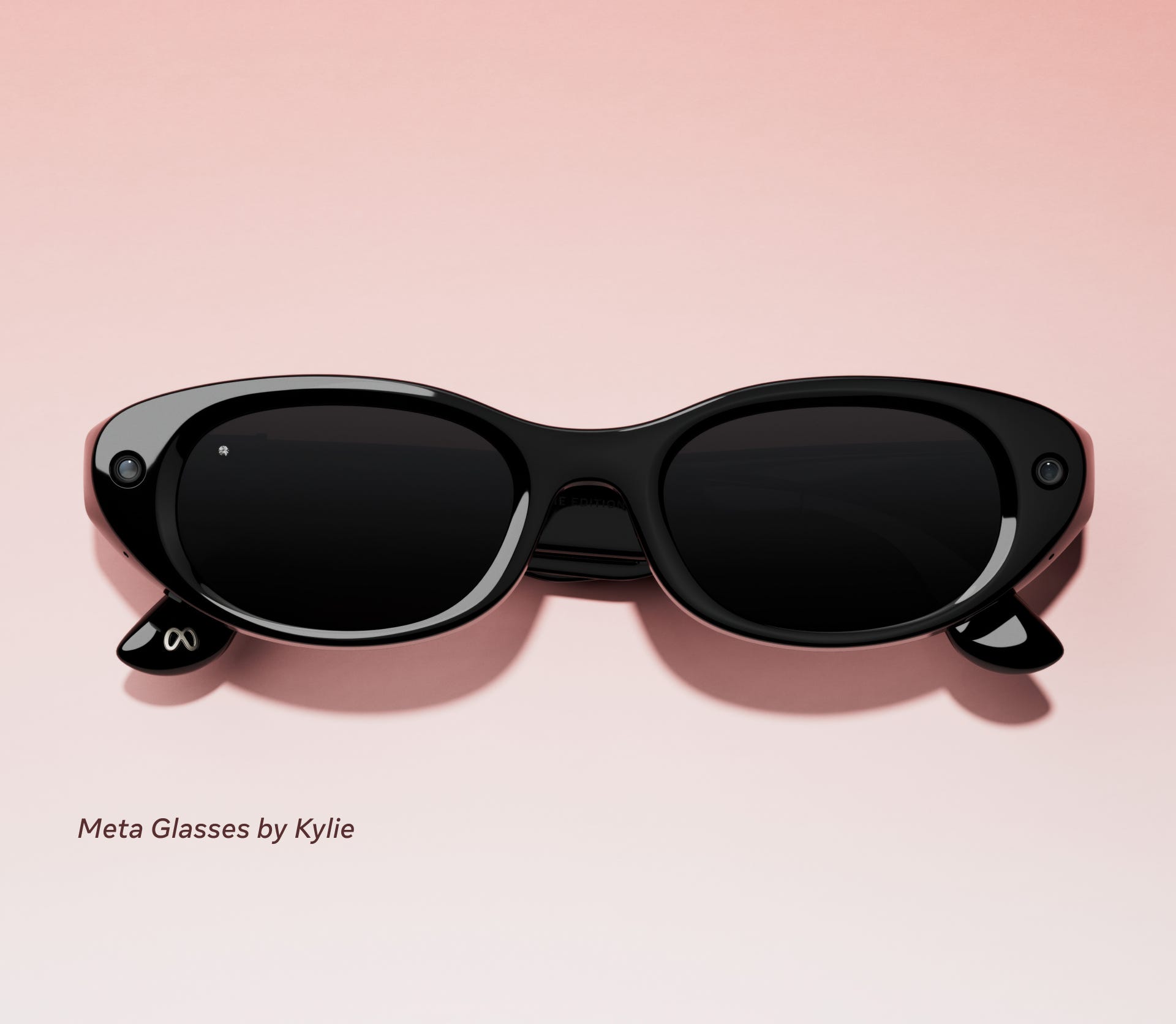
They ship with Meta AI powered by Muse Spark from Meta Superintelligence Labs from day one. Counterpoint Research estimates Meta and EssilorLuxottica hold over 80% of the smart glasses market, and Meta sold more than 7 million Ray-Ban smart glasses in 2025. Snap just unveiled consumer Specs at $2,195. Apple’s smart glasses, codenamed N50, are expected to be announced this fall, per Bloomberg’s Mark Gurman, with potential shipping in 2027.
So Meta is trying to flood the market and lock in as many users as possible before Apple shows up. The big question I have is about consumer appetite. Increasingly, these wearables are becoming a target for the AI backlash. Easy to spot, and many feel they are invasive. Are smartglasses becoming billboards for AI overreach? The symbolism feels similar to pushback around data centers. It really is becoming Glasshole 2.0.
Wired reported that Meta accidentally exposed employee data from its employee-tracking program, the Model Capability Initiative. Meta launched MCI back in April. The program collects keystrokes, mouse movements, click locations, and screen content from US-based employees’ work laptops, with the stated purpose of training AI models to replicate how humans interact with computers. CTO Andrew Bosworth had told employees that tracking was mandatory. Over 1,600 employees signed an internal petition demanding the program be canceled, specifically noting that executives got their own opt-out while rank-and-file employees could not.
Bosworth eventually acknowledged the deployment “fell short of the company’s own privacy review standards” and offered limited concessions: you could pause data collection for up to 30 minutes at a time. Private data was leaking to all Meta staff, exposed across 45,000 hive tables, including full prompts and transcriptions, private conversations, and people and performance data. It was treated as a high-severity event. Meta paused the program and is “investigating.” Bosworth has separately admitted company morale is “near the worst it’s ever been.”
John Jumper, who shared the 2024 Nobel Prize in Chemistry for developing AlphaFold, announced he’s leaving Google DeepMind after nearly 9 years to join Anthropic. AlphaFold is the AI system that predicts 3D protein structures from amino acid sequences, a concrete example of AI doing something genuinely useful for science. Jumper credited Demis Hassabis for taking a chance on him, letting him lead the AlphaFold team just six months after finishing his PhD. At Anthropic, he’s expected to lead a new AI-native platform for scientific discovery.
Earlier in the week, Noam Shazeer, VP of Engineering and co-lead of the Gemini models, announced he was leaving Google for OpenAI. Shazeer co-authored the 2017 “Attention Is All You Need” paper that introduced the Transformer architecture. Google paid $2.7 billion in August 2024 to bring Shazeer and his team back from Character.AI. Less than two years later, he’s gone again. Sam Altman on X: “noam is one of the people I have most wanted to work with since the very beginning of openai. only took 10 years.”
DeepMind CEO Demis Hassabis told Semafor that Google still has the deepest AI research bench and no problems hiring top recruits. So, you know, don’t worry about it.
Google is investing about $75 million in indie film studio A24 through a research partnership with Google DeepMind. It’s Google’s first-ever stake in a film studio. A24’s tech division, A24 Labs, will use DeepMind’s research and infrastructure to develop AI-powered storyboard tools. A24 partner Scott Belsky said the new tools “won’t look anything like the prompted generation type of AI that people feel uncomfortable with.” The deal does NOT give Google access to A24’s content library. But the fan reaction was unsurprisingly intense. Fans see this as a betrayal of A24’s creator-first branding, and this isn’t the first time A24 has caught flack for AI. They got blowback for AI-generated promotional posters for the 2024 film “Civil War.” Kane Parsons, the Petaluman director who directed “The Backrooms” (A24’s biggest box office hit), recently said in an interview, “If I could snap my fingers and make generative AI disappear forever, I probably would.” He called generative AI “genuinely harmful” and “cultural rot.”
Separately, Google DeepMind’s Marcia Mayer, a former Pixar producer, produced a 6-minute animated short called “Dear Upstairs Neighbors” screening at the 2026 Tribeca Film Festival. The film was made using custom builds of Google’s Veo and Imagen models, fine-tuned with concept art, using video-to-video workflows with human animators in the loop. It’s being framed as proof that AI filmmaking can be “artist-driven” and human-led.
Amazon just dropped a nearly completed film about OpenAI. The movie is called “Artificial,” directed by Luca Guadagnino. It’s the Social Network-style drama about the 2023 period when Sam Altman was fired and rehired from OpenAI. Andrew Garfield plays Altman, Yura Borisov plays Ilya Sutskever, Monica Barbaro plays Mira Murati, and Ike Barinholtz plays Elon Musk. Why did Amazon drop it? Amazon invested $50 billion in OpenAI back in February as part of a multi-year strategic partnership for OpenAI to use AWS. The screenplay portrays Altman as “sociopathic.” So you’ve got a $50 billion business partner who might not love seeing their CEO depicted that way. Amazon’s statement: “We believe that Artificial will be better served if it were released by a different studio.” It’s now being shopped around and studios are passing. Netflix, Focus Features, A24, Lionsgate, Warner Bros, Sony, Paramount, Disney... all out.
Midjourney, the AI image generator, announced it’s building a full-body ultrasonic scanner. They’re calling it Midjourney Medical. The scanner uses a ring of 500,000 tiny transducer squares, each about the size of a grain of sand, that emit ultrasonic waves and record reflections to produce a 3D body map. Similar to an MRI but with no radiation, just sound waves and water. 20 minutes per scan right now, and they’ve scanned about 12 people. The target is 60 seconds per scan. 17 gigabytes per SECOND, terabytes per scan, processed by a cluster of thousands of computers. They licensed Butterfly Network’s ultrasound-on-chip technology last November for $15 million with exclusive rights. The project is led by Ahmad Abbas, who previously worked on Apple Vision Pro.
And they’re building “Midjourney Spas” with hot tubs, saunas, cold plunges, and scanner rooms. The first one opens in San Francisco in 2027. From the site: “We think it’s completely possible that with enough early imaging in the future, the world could avoid 30% of all deaths and 50% of all healthcare costs.” But, you know, they’ve scanned 12 people so far. The whole thing is entirely community-funded from image generation subscriptions.
OK, I love this one. Ribbie is a free vibe-coded fan project that converts real-time MLB game data into 8-bit, arcade-style pixel-art broadcasts. Creator Eric Brownrout used Claude Code and Codex over “a few weekends” to create the free site despite never having built a video game before. It pulls from MLB’s public StatsAPI and renders pitch-by-pitch play-by-play with pixel-art representations of every stadium and player. He recently added fantasy baseball roster tracking and is now recording his own “Ball! Strike! Out!” audio for sound effects.

On the legal side, he cites a 2007 court ruling, CBC v. MLBAM, that baseball stats are facts and therefore not copyrightable. Just a guy who loves baseball and had access to AI coding tools and made a thing for fun.
Google is apparently working on a Pixel feature called “Audio Memory” that would ambiently track what you hear throughout the day. Found in an APK teardown of Android System Intelligence for the Pixel 10, it would expand the existing Now Playing song-ID feature into a broader ambient listening tool that could also transcribe and generate notes from conversations. Google says it would run on-device via Private Compute Core, and that “background conversations and audio are never sent to Google.” But “ambient conversation tracking” will definitely make some people very uncomfortable.
Anthropic launched Claude Tag in research preview for Enterprise and Team customers. It’s an always-on AI presence that lives in Slack channels, builds persistent context and memory as it follows conversations, and can be tagged to assign tasks. There’s an “ambient mode” that proactively jumps into conversations to flag items and follow up on forgotten threads. Each Claude identity is scoped to specific channels by admins, so your legal Claude can’t wander into the engineering channel. The legacy Claude Slack app automatically switches to Claude Tag on August 3.
Trump signed two executive orders to boost quantum computing. The first launches a national effort to build a quantum computer capable of important scientific calculations within five years. The second sets a goal of migrating government computing to post-quantum cryptography by 2030-2031 to defend against quantum-powered cyberattacks.
And NotebookLM got a big upgrade. It now runs on Gemini 3.5 with a secure cloud computer for running code. It can generate PDFs, spreadsheets, slide decks, and data visualizations. And you can now start research projects with loose ideas rather than needing pre-gathered sources, because NotebookLM will use Google Search to find and suggest relevant sources for you. Google says the upgraded system achieved a 65% average win rate over the prior version, with a 78.2% win rate in web research and source discovery. That shifts it from “bring your own sources” into more direct competition with Perplexity.
A huge thank you to our Executive Producers: DrDew, Jeffrey Marraccini, Radio Asheville 103.7, Dante St James, Bono De Rick, Jason Neiffer, Jason Brady, Anthony Downs, Mark Starcher, and Karsten Samaschke!
And big thanks to Victor Bognot and Daniel Kroft for video support behind the scenes.
Thank you for watching and reading! Find all episodes, show notes, and subscribe links at aiinside.show. See you next week!
Comments
Nothing yet. Say the first thing.
Sign in to join the conversation.