
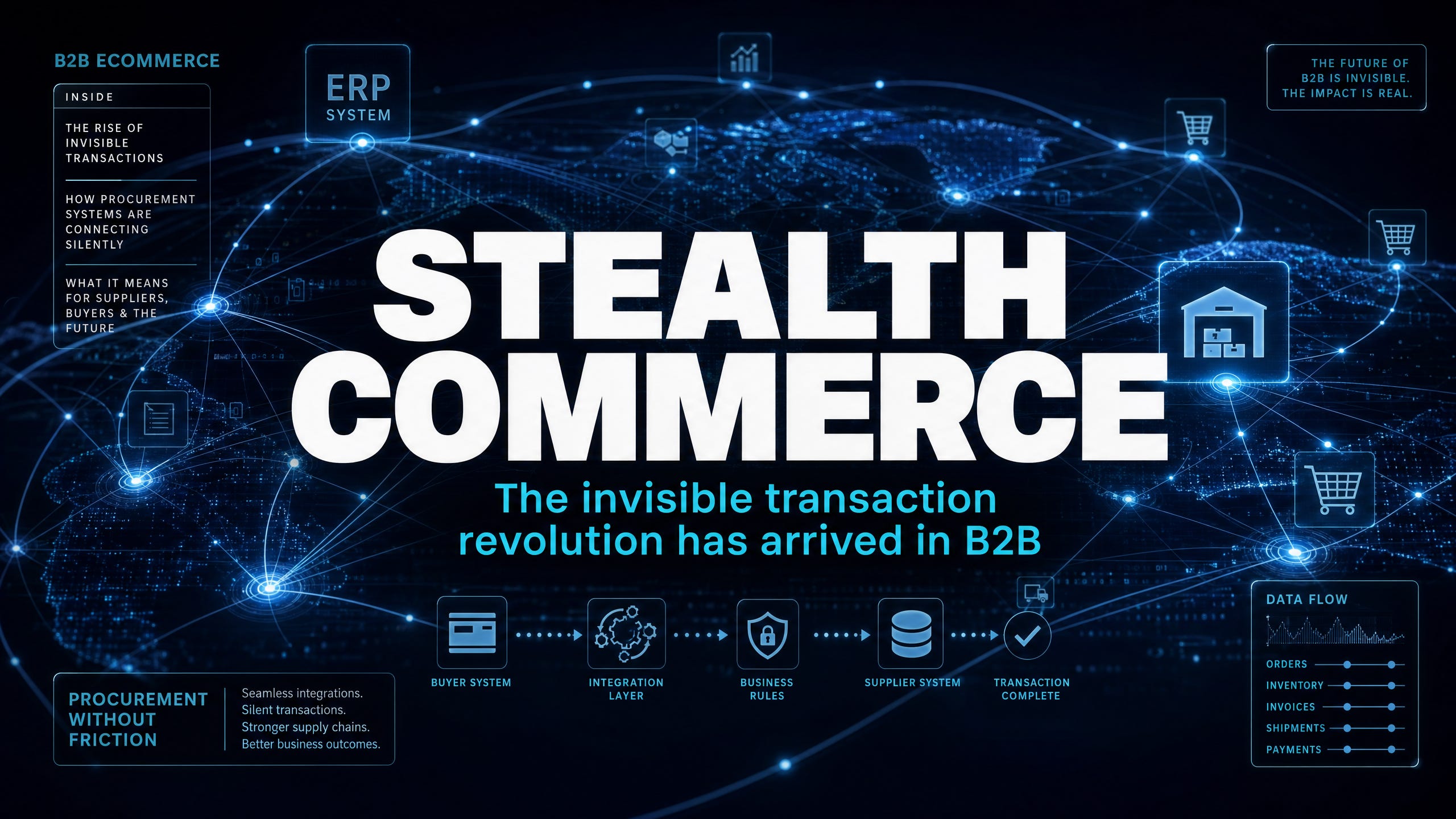
In February 2019, I published an article introducing a concept I called Stealth Commerce.
At the time, I defined it as a scenario where “the customer no longer recognizes a transaction as a transaction.”
It was an exploration of a future digital commerce experience so seamless and tightly woven into the fabric of a buyer’s daily life that it becomes almost invisible [1].
I argued in 2019 that the ultimate goal of digital commerce was not to build a better website but instead to make the website unnecessary.
Seven years later, we are watching this exact phenomenon play out in the B2B distribution landscape far more rapidly than it has in retail.
For proof of this, look no further than the Q2 2026 earnings reports from two of the largest industrial distributors in North America:
Global Industrial
W.W. Grainger
Their data reveals a significant shift in B2B buying behavior.
From this data, it’s clear that B2B buyers increasingly want invisible and seamless purchasing workflows.
Welcome to the era of Stealth Commerce in B2B.
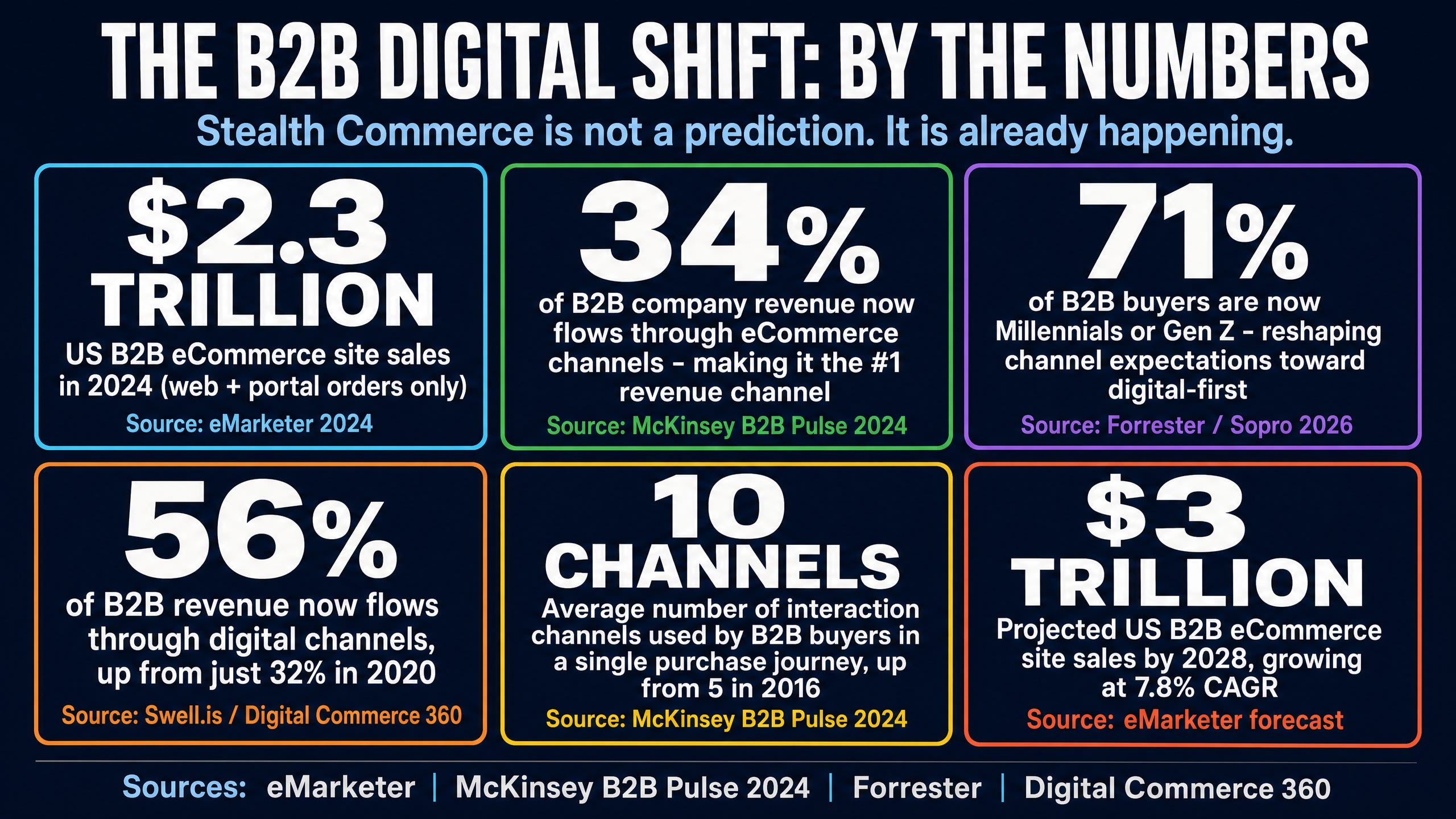
For decades B2B distributors have obsessed over the visible mechanics of eCommerce.
We worked hard to:
Optimize site search
Tweak checkout flows
Develop deep personalization engines
In many cases, we tried to build “Amazon-like” experiences for procurement managers.
But somehow we often still missed the key difference between a consumer and a corporate buyer:
A consumer shops for fun, utility or inspiration.
A corporate buyer shops because they have a problem to solve or a purchase they MUST make.
Every minute they spend browsing a distributor’s website is a minute of friction!
Global Industrial’s Q2 2026 strategy shift is a masterclass in Stealth Commerce execution.
CEO Anesa Chaibi recently told analysts that the company’s primary objective is:
“becoming an extension of their team and making it easier for them to transact with us through the channels and systems they use every day” [2].
Notice she did not say “making it easier for them to use our website.”
She said the systems they use EVERY day.
This is the core of the Stealth Commerce concept:
The transaction moves out of the seller’s environment and embeds itself directly into the buyer’s environment.
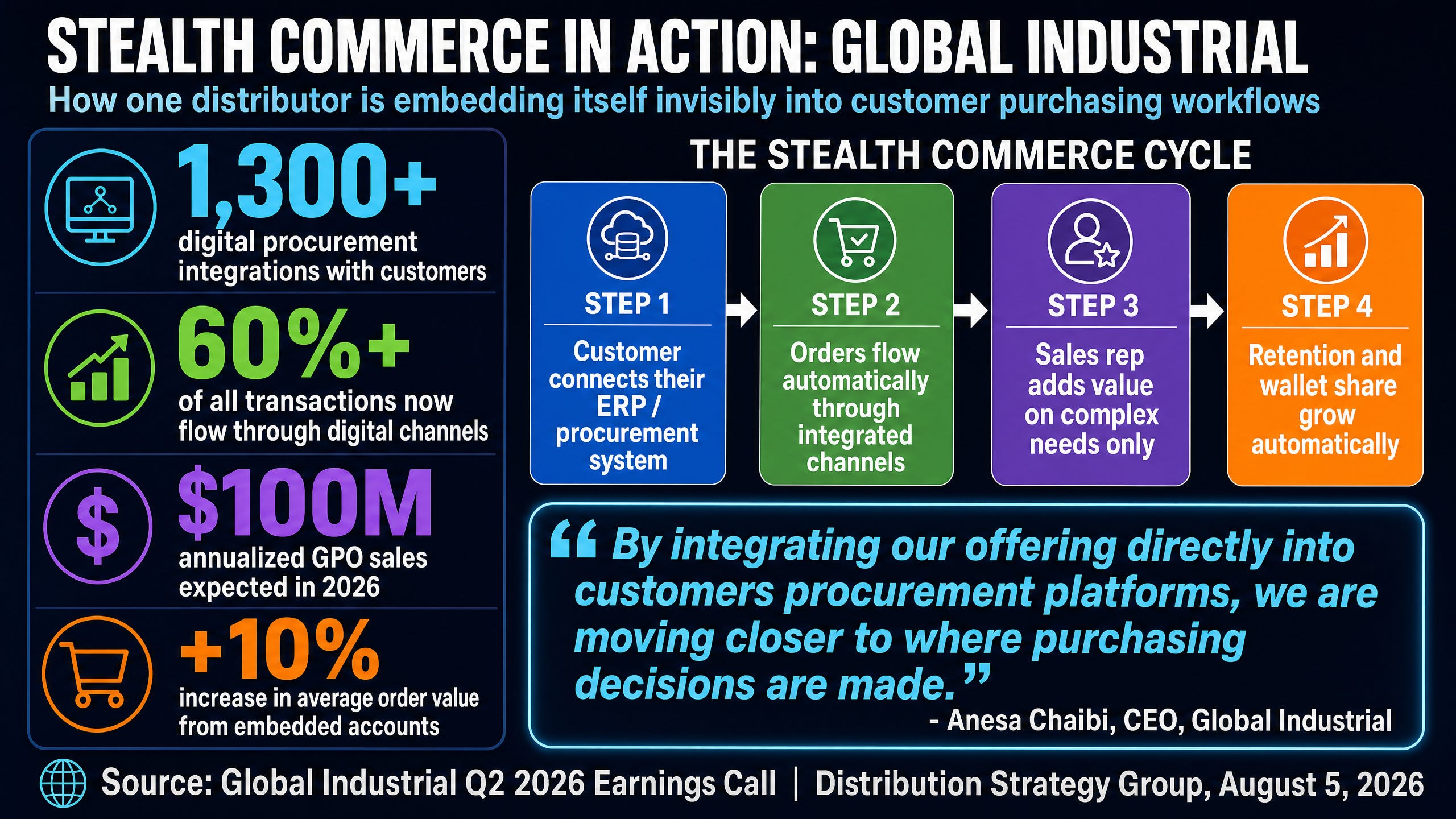
Global Industrial backed this up with hard data & results:
In the first half of 2026 alone, they added over 50 new purchasing connections, bringing their total digital procurement integrations to more than 1,300 customers [2].
As a direct result, more than 60% of the company’s transactions now flow through digital channels [2].
Yes - 60%
Let that sink in.
When a distributor achieves this level of integration via PunchOut catalogs, EDI and/or direct API connections, the transaction effectively turns into a background process.
The buyer stays in their own ERP or eProcurement system (like Jaggaer, Coupa or Ariba).
They approve a requisition and the order flows directly to the distributor automatically.
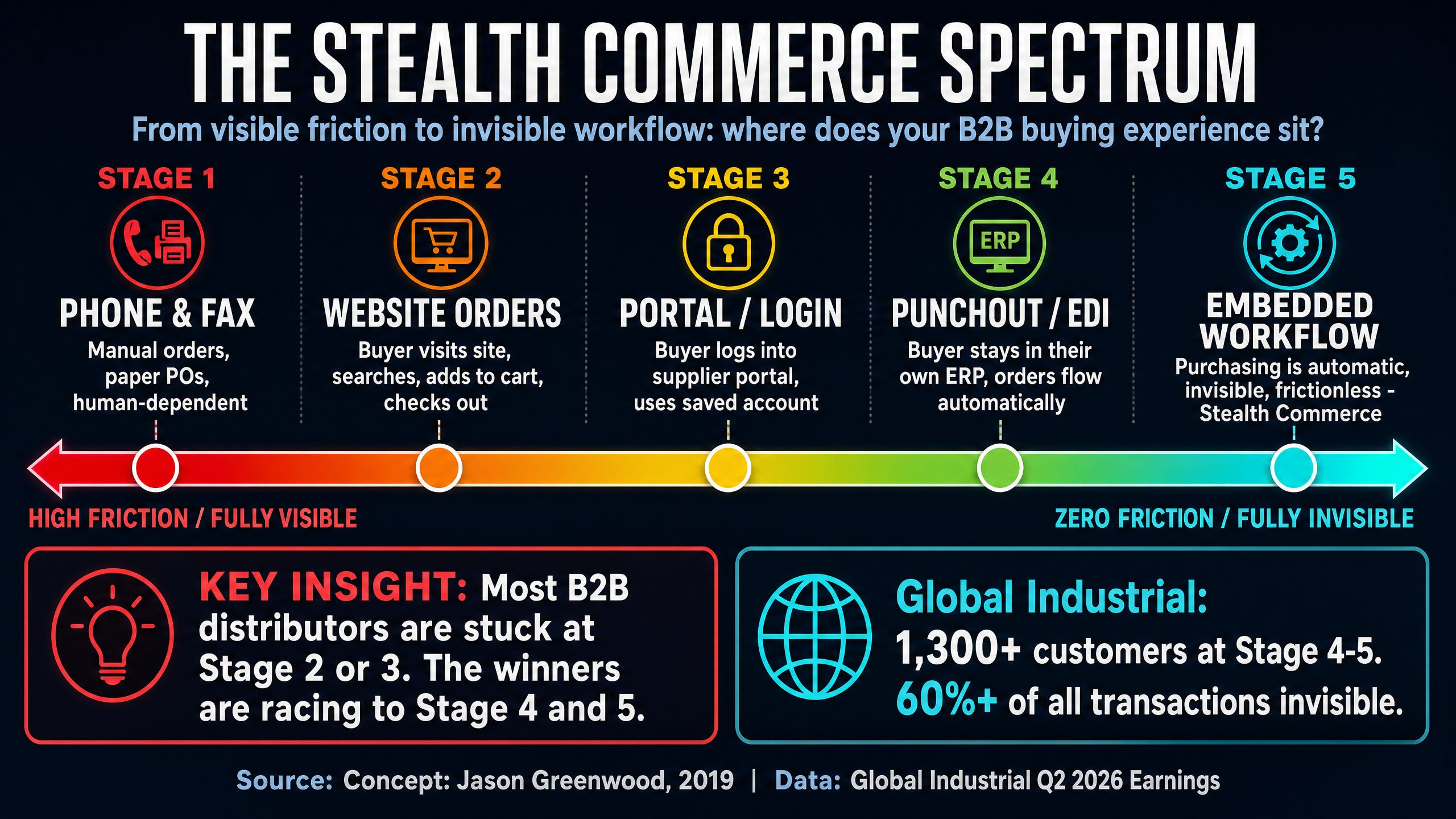
Not all B2B transactions are created equal.
We can plot the current state of B2B purchasing on a spectrum, ranging from highly visible friction to completely invisible workflow.
Stage 1: Phone and Fax
The dark ages. Manual orders, paper POs, and total human dependence. High friction, high error rate.
Stage 2: Website Based Orders
The traditional eCommerce model. The buyer must leave their system, visit your site, search for products, add them to a cart, and check out. It is digital, but it is highly visible and disruptive to their workflow. And it often does not offer the level of personalization (pricing, entitlements etc) that modern B2B buyers expect.
Stage 3: Dedicated Buyer Portal Login
A slight improvement. The buyer logs into a dedicated supplier portal with saved account details and contracted pricing. Better, but still requires the buyer to operate in the seller’s environment.
Stage 4: PunchOut & EDI
The beginning of Stealth Commerce. The buyer accesses the supplier’s catalog from within their own procurement system. The data flows automatically, but human initiation is still required.
This can also take the form of agentic buying via the buyer’s internal LLM of choice, connected to (eg) a supplier Portal MCP server or via automated interaction with the supplier via Email, WhatsApp, Slack, Teams etc.
Stage 5: Embedded Workflow
True Stealth Commerce.
Purchasing is automatic, invisible, and frictionless. Inventory sensors, predictive AI, or recurring Group Purchasing Organization (GPO) contracts trigger replenishment without human intervention.
Most B2B distributors today are stuck in a painful and slow transition from Stage 1 to Stage 2.
The winners are moving quickly toward Stages 4 and 5.
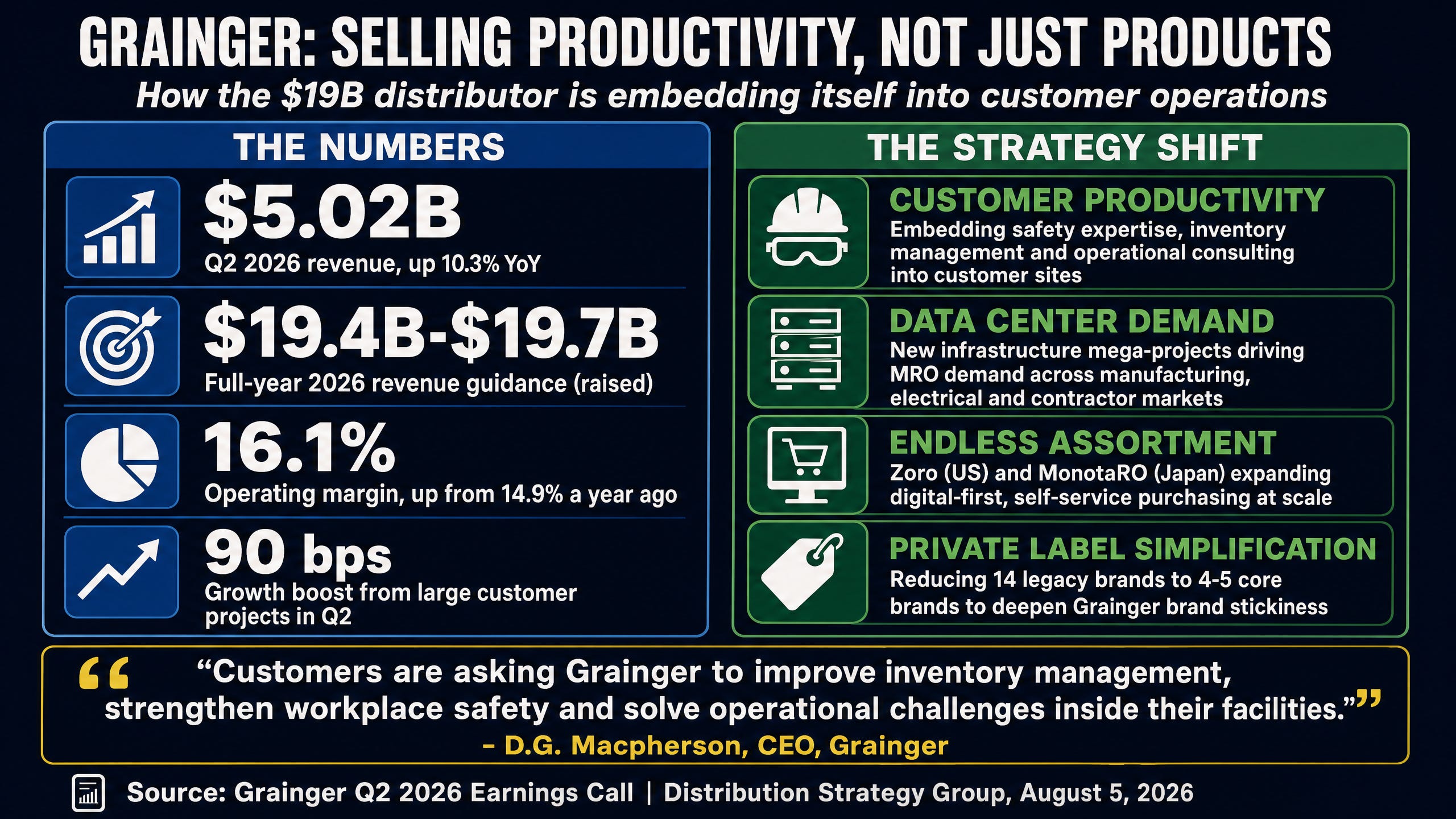
Grainger’s Q2 2026 earnings report reinforces this trend from a different angle.
While Global Industrial is focused on software integration, Grainger is embedding itself physically and operationally into customer facilities!
Grainger reported Q2 sales of $5.02 billion (up 10.3% year-over-year) and raised their full-year guidance to nearly $20 billion [3].
But the most interesting part of their report was how they are driving that growth.
CEO D.G. Macpherson noted that customers are increasingly asking Grainger to improve inventory management, strengthen workplace safety, and solve operational challenges inside their manufacturing facilities [3].
This is the physical version of Stealth Commerce.
By taking over the management of a customer’s tool crib or safety supply closet, Grainger removes the purchasing decision entirely.
The customer does not “buy” safety glasses, they simply walk to the crib and take them. Grainger monitors the inventory and replenishes it silently in the background.
In this scenario, the distributor is selling productivity and uptime.
This kind of integrated buyer/supplier engagement model is often known in B2B as VMI or Vendor Managed Inventory.
I also like to think of this model as selling solutions vs just selling SKU’s.
There is a massive strategic advantage to achieving Stealth Commerce: it creates an almost unassailable competitive moat.
In a traditional eCommerce environment (Stage 2), a competitor is always just one Google or LLM search away.
If a buyer is manually searching your site for a widget, they can just as easily search a competitor’s site.
But when you are embedded into their eProcurement system (Stage 4) or managing their physical inventory (Stage 5), the switching costs become HUGE = you have an instant supplier moat.
You move from being just a vendor to being part of their operational infrastructure.
This is why Global Industrial is aggressively pursuing Group Purchasing Organization (GPO) contracts, expecting annualized GPO sales to reach $100 million this year [2].
GPO contracts provide a business native, pre-approved pathway into a customer’s eProcurement system. Once integrated, the purchasing activity becomes recurring and sticky as it fully automates replenishment - essentially the equivalent of Subscription buying in the retail eCommerce world.
And the data proves this works very well…
Global Industrial reported that average order values from these embedded accounts increased by roughly 10% in Q2, driven by larger, more comprehensive orders rather than simple price increases [2].
When you remove the friction of buying, customers buy more, it’s that simple.
If you are a B2B distributor or manufacturer, the window to act is closing.
Most B2B buyers don’t actually want a retail eCommerce experience at all, instead they want to make purchases in the most efficient way possible.
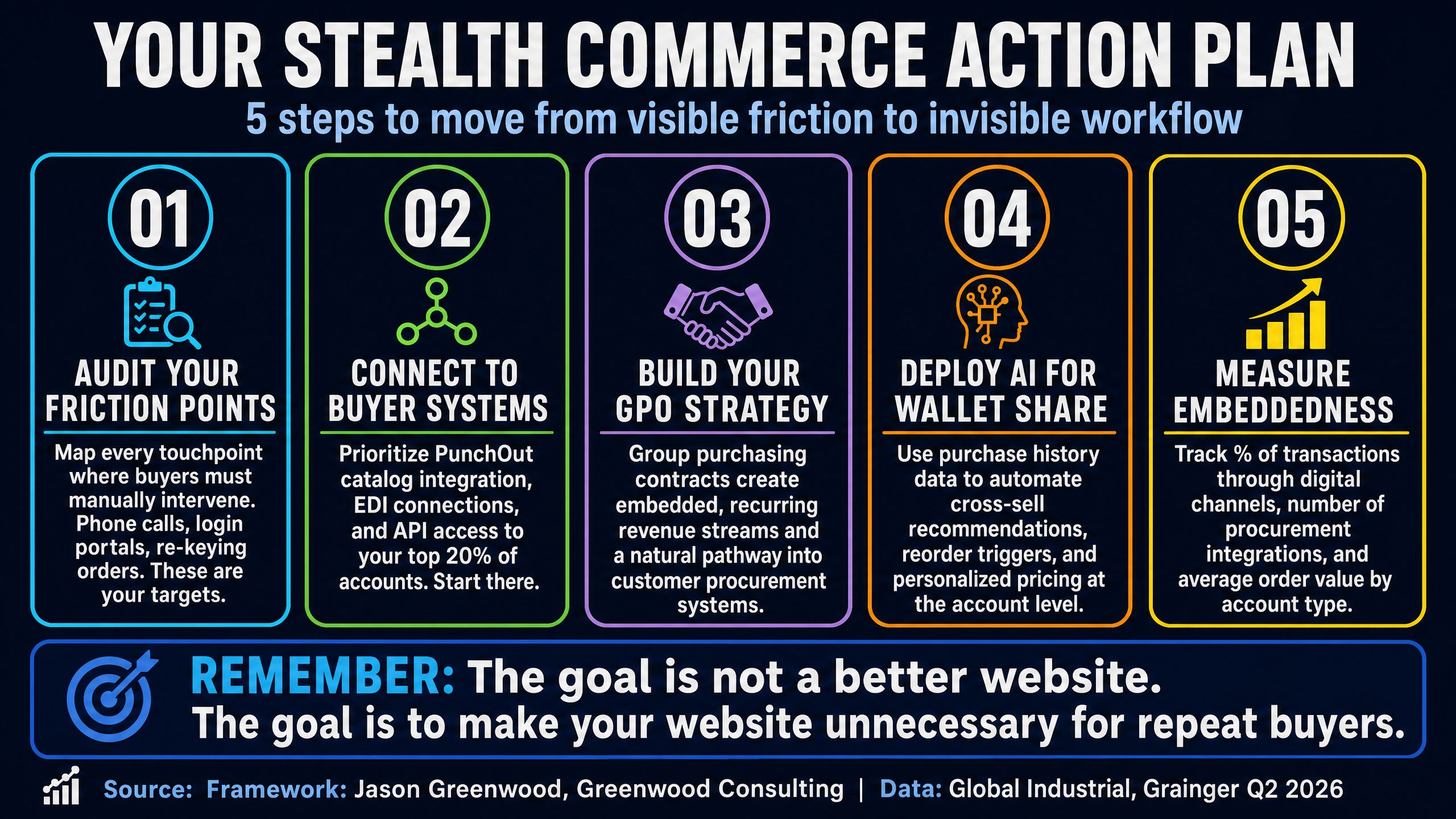
Here is how you start:
Audit Your Friction PointsMap every touchpoint where buyers must manually intervene. Phone calls, login portals, re-keying orders. THESE are your first targets for elimination.
Connect to Buyer SystemsPrioritize PunchOut catalog integration, EDI connections and API access to your top 20% of accounts. Do not force your best customers to use your website if they have their own procurement software.
Build Your GPO StrategyGroup purchasing contracts are not just about volume discounts - they are Trojan horses that get you integrated into enterprise procurement systems.
Deploy AI for Increased Spend Share
Use the purchase history data generated by these integrations to automate cross-sell recommendations and reorder triggers. As AEM recently noted, AI in the aftermarket only works if your underlying parts data and customer data foundation are clean [4].
Measure Embeddedness
Stop measuring success purely by website traffic or cart conversion rates. Start tracking the percentage of transactions flowing through integrated digital channels and the number of active procurement integrations you maintain.
And remember, an advanced digital portal is still required for many digital services such as:
Quote Requests
RMA Requests
Inventory/Delivery Checks
Price Checks
MOQ Checks
Spend/budget/account Management
and MUCH more.
So, while the portal is not going away, it should be less about the actual transaction and more about everything else.
In 2019, I wrote that breaking into the new paradigm of Stealth Commerce would become a case of “unseating an incumbent and unless they make some kind of monumental error, you’ll never get a shot at it again” [1].
That future is here.
If you are forcing your B2B customers to remember passwords, navigate complex category trees and manually enter credit card or account details you are introducing friction.
Friction is the enemy of retention.
The distributors who win over the next decade will be the ones that remove the most friction AND make themselves indispensable to the buyer’s procurement workflow.
[1] Greenwood, J. (2019, February 11). ARE YOU READY FOR ‘STEALTH COMMERCE’? LinkedIn. https://www.linkedin.com/pulse/you-ready-stealth-commerce-jason-greenwood
[2] Brohan, M. (2026, August 5 ). Global Industrial Deepens Customer Integration Strategy to Fuel Growth. Distribution Strategy Group. https://distributionstrategy.com/2026/08/global-industrial-deepens-customer-integration-strategy-to-fuel-growth/
[3] Brohan, M. (2026, August 5 ). Grainger Strategy Shifts Toward Data Centers, Customer Productivity and Distribution Network Expansion. Distribution Strategy Group. https://distributionstrategy.com/2026/08/grainger-strategy-shifts-toward-data-centers-customer-productivity-and-distribution-network-expansion/
[4] Harrington, K. (2026 ). AI in the Aftermarket Starts With the Foundation You Build Today. Association of Equipment Manufacturers. https://www.aem.org/news/aem-blog/ai-in-the-aftermarket-starts-with-the-foundation-you-build-today
[5] Okhrem, P. (2026, May 12 ). B2B Ecommerce Statistics [2026]: Market Size, Buyer Behavior, Growth & Conversion Benchmarks. Elogic Commerce. https://elogic.co/blog/b2b-ecommerce-statistics/
[6] PYMNTS. (2026, March 13 ). B2B’s Biggest Innovation Isn’t Technology. It’s the Buying Experience. PYMNTS.com. https://www.pymnts.com/news/b2b-payments/2026/b2bs-biggest-innovation-isnt-technology-its-the-buying-experience/
No posts
Comments
Nothing yet. Say the first thing.
Sign in to join the conversation.